
The best MVP development companies in 2027 are DevSquad, thoughtbot, Altar.io, Designli, and Rootstrap. DevSquad scopes hard in Rapid Prototyping before a monthly squad builds. thoughtbot brings senior Rails engineers and a two-week discovery sprint. Altar.io offers co-founder-style strategy at pre-seed. Designli is built for non-technical founders, with a 30-day V1 offer. Rootstrap gives you a nearshore team that scales with you.
You've had the sales calls. Every company says it builds MVPs fast. Every proposal looks thorough. Yet nobody told you what the first month costs. Nobody said what happens the week after launch, when the feedback arrives and half the budget is gone.
So you're left comparing proposals that all sound the same. That's the gap this list fills. Each entry answers the five questions you'd ask on a sales call. What does it cost to start? How do the first weeks run? Which launch can you check? What do clients praise and criticize? Who should skip this company? If you want to see how we approach MVP development ourselves, that's covered in the DevSquad entry below.
I've launched more than 100 products since 2014, and the MVPs that struggled almost never failed on code. They failed because nobody decided what to leave out before the first sprint started.
MVP development companies compared at a glance
Use this table to build your shortlist. Every figure comes from the company's Clutch listing or its own published pricing.
Company | HQ | Best for | Team model | Starting budget | Clutch rating |
DevSquad | Murray (Salt Lake City), Utah | MVPs that need hard scoping first | Managed squad, monthly, cancel anytime | Month to month, scoped after Rapid Prototyping | 5.0 (2) |
thoughtbot | New York (remote, plus London) | Senior Rails web MVPs | Embedded consultancy team | $10,000+ min; $150 to $199/hr | 4.9 (39) |
Altar.io | Lisbon, Portugal | Pre-seed founders needing strategy | Co-founder-style product team | $25,000+ min; $50 to $99/hr | 4.9 (28) |
Designli | Greenville, South Carolina | Non-technical founders | Founder-aligned product team | $10,000+ min; $50 to $99/hr | 5.0 (83) |
Rootstrap | Beverly Hills, California (LatAm delivery) | US startups scaling nearshore | Nearshore product team | $50,000+ min; $50 to $99/hr | 4.8 (44) |
Cheesecake Labs | San Francisco and Brazil | Mobile and fintech MVPs | Nearshore full product delivery | $50,000+ min; $50 to $99/hr | 4.9 (65) |
Netguru | Poznań, Poland | Funded teams wanting structure | Cross-functional product squad | $50,000+ min; $50 to $99/hr | 4.8 (73) |
Sidebench | Los Angeles | Healthcare and HIPAA MVPs | Health tech product studio | $50,000+ min; $50 to $99/hr | 4.9 (48) |
ScienceSoft | McKinney, Texas | Regulated, enterprise-grade MVPs | Time and materials, published estimates | $5,000+ min; $50 to $99/hr | 4.8 (45) |
Upsilon | US, Poland, Estonia (remote) | Budget-conscious startups | Remote product studio | $25 to $49/hr (self-reported) | No Clutch profile found |
Ratings and minimums change, so check each Clutch profile before you sign.
How we selected these MVP development companies
Disclosure: DevSquad wrote this list and ranks itself first. We held ourselves to the same three-source standard as every other company here, and we've flagged where our own evidence is thinner.
We researched every company in late October of 2026. We checked each one against three sources. First, its verified Clutch reviews. Second, its own process or pricing page. Third, at least one case study, government filing, or independent listing. Homepages didn't count as evidence. Here's how we weighted what we found.
Criterion | Weight | What we checked |
Scoping and discovery process | 25% | A defined, paid or named discovery phase before the build |
Verifiable MVP launches | 25% | At least one launch with a timeline or outcome we could check |
Cost transparency | 20% | Published minimums, rates, or pricing |
Post-launch continuity | 15% | Evidence the team stays, scales up, or scales down after launch |
Review evidence, including criticism | 15% | Verified review themes, both praise and complaints |
Directory rank wasn't scored at all. Here's why. Open Clutch's software developer directory and check the sort menu. The default is "Sponsored," so the companies at the top of the list paid to be there.
Price filters you just as fast. Published minimums on this list alone run from $5,000 to $50,000+, and a company's rank tells you nothing about which side of that line it sits on.
So rank is advertising, and reviews are evidence. We read the reviews, including the critical ones.
I wrote this list, and DevSquad is on it, so judge us on the same evidence as everyone else. If a company below fits you better than we do, I'd rather you hire them than hire us and regret it.
Scoping carries the most weight because it decides everything downstream. Our own product managers put it bluntly:
"Software development should be objective, focused on solving business problems. Not just creating features for any product. Start by aligning on a clear MVP, focused on generating resources for growth and fundamental needs." — Caio Alves, Technical Product Manager, DevSquad
The 10 best MVP development companies for 2027
Every entry follows the same five parts, so you can compare like for like: what it costs to start, how the first weeks run, one verifiable launch, what clients praise and criticize, and who should skip them. Each closes with a link to the company's Clutch profile.
1. DevSquad: best for MVPs that need hard scoping before code
The pick if you want someone to cut your scope before a monthly squad builds it.
Founded | 2014 |
Team size | 90+ people |
Engagement model | Starts with Rapid Prototyping, then month to month |
Monthly squads | Sized to your roadmap, no long-term contract |
Clutch rating | 5.0 (2 reviews) |
Our Clutch profile is thin: two reviews, both from 2018. The proof below comes from our own case studies.
How the first weeks run. Every MVP starts with Rapid Prototyping, our Phase 1. A Solutions Architect, Technical Product Manager, and Tech Lead define the problem and the users. You walk away with a clickable prototype, a technical architecture, and a prioritized roadmap. Length depends on complexity. Then a build squad takes over, with UX/UI design included and no long-term contract.
Proof. Drivably helps used car dealers buy inventory. It had spent nine months and hundreds of thousands of dollars on an internal build that still wasn't ready. DevSquad ran a two-day prototyping sprint, rebuilt the product on a faster stack, and shipped a true MVP in 45 days. Drivably started acquiring paying customers within weeks of launch.
ParentPulse reached a market-ready platform in under four months. Crew 360 shipped its first version in under three months, and estimates that took about an hour now take about 25 minutes.
What clients say.
"DevSquad works really well with non-technical founders. Anyone who's discovered a need for a product but doesn't know how to implement it could succeed with DevSquad." — Chris Matson, Founder and CEO, HiBeam
What your budget buys. A typical path is a few weeks of Rapid Prototyping, then a monthly squad sized to the roadmap. Squads run month to month, so you can adjust after launch. Drivably took 30 days after launch to collect feedback before planning to add developers.
Choose DevSquad if you want your feature list challenged before you pay to build it, and you want a team that stays after launch.
Skip DevSquad if you have a finished spec and want a fixed-price quote without pushback. Skip us too if your budget can't cover at least one month of a squad after prototyping.
You can read DevSquad's client reviews for more.
2. thoughtbot: best for senior Rails engineering and a short discovery sprint
A long-running consultancy for founders who want senior engineers and strong product design from day one.
Founded | 2003 (1,000+ clients) |
Team size | 50 to 249, New York and London |
Minimum project | $10,000+ |
Hourly rate | $150 to $199 |
Clutch rating | 4.9 (39 reviews) |
How the first weeks run. thoughtbot calls its kickoff an MVP Shaping Sprint. It covers research with target users and a roadmap, including technology choices, in as little as two weeks. Its UK government service listing spells out the shape: a discovery week, then a product design sprint week. You leave with a prototype, a roadmap, and refined estimates.
Proof. In September 2025, TellaDraft hired thoughtbot for a two-week discovery sprint. The result was a working AI prototype that 12 entrepreneurs were already testing when the founder reviewed them on Clutch. The founder had expected a plan. She got a product she could put in front of users.
What your budget buys. At the top of thoughtbot's rate band, the $10,000 minimum covers about 50 hours. That's a discovery sprint, not a build. Plan your real MVP budget around a longer engagement with a small senior team.
What clients say. Reviewers praise code that stays easy to maintain long after the team leaves. Clients also describe thoughtbot adapting to their own tools and rituals instead of forcing a process. The repeated complaint is price: several clients say thoughtbot sits at the top of the market. One MVP client also felt discovery ran longer than planned.
Choose thoughtbot if your MVP is a web product and you care about code your next hire can work on.
Skip thoughtbot if your budget can't absorb premium US-level rates.
Source: thoughtbot on Clutch
3. Altar.io: best for pre-seed founders who want a co-founder-style partner
A studio founded by former startup founders that works more like a strategic co-founder than a vendor.
Founded | 2015 |
Team size | 10 to 49, Lisbon |
Minimum project | $25,000+ |
Hourly rate | $50 to $99 |
Clutch rating | 4.9 (28 reviews) |
How the first weeks run. Before anything is quoted, Altar runs a product scoping process. Several Clutch reviewers describe senior leadership, including the CEO, leading it. Reviewed projects range from $5,000 to $180,000, so the scope decides a lot.
Proof. Apiax, a Swiss regtech startup, spent €25,000 to €50,000 with Altar on its MVP frontend. With that MVP, Apiax won a pilot with a global financial institution and closed a seed round. Altar also helped Apiax build its own frontend team in Portugal afterward. Few studios offer that.
What your budget buys. At $99 an hour, the $25,000 minimum buys roughly 250 hours. That's enough for a focused first version if the scoping phase does its job. It's also why Altar spends so much time on scope before it quotes.
What clients say. Reviewers single out Altar's skill at defining an MVP and its creative problem solving. Several also mention business-model advice that went beyond the software. The critical theme: post-MVP costs could be clearer up front.
Choose Altar.io if you're pre-seed and need help shaping the idea as much as building it.
Skip Altar.io if you need a large team or full-day US time-zone overlap.
Source: Altar.io on Clutch
4. Designli: best for non-technical founders who want a working V1 fast
A Greenville-based team built around non-technical founders, with one of the most concrete MVP offers on this list.
HQ | Greenville, South Carolina |
Team size | 50 to 249 |
Minimum project | $10,000+ |
Hourly rate | $50 to $99 |
Clutch rating | 5.0 (83 reviews) |
How the first weeks run. Designli runs two named programs. SolutionLab is a planning phase that pins down goals, user stories, and technical requirements. TractionLab promises a real user on a working version one within 30 days, or your next month is free.
Proof. Clutch reviews describe Designli delivering clickable MVP prototypes plus technical documentation before a build begins. One was for an AI-powered operating system. Another was for a construction management product.
What your budget buys. At the top of the band, $10,000 covers about 100 hours. The most common Designli project on Clutch comes in under $50,000. That range fits a founder testing one core workflow. The 30-day offer puts a hard date on your first real user.
What clients say. Non-technical owners praise how clearly the team explains technical choices. Reviewers also value regular updates that don't assume engineering knowledge. The critical theme: some timelines ran past initial estimates.
Choose Designli if you're non-technical and want a team that translates technical choices for you.
Skip Designli if your first release needs deep regulated-industry or heavy integration work.
Source: Designli on Clutch
5. Rootstrap: best for US startups that plan to scale a nearshore team
A Beverly Hills company with a 200+ person team, staffed mainly from Latin American delivery centers, that can start small and grow with you.
Founded | 2011 |
Team size | 200+, mostly in Latin America |
Minimum project | $50,000+ |
Hourly rate | $50 to $99 |
Clutch rating | 4.8 (44 reviews) |
How the first weeks run. Clients on Clutch describe a named discovery process that starts with competitive analysis and market research. Storyboards, a backlog, and the MVP follow. Reviewed project costs run from $15,000 to $700,000.
Proof. MasterClass started with a couple of Rootstrap engineers. Its VP of Engineering told Clutch the team grew to around 18 people, covering SEO, the website, and mobile backend work. That's what scaling up looks like in practice.
What your budget buys. At $99 an hour, the $50,000 minimum covers about 500 hours. The most common Rootstrap project runs $50,000 to $199,999. You're buying a team that can grow, not a one-off build.
What clients say. Reviewers praise clear documentation and steady communication. Clients also note flexibility when scope changed mid-project. The critical theme: pricing could be more competitive.
Choose Rootstrap if you expect to need a larger team within a year and want US time-zone overlap.
Skip Rootstrap if your total budget is under $50,000.
Source: Rootstrap on Clutch
6. Cheesecake Labs: best for mobile-first and fintech MVPs
A company with 300+ delivered projects and deep mobile, fintech, and blockchain experience.
Founded | 2013, San Francisco and Brazil |
Team size | 50 to 249 |
Minimum project | $50,000+ |
Hourly rate | $50 to $99 |
Clutch rating | 4.9 (65 reviews) |
How the first weeks run. Cheesecake Labs offers a standalone product definition phase. One animal health firm hired them only to define a super app MVP. The deliverable was a prototype plus usability tests.
Proof. EQI Investimentos needed a mobile app for its investment clients. Cheesecake Labs built it in React Native. The MVP reached 1,000+ users in its first month and earned a 4.6 rating on Google Play.
What your budget buys. Cheesecake Labs lists a $50,000 minimum on Clutch. At $99 an hour, that covers about 500 hours. Reviewed budgets run from about $10,000 to over $500,000, so scope drives everything here.
What clients say. Reviewers praise project management and design quality. Many highlight well-run sprints with clear deliverables. One honest caveat: its Clutch profile now leads with AI, data, and modernization work, and 80% of its clients are mid-market or enterprise. If you're a solo founder, ask how much early-stage work the current team takes on.
Choose Cheesecake Labs if your MVP lives on a phone or touches payments.
Skip Cheesecake Labs if you want a small, founder-led studio.
Source: Cheesecake Labs on Clutch
7. Netguru: best for funded teams that want a large bench and structured workshops
A certified B Corp with 250 to 999 people and clients that include IKEA and VW.
Founded | 2008, Poznań, Poland |
Team size | 250 to 999 |
Minimum project | $50,000+ |
Hourly rate | $50 to $99 |
Clutch rating | 4.8 (73 reviews) |
How the first weeks run. Netguru opens with Sprint 0 and product workshops covering research, discovery, and validation. Its stated goal is an MVP launch within 12 weeks.
Proof. Prospero.AI, a New York fintech, needed an MVP ready for a conference. Netguru delivered it in five weeks, below budget.
What your budget buys. At $99 an hour, $50,000 covers about 500 hours. The most common Netguru project lands between $50,000 and $199,999. Expect a full squad: product manager, designers, and engineers from the start.
What clients say. Reviewers praise project management and honest scoping. One early-stage founder said Netguru was the most expensive of three bidders and still the right choice. The same founder wished a budget overrun had been flagged sooner.
The caveat is positioning. Netguru's Clutch profile now centers on digital commerce, and 80% of its clients are mid-market or enterprise. That's not a red flag if you're funded. It does mean a pre-seed founder should ask who will actually staff the project, and how much early-stage work that team has done recently.
Choose Netguru if you're funded and want process plus a deep bench.
Skip Netguru if you're pre-seed with under $50,000.
Source: Netguru on Clutch
8. Sidebench: best for healthcare MVPs with compliance stakes
A health tech product studio that builds, and invests in, products where HIPAA and integrations matter from version one.
Founded | 2012, Los Angeles |
Team size | 50 to 249 |
Minimum project | $50,000+ |
Hourly rate | $50 to $99 |
Clutch rating | 4.9 (48 reviews) |
How the first weeks run. Clients on Clutch praise a research-heavy discovery. It often ends in a navigable prototype before the build is scoped. Reviewed investments range from $20,000 to $3 million.
Proof. One health plan has come back for more than 30 separate engagements over seven years. Sidebench also built the member app for Inland Empire Health Plan, which serves about 1.2 million members.
What your budget buys. At $99 an hour, the $50,000 minimum covers about 500 hours. In healthcare, a meaningful share of that goes to compliance and integration work you can't skip. Budget for it before you budget for features.
What clients say. Reviewers praise healthcare expertise and design. Several mention integrations with Salesforce and existing health systems. The critical themes: continuity suffered when project managers changed, and some projects ran late.
Healthcare is the one category where a generalist shop can hurt you. A missed compliance requirement found after launch costs far more than one caught in discovery. That's why a specialist earns a place on a general list.
Choose Sidebench if your MVP handles patient data or plugs into health systems.
Skip Sidebench if you're building outside healthcare on a lean budget.
Source: Sidebench on Clutch
9. ScienceSoft: best for regulated or enterprise-grade MVPs on a fixed estimate
The most established company here, built for MVPs that need security and compliance from day one.
Founded | 1989, McKinney, Texas |
Team size | 750+ experts (4,300+ projects) |
Minimum project | $5,000+ |
Hourly rate | $50 to $99 |
Clutch rating | 4.8 (45 reviews) |
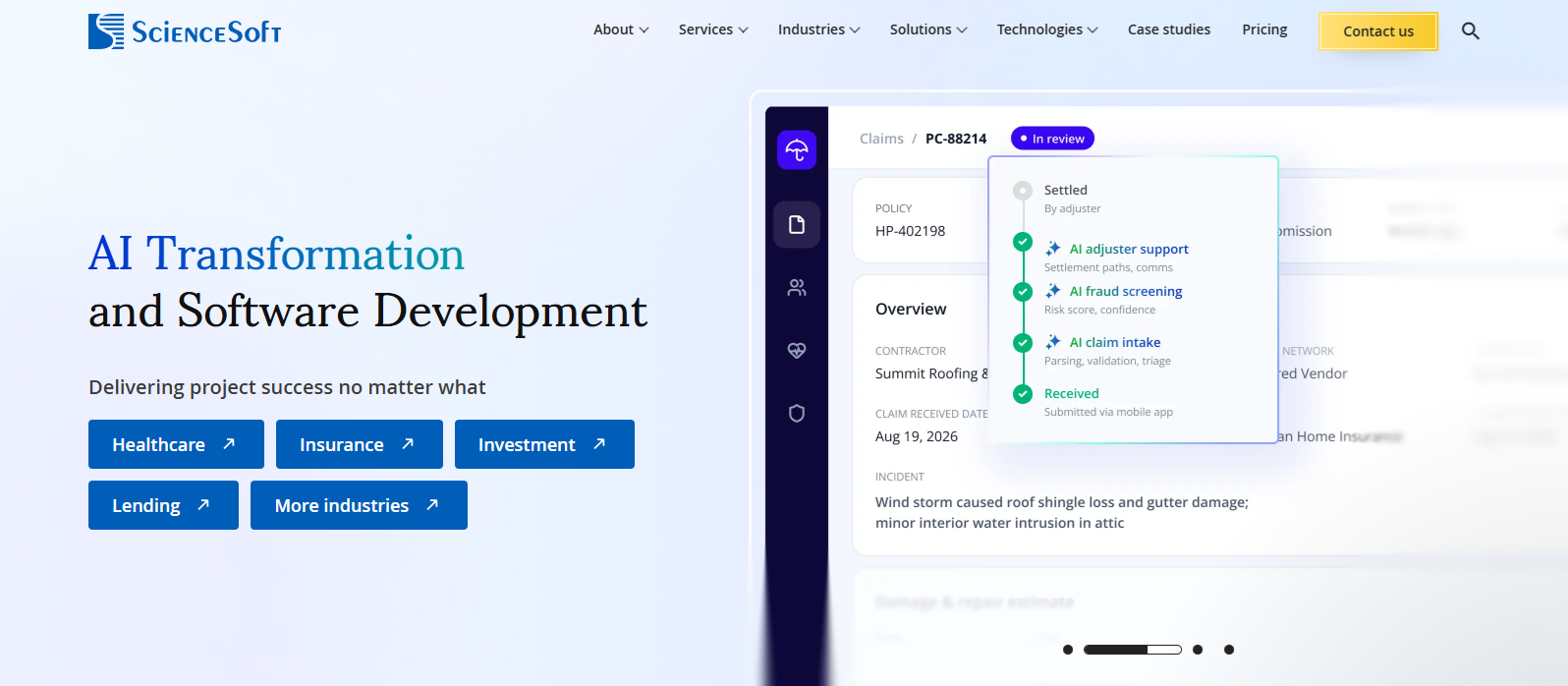
How the first weeks run. ScienceSoft publishes more of its process than anyone else on this list. Its sample MVP proposal shows a time and materials estimate, a one-month design and analysis phase, a rate card, and monthly payments. Its startup page lists MVPs at $40,000 to $300,000 over two to six months. Prototypes run $2,000 to $5,000.
Proof. That public estimating approach is the proof: you can read how they'll price you before the first call. Its MVP services page also features a blockchain-based supply chain MVP.
What your budget buys. The $5,000 minimum covers a prototype, not an MVP. ScienceSoft's own MVP range starts at $40,000. The upside is predictability: you'll see the rate card and the phase plan before you sign.
What clients say. Reviewers praise security, testing, and structured delivery. Clients also value the ability to scale the team up or down as needs change. The critical theme: time zone differences need better handling.
Choose ScienceSoft if your MVP will be audited or sold to enterprises.
Skip ScienceSoft if you want a small studio that pushes back on product strategy.
Source: ScienceSoft on Clutch
10. Upsilon: best for budget-conscious startups open to an equity deal
A remote product studio with lower rates than most firms on this list, and a rare equity option.
Founded | 2012 |
Team size | 60+, across the US, Poland, and Estonia |
Minimum project | Not published |
Hourly rate | $25 to $49 (self-reported) |
Clutch rating | No Clutch profile found |
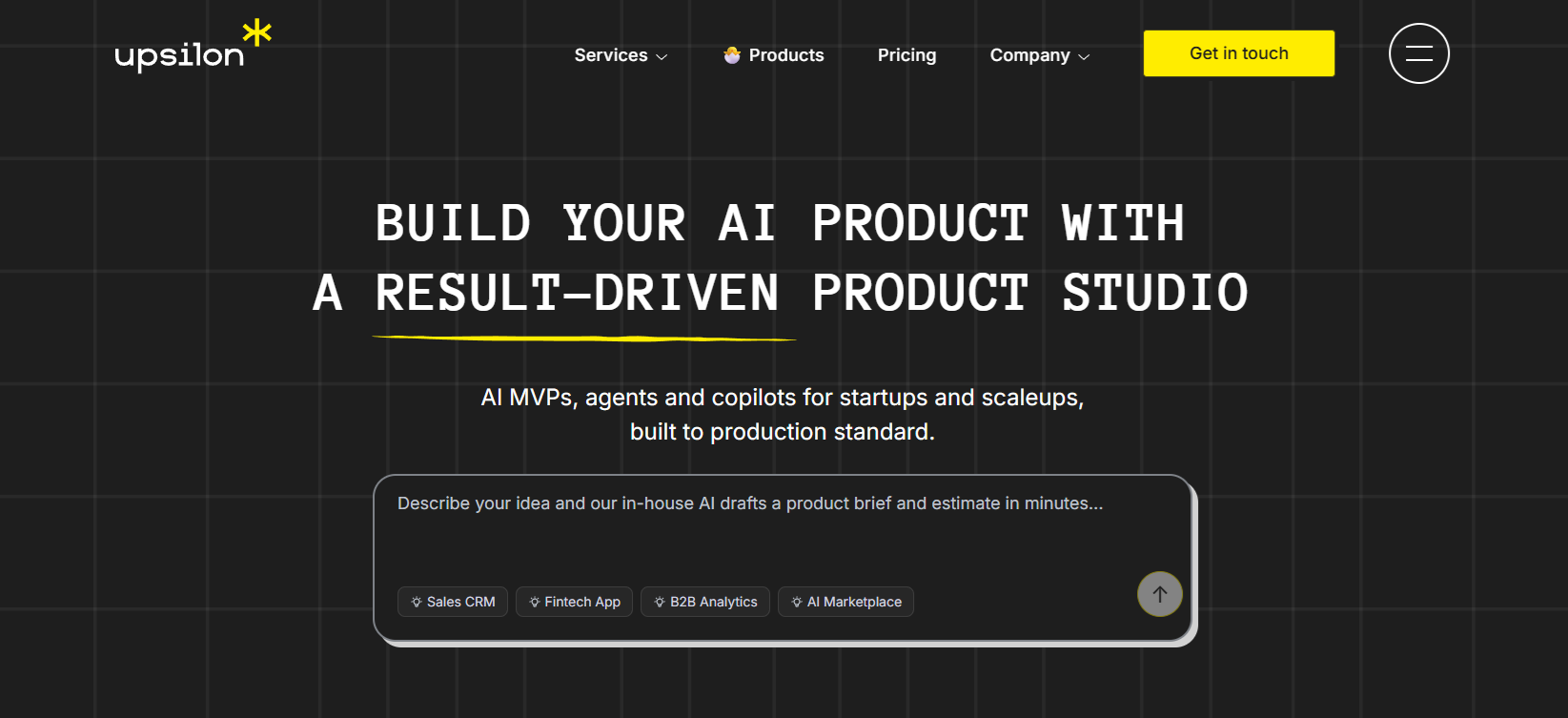
How the first weeks run. Upsilon offers discovery phase services and an online MVP cost calculator. Run the calculator before your first call so you arrive with a number. Upsilon says its average MVP takes about three months. It also says startups can get discounted rates in exchange for equity.
Proof. Renopay, a UK startup, wanted to replace risky bank transfers on home renovations with milestone-based escrow. Upsilon took it from discovery to a live MVP in 12 weeks, built as a progressive web app so one codebase covers web and mobile. The team scoped the MVP down to the flows that mattered most: project setup, milestone planning, funding, approvals, payment release, and basic disputes. Funds sit with an FCA-authorised payment partner rather than on Renopay's own books. Founder Toby Millward credits Upsilon with pushing back on scope in the right places. The case study doesn't publish user or revenue numbers yet.
What your budget buys. At $49 an hour, every $10,000 buys about 200 hours. That's double what the same money buys at $99 an hour. Equity changes the math further. Get the dilution terms in writing before you compare it to a cash quote.
What clients say. We couldn't find a Clutch profile for this Upsilon, and a similarly named firm, Upsilon Labs, is a different company. The client feedback we could find is on Upsilon's own site. The Renopay founder credits the team with pushing back on scope and moving fast without cutting corners on the payment flows. Treat self-published testimonials as a starting point, and ask for two references you can call.
Choose Upsilon if your runway is tight and you're open to sharing equity.
Skip Upsilon if you need a US-based team or a long verified review record.
How to choose an MVP development company that cuts your scope
Every company above can write code. Your real question is which one will remove scope, price the first weeks honestly, and still be there in month two. Bring these three questions to your next sales call. They work whether you're a founder or an owner launching a first product after years of running operations.
Ask what they would cut first
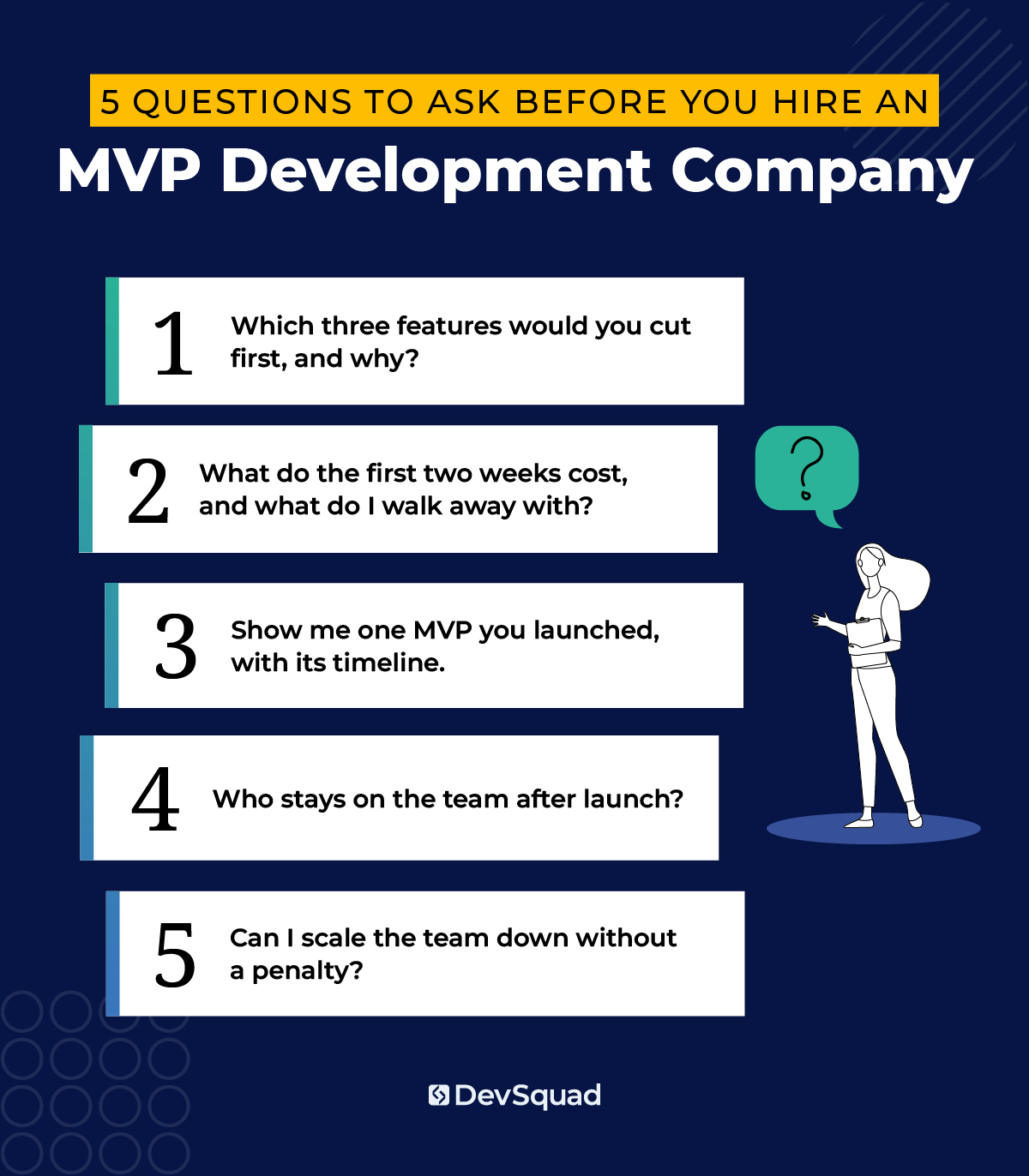
Bring your feature list to the first call. Ask which three items they'd cut, and why.
A good partner answers with reasons tied to what the MVP has to prove. A weak one sends a quote for all of it. Listen for the difference. If you need a refresher on what belongs in a first version, our SaaS MVP guide covers it.
Here's what that conversation sounds like inside a real rebuild:
"We rebuilt the whole platform from nothing, and the conversation that made it possible was about what to leave out. The old software did many things. We asked which ones actually had to exist before customers could be moved across. You lose some features in that trade. What you gain is a codebase you control, and everything you dropped can come back later." — Vitor Carnello, Product Manager, DevSquad
When I started DevSquad, I promised we'd push back instead of taking orders. The fastest way to test any MVP partner is to ask which of your features they'd cut, then watch whether they can tell you why.
Match the starting budget to the engagement model
"Starting budget" means different things on this list. Compare like for like.
Some companies charge for a discovery phase first: DevSquad's Rapid Prototyping, thoughtbot's sprint, Designli's SolutionLab. Some publish a minimum project size, from $5,000 to $50,000+. ScienceSoft works in time and materials with a rate card.
Do one piece of math before every call. Divide your budget by the top of the company's hourly band. That's how many hours you're really buying. Then ask whether discovery is billed separately.
A regional services company with a strong operations team came in with a customer portal spec. It had grown to dozens of features over two years of internal meetings. Prototyping showed customers needed two things at launch: booking a visit and seeing its status. The first release shipped with those two flows. Everything else moved to a roadmap ranked by what customers asked for next.
Ask what happens in month two
Launch day starts the expensive learning. It doesn't end the project.
Ask three things. Does the same team stay after launch? Can you scale the team down without a penalty? How does feedback turn into the next sprint? For the bigger picture on sequencing, see our post on MVP development strategy.
Some of the best MVPs launch without features on purpose:
"A build with real safety and compliance requirements took a little over six months to reach production. It did not launch complete. The internal messenger and the client reports came afterward. Getting the core operation running first is what makes everything after it affordable." — Antônio Salla, Product Manager, DevSquad
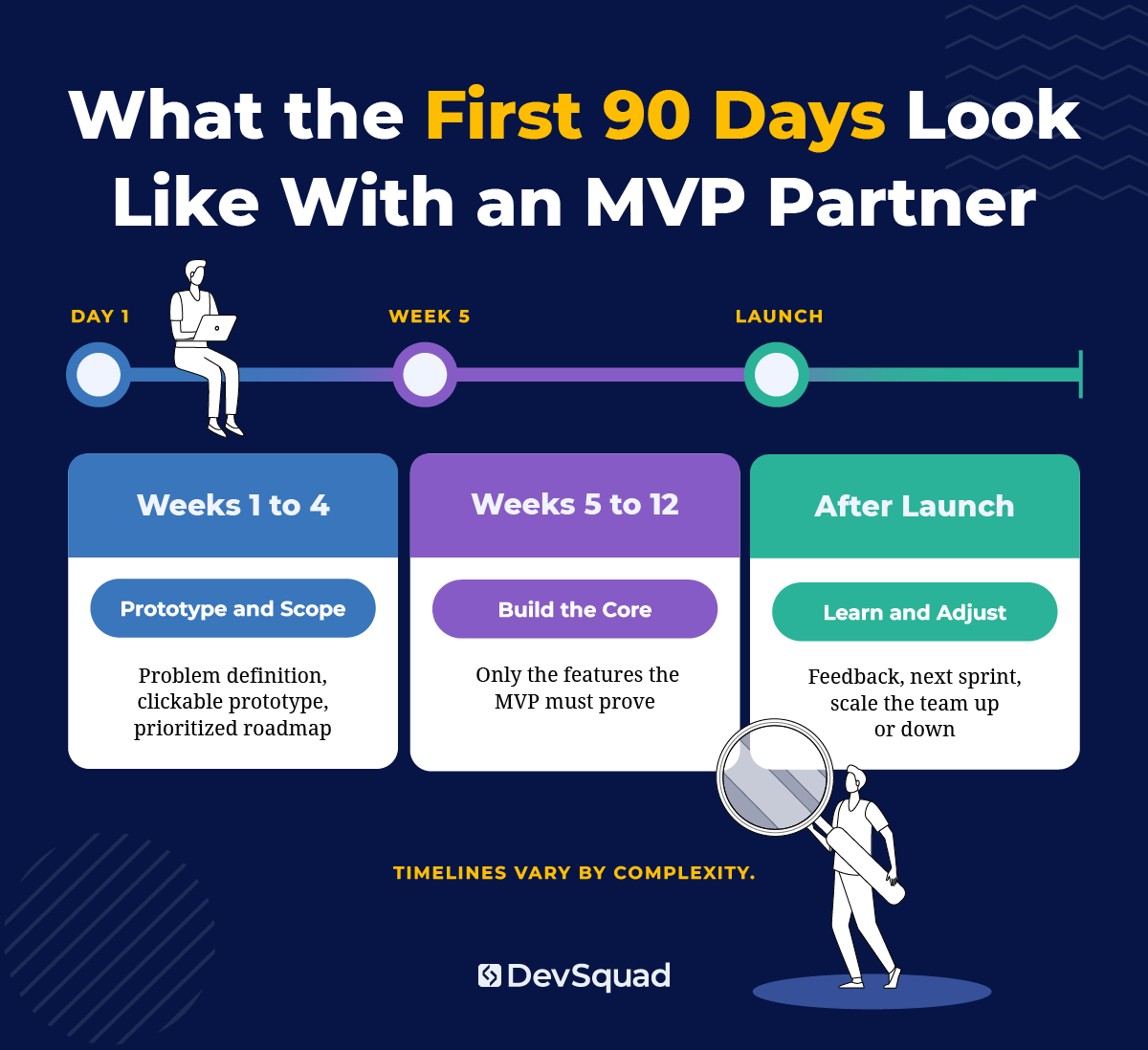 Any company on this list can earn its place with good answers. Ask what it would cut, what the first weeks cost, and who stays in month two. If you want a partner that cuts scope before it builds, start with Rapid Prototyping. You'll know within weeks what your MVP needs and what it doesn't.
See how DevSquad handles MVP development, then bring us your feature list.
Best MVP development companies FAQs
It depends on the engagement model. On this list, published minimums run from $5,000 (ScienceSoft) to $50,000+ (Rootstrap, Cheesecake Labs, Netguru, Sidebench). ScienceSoft publishes MVP ranges of $40,000 to $300,000. DevSquad starts with Rapid Prototyping, then moves to a monthly squad scoped to your roadmap. Divide your budget by the hourly rate to see what you're buying. For SaaS-specific numbers, see our guide to SaaS development costs.
Weeks to several months, depending on scope. On this list, Drivably launched in 45 days, Netguru delivered Prospero.AI in five weeks, and Crew 360 shipped in under three months. ScienceSoft quotes two to six months. Upsilon says it averages about three. The biggest factor is how much you cut before the build starts.
Hire a company if you need strategy, design, development, and QA working together, and someone accountable for the whole result. Freelancers can fit a narrow, well-defined task you can review yourself. If you're building a SaaS product, our list of the best SaaS development companies covers partners for that path. Ask any partner who stays on the team after launch.
Everything the product runs on. That means the code, the cloud and hosting accounts, the domain, and any third-party keys, all registered to your company. Make this part of the contract before work starts. Ownership lets you change teams, scale down, or bring development in-house without starting over. Ask every company on your shortlist how they hand those over.
Yes. Several companies on this list name mid-market and enterprise clients outright, including Netguru, Cheesecake Labs, and ScienceSoft. If you run an established business, your challenge is usually a long feature list built from years of operations. Choose a partner that will cut it down before building. Rapid Prototyping exists for exactly that.
Get in touch to learn more about Rapid Prototyping.

Phil Alves is the CEO and Founder of DevSquad and DevStats. He’s built and launched 100+ software products for bootstrapped founders, fast-growing startups, and enterprises. Phil writes about SaaS, product strategy, operational complexity, and building scalable development processes. He enjoys aviation, investing, and learning from other SaaS founders.