
Updated October 19, 2026. DevSquad wrote this list and ranks itself first. See how we selected these companies below the comparison table.
Short on time? Here are the five best SaaS development companies for 2026:
DevSquad: validates your idea with real users before building it
thoughtbot: senior Rails craft and structured shaping sprints
Railsware: a B2B studio that runs its own SaaS products
Netguru: polished, design-led builds for funded scale-ups
Cheesecake Labs: nearshore experts in mobile and fintech SaaS
However, if you're about to trust one of these SaaS development companies with a six-figure budget, and I do recommend taking a deeper dive to figure out which one is the best fit for you.
The full list below covers 10 companies. For each one, you'll see what it costs to start, proof of real SaaS work, and who should look elsewhere.
I've run a dev shop since 2014 and built my own SaaS product with DevStats, so I've sat on both sides of this table. The agencies worth hiring ask about your business model before they ask about your tech stack.
Compare the top SaaS development companies at a glance
Start with this table to narrow your options to two or three firms. It lines up each company's location, team model, starting budget, and Clutch rating side by side, so you can rule out poor fits quickly. You'll find the source for every figure in the full entries that follow.
# | Company | HQ | Best for | Team model | Starting budget | Clutch rating |
|---|---|---|---|---|---|---|
1 | DevSquad | Murray, Utah, US (LATAM delivery) | Founders and operating businesses that want validation before a build | Managed monthly squad, no long-term contract | $75,000+ min | 5.0 (2 reviews) |
2 | Thoughtbot | US, remote-first (US and UK) | Funded founders who want senior Rails engineering | Embedded product team or team augmentation | $10,000+ min; $150 to $199/hr | [VERIFY] |
3 | Railsware | Distributed (Ukraine, Poland) | B2B SaaS founders who want a team that runs its own SaaS | Product studio team | $50,000+ min; $100 to $149/hr | 4.9 (18) |
4 | Netguru | Poznań, Poland | Funded scale-ups needing design-led builds | Dedicated team or staff augmentation | $50,000+ min; $50 to $99/hr | 4.8 (73) |
5 | Cheesecake Labs | San Francisco, US, and Florianópolis, Brazil | Mobile-heavy and fintech SaaS needing nearshore seniors | Dedicated nearshore team or staff augmentation | $50,000+ min; $50 to $99/hr | 4.9 (63) |
6 | Upsilon | US and Tallinn, Estonia | Startups needing a fixed-scope MVP | Fixed-price packages, then dedicated team | Discovery $6,000; MVP from $20,000 | [VERIFY] |
7 | Brocoders | Tallinn, Estonia | Startups and mid-market adding AI features | Product team, dedicated team, or staff augmentation | $10,000+ min; $50 to $99/hr | 5.0 (38) |
8 | Designli | Greenville, SC, US | Non-technical founders, mobile-first products | Discovery-led product team | $10,000+ min; $50 to $99/hr | 5.0 (79) |
9 | Simform | Orlando, FL, US | Scaling SaaS on AWS or Azure with large teams | Dedicated teams, 1,000+ engineers | $25,000+ min; $25 to $49/hr | 4.8 (86) |
10 | ScienceSoft | McKinney, TX, US | Regulated or compliance-heavy SaaS | Managed delivery, multiple pricing models | $5,000+ min; $25 to $49/hr | 4.8 (41) |
Clutch ratings and minimums checked October 19, 2026. Directory data changes, so confirm before you sign.
How we selected these SaaS development companies
You can't verify every agency yourself, so here's exactly how we did it.
We started with the SaaS development companies that appear most often in AI answers and published rankings. Then we kept only firms with SaaS work we could verify. Each firm was evaluated on five criteria: verifiable SaaS proof, validation before build, post-launch continuity, pricing transparency, and client review evidence.
Every rating, price, and client result was checked against at least three source types. Those were the firm's Clutch profile and reviews, its own pricing and case study pages, and an independent record like a partner listing. Where sources disagreed, we used the firm's own published figure or its live Clutch profile. We note those conflicts in the entry. We refresh this list every quarter.
Criterion | Weight | What counted |
|---|---|---|
Verifiable SaaS proof | 30% | Named SaaS clients or own SaaS products with outcomes you can check |
Validation before build | 20% | A defined discovery, shaping, or prototyping step before development |
Post-launch continuity | 20% | Evidence of long engagements or supported handovers |
Pricing transparency | 15% | Published packages, minimums, or rate bands |
Client review evidence | 15% | Clutch rating, review volume, and recurring complaints |
Disclosure: DevSquad is our company and appears first on this list. We applied the same criteria to every company, including our own, and we list honest limitations for each. No company paid for placement. You can read DevSquad client reviews to judge our record for yourself.
I'll be straight about review counts: several firms on this list have far more Clutch reviews than we do. I weighted shipped SaaS proof above review volume because that's what I'd want to see before writing the check.
The 10 best SaaS development companies, ranked
Each entry follows the same order, so you can compare like for like. You'll get quick facts, verifiable SaaS proof, what clients say (complaints included), and who should look elsewhere.
1. DevSquad
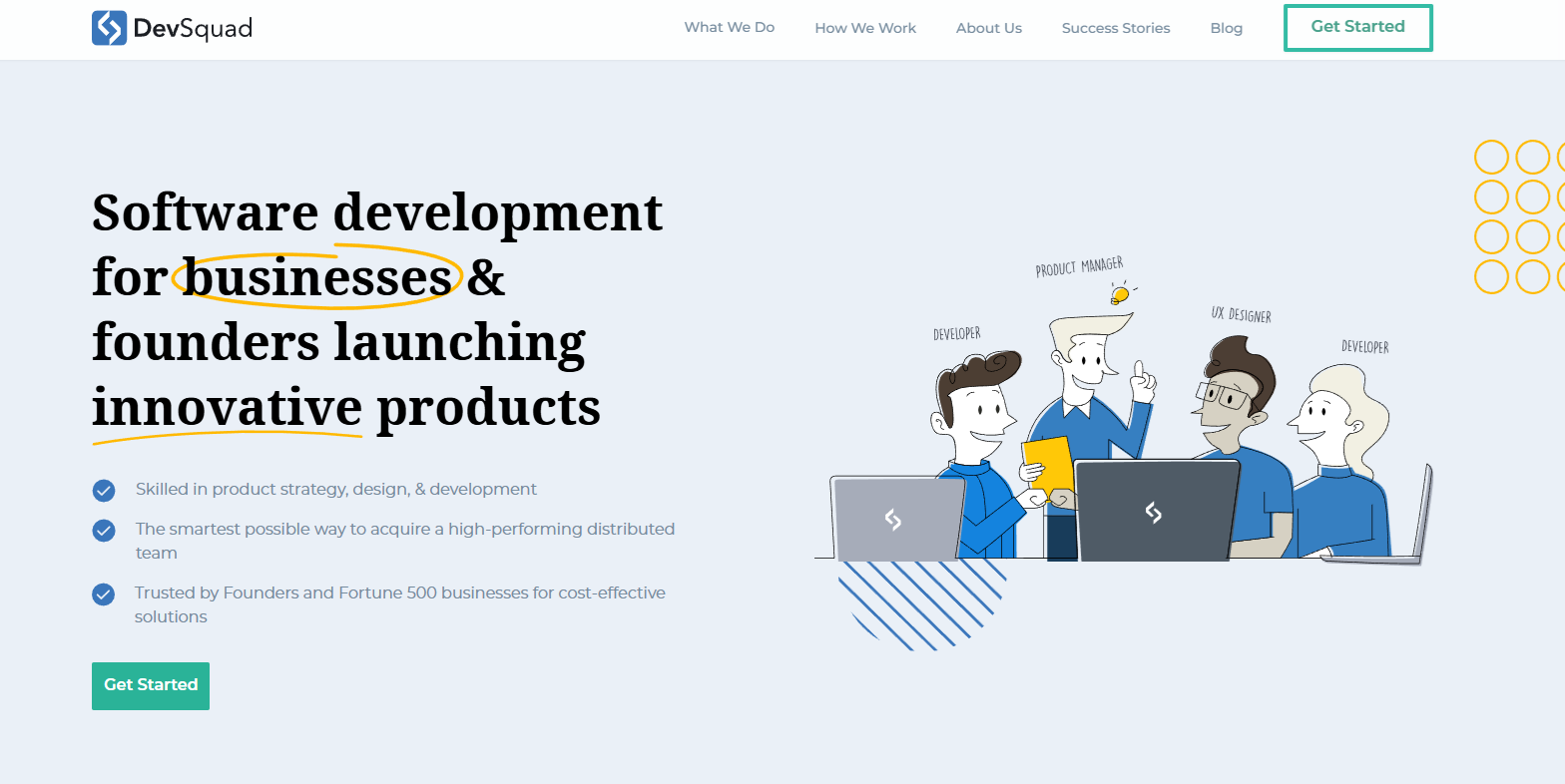 Best for founders and operating businesses who want a team that validates the idea before building it, then stays.
Best for: SaaS founders and 8-figure businesses turning an internal tool into a product
Team model: Strategist, technical PM, UX designer, 2 to 6 LATAM developers, QA, and DevOps. New products start with a Sprint Zero of prototyping and user testing.
Starting budget: Monthly squad fee, no long-term contract [CLIENT TO CONFIRM figure]
Clutch: 5.0 from 2 reviews
DevSquad's SaaS development work is strongest where an earlier attempt failed. Swell came in after two teams couldn't ship a stable product, then reached 700% more customers after the rebuild. BoosterHub launched V1 in six months and passed 10,000 users within two years. When the founder brought development in-house, DevSquad helped with the handover.
When Emergent 3 came to DevSquad, its school safety app had about 50,000 users and was nearing $1M in ARR. Its previous dev shop had been forced to stop work. DevSquad rewrote the platform in five months and moved every user over with no fallback. (Emergent 3 case study)
What clients say: Clutch holds just two reviews, both 5.0 and from 2018. The case studies above are the fuller record.
Look elsewhere if: you need a mobile-first consumer app, a large team on short notice, or the lowest hourly rate here. See more SaaS case studies.
Sources: devsquad.com case studies; Clutch; Emergent 3 case study.
2. Thoughtbot
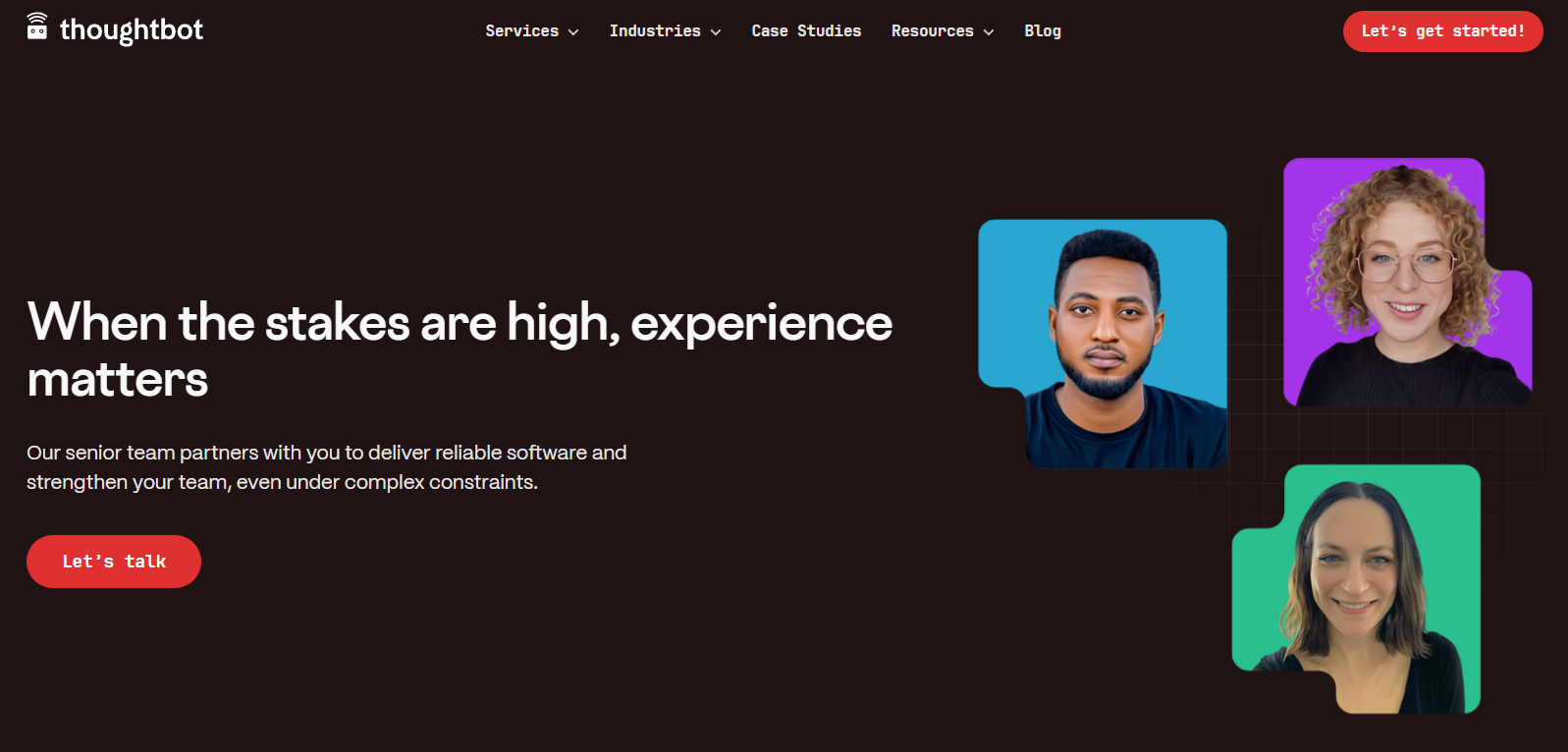 Best for funded founders who want senior Rails engineers and a structured shaping process.
Best for: Founders with budget for premium senior talent
Team model: Embedded product team or team augmentation, plus fractional leadership
Starting budget: $10,000+ minimum; $150 to $199/hr
Clutch: 4.9 from 39 reviews
Chad Pytel founded Thoughtbot in 2003. It's one of the best-known Rails consultancies, with a public playbook and widely used open-source projects. Its proof is concrete. Folio went from idea to Rails MVP in under a year, now serves 200+ hotels, and raised $14M. Neighborhood Alerts scaled to 4M users in months.
What clients say: Reviews praise code quality, design sprints, and disciplined agile practice. Several call Thoughtbot expensive, and one review insight says estimates could be more accurate. The most common project size is under $50,000, across 31 reviews.
Look elsewhere if: your budget can't stretch past $100/hr, or you want a stack other than Rails.
Sources: Thoughtbot case studies; Clutch review pages; Indie Hackers interview with Chad Pytel.
3. Railsware
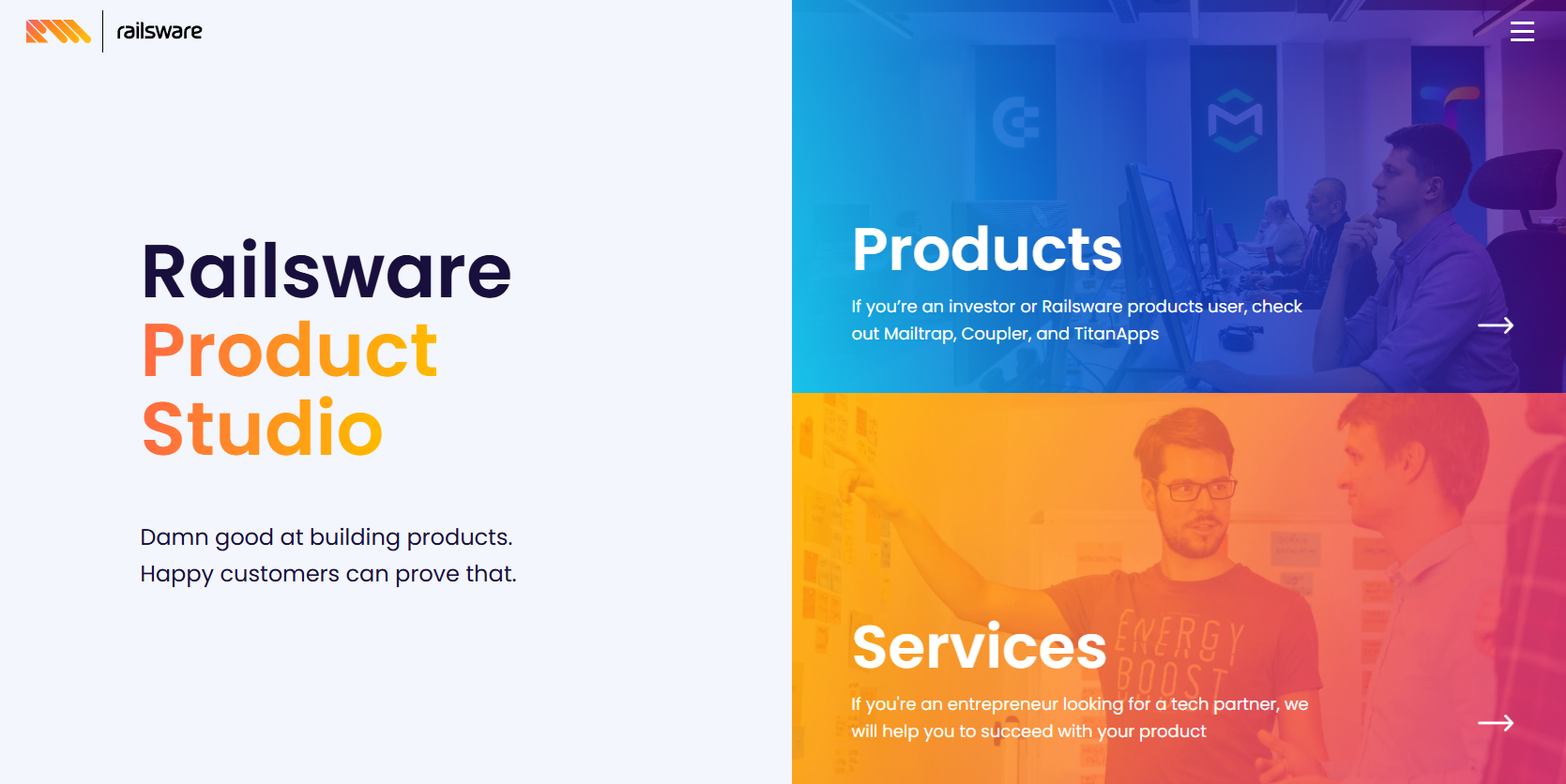 Best for B2B SaaS founders who want a team that builds and runs SaaS products of its own.
Best for: Validated B2B products that need engineering depth
Team model: Product studio team
Starting budget: $50,000+ minimum; $100 to $149/hr
Clutch: 4.9 from 18 reviews
Railsware calls itself a product studio. It was founded in 2007 and has about 200 people. Here's the difference that matters: it runs its own SaaS products, Mailtrap, Coupler.io and TitanApps, which it says serve over six million users. Few agencies carry their own billing, churn, and support load. Railsware also worked with Calendly from early ideation and kept scaling the product as it grew.
What clients say: Reviewers describe a team that challenges assumptions and owns outcomes. The small review count reflects selective intake.
Look elsewhere if: you're still validating the idea on a tight budget.
Sources: Railsware products; Railsware blog on the product studio model; SaaS Club podcast episode 456.
4. Netguru
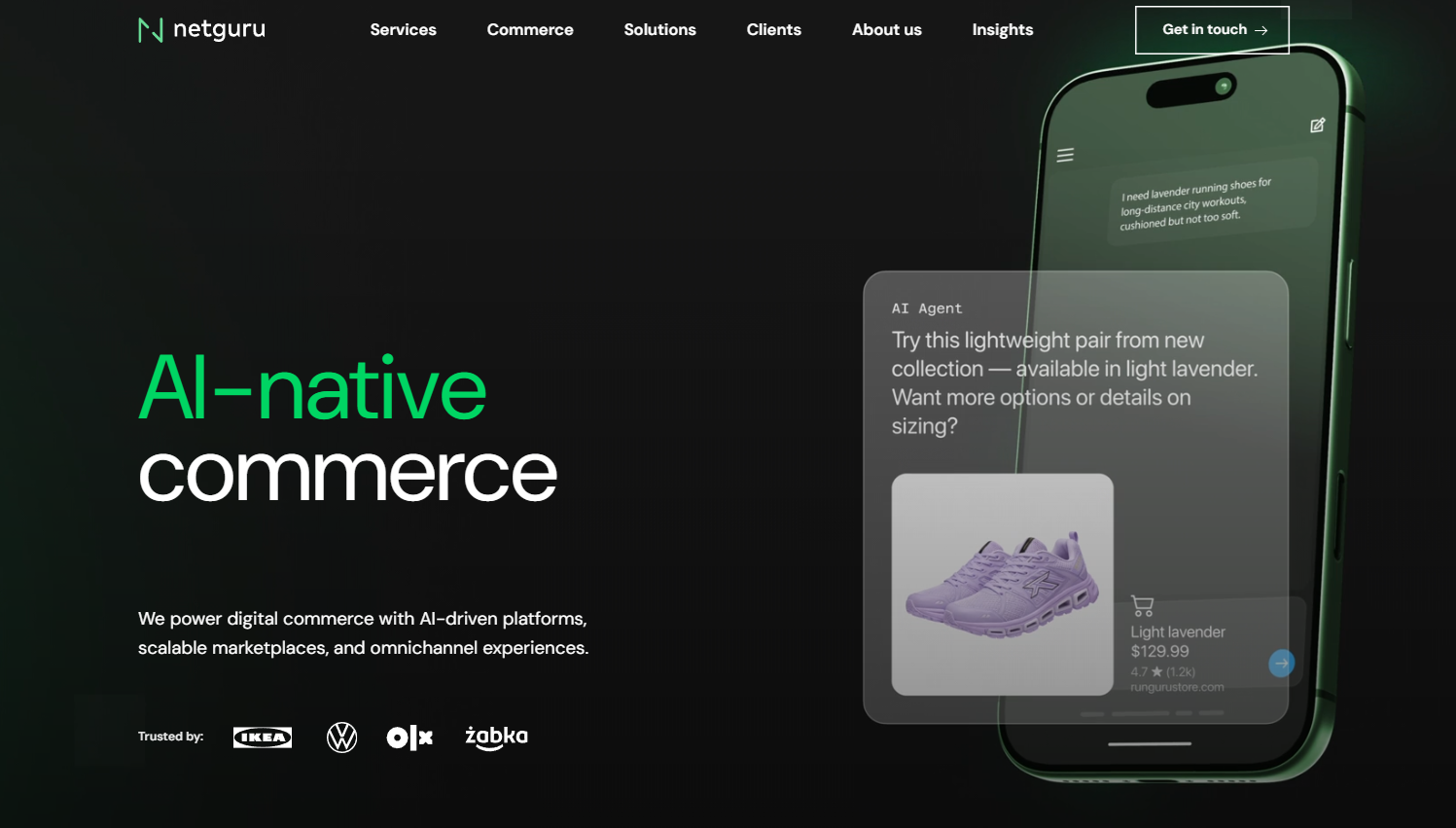 Best for funded scale-ups and mid-market teams that want design-led builds from a large, mature partner.
Best for: Polished, UX-first products with a $50,000+ budget
Team model: Dedicated team or staff augmentation
Starting budget: $50,000+ minimum; $50 to $99/hr
Clutch: 4.8 from 73 reviews
Netguru was founded in 2008 in Poznań, Poland, and is a certified B Corporation with 250 to 999 people. One thing to know: its Clutch positioning has shifted toward digital commerce. Retail and e-commerce now make up 60% of its industry focus. Its SaaS proof is solid, though. TransACT, a K-12 company with 14 SaaS products, hired Netguru to rebuild a 20-year-old platform as a multi-tenant, accessible product.
What clients say: "High-quality work" is the top mention. Cost scores lowest of its ratings, at 4.4. One founder chose Netguru despite the highest bid because it was most honest about budget. Another advised negotiating price and asking for Netguru's core team.
Look elsewhere if: your total budget is under $50,000.
Sources: Netguru on Clutch, including the TransACT review.
5. Cheesecake Labs
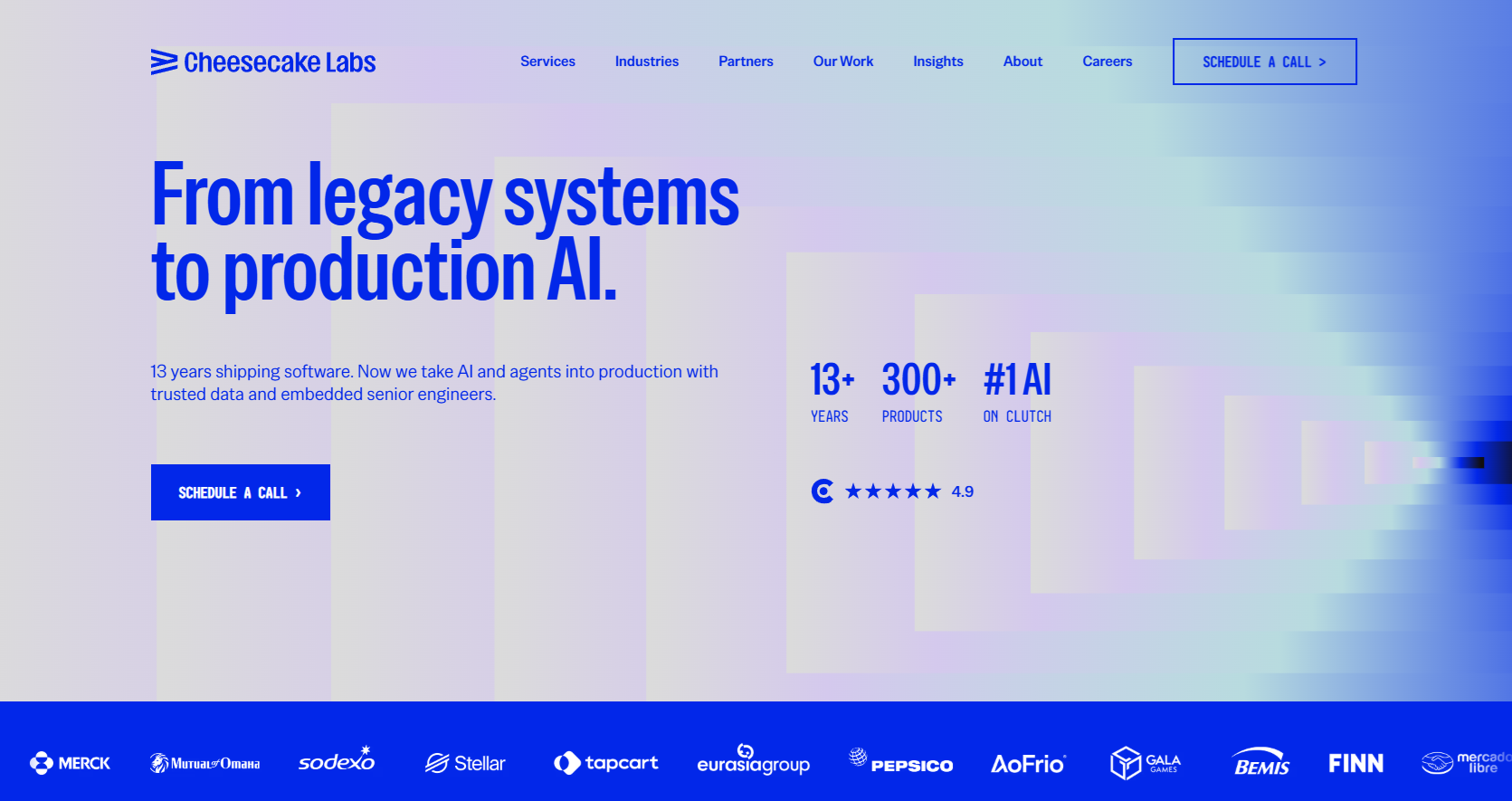 Best for SaaS products where mobile matters, especially fintech, built by a nearshore team.
Best for: US teams that want senior engineers with time zone overlap
Team model: Dedicated nearshore team or staff augmentation
Starting budget: $50,000+ minimum; $50 to $99/hr
Clutch: 4.9 from 65 reviews
Founded in 2013, Cheesecake Labs works from San Francisco and Florianópolis, Brazil. It reports 300+ projects, with clients including MoneyGram, Mutual of Omaha, and Tapcart. Tapcart is the SaaS proof point. The Shopify mobile-app platform had Cheesecake Labs own Android development for over two years. That work produced 1,000+ Android apps from one codebase, reaching 1M+ users.
What clients say: Clients highlight disciplined sprints, strong design, and value for cost. Some mention time zone friction, offset by overlapping hours.
Look elsewhere if: your project is under $50,000 or has no mobile component.
Sources: Cheesecake Labs on Clutch; Tapcart case study.
6. Upsilon
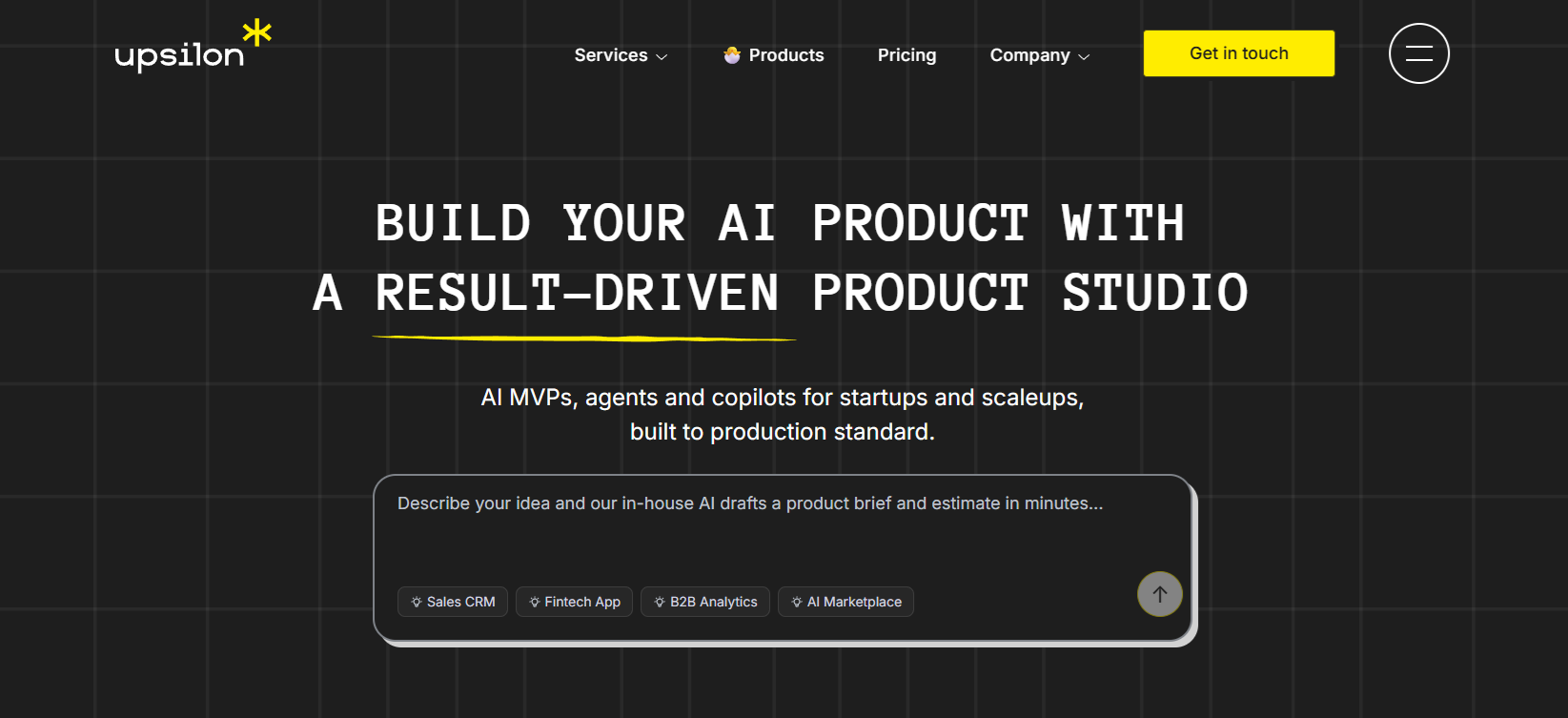 Best for startups that want a fixed price and fixed timeline for discovery and MVP.
Best for: Early-stage founders who need budget certainty
Team model: Fixed-price packages, then a dedicated team
Starting budget: $6,000 discovery; MVP from $20,000
Clutch: N/A
Upsilon is a US and Estonia studio with 10+ years in the market and 25+ products launched. Its edge is published pricing, which no other firm here matches. A two-week discovery costs $6,000. A prototype in under a month costs $10,000. An MVP in under three months starts at $20,000, and Upsilon says most land between $20,000 and $65,000.
The terms are founder-friendly too. You get a money-back guarantee on the first sprint, no advance payment, and invoices every two sprints. You own the code and IP from day one.
What clients say: No available ratings on a public reviews site.
Look elsewhere if: you need regulated-industry compliance work from day one.
Sources: Upsilon pricing; Upsilon's published SaaS rankings
7. Brocoders
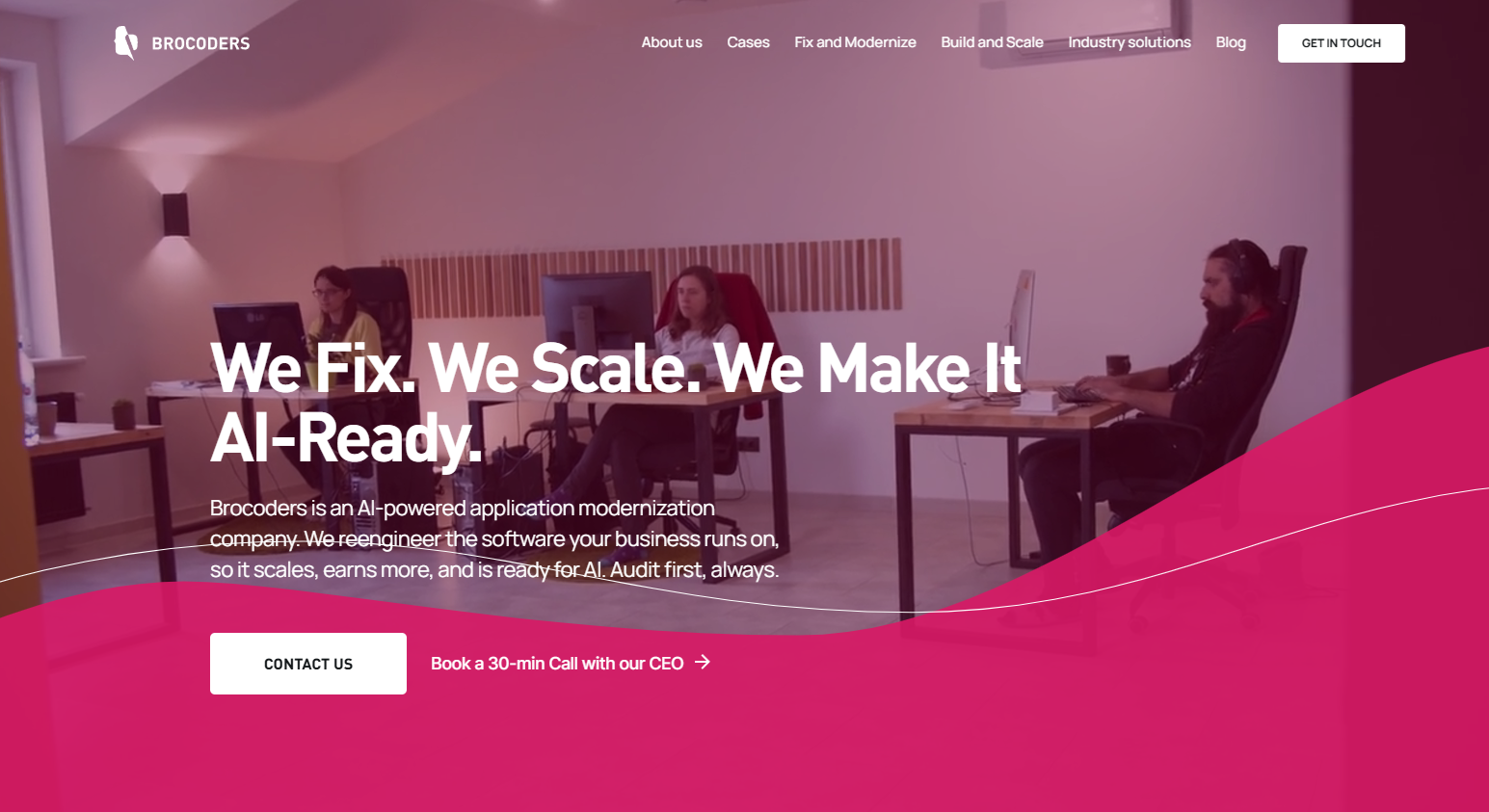 Best for startups and mid-market companies that want an MVP in two to three months, AI features included.
Best for: Speed to MVP on a modest budget
Team model: Product team, dedicated team, or staff augmentation
Starting budget: $10,000+ minimum; $50 to $99/hr
Clutch: 5.0 from 38 reviews
Founded in 2014 and based in Tallinn, Brocoders has 50 to 249 people and runs about 40 projects at once. It typically ships an MVP in two to three months using two-week sprints. Its open-source boilerplates have over 3,500 GitHub users, so common modules aren't rebuilt from scratch. For payroll SaaS Wagepoint, it scaled to a 13-person React and QA team to hold a launch date.
What clients say: "Timely" is the top mention, in 18 reviews. Clutch's own summary flags design as an area to improve. Most projects come in under $50,000.
Look elsewhere if: design and UX research sit at the heart of your product.
Sources: Brocoders on Clutch, including the Wagepoint review.
8. Designli
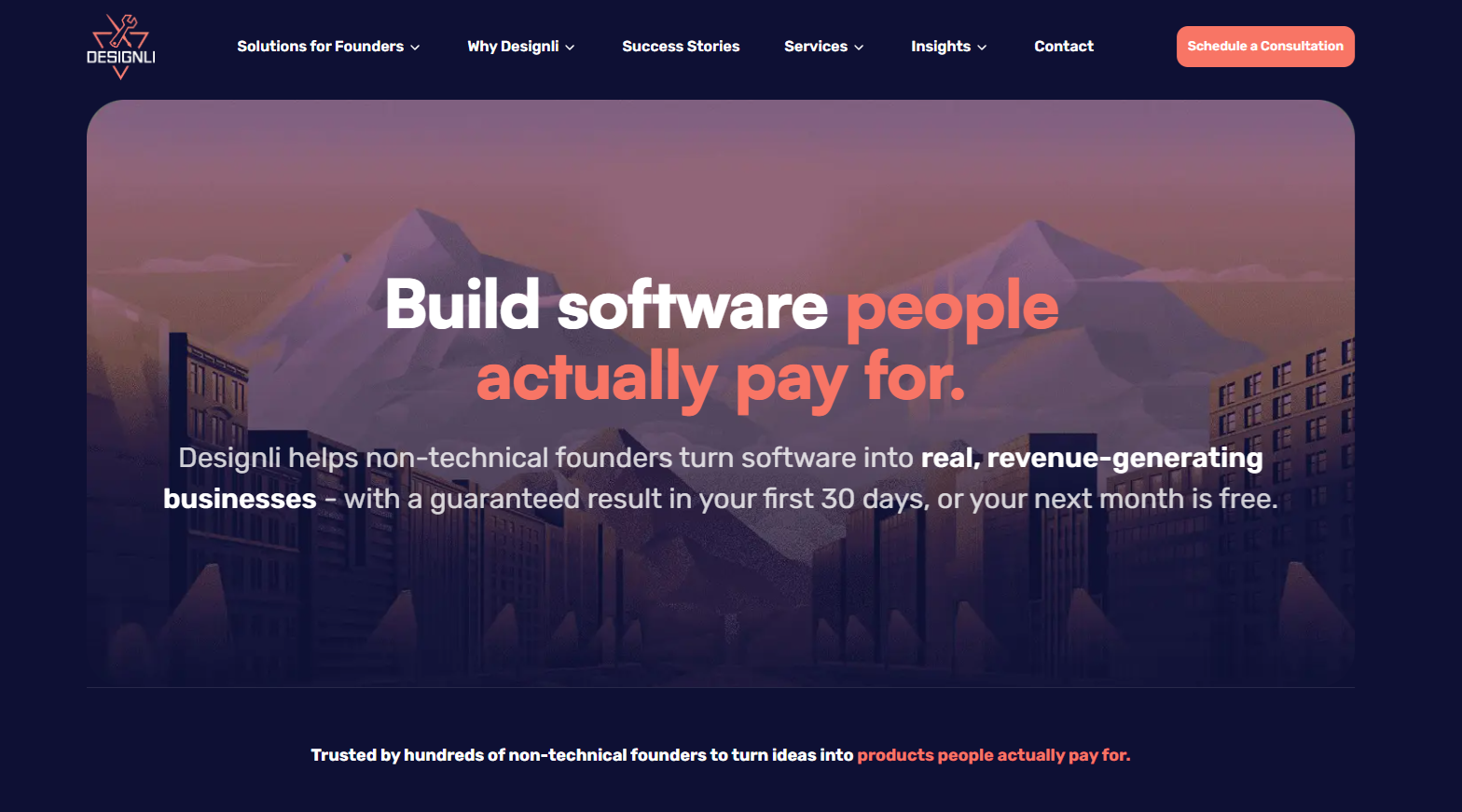 Best for non-technical founders building a mobile-first product.
Best for: First-time founders who want a guided process
Team model: Discovery-led product team
Starting budget: $10,000+ minimum; $50 to $99/hr
Clutch: 5.0 from 79 reviews
Designli is based in Greenville, South Carolina. It helps non-technical founders turn software into revenue-generating businesses. Its SolutionLab planning process is the most-praised item in its Clutch reviews. Mobile is its core focus, at 60% of its services. Project investments run from about $7,000 to $650,000, with most between $10,000 and $49,999.
What clients say: 79 reviews at a perfect 5.0 is the strongest review record here. Clients praise MVP delivery, organized project management, and patient guidance.
Look elsewhere if: you're building a complex B2B web platform with heavy integrations. If you've never managed a software build, though, Designli's guidance is the point.
Sources: Designli on Clutch; designli.co.
9. Simform
 Best for funded SaaS companies scaling on AWS or Azure that need large teams on demand.
Best for: Cloud-heavy platforms past product-market fit
Team model: Dedicated teams drawn from 1,000+ engineers
Starting budget: $25,000+ minimum; $25 to $49/hr
Clutch: 4.8 from 86 reviews
Simform is headquartered in Orlando, Florida. It holds AWS SaaS Competency status and is an Azure Expert Managed Services Provider. Its average engagement lasts two years. For proptech company Digital Natives, Simform merged separate branded apps into one Azure codebase. Branded apps now launch 10x faster, and the platform supports 1,000+ concurrent users.
What clients say: Simform has the largest review base on this list. Clients praise structured project management and value. Some mention cultural and time zone challenges.
Look elsewhere if: you're pre-validation and need product strategy more than engineering capacity.
Sources: Simform on Clutch; Simform AWS SaaS services; Digital Natives case study.
10. ScienceSoft
 Best for SaaS in regulated industries, where documented compliance and security matter.
Best for: Healthcare, finance, and other compliance-heavy products
Team model: Managed delivery with T&M, capped T&M, fixed-price, or subscription pricing
Starting budget: $5,000+ minimum; $25 to $49/hr
Clutch: 4.8 from 41 reviews
ScienceSoft has built software since 1989 and SaaS since 2012, from McKinney, Texas. It's ISO 9001 and ISO 27001 certified, a Microsoft Solutions Partner, and an AWS Advanced Tier Services Partner. Its own cost guide puts a medium-complexity SaaS product at $100,000 to $500,000. It also says maintenance runs 15 to 20% of build cost every year. Budget for that, whoever you hire.
What clients say: Reviews highlight fast response times and broad capability. One review noted less thorough penetration testing than expected.
Look elsewhere if: you want a small, senior team that will challenge your product strategy.
Sources: ScienceSoft SaaS cost guide; ScienceSoft SaaS services.
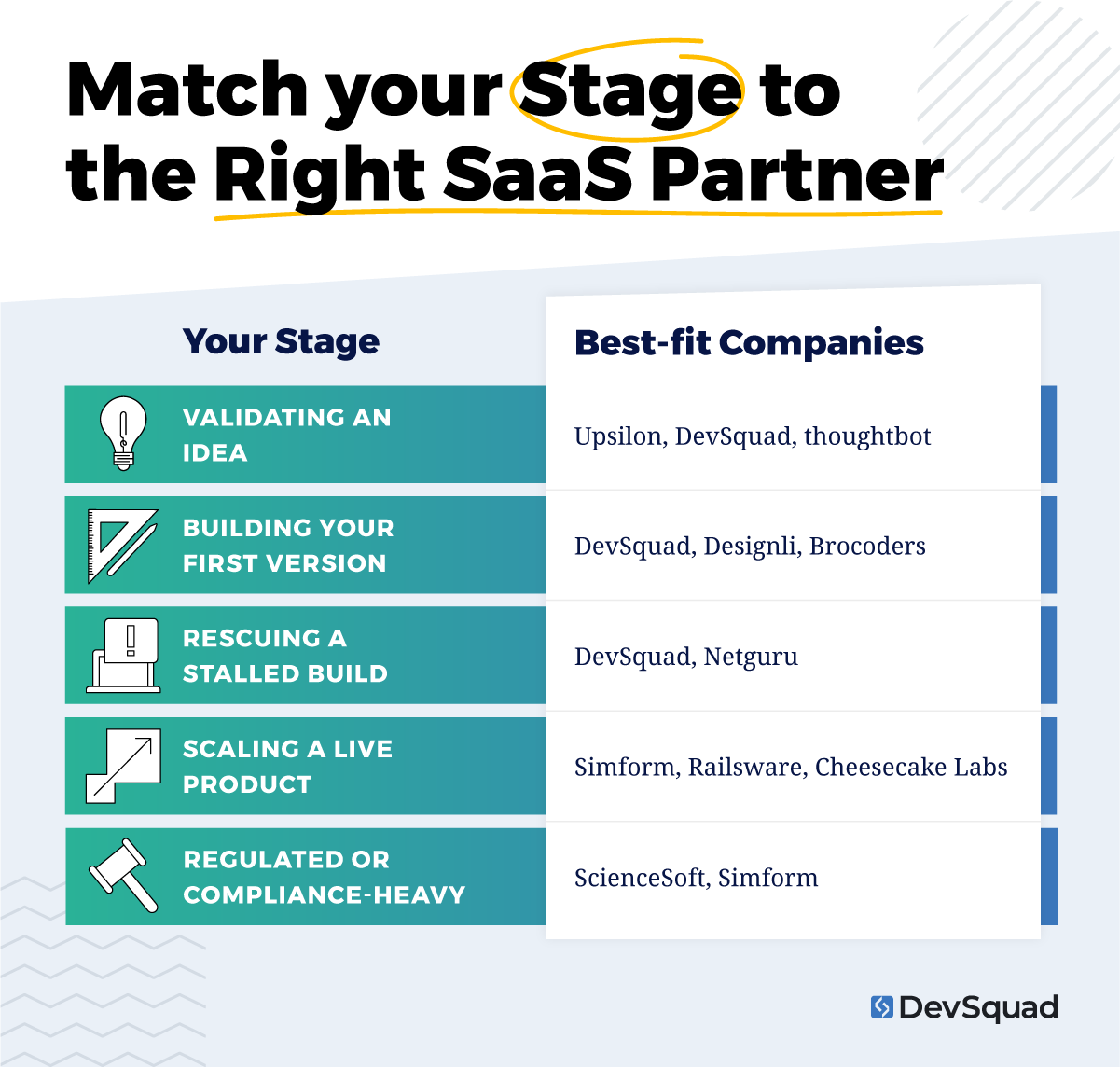
Which SaaS development company fits your stage
Your stage matters more than any star rating. If you're still learning how SaaS development works, start here.
Validating an idea: Upsilon's fixed $6,000 discovery, DevSquad's Sprint Zero with user testing, or thoughtbot's shaping sprints.
Building V1 as a non-technical founder: DevSquad, Designli, or Brocoders. Each pairs MVP development with hands-on guidance.
Rescuing a stalled build: DevSquad (Swell, Emergent 3) or Netguru (the TransACT rebuild).
Scaling a live SaaS: Simform for cloud capacity, Railsware for B2B engineering depth, or Cheesecake Labs for mobile.
Regulated or compliance-heavy: ScienceSoft or Simform.
Stalled builds rarely fail on code. They fail on structure. So whichever stage you're in, ask who validates the work.
"Before working with us, a client had just two developers. No product manager, no QA, no tech lead. They had been building for over a year and the portal still could not go to market. I do not think they failed on code. They failed because nobody was validating the work or maintaining a real backlog." — Flavio Pano, Product Manager, DevSquad
5 questions that separate a SaaS partner from a dev shop
Every firm on this list can write code. These five questions show you which ones will protect your runway. Ask them on the first call.
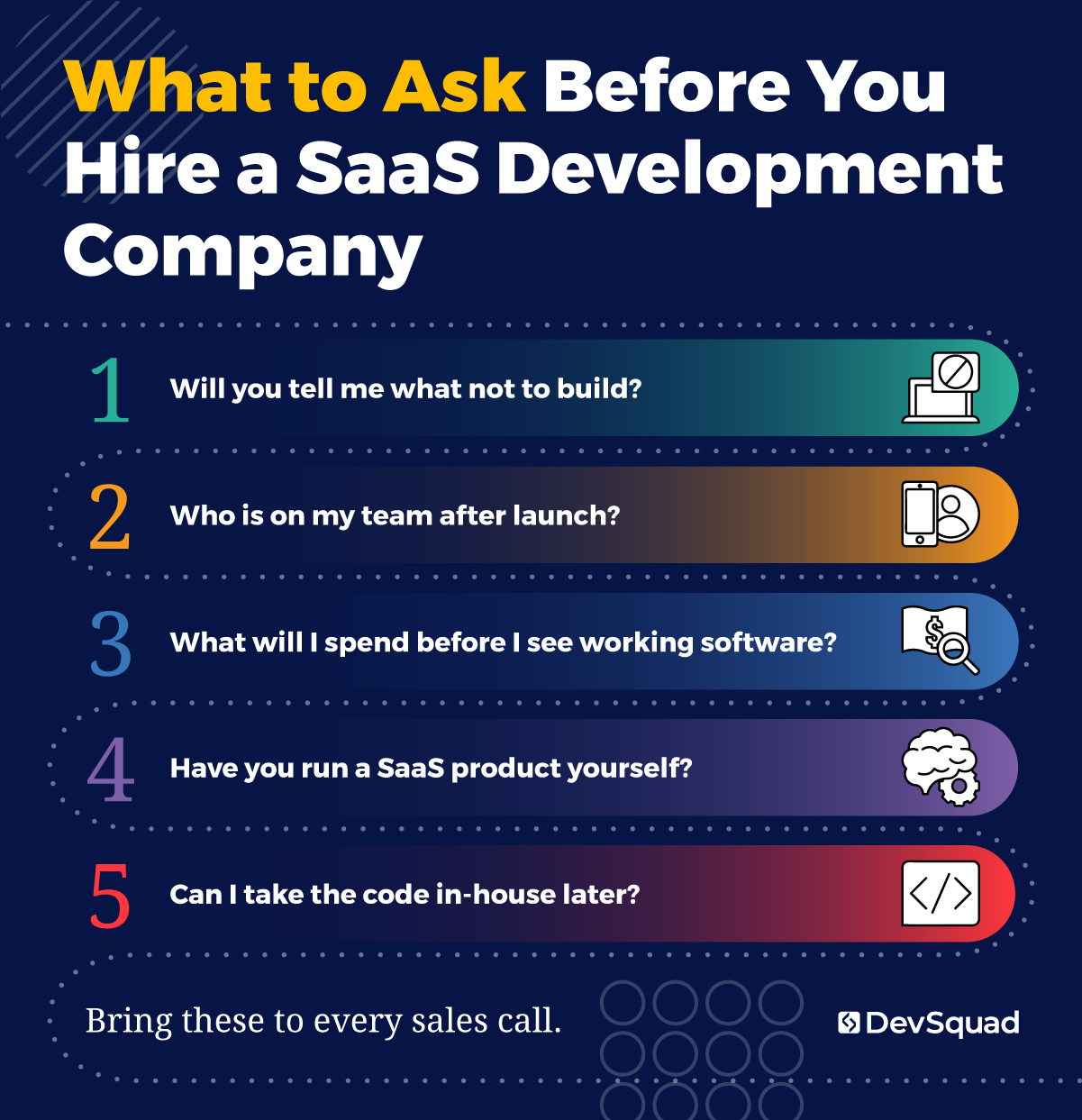
1. Will you tell me what not to build?
The cheapest feature is the one you never build. Look for a paid, structured step before development: DevSquad's Sprint Zero, Thoughtbot's shaping sprints, or Upsilon's fixed discovery. Bring your feature list to the call and watch who cuts it.
Some of the most valuable advice I've given founders was to cut scope before anyone wrote a line of code. Every firm on this list can build what you ask for; ask which ones will push back.
"The building is usually the easy part. The discovery is what is hard. Working out what to build, what will actually get used, and what will make someone come back is where the difficulty lives, and no amount of engineering speed helps with that." — Flavio Pano, Product Manager, DevSquad
2. Who is on my team after launch?
Launch is the start of the work. The people who know your product are worth more every month they stay. Simform's engagements average two years, and Railsware stayed with Calendly as it grew.
"Since he's been working with us so long, Antonio is able to suggest enhancements we didn't think of, or take something that was initially overcomplicated and simplify it, and have it land with a better user experience." — Chris Matson, Founder and CEO, HiBeam
3. What will I spend before I see working software?
Ask for the minimum engagement and the first milestone price, not the hourly rate. Upsilon publishes its packages. Elsewhere, minimums run from $5,000 at ScienceSoft to $50,000+ at Netguru, Railsware, and Cheesecake Labs.
4. Have you run a SaaS product yourself?
Running a product changes how you build one. Billing, churn, and support load stop being theory. Railsware is the clearest example here, and our founder built DevStats.
5. Can I take the code in-house later?
Put code and IP ownership in the contract from day one, as Upsilon does by default. Then ask for proof of a real handover. DevSquad supported both BoosterHub and Emergent 3 as they moved development in-house. Here's how to vet a development partner in more depth.
Your next step
Pick two or three firms that match your stage. Bring the same feature list and these five questions to every call. Then compare who pushes back, not who agrees fastest.
If DevSquad makes your shortlist, start with a Sprint Zero. You'll test the idea with real users before you commit to a build. Learn more about our SaaS development process.
SaaS development companies FAQs
Upsilon publishes an MVP price from $20,000, with most MVPs landing between $20,000 and $65,000. ScienceSoft puts a medium-complexity SaaS product at $100,000 to $500,000. Minimums on Clutch range from $5,000 to $50,000+. Plan for maintenance too, which ScienceSoft estimates at 15 to 20% of build cost each year.
Expect two to nine months, depending on scope. Brocoders typically ships an MVP in two to three months. Upsilon commits to under three months. DevSquad's SaaS MVPs launch in three to nine months, depending on complexity and integrations. Be wary of any quote that skips discovery to promise a faster date.
Hire a company if you need a PM, designers, developers, and QA at once. Recruiting them all takes months. Many founders start with an agency and move in-house after traction. BoosterHub and Emergent 3 both made that switch with DevSquad's help. Ask any firm how it handles a handover.
You should, from the first commit. Get it written into the contract, covering source code, cloud accounts, and third-party credentials. Upsilon states this outright in its terms. If a firm hesitates, treat it as a warning sign. Owning your code is what lets you switch partners or hire your own team later.
Often, yes, if time zone overlap matters to you. Cheesecake Labs works from Brazil with hours that overlap US teams. DevSquad pairs Utah-based strategists with LATAM developers. Some Simform reviews mention cultural and time zone challenges, so ask any offshore firm how it handles real-time decisions.
Get in touch with us for a free consultation to learn more about our process for vetting SaaS ideas and discovering what’s worth building.

Dayana Mayfield is a SaaS copywriter and content marketer specializing in SaaS marketing, positioning, and go-to-market strategy. She has consulted for over 195 SaaS companies, focusing on both traffic and conversions. She has been featured in Entrepreneur, Forbes, and Business Insider. Outside of work, Dayana writes SciFi novels and spends her evenings surviving auditions, rehearsals, and tech week as a proud theater mom.