
Before you build a minimum viable product, you need a strategy.
Too many teams jump into development without a clear plan, only to end up with a bloated, unfocused product that users don’t actually need. A strong MVP development strategy helps you avoid that by identifying the right problem, the right users, and the smallest feature set that delivers value.
The right MVP strategy depends on who the software is for. A SaaS product and a tool for your own team start with different questions, get validated by different people, and run on different timelines. And with AI writing more of the code, you also need to know what it speeds up and what it can't.
What is an MVP development strategy?
Before building a minimum viable product, you need a strategy. A strong MVP strategy defines what you’re building, why you’re building it, and how you’ll prove it delivers value. Without this foundation, even a fast launch can miss the mark — wasting time, budget, and user trust.
An MVP development strategy aligns your team, clarifies the problem you’re solving, and sets the stage for validation. It’s how smart teams avoid guessing and start building with purpose.
Why strategy matters more than speed
MVP development is often misunderstood as a race to launch something — anything — just to get into the market quickly. But speed alone doesn’t translate to success. Without a clear strategy, fast execution can lead to wasted resources, missed opportunities, and products that solve the wrong problems.
A strong MVP development strategy helps you avoid these pitfalls by defining what your product needs to achieve from day one. It aligns your team around the real problem to solve, who you’re solving it for, and how to validate whether the solution is working. And all of this is done before writing a single line of code.
Instead of guessing what users want, a strategic approach builds in research, prototyping, and testing to reduce risk and guide smarter decisions. That’s how great SaaS MVPs are born — not just from code, but from clarity.
Goals of a strong MVP strategy
A well-defined MVP strategy should do the following:
Validate a core product hypothesis: Your MVP typically exists to test a specific assumption about the problem, the user, or the solution.
Minimize time to learning: The faster you can gather real user feedback, the better. But it needs to be the right feedback, based on thoughtful prioritization and UX design.
Clarify what’s not important: One of the hardest parts of MVP planning is knowing what to leave out. Strategy gives you a framework to say “no” to anything that doesn’t support the core learning objective.
Align cross-functional teams: Strategy ensures that product managers, designers, developers, and stakeholders are building toward the same outcome, and not working in silos.
Support iteration: MVPs aren’t endpoints; they’re starting points. A solid strategy builds in flexibility so you can evolve based on what you learn post-launch.
SaaS vs. custom software: the question your MVP has to answer
Before you scope anything, answer one question: who is the software for?
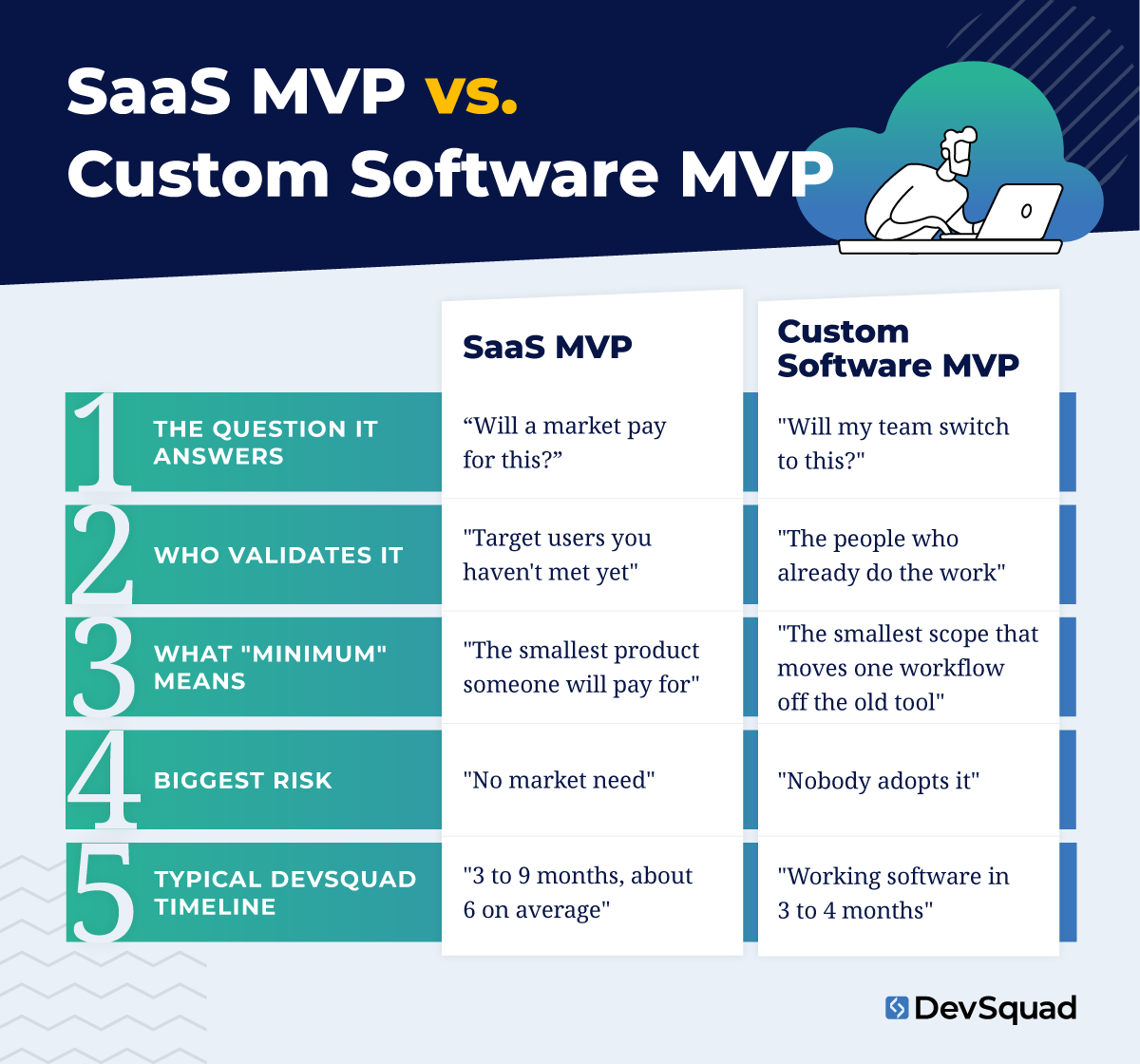
I've consulted for over 195 SaaS companies, and nearly every MVP conversation I've had starts with one question: will anyone pay for this? Build software for your own team and that question disappears, replaced by a harder one about whether people will actually switch their workflows.
That split changes your whole MVP strategy. A SaaS product has to prove a market wants it. Custom software has to prove your team will use it.
SaaS MVPs test whether a market will pay
A SaaS MVP is an experiment on a market you don't control yet. Demand is your riskiest assumption. So validation means testing a prototype with target users you haven't met, and looking for proof they'd pay.
DevSquad's SaaS development process follows that order: strategy, a realistic prototype tested with real target users, then an honest call on whether to build. Every new SaaS product goes through Sprint Zero first.
ParentPulse came to DevSquad with a new software idea. Rapid prototyping and collaborative product strategy kept version one lightweight, and the platform reached the market in under four months. It delivered value early without unnecessary complexity, which let the company keep bootstrapping efficiently.
For the full build sequence, see the step-by-step SaaS MVP guide.
Custom software MVPs test whether your team will switch
Building for your own team flips the risk. Demand is already proven: your people do this work today, in spreadsheets or a SaaS stack that doesn't fit. The question is whether they'll switch without breaking daily work.
Here, minimum means the smallest scope that moves one real workflow off the old tool. Everything else waits for version two.
"Focus on the main pain: what will have the most outcome with less effort. Don't be misled by a lot of nice-to-haves at the beginning just because you saw them in another place." — Sandro Boçon, Technical Project Manager, DevSquad
DevSquad's internal software development process follows that logic: workflow discovery, a high-fidelity prototype tested with your own team, then a fast Version 1. See what that looks like in these internal-use software examples.
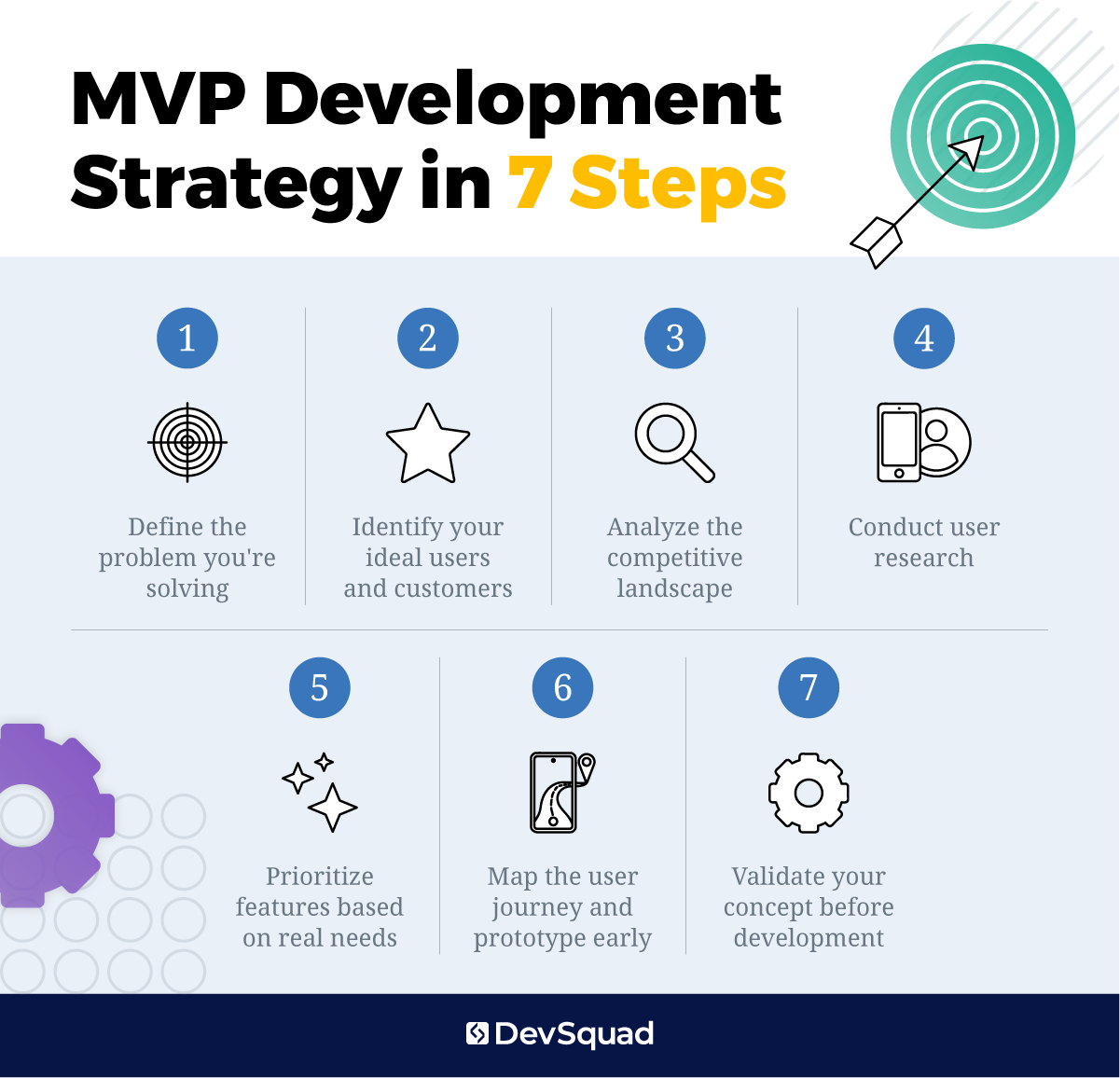
7 steps for MVP development strategy
Here are the steps for creating a solid MVP development strategy.
1. Define the problem you're solving
Every successful MVP starts with a clearly defined problem. If you can’t articulate the problem in one sentence, you’re not ready to build.
This step is about focusing on the pain point your product will address for a specific type of user. A clear problem statement serves as the foundation for product decisions, messaging, and prioritization.
“A problem statement has the power to get stakeholders aligned so that potential solutions resolve the biggest, highest-priority problem.”
A well-defined problem gives your MVP direction. Without it, you risk building features that feel disconnected, or worse, irrelevant. Start here or risk wasting development cycles chasing the wrong outcome.
2. Identify your ideal users and customers
Once you’ve defined the problem, you need to identify who exactly experiences it. Your MVP isn’t for everyone — it’s for a specific group of people with a specific need. The clearer you are about your target users, the easier it is to make smart product decisions.
This is where user personas come in.
A user persona is a simple profile that represents a key segment of your audience. It includes details like job title, goals, challenges, current tools they use, and how they make decisions. You might have one primary persona or a few if your MVP serves multiple segments.
Building around real personas keeps your MVP focused and prevents you from overbuilding. It also helps your design, messaging, and onboarding feel tailored. All of which increases the chance users will stick around.
3. Analyze the competitive landscape
Competitive analysis shows you how users are currently solving the problem you want to address. It helps you identify what’s working in the market, what’s missing, and how your MVP can stand out.
Start by listing both direct and indirect competitors. These include SaaS tools, outdated systems, and even manual solutions like spreadsheets. Look at product reviews, feature pages, and customer testimonials. Pay attention to what users like, what they complain about, and what they wish existed.
Focus on these key areas:
Core features competitors offer
Pain points users still experience
Pricing and positioning
Gaps in functionality or user experience
Use this research to shape your MVP. If competitors all offer a bloated set of features, your edge might be simplicity. If users complain about slow onboarding or poor integrations, your MVP can solve for that. You don’t need to be first — just clearer, faster, or better at solving one problem.
4. Conduct user research
User MVP research helps you build what people actually need. It doesn’t have to be complex or time-consuming — but it does need to be thoughtful.

Whether you're building internal software or a SaaS MVP, follow these key steps:
Set a clear research goal: Decide what you want to learn: pain points, workflows, tool usage, or decision-making patterns.
Define your target user group: Base this on your user personas. For internal tools, this may include specific departments or roles.
Choose the right method: Use interviews or observational research for depth. Use surveys if you need volume. Match the method to your goal.
Ask open-ended questions: Avoid yes/no questions. Ask users to describe how they work and where they get stuck.
Observe carefully: Pay attention to actions, not just words. Look for delays, workarounds, and repeated complaints.
Record and organize insights: Group responses by theme. Watch for repeated phrases or patterns — those are your signal.
Avoid assumptions: Don’t project your own expectations onto users. Let the data tell you what matters.
Stay empathetic: Listen without interrupting. Let people express frustration or show where something breaks down.
5. Prioritize features based on real needs
After you’ve gathered insights from users, turn that feedback into a focused feature set. Your MVP should only include what’s necessary to solve the core problem and prove value.
Start with the problem: Revisit your problem statement and choose features that directly support solving it.
Use user research to guide you: Prioritize what users said they need, not what they might like someday.
Map each feature to a goal: If a feature doesn’t support activation, learning, or workflow success, cut it.
Avoid feature bloat: You’re not building the final product. You're building the version that gets feedback.
Apply a simple prioritization framework: Use MoSCoW (Must, Should, Could, Won’t) or Now/Next/Later to organize priorities.
Keep the scope tight: For an internal MVP, this might mean one team or one workflow. For SaaS, one use case.
Write clear user stories: Translate each feature into a short description of what the user needs to do and why.
6. Map the user journey and prototype early
Before prototyping anything, make sure you’ve taken the time to think through the full user experience. That starts with user journey mapping — a visual outline of the steps your user will take to complete a task or solve a problem. It’s one of the most strategic activities in the MVP development process because it forces you to define the experience before you commit to design or development.
A mapped journey helps you align the product’s purpose with how real users think and work. It clarifies the minimum experience required for users to get value and exposes unnecessary steps, confusion points, or logic gaps.
Once your journey map is clear, you can move into prototyping with direction. A clickable prototype allows you to validate your flows and decisions before development begins, reducing risk and rework later.
7. Validate your concept before development
Before you build anything, make sure your concept solves a real problem for real users. Validation is about confirming that people want what you’re planning to deliver — not just in theory, but in practice.
Show your prototype or user journey to people who match your target persona. Ask if they would use it, what they’d expect it to do, and where it falls short. Watch for real interest, not vague approval.
You can also use landing pages, internal sign-up forms, or waitlists to test demand. The goal is to get signal — not assumptions.
Validation helps you avoid building the wrong thing and gives your strategy a green light to move forward.
5 strategic frameworks to guide your MVP
There are many great product discovery frameworks, and many of them are tailored to support the strategy side of MVP development. The right framework for you depends on your business and objectives.
Here are 5 great options to consider.
1. Lean Canvas
 Source: Canva
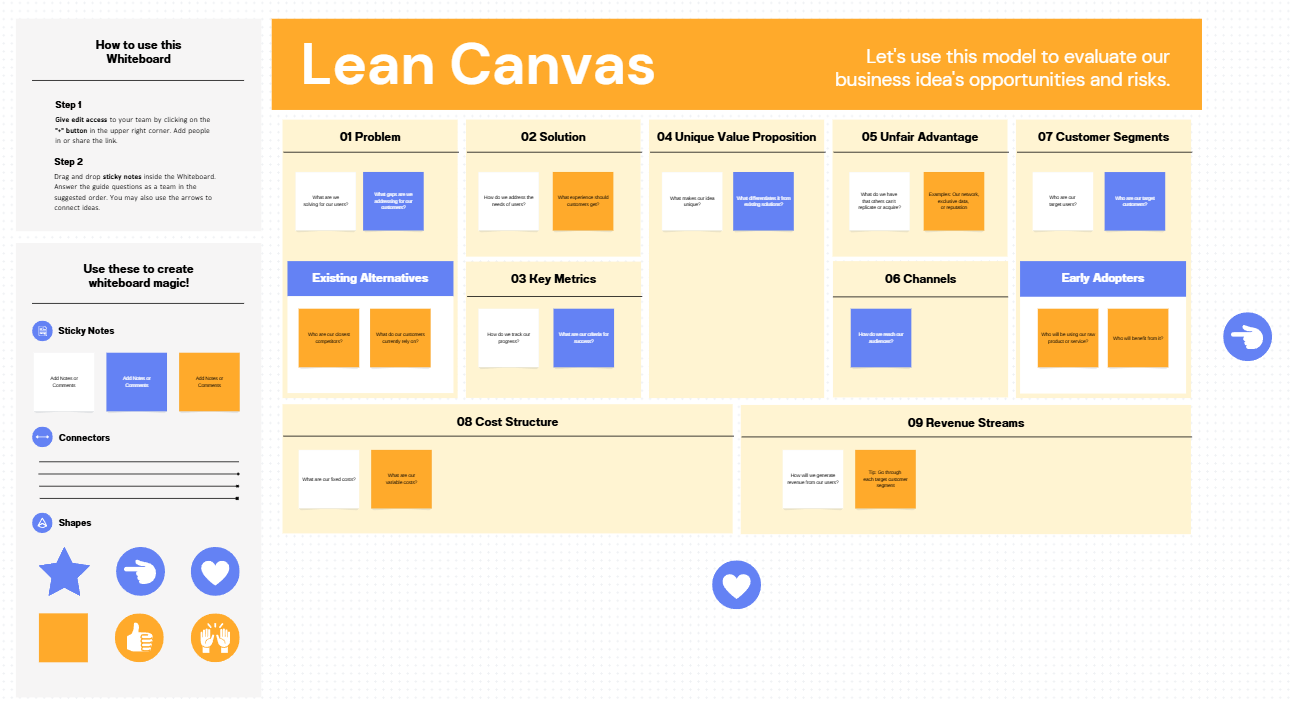
Lean Canvas is a one-page business model designed for startups. It helps you define your product’s core strategy by mapping out the problem, solution, customer segments, key metrics, and more — all on a single page. It forces clarity and focus at the earliest stage of planning.
This framework is a good fit for: founders or teams who need to align quickly around a product concept and business model before development.
2. Jobs to Be Done (JTBD)
.png)
JTBD is a way to define what users are actually trying to accomplish — the “job” they’re hiring your product to do. It focuses on outcomes and context, helping teams understand user motivation beyond features or demographics.
This framework is a good fit for: identifying the real problem to solve and ensuring your MVP centers on user outcomes, not assumptions.
3. Now / Next / Later roadmap
 Source Productstride
This lightweight planning tool breaks your roadmap into three buckets: what you’ll build now, what’s coming soon, and what’s on hold. It helps teams communicate priorities clearly without overcommitting or overplanning.
This framework is a good fit for: keeping MVP scope under control while showing stakeholders how the product can evolve over time.
4. MoSCoW prioritization

MoSCoW stands for Must, Should, Could, and Won’t. It’s a feature prioritization method that helps teams stay focused on what’s essential for the MVP and what can wait.
This framework is a good fit for: deciding what to include in the first release and keeping discussions grounded in user and business value.
5. Design thinking
.png)
Design Thinking is a structured process for solving problems creatively and empathetically. It moves through five phases: empathize, define, ideate, prototype, and test. It helps you uncover user needs before committing to a solution.
This framework is a good fit for: early strategy work, especially when you’re unsure of the right solution and need to explore multiple ideas before building.
UX and experience planning
Strategy doesn’t stop once you’ve defined your features. You also need to think through how users will actually interact with your MVP. A strong user experience makes the difference between a product that gets adopted and one that gets ignored.
Mapping the user journey
You started mapping the user journey during strategy planning. Now that work becomes the foundation for UX decisions.
At this stage, the journey map moves from a strategic tool to a design resource. It helps your product team understand what each screen needs to accomplish, what information should appear at each step, and how to guide users from point A to point B without friction.
This is especially useful when handing off work between strategists, designers, and developers. A well-documented journey map keeps everyone aligned on what the product needs to do, not just what it needs to look like.
Wireframing and prototyping key flows
Once the journey is mapped, wireframe your core flows. Focus on essential screens and interactions tied to your MVP’s value proposition. You don’t need polished visuals — clarity and logic are more important.
From there, create a clickable prototype to simulate how users will move through the product. This helps you test assumptions and gather feedback early, while it’s still easy to adjust.
Usability testing before coding
Test your prototype with real users before you commit to development. Watch how they navigate the product. Look for hesitation, confusion, or signs they’re not finding what they need.
This round of testing is essential to the user experience design process and gives you a final chance to make corrections while changes are still fast and cheap. It’s also one more layer of validation that your strategy is headed in the right direction.
How AI changes your MVP strategy
AI now touches every step above, from specs to prototypes to code. It shortens the build. It doesn't shorten the time it takes to learn whether you built the right thing. As covered in "Why strategy matters more than speed," fast work in the wrong direction is still waste. For the tool-level view, see how AI has changed software development.
Prototype faster, but validate the same way
AI assistants let a founder or product manager turn a concept into a clickable flow or low-fidelity prototype in hours instead of days. Put that saved time into more user conversations.
I use AI every day, and it has made me dramatically faster at producing first drafts. It hasn't made me one bit better at knowing which drafts deserve to exist.
The rule stays the same. Every AI-generated prototype goes in front of real users (SaaS) or the real team (custom) before anyone builds it. Keep that loop running after launch with dual-track agile.
Faster code needs a stronger quality check
Faster code means more code to check. 90% of technology professionals report using AI at work, but 30% report little or no trust in AI-generated code (Google Cloud DORA, 2025). The same research found AI adoption still has a negative relationship with software delivery stability.
Why does that hit an MVP harder? Because a buggy first version gives you bad feedback. Users react to the bugs instead of the idea.
"AI has accelerated development and brought up the necessity to take care of code quality." — Marina Beretta, Tech Lead, DevSquad
DevSquad uses AI-driven tools to build faster. Speed alone doesn't win markets, though, so the time saved goes back into strategy and UX.
Put AI in the product only when users need it
Using AI to build your MVP and putting AI inside it are separate decisions. AI features face the same filter as every other feature in step 5. If users don't need it to solve the core problem, it waits.
For a SaaS product, the AI feature might be the value proposition itself. Then it belongs in version one. For custom software, connect your systems first, because AI and automation projects stall on disconnected ones. An AI agent or automation earns its place in release two, once the core workflow runs cleanly.
Assembling your MVP team
The right team makes or breaks an MVP. You don’t just need people who can build — you need people who can think strategically, move quickly, and adapt as feedback comes in. Whether you're building in-house or working with a partner, your core team should be small, cross-functional, and focused.
Key roles: strategist, PM, designer, tech lead
These four roles form the foundation of a high-performing MVP team:
Product strategist: Shapes the big-picture direction, making sure everything ties back to the user problem and business goals.
Technical product manager (TPM): Translates strategy into actionable plans and user stories, while coordinating design, development, and testing.
UX/UI designer: Focuses on user flows, interface clarity, and overall usability — not just how things look, but how they work.
Tech lead or senior developer: Makes architectural decisions, sets up the codebase, and guides early implementation with scalability and maintainability in mind.
In-house vs outsourced MVP teams
If you have in-house talent with startup experience and capacity, building internally may be a good fit. But in many cases, teams are stretched thin or lack the mix of skills needed to move fast and build well.
Outsourced MVP teams can bring:
Pre-established workflows for strategy and delivery
Experienced specialists who have shipped multiple MVPs
Shorter timelines and reduced management overhead
The key is to work with a team that not only codes, but guides you through the process. Strategy-first partners will challenge assumptions, help you define scope, and validate direction before development begins.
Scoping and planning for launch
With strategy, UX, and team alignment in place, the next step is to define what you'll actually build, and how to manage the work. This is where clear scope, realistic effort estimates, and a short-term launch plan come together.
Define your minimum viable feature set
Remember that your MVP isn't a stripped-down version of your future product. It’s the beginning of an evolving product. It's the smallest version that delivers real value and answers a key question: Does this solution work for our users?
Use the research and prioritization work you’ve already done to decide what’s essential for version 1. Keep it focused. Every feature should support the core user journey and tie directly back to the problem you set out to solve.
Avoid the temptation to add “nice to have” features. You can build those later, after you’ve validated the basics.
Estimating effort with Planning Poker
Once you’ve locked in the feature list, your team needs to estimate how much effort each item will take. One effective method is Planning Poker — a collaborative estimation technique based on the Fibonacci sequence.
Each team member assigns a point value to a task based on complexity and effort. The group then discusses and aligns on an estimate. This helps surface unknowns early and prevents overloading the first release.
Planning Poker is not just about time. It's about clarity. If the estimates are all over the place, that’s a signal the task needs to be better defined.
How long your MVP should take
Your timeline depends on which path you're on. Your answer to the SaaS vs. custom question sets the clock.
With DevSquad, most SaaS MVPs launch in 3 to 9 months, about 6 months on average. Internal tools reach working software faster, in 3 to 4 months.
The gap comes from what each path has to prove. A SaaS product needs market validation loops before and after the build. An internal tool has known users and a narrower first workflow.
One warning holds on both paths. If your estimate runs well past these ranges, your scope is too big.
Validation and iteration post-launch
Your MVP launch should mark the beginning of a learning cycle, not the end of a development sprint. The goal is to validate your assumptions with actual usage and improve based on real feedback. Make sure you know how to validate a software product because what you do in the first few weeks after launch will determine whether your MVP becomes a successful product or just a short-lived experiment.
What to track after release
Pay close attention to how users interact with the product. Don’t rely solely on feedback as usage patterns often tell you more.
Look at:
Activation and completion rates
Drop-off points in key flows
Time to value (how quickly users reach their goal)
Support tickets or recurring questions
Internal adoption rates (if it’s an internal tool)
Set up simple tracking tools like session recordings, analytics dashboards, or quick user surveys to gather insight without slowing down the team.
Building an internal tool? Watch one signal above everything else: whether the people who asked for it are using it while the build team is still engaged.
"We launched in January and the client did not properly test it until April. That gap is the most common failure I see after launch, and it is not a development problem. Whoever asked for the software has to be using it while the team that built it is still on the project." — Antônio Salla, Product Manager, DevSquad
Running continuous discovery sprints
Use regular discovery sprints to explore improvements while continuing development. This means checking in with users, testing small iterations, and updating your roadmap based on what you learn.
Your MVP may reveal new problems, unexpected user behavior, or gaps in your original thinking. That’s expected. The point of launching lean is to learn fast and adjust.
Continuous discovery helps you keep your product aligned with user needs as they evolve, without blowing up the development schedule.
Avoiding feature bloat as you scale
As feedback rolls in, the pressure to add features can grow fast. Stay disciplined. Just because something is requested doesn’t mean it belongs in the next release.
Revisit your user personas and product goals often. New ideas should go through the same prioritization filter you used during the MVP strategy phase. This protects your team’s focus and keeps the product clean and usable.
MVP strategy FAQs
It depends on who the software is for. With DevSquad, most SaaS MVPs launch in 3 to 9 months, about 6 on average. Internal tools reach working software in 3 to 4 months. If your estimate runs far longer, cut scope first.
No. AI can turn a concept into a clickable prototype in hours. It can't tell you whether a market will pay or whether your team will switch. Only real users can. Put every AI-generated prototype in front of them before you build.
Yes, but it answers a different question. Demand is already proven, so your MVP tests adoption. Scope it to the smallest version that moves one real workflow off the old tool. Then make sure the people who asked for it use it while the build team is still engaged.
Planning on building an MVP? Learn more about our MVP development strategy and process.

Dayana Mayfield is a SaaS copywriter and content marketer specializing in SaaS marketing, positioning, and go-to-market strategy. She has consulted for over 195 SaaS companies, focusing on both traffic and conversions. She has been featured in Entrepreneur, Forbes, and Business Insider. Outside of work, Dayana writes SciFi novels and spends her evenings surviving auditions, rehearsals, and tech week as a proud theater mom.