
You've got sensors. Maybe dozens, maybe hundreds. They're generating data constantly. Information like equipment temperatures, vehicle locations, energy draws, inventory levels building by the hour. And right now, that data is going somewhere useless: a spreadsheet, a siloed platform, or nowhere at all. The gap between the hardware you've deployed and the decisions that hardware should be informing is a software problem.
That's the moment custom IoT software development becomes necessary. Not when you're evaluating IoT for the first time, but when you realize the devices are already there and the software layer isn't keeping up.
This guide covers the industries where custom IoT software delivers the strongest return, the discovery process that separates builds that create value from builds that create technical debt, and how to choose the right development partner before you commit to anything.
When a client comes to DevSquad with an IoT project, the first thing I ask is what decisions they want to make that they can't make today. If they can answer that question clearly, the software almost designs itself. If they can't, we have more discovery to do before any development should start.
What is custom software development for IoT?
Custom software development for IoT refers to the process of designing, building, and deploying software solutions specifically tailored to connect, manage, and control Internet of Things (IoT) devices. This development goes beyond standard applications to support the complex infrastructure required to turn raw device data into actionable insights, automate workflows, and integrate systems across industries.
Unlike off-the-shelf solutions, custom IoT software is built for company software used internally, enabling precise data handling, custom integrations, and specialized device interactions that generic tools simply can't accommodate.
Be it a smart thermostat in a residential setting or a fleet of sensors tracking crop health on a large farm, IoT systems rely on a strong software backbone. The more tailored that backbone is, the better it will support your company’s goals, environment, hardware limitations, and scale.
Why companies choose custom software over IoT platforms
Developing custom software for IoT is so much more than connecting devices. We're talking about building a platform that fits your business, your users, and your goals. Below are the key reasons why companies invest in tailored IoT development over off-the-shelf options.
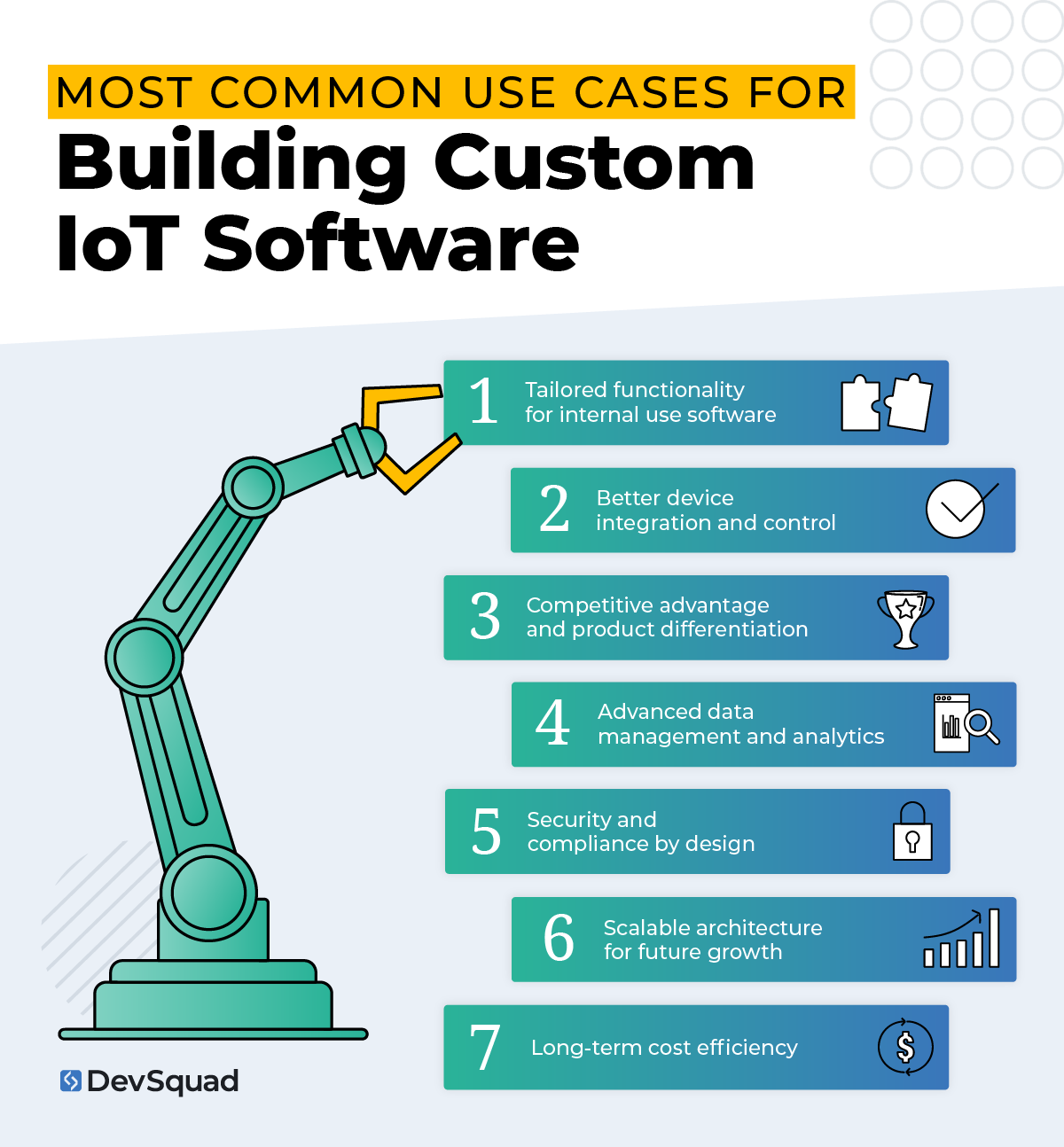
1. Tailored functionality for internal use software
Many businesses turn to custom software development for IoT because internal operations can’t be supported by one-size-fits-all tools. Whether you’re monitoring supply chain logistics or managing equipment across multiple sites, custom development allows you to design workflows, user interfaces, and system logic that reflect how your business actually operates.
This is especially important when building internal software for teams that rely on speed, accuracy, and automation. DevSquad's discovery phase maps those workflows, user interfaces, and system logic before development begins, so the build starts from a clear operational picture, not a wishlist.
2. Better device integration and control
IoT ecosystems rarely consist of a single type of device or manufacturer. You may be working with different sensors, gateways, controllers, or cloud platforms. With custom development, you gain full control over how those devices communicate and perform.
3. Competitive advantage and product differentiation
If you’re building a market-facing IoT product, custom software is essential for differentiation. With it, you can deliver features your competitors can’t match, create a more intuitive UX, and pivot quickly based on user feedback.
4. Advanced data management and analytics
IoT generates vast amounts of real-time data. What you do with that data determines whether your system becomes a business asset, or just another source of noise.
Custom software lets you design exactly how data is stored, processed, visualized, and used across your teams. You build tools that show what matters, when it matters. That includes everything from machine learning models to tailored compliance reports.
5. Security and compliance by design
Security vulnerabilities in IoT systems can be catastrophic. Off-the-shelf solutions might not give you enough visibility or control to meet internal security policies or regulatory requirements.
With custom software, security is built into the architecture from day one. You choose the authentication, encryption, data access policies, and auditing standards,making it far easier to meet industry compliance requirements and protect sensitive information.
6. Scalable architecture for future growth
Your IoT system shouldn’t cap your growth. Custom software allows you to build a backend that scales with your business—whether that means handling more data, managing thousands of connected devices, or expanding to new geographies..
7. Long-term cost efficiency
While the initial cost of custom software development for IoT may be higher, the long-term ROI is substantial. You cut out recurring licensing fees, reduce dependency on third-party roadmaps, and avoid costly rework or inefficient manual processes. With the support of AI the efficiencies of development have also greatly increased which have reduced the financial barriers previously associated with custom software solutions.
The industries seeing the strongest return on custom IoT investment share one trait: workflows that off-the-shelf platforms consistently fail to accommodate. Here is where that gap shows up most clearly.
Healthcare IoT: where compliance makes custom software essential
Healthcare IoT carries the highest compliance stakes of any vertical. HIPAA requirements, medical device classifications, and EHR interoperability mean off-the-shelf platforms rarely check all the boxes. Custom software lets you build compliance requirements into the architecture from the start, rather than retrofitting them later.
Remote patient monitoring
Wearables and home monitoring devices can feed a custom clinical dashboard that alerts care teams when readings cross defined thresholds. The operational outcome: readmission rates drop for chronic disease patients because intervention happens before a crisis, not after it.
Equipment tracking and utilization
RFID or Bluetooth tags on medical equipment feed a custom location and utilization dashboard. Nurses spend less time searching for equipment. Hospital administrators right-size the device fleet based on actual utilization data rather than estimates.
Manufacturing IoT: from predictive maintenance to ERP integration
Manufacturing delivers the highest ROI from custom IoT software of any vertical. Mid-market plants often run legacy equipment that generates data no existing SaaS platform can cleanly ingest. Custom software bridges this gap between what the machine knows and what your operations team can act on.
The global IoT in manufacturing market is projected to reach $172.65 billion in 2026 and grow to $1,108.42 billion by 2034 (Fortune Business Insights, 2025).
Predictive maintenance
Sensors on production equipment feed a custom dashboard that alerts maintenance teams before a failure occurs. Unplanned downtime in a mid-size plant can run to hundreds of thousands of dollars per incident. Catching the failure before it happens is where the ROI concentrates.
A mid-market plastics manufacturer was manually pulling equipment logs every shift and comparing them in spreadsheets to identify patterns. After a custom IoT dashboard was built to ingest sensor data from 40 machines in real time, maintenance alerts became automated and the plant reduced unplanned downtime by 30% in the first six months.
Production monitoring
Real-time visibility into throughput, quality control flags, and line efficiency across a facility gives shift supervisors what they need to identify bottlenecks and adjust without waiting for an end-of-day report. The impact compounds when you're managing multiple facilities: a custom software layer creates a single view across sites that no off-the-shelf tool provides cleanly.
ERP and SCADA integrations
Custom software that bridges IoT sensor data with existing ERP or SCADA systems lets operational data flow into business planning systems without manual export and import. Finance and operations teams work from the same numbers. Reconciliation time drops. Decision lag drops with it. Integrating legacy systems is one of the most common starting points DevSquad encounters with industrial IoT clients, and one of the highest-value early wins when it's done right.
Logistics IoT: fleet, cold chain, and warehouse visibility
Logistics operators manage fleets, routes, warehouses, and carrier relationships simultaneously. Off-the-shelf platforms offer pieces of this, but no single SaaS product handles the full scope of a complex distribution operation. Custom software connects the dots.
Fleet tracking and telematics
Real-time GPS and diagnostics data from a vehicle fleet, feeding a custom operations dashboard that shows location, fuel consumption, driver behavior, and maintenance alerts in one view. Dispatchers make faster routing decisions. Fuel costs drop. Compliance reporting becomes automated rather than a manual extraction exercise at the end of each month.
Cold chain monitoring
Temperature and humidity sensors in refrigerated trucks, containers, or storage facilities, connected to a custom alert and compliance system. Spoilage incidents get caught in transit rather than at delivery. Audit documentation for food safety compliance is automated: a manual burden that disappears entirely once the system is live.
Warehouse visibility
Inventory sensors and RFID readers feed a custom warehouse management overlay that shows real-time stock levels, pick-path efficiency, and dock scheduling. This use case often starts as a gap-filler when an existing WMS doesn't support sensor data ingestion. Pick accuracy improves. Manual cycle counts drop in frequency.
Energy and utilities IoT: grid monitoring and field operations
Utilities manage distributed infrastructure across large geographies, and no off-the-shelf tool handles the full scope of grid monitoring, outage management, and field technician coordination. Custom software creates a unified operations layer.
Smart meter and grid monitoring
Meter data flows into a custom platform that tracks consumption patterns, flags anomalies, and feeds outage prediction models. Outage response time drops because the system identifies likely failure points before they cascade into wider incidents.
Field technician mobile apps
Custom mobile applications for field crews that receive work orders, capture on-site readings, and sync back to the central operations platform via IoT connectivity. Data capture happens at the point of work rather than in a back-office re-entry step. This reduces errors and accelerates billing cycles in the same motion.
How the discovery process works for custom IoT software
Custom IoT software isn't plug-and-play. Whether you're building internal software to support an existing device fleet or launching a brand-new connected system, the discovery process is where everything starts.

At this stage, you're defining features and making long-term architectural decisions. You’re aligning software requirements with business goals, clarifying user needs, and either preparing for device integration or selecting the right hardware from scratch.
Two common paths emerge:
If you already have IoT devices in place, the focus is on integrating them, normalizing data, and building internal use software that adds functionality, visibility, or automation.
If you’re developing a new IoT system, your discovery phase must include hardware research and planning, including how those devices will capture, transmit, and secure data.
Here’s how to approach the discovery process for both scenarios.
1. Understand your business case and internal goals
Before selecting a framework or syncing a sensor, you need clarity on why this product exists.
What business outcome does the IoT system support?
Who are the internal stakeholders?
How will success be measured?
This is especially important when developing internal use software, where the value often comes from cost reduction, operational efficiency, or process modernization—not direct revenue.
For existing devices:
Focus on how custom software can eliminate manual steps, unify siloed tools, or enable automation. Talk to operations teams to find current pain points.
For new systems:
Define the full use case before exploring hardware options. Make sure the system supports actual needs rather than technology for its own sake. Avoid scope creep by anchoring all decisions to business outcomes.
2. Define device interactions and technical requirements
This is where your software vision intersects with physical infrastructure.
What kind of data will devices collect?
How frequently?
How is it transmitted, and in what format?
You’ll need to define how the software handles device messaging, real-time data streams, configuration commands, and alert thresholds.
For existing devices:
You may be limited by current communication protocols, sampling rates, and data formats. Map out what's feasible with the existing fleet and identify any hardware or firmware changes that may be required.
For new systems:
You’ll need to select hardware that fits your software and data needs, not the other way around. Choose sensors that deliver the required fidelity and reliability. Evaluate connectivity (cellular, LoRaWAN, Wi-Fi, etc.) based on the deployment environment.
3. Audit your existing systems and integration needs
Your custom IoT software won’t live in a vacuum. It will interact with databases, business systems, or third-party APIs. Discovery includes identifying these systems and determining how (and where) data should flow.
For existing devices:
Focus on integrating device outputs with the systems your team already uses: SCADA platforms, ERPs, CRMs, or internal dashboards. Also assess any middleware currently in place, which could introduce delays or distort data. Pay attention to any legacy systems that may require updating to achieve your objectives.
For new systems:
Even if the IoT platform is greenfield, your organization may still need to integrate with existing business software. Build data interoperability into your architecture early, and avoid assuming the IoT software will operate in isolation.
4. Identify user types and workflows
Who are the end users, and what decisions or actions will they take using the system? Map out the tasks and touchpoints that matter most—from real-time monitoring to exception handling.
This is critical for internal software where different user roles (technicians, analysts, managers) require different levels of access, context, and functionality.
For existing devices:
Interview current users to learn how they’re interacting with device data today. What’s manual? What’s unreliable? What’s missing? Build workflows into the custom software to solve those problems.
For new systems:
Create user personas and expected workflows based on business objectives. Don’t design features in a vacuum, mock up how users will interact with the system and use that to guide UI/UX decisions.
5. Plan for data architecture and machine learning
Data is the most valuable output of any IoT system. Discovery must include planning for how that data is captured, processed, stored, and used. Make sure you're using machine learning to generate insights, this is also where you define the model inputs, frequency of training, and expected outputs.
For existing devices:
Start with a thorough understanding of current data fidelity and volume. What format is the data in? How clean is it? Can it support predictive models? Plan data pipelines that can handle both historical ingestion and real-time streaming.
For new systems:
Design the architecture with future capabilities in mind, even if you're not using machine learning from day one. Select hardware that supports timestamp accuracy, sufficient sampling rates, and structured output for easy processing.
6. Define compliance, security, and performance requirements
IoT systems are often subject to regulatory standards, cybersecurity risks, and performance constraints. Discovery should identify all relevant requirements across data handling, encryption, access control, and uptime expectations.
For existing devices:
You may need to retrofit security measures if the original deployment didn’t include end-to-end encryption or secure boot. Also consider how updates will be deployed—especially if devices are remote.
For new systems:
Bake compliance and security into the architecture from the start. Choose devices with built-in encryption and authentication, and define how software will handle key management, user permissions, and system alerts.
7. Create a prototype and validate with real users
Prototyping during discovery helps you de-risk assumptions and expose usability flaws before development begins. You’ll save time, money, and avoid building the wrong tool.
For existing devices:
Use real device data to simulate dashboards, alerts, and workflows. Test the prototype with users to verify that the software solves the intended problems.
For new systems:
Use dummy data or manually generated inputs to build an interactive prototype. Conduct one-on-one testing with stakeholders and iterate before finalizing scope.
8. Build a strategic roadmap
The goal of discovery is to produce a clear, practical roadmap. You’re not just listing features—you’re prioritizing what gets built now, next, and later. This is especially important in IoT, where infrastructure, data models, and UX all evolve over time.
For existing devices:
Plan the minimum required software to deliver immediate value, followed by phases that expand functionality. Build your roadmap around pain point resolution.
For new systems:
Launch with a tightly scoped MVP that validates core hardware and software interactions. From there, expand into machine learning, integrations, or more advanced automation based on user feedback and system performance.
What separates successful IoT builds from failed ones
A rigorous discovery process is necessary, but not sufficient. The IoT projects that deliver ROI versus the ones that become technical debt usually come down to three things: clarity on what decision the software needs to enable (not just what data it will collect), a development partner who has worked with the specific hardware type and protocols involved, and an architecture that accounts for the deployment environment from the start rather than discovering its constraints mid-build.
"The IoT projects I've seen fail had one thing in common: the software was designed in isolation from the hardware. When you understand the device's constraints, the communication protocols, and the deployment environment before you write a line of code, the architecture decisions become obvious. When you don't, every constraint you missed in discovery becomes a rewrite in production." — Nelson Pereira, Technical Product Manager, DevSquad
The frameworks most commonly used in IoT software development
When building custom software development for IoT devices, the framework you choose shapes how fast your team can build, how scalable your system becomes, and how effectively you can handle real-time data, automation, and user interaction.
From internal dashboards to secure APIs and device-facing services, these frameworks are the top choices for today’s IoT platforms.
1. Laravel (PHP)
Laravel is an ideal framework for building the core application layer of your IoT system—especially if you're building internal use software, custom dashboards, or secure RESTful APIs.
Its clean architecture, built-in authentication, robust routing, and queue handling make it well-suited for managing device data, alerts, and user roles. Laravel is also developer-friendly, with excellent documentation and a wide ecosystem of tools for rapid development.
Use Laravel when:
You’re building internal software or admin panels
Your system requires strong authentication and access control
You need to move fast without sacrificing maintainability
You want built-in tools for background jobs, task queues, and scheduled processes
You’re planning for multi-tenant access or user-based permissions at scale
2. Node.js with Express
Node.js is lightweight and non-blocking—ideal for real-time data pipelines and handling large volumes of simultaneous device connections. With Express, it becomes a fast and flexible way to build APIs or event-driven services.
Use Node.js when:
You're handling real-time communication from devices
You need middleware between devices and your backend
Your system uses MQTT, WebSockets, or event queues
3. Django (Python)
Django is a secure, scalable Python framework built for speed and clarity. It’s especially useful when your IoT system involves structured data, analytics, or machine learning—thanks to Python’s native libraries and integrations.
Use Django when:
You’re working in healthcare, energy, or scientific domains
Your system needs machine learning integration
You want a batteries-included backend with admin tools
You’re building multi-layered applications with complex data models
4. FastAPI (Python)
FastAPI is a modern Python framework for building high-performance APIs. It’s asynchronous, type-safe, and ideal for microservices or edge-side services that handle requests from devices quickly and efficiently.
Use FastAPI when:
You're building lightweight APIs or edge services
You need to serve ML model results in real time
You want fast performance with Python-based tooling
5. Spring Boot (Java)
Spring Boot is an enterprise-grade framework used across industries for building production-ready software. It’s commonly used in large-scale IoT deployments—especially in industrial, manufacturing, and energy applications.
Use Spring Boot when:
You're working with enterprise systems or legacy infrastructure
You need strict security and configuration management
Your team is already using Java
6. .NET Core (C#)
.NET Core is a powerful option for companies using Microsoft infrastructure. It supports scalable backend services, custom APIs, and strong integrations with enterprise software. It’s especially useful in manufacturing, logistics, and healthcare.
Use .NET Core when:
You're building internal software in a Microsoft environment
You need long-term maintainability and stability
You're integrating with Windows-based systems
7. PlatformIO (C/C++)
While most of this list focuses on backend development, many IoT teams also work on embedded firmware. PlatformIO is a development ecosystem for embedded C/C++ and simplifies firmware development for microcontrollers.
Use PlatformIO when:
You're building both software and firmware in-house
You need to manage multiple embedded environments
You want to streamline development on devices like ESP32, STM32, or Arduino boards
You need continuous integration and testing pipelines for firmware
How to choose a custom IoT development partner
Most IoT development agency listings look the same: years of experience, client logos, a technology stack overview. That surface-level presentation doesn't tell you anything useful. The real differentiation happens in three places.
Look at how they run discovery
A strong IoT development partner starts every engagement with a structured discovery process. They ask what decisions you're trying to enable, not what features you want to build. They map your existing device fleet, protocols, and data formats before proposing a technical solution. If a partner moves straight to a statement of work without a dedicated discovery phase, scope will shift once development begins. Count on it.
One of the most important questions I ask any potential IoT client is whether they know what format their device data is in and how frequently it's transmitted. If they don't know, discovery is going to take longer and cost more than the estimate suggests. That's not a bad thing, it just means we need to build that into the plan honestly rather than pretending we can skip it.
DevSquad's discovery-first approach is designed around exactly this: understanding the operational problem before touching the technical solution. You can learn more about how that process works on our internal use software page.
Firmware expertise vs. software expertise
Most IoT projects require both firmware expertise (what runs on the device itself) and software expertise: the backend platform, dashboard, and integrations. These are different skill sets, and not every agency covers both. Before evaluating partners, get clear on where your project sits.
If devices are already in the field and you need a software layer on top, strong backend and integration experience matters more than embedded firmware depth. If you're designing a new connected product from scratch, firmware expertise is critical. Ask any prospective partner to describe their experience on both sides and show you where previous engagements required each. The answer will tell you quickly whether their team matches your project's actual requirements.
Ask about integration track record, not just client count
A client count is social proof. For IoT work, the more useful question is: what systems have you integrated with, and how did you handle protocol mismatches or legacy data formats? Ask specifically whether they've integrated with the type of ERP, SCADA, or cloud platform your organization runs. Request examples of projects where device data was ingested from existing hardware rather than new devices the agency specified.
Integrating legacy systems often requires middleware or API layers that a capable development partner should be able to design before scope is finalized, not discovered during development.
"I always tell clients to ask their development candidates not just what they've built, but what they've had to go back and fix. The agencies that can talk honestly about where a project hit an integration wall and how they resolved it are the ones who've actually done this work before. The ones who only talk about success stories are worth being skeptical of." — Mauricio Kiyama, VP of Product, DevSquad
Five agencies worth evaluating for custom IoT development
Choosing the right development partner is one of the most important decisions when building a custom IoT solution. Whether you're developing internal use software, a market-facing product, or a platform to support your device ecosystem, your agency needs to understand both the technical demands of IoT and the business outcomes you're targeting.
Here are five of the top agencies offering IoT app development services, with DevSquad leading the list.
1. DevSquad
Custom software for IoT, built with your goals in mind.
DevSquad is a consulting-first development partner that specializes in building custom software for companies with complex needs—IoT included. Every project begins with a strategic discovery phase, tailored to identify the right technical approach, integrations, and user workflows. Their teams are fully managed and include product strategists, developers, QA engineers, and DevOps specialists.
They frequently work with companies building internal software, mobile dashboards, or API layers for connected devices. Laravel is a go-to framework in their stack, but DevSquad’s real advantage lies in their process: streamlined discovery, fast execution, and ongoing iteration through dual-track agile.
2. SDSol Technologies
SDSol Technologies is a Florida-based firm offering end-to-end IoT product development. Their services span both hardware and software, including electrical engineering, firmware, mobile apps, and backend systems. With over 1,200 IoT projects completed, SDSol serves startups and enterprises looking to bring connected products to market.
3. WebbyLab
WebbyLab offers full-cycle IoT development with a strong track record in smart automation, EV charging, HVAC systems, and access control. With a team of 120+ and over 14 years in the industry, they specialize in building scalable platforms from PoC through to post-launch growth.
4. SOLTECH
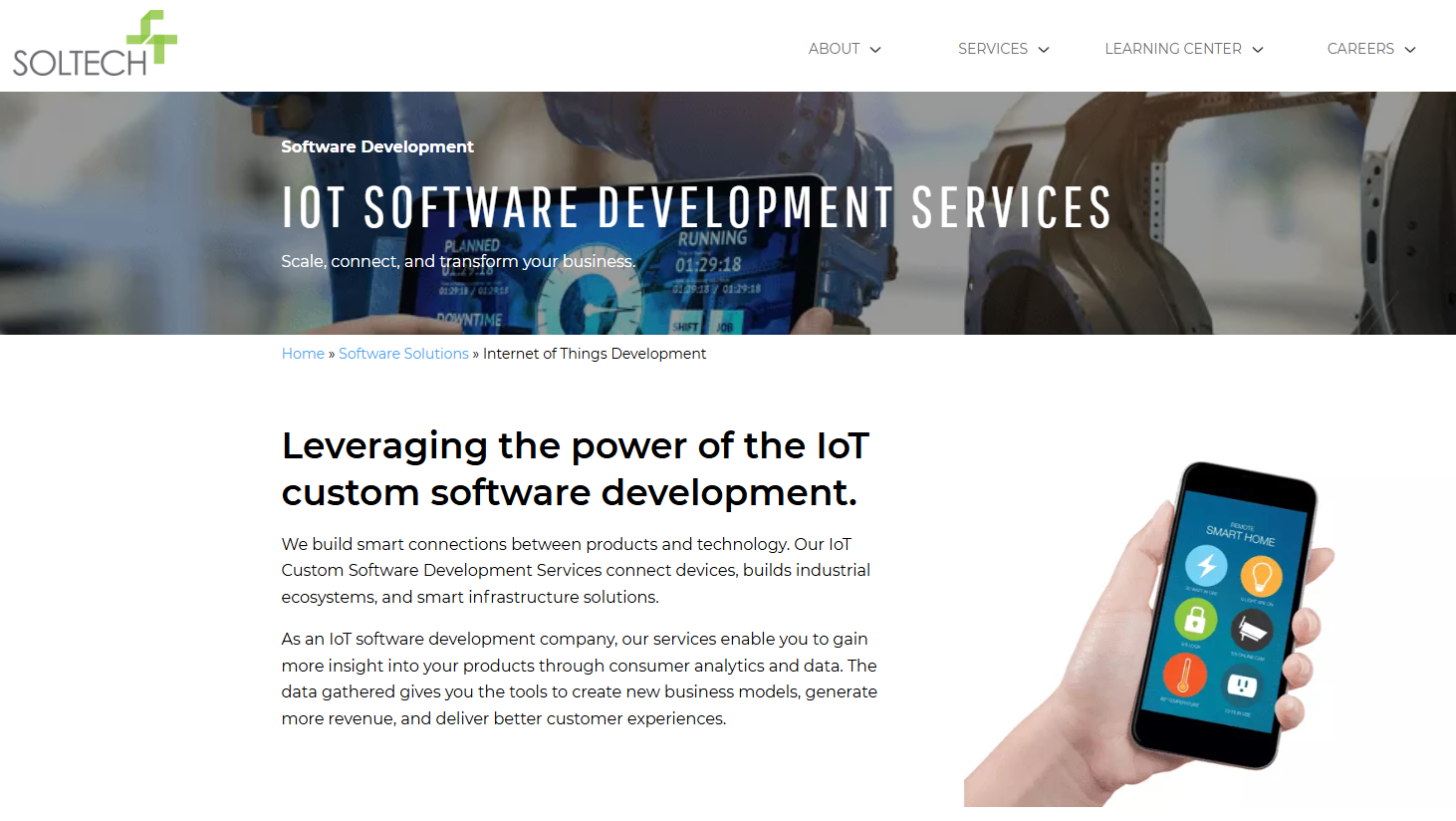
SOLTECH offers custom IoT software solutions focused on connecting devices and optimizing industrial ecosystems. Based in Atlanta, they support projects across wearables, remote monitoring, and energy management—often integrating data analytics and real-time alerts to improve performance.
5. Itransition
Itransition brings more than five years of focused IoT experience and a long-standing background in enterprise software development. They serve startups and global enterprises alike, offering IoT consulting, implementation, and analytics-driven solutions. Industries served include healthcare, manufacturing, automotive, and logistics.
Ready to build your IoT customized software? Learn more about our custom software development services.
Custom software development for IoT FAQs
Off-the-shelf IoT platforms like AWS IoT, Azure IoT Hub, and Google Cloud IoT, part of the wider landscape of IoT SaaS platforms, give you a general infrastructure for connecting and managing devices. They handle device authentication, data ingestion, and basic storage well. What they don't do is adapt to your specific operational workflows, integrate cleanly with your existing ERP or SCADA systems, or surface the exact alerts and dashboards your team needs. Custom IoT software is built around your data model, your user types, and your business logic. The tradeoff is upfront build time versus long-term fit. For businesses with straightforward device-to-cloud needs, a platform may be enough. For businesses with operationally complex environments, custom software pays for itself by eliminating the workarounds a platform would require.
The starting point is an audit of what your existing devices are generating: data format, transmission frequency, protocol, and what's currently being done with it. From there, the discovery process focuses on integration: how do you connect that existing device output to a custom software layer that adds visibility, automation, or decision support? You're not replacing the hardware. You're building the software that makes it useful. The most common early deliverable is a custom dashboard that normalizes data from multiple device types into a single operational view. From that foundation, you can layer in alerts, machine learning, ERP integration, or whatever the business case requires.
Cost and timeline are driven by three variables: the complexity of the device integrations, the number of user types and workflows the software needs to support, and the data architecture decisions made during discovery. A custom dashboard pulling from a single device type with a clean API layer is a different project from a platform ingesting data from 40 legacy machines across multiple protocols. Most mid-market IoT software projects run in the range of three to six months for an initial working version, with ongoing iteration from there. The discovery phase is where scope is defined, and where the difference between a realistic estimate and a costly surprise gets determined.
The highest-risk areas in IoT security are device authentication, data transmission encryption, and access control on the software side. Devices need to be authenticated before they can send data to your backend. Data in transit needs to be encrypted: TLS at minimum, with additional measures depending on industry compliance requirements. On the application side, role-based access control matters: a floor technician and a plant manager should not see the same data or have the same permissions. For industries with regulatory requirements, those compliance frameworks need to be built into the architecture during discovery, not added after development is underway.
Solve big problems with custom software optimized to your business. Learn more

Dayana Mayfield is a SaaS copywriter and content marketer specializing in SaaS marketing, positioning, and go-to-market strategy. She has consulted for over 195 SaaS companies, focusing on both traffic and conversions. She has been featured in Entrepreneur, Forbes, and Business Insider. Outside of work, Dayana writes SciFi novels and spends her evenings surviving auditions, rehearsals, and tech week as a proud theater mom.