
Industry benchmarks consistently place legacy system maintenance at 60-80% of total IT spend across enterprise portfolios.
That means for every dollar your IT organization spends, half goes toward keeping existing systems running instead of building anything new. When those systems are also blocking integrations and stalling your AI initiatives, the cost of staying isn't fixed. It's compounding daily.
IT organizations worldwide carry an estimated $1.52 trillion in accumulated technical debt, according to Wall Street Journal reporting.
I've worked with hundreds of organizations on modernization projects, and the pattern holds every time. Delaying modernization doesn't save money. It defers the cost and stacks debt on top of debt, then ends in a crisis-driven migration that costs more than the planned one would have.
The companies that come to us mid-crisis are almost always the ones that knew three years ago that modernization was coming. They just kept pushing it. By the time they call, they've already spent more on emergency patches and developer workarounds than the modernization would have cost. The delay is never free.
This guide covers what software modernization is, real examples that got it right, the five approaches that fit different situations, the nine steps to run a project, and how to recognize when your system has crossed from aging into urgent.
What is software modernization?
Software modernization is the process of re-architecting, rebuilding, or replacing legacy systems so your organization can move faster, reduce breakage, and deliver better user experiences. Modernizing an application gives your team the ability to build new features without fear, eliminate technical debt, strengthen security, and improve long-term maintainability.
Because frameworks, cloud infrastructure, and development best practices evolve quickly, even applications that are only 5–10 years old can become outdated and difficult to scale.
Modernization can take several forms depending on your goals, budget, and the condition of your legacy system. Common types of software modernization include:
Code refactoring: Refactoring legacy code means cleaning up and restructuring existing code without changing functionality.
Re-platforming: Moving the application to a modern platform or cloud environment.
Re-architecting: Changing the underlying architecture (for example, moving from a monolith to a modular architecture).
Rewriting or rebuilding: Creating a new application using modern frameworks and practices.
UX and interface modernization: Redesigning user flows and the visual experience.
Data architecture modernization: Updating how data is structured, stored, and shared across systems.
Integration modernization: Using APIs and modern tooling to connect systems that previously relied on fragile or manual processes.
Process modernization: Updating development processes (like CI/CD, DevOps practices, agile workflows) so the product can evolve more efficiently in the future.
Top reasons to undertake software modernization
Organizations pursue custom software modernization for several business-critical reasons. Modernization has more to do than just improving the codebase; it’s a strengthening of your company’s capacity to serve users, stay competitive, and operate efficiently.
Here are the top reasons to consider legacy application modernization today:
Fragile systems that break easily: Legacy applications often become brittle over time. A single change can trigger failures in unrelated parts of the application, slowing your team down and creating unnecessary firefighting.
Difficulty adding new features: Outdated software stacks make it hard—sometimes impossible—to add the functionality customers expect. This slows innovation and puts you behind competitors who can ship features more quickly.
Challenging or expensive maintenance: The cost of maintaining legacy systems is no joke. Older systems accumulate technical debt and require niche expertise, which increases long-term maintenance costs. As frameworks age out, finding developers who can work with them becomes even harder.
Development team frustration: Developers want to work with modern tools, not spend their days patching old infrastructure. Modernization improves developer morale and retention by giving teams a system they can actually build on.
Security and compliance risks : Legacy systems introduce vulnerabilities, lack modern security standards, and often fall short of industry compliance requirements. Modernizing reduces risk across the organization.
Scalability limitations: As usage grows, outdated systems can’t support higher traffic or more complex data flows. Modern architectures—especially modular and cloud-based ones—make scaling far more cost-effective.
Inability to integrate with modern tool: Today’s operations depend on integrations. And while you can potentially integrate legacy systems, you often can’t connect cleanly with modern CRM, ERP, analytics, or workflow tools.
Poor user experience (UX): Slow load times, dated interfaces, and confusing workflows frustrate users. Modernization creates a smoother, more intuitive experience that improves retention and customer satisfaction.
Blocking digital transformation initiatives: When your internal systems are outdated, every new digital initiative becomes more complicated and expensive. Modernization removes these blockers and opens the door to long-term transformation.
Revenue and growth constraints: Ultimately, outdated software limits your ability to grow. Whether you’re selling SaaS or relying on internal tools, modernization lays the groundwork for new features, new markets, and better customer value.
What most companies get wrong when modernizing their legacy systems
When you're modernizing a legacy system or application, you're not just modernizing the software. You're also modernizing the processes that got you to where you are currently.
If you forget about the second part (processes), then you run the risk of failing to keep up with innovation yet again.
To address your processes, make sure to choose one or more of these approaches:
Outsource development to a product dev firm with their own well-oiled processes (the firm should also offer you training and upskilling if and when they hand the product back to you)
Hire an agile development consultant to train your internal product team
Hire new talent with skills that match your updated framework and processes
How 7 companies actually modernized their software (and what worked)
There are many legacy system examples out there to help you recognize if you're falling into that category. For here though, we present these software product modernization examples to help inform and inspire your own project.
1. US Ski and Snowboard Team
In this example, the US Ski and Snowboard Team needed to modernize their legacy systems for storing internal data, on both Olympic athletes as well as sports club participants. The US Ski and Snowboard Team supports 450 sports clubs across the country and over 30,000 members.
Their membership application wasn't integrated with their core systems, and there were risks to the data as well.
They worked with DevSquad to connect their e-commerce, membership application, and other operational systems and to build a custom API.

The end result was a fully integrated operational system that saved hundreds of hours a month, while also providing the opportunity for revenue generation through e-commerce.
2. Shopify
Founded in 2006, Shopify owns 33% of the US ecommerce platform market (the biggest market share of all competitors).
Shopify was dealing with the fallout of 3 million lines of code and one of the biggest monolith applications in the world:
The application was extremely fragile with new code having unexpected repercussions. Making a seemingly innocuous change could trigger a cascade of unrelated test failures. For example, if the code that calculates our shipping rate called into the code that calculates tax rates, then making changes to how we calculate tax rates could affect the outcome of shipping rate calculations, but it might not be obvious why. This was a result of high coupling and a lack of boundaries, which also resulted in tests that were difficult to write, and very slow to run on CI.
You may have read that a common form of software modernization involves breaking down a large monolithic architecture into smaller microservices, but this just causes even further complexity as well as a slow, inefficient architecture. When modernizing their applications, Shopify decided to use a modular approach, rather than build microservices that break their application down too far. They only broke down the components into natural parts of the system for both development and testing.
 Source: Shopify
The end result was an architecture that allowed teams to add new features "as fast as ever" without the same amount of breaks as before.
3. QuickBooks
Founded in 1983, QuickBooks has remained the top accounting software in the US by continually modernizing their products. With nearly 40 years of history, the company provides countless examples of software modernization.
But here, we'd like to focus on their ability to own different segments of the overall accounting market, from large enterprises to solopreneurs. They've achieved this through their rapid adoption of cloud-computing, even launching their first cloud-based product as early as 2001.
The company has also excelled at re-building their accounting products for new customer demands and for new audiences. If you take a look at their website today, you'll see that there are 9 different products. The user must select the right one to login to, as they all are completely different.

While this might seem overwhelming at first glance, it actually prevents feature bloat and customer overwhelm. QuickBooks offers invoices, purchase orders, multiple accounts, and other advanced features in their QuickBooks Online product for enterprises and SMBs, while QuickBooks Self-Employed is really intended for small LLCs and DBAs needing to file just a schedule C.
Sometimes, modernization can look like modernizing one product (the enterprise solution) while creating a separate product from scratch (for solopreneurs). Of course, this is only advisable if your core product is so complex, that scaling to new niches and markets is impossible, given the target audience.
4. MMToolParts.com
MMToolParts.com is a long-running family business with more than 75 years serving the woodworking, construction, and power tool community. As the company expanded its online presence, its aging ecommerce system became a major blocker. With more than 500,000 products, thousands of diagrams, and significant organic traffic, their outdated platform was becoming increasingly fragile and difficult to manage — and the marketing team had little visibility into user behavior or conversion patterns.
The DevSquad team rebuilt the entire ecommerce experience from the ground up, migrating the full product catalog, customer data, and order history to a modern, scalable architecture. We also implemented a structure that could handle heavy traffic loads, plus new business intelligence tools to help the marketing team understand what visitors were doing on the site and which products were most likely to convert.

The result was a cleaner, faster, and far more effective ecommerce experience. With improved UX, optimized product pages, updated email flows, and better upsell opportunities, MMToolParts.com saw higher conversions than ever before.
5. WNBA App
As fan interest in the WNBA surged, the league realized its existing digital ecosystem wasn’t keeping pace. The website and mobile app offered only basic functionality and lacked the depth, personalization, and real-time engagement that modern sports fans expect. With demand rising and fan behavior shifting toward year-round digital interaction, the league set out to rebuild its mobile experience from the ground up.
The goal was to create a flexible, continuously evolving platform that could serve every fan—from newcomers following a favorite rookie to lifelong supporters tracking advanced stats. To do this, the WNBA developed a long-term digital strategy, conducted deep fan research, and redesigned the app architecture around personalization and discovery. The updated system delivers curated content streams, improved stats capabilities, tailored onboarding, and a more dynamic way to follow teams and players.
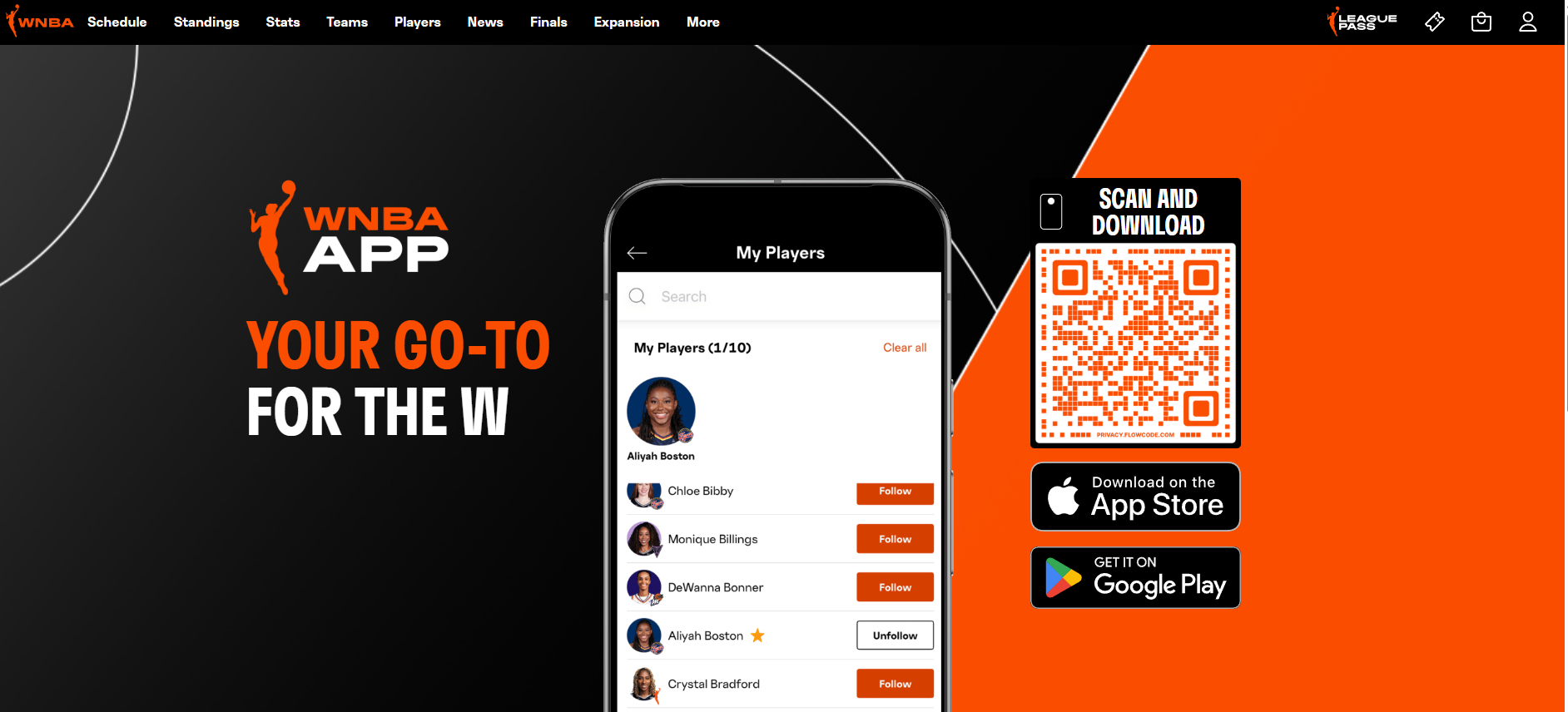
Since launching the new WNBA app in 2022, the WNBA has seen dramatic growth across all digital channels. Engagement climbed as new features rolled out based on real user data, and the league used analytics to guide content decisions and strengthen relationships with fans and sponsors.
6. Lufthansa Group
Lufthansa Group relied on multiple standalone mobile apps to manage ground operations, but this patchwork created inefficiencies, inconsistent workflows, and rising licensing costs. With flight delays carrying major financial and customer-experience consequences, the organization needed a unified system that could streamline communication and coordination.
They consolidated these tools into a single, web-based platform accessible across devices. The new solution centralizes communication, turnaround tracking, and task management in one interface, replacing outdated backend systems and reducing cost. Ground crews, pilots, and operations teams now work from the same real-time information, supported by clear data visualization, intelligent alerts, and role-specific workflows.
The cloud-native architecture improves scalability and performance, while a modular design allows the platform to expand quickly across additional airports and user groups. New features can be deployed with only minutes of downtime, a dramatic improvement over the legacy system.
By modernizing its ground operations ecosystem, Lufthansa Group increased efficiency, reduced delays, lowered licensing expenses, and improved staff coordination. The unified system also provides a stronger foundation for future enhancements, including new functionalities and potential AI-driven optimizations.
7. Jonas Fitness
Jonas Fitness had relied on a legacy mainframe for decades, powering membership management and payment processing for more than 3,000 fitness centers. As the system aged, it became harder to maintain, expensive to host, and increasingly difficult to staff due to shrinking COBOL expertise. The company needed a modernization approach that would preserve critical business logic while giving its team the freedom to adopt modern development practices.
They undertook a full refactor of their core applications, migrating business logic from COBOL to Java and moving from an on-premise mainframe to a cloud-based architecture. During the transition, legacy databases were converted to PostgreSQL, and outdated green-screen interfaces were rebuilt as modern web applications. The new environment introduced containerization, scalable infrastructure, and updated identity management—replacing rigid, monolithic systems with flexible, service-driven components.
The shift dramatically reduced technical debt, allowed the team to move faster, and cut operating costs by 90%. Jonas Fitness can now scale resources on demand, iterate at the application level, and build new capabilities without the constraints of the old environment.
With a modernized foundation in place, the company is now exploring AI, data lakes, and new customer-facing innovations that were impossible before the migration.
Signs your system is ready for software modernization
Not every aging system needs to be modernized immediately, but most leaders wait too long. The signs below are the ones DevSquad consistently finds when auditing client systems before a modernization engagement. Any one of them is a signal. Multiple is a case.
When your integrations keep breaking
The system can't connect cleanly to modern tools via standard APIs or middleware, so your team builds custom point-to-point integrations that require constant maintenance. Every time a connected SaaS tool updates its API, something breaks. The integration layer has become a fragile patchwork that consumes more developer time than the features it enables. When the integration problem is the system, not the integrations, modernization is the answer.
When security vulnerabilities are compounding faster than you can patch them
Legacy systems built before modern security standards often can't be retroactively hardened. They lack role-based access controls, audit logging, encryption-at-rest, and the architecture to support zero-trust security models. When a patch requires spinning up a months-long project and the vulnerability queue keeps growing, the system is signaling that it can't be secured without being rebuilt. For industries subject to HIPAA, SOC 2, or GDPR, a legacy system that can't produce audit trails is a liability that grows with every passing audit cycle.
When you can't hire or keep developers who can maintain it
This is one of the most underappreciated modernization signals. When a system runs on a framework fewer and fewer developers want to work with, or when institutional knowledge sits with one or two people approaching retirement, your ability to maintain and evolve the system erodes quietly.
The average age of a COBOL developer is now 62. When a system's maintenance depends on talent that's actively retiring and can't be replaced at market rate, the cost of staying isn't stable. It's accelerating.
When the system blocks new AI and automation initiatives
In 2026, this is the fastest-growing modernization trigger. You can't build AI-powered workflows, automated reporting, or intelligent process automation on top of systems that don't expose APIs, don't have clean data architecture, and can't connect to modern data platforms. Companies with fragmented or legacy systems are 30% more likely to experience AI implementation delays.
Not every modernization project looks the same. The right approach depends on how far the current system has drifted from operational requirements, how much technical risk exists in the codebase, and what the business needs to be able to do in 24 months. These are the five approaches DevSquad recommends most often, along with the signals that point to each one.
When refactoring is the right call: cleaning up what's there
The architecture is sound, the business logic is correct, and the system does what it's supposed to do. But the code is messy, poorly documented, and frightening to touch. Refactoring improves the code without changing functionality. It reduces technical debt, makes the codebase legible to new developers, and restores your team's ability to ship features without fear. The signal: your developers are slowing down, not because the system is wrong, but because the code is chaotic.
What DevSquad finds: Refactoring projects almost always surface more than the client expected. The code cleanup reveals architectural decisions that made sense in 2012 but actively block what the business needs in 2026. We scope refactoring conservatively and expand only when discovery confirms there's structural work hiding beneath the surface debt.
Learn more in our guide to refactoring legacy code.
When replatforming makes sense: moving without rebuilding
The existing business logic works, but the platform it runs on is obsolete, unsupported, or too expensive to maintain. Moving the application to a modern cloud environment preserves what works while eliminating the operational burden of aging infrastructure. The signal: high infrastructure costs, limited vendor support, or an inability to deploy to cloud environments the rest of your organization has already moved to.
What DevSquad finds: Replatforming is often underestimated in complexity. Businesses assume it's a lift-and-shift exercise. In practice, the existing platform has workarounds baked into the architecture that don't exist on the destination platform. We surface those in discovery before committing to a timeline.
"Focusing on understanding the client's business processes before proposing a technical solution is what makes modernization work. The technical approach should follow from understanding what the business actually needs to do, not from what's easiest to migrate." — Thainê Ethur, Product Designer, DevSquad
When re-architecting is necessary: changing the structure itself
The application logic is correct, but the underlying architecture makes it brittle, slow, and nearly impossible to extend. Re-architecting means moving from a monolith to a modular structure, or from a rigid relational database to one that can support the integrations your business needs. The signal: adding any new feature requires touching code across the entire application, deployment is risky and infrequent, and developers avoid certain parts of the codebase.
What DevSquad finds: Re-architecting projects require the most thorough discovery of any modernization engagement. The Shopify example earlier in this guide, breaking a monolith into natural modules, is the right model. The wrong model is breaking it into too many microservices. We help clients find the modular structure that matches their actual development team's size and velocity, not the complexity their architecture could theoretically support.
When rebuilding is the answer: starting from the validated foundation
The existing system is too expensive to maintain, too brittle to extend, and too outdated to meet current security requirements. A full rebuild uses current frameworks and modern architecture to recreate the system's functionality on a foundation that can evolve. The signal: maintenance costs exceed 30-40% of annual IT budget for a single system, your developer team dreads every change, and the system is a single point of failure for critical business operations.
What DevSquad finds: Rebuilds that succeed start with a validated discovery phase that preserves the business logic from the old system, not the code. The rules, workflows, and edge cases learned over 10 years of operations are the most valuable thing the old system contains. The code is not.
The question we ask before every rebuild engagement is: what does this system know about the business that isn't written down anywhere? That institutional knowledge, baked into the code through years of edge case handling, is the thing we have to capture before we touch anything else.
When business alignment determines the approach: SaaS vs. custom
Sometimes the modernization answer isn't to rebuild but to replace with an existing SaaS tool and customize around it. This is the right call when your existing system handles standard workflows that a mature SaaS product already supports. The wrong call is rebuilding something that already exists and works well in a SaaS product.
What DevSquad finds: The best modernization discovery sessions are the ones where the answer turns out to be that you don't need a custom rebuild. You need a better-configured SaaS tool and a custom integration layer. That outcome saves the client two years and half the budget. We're only interested in recommending custom development when it's genuinely the right answer.
How to run a software modernization project: 9 steps
To modernize your software, follow these key steps. We've honed our process of modernizing software for small SaaS businesses and large government agencies.

1. Architecture Audit
Always start with an architecture audit. The Shopify example mentioned above is an excellent example of this because they assessed how features impact each other in order to break their monolithic structure down into a few core modules (with no need for microservices).
Atlassian provides a useful software architecture review template.

You should also use Figma or Lucidchart to draw out the current structure and label problem areas or connections.
2. Code Audit
The next step is to audit the code. Code audits are performed regularly to find glitches that unit and acceptance tests may have missed, review security vulnerabilities, and assess performance. In this instance, a code audit is very similar to this regular process, except that you'll need to review all of the most important code (rather than just new code for a current sprint).
You should review the code that's making up the most important features. This will help you discover any issues that are causing the software to appear and behind in an unmodern way. You'll also find code that can be refactored.
3. UX Audit
Next, conduct a UX audit that will help identify the problem areas and outdated elements of your user interface design. Make sure to determine your criteria for a quality experience (both quantitative and qualitative), and then collect both types of data, review it, and format your findings.
For example, you might uncover quantitative data on freemium-to-paid conversions, feature usage, NPS ratings, and average weekly or monthly usage. And for qualitative data, you can describe anecdotes from customers in terms of challenges, frustrations, and feedback. You should also be sure to include your own opinions and recommendations about the design.

During this stage, you can also conduct a UX and feature audit of your competitors' products.
4. Product Strategy
Now that you've reviewed the current application's architecture, code, and UX, it's time to determine the product strategy.
Here are some questions your documented strategy should be able to answer:
What features are essential for creating positive user outcomes?
What features are contributing to bloat and overwhelm?
Which elements of the product no longer appeal to our target audience?
Where is our product lacking, in terms of user outcomes and audience appeal?
Which of our competitors are the most direct?
Which competitors do we not want to compete with and why?
What are the core differentiators that will set our product apart from our direct competitors?
You can document your product strategy using a template like this one from Amplitude.

Share it with all stakeholders and get buy-in before moving on.
5. UX Design
Before you move on with modernizing the application's infrastructure and code, you need to plan the UX design. Create a high fidelity prototype that you can use to get feedback from both stakeholders and users. Be sure to work with an expert in modern UX design so that your new product truly connects with users and is easy to learn. Without amazing UX, users can't achieve their desired outcomes.
6. Refactoring
The next step in the software modernization process is to refactor the code. Refactoring is the systematic process of improving code through editing and cleaning up previously written code.
You might also need to write new code for any new features that are being added to the product. However, you might wait to add new features until the original software is modernized (see Step 9).
7. Performance Testing
Now it's time to test the performance. This is a critical step during software modernization, because many projects have performance as their number one goal.
During this phase, you'll test:
The speed of the system and how to responds to queries
The scalability of the system (speed during high load times)
How stable the system is during heavy concurrent user loads
The reliability of the system during prolonged periods of high loads
You should discover the root causes of any performance issues and identify bottlenecks within the system.
8. Quality Assurance
The next stage is to run comprehensive quality assurance of your new application or system. You should both scripted testing (test plans, steps, and criteria) as well as exploratory testing (using a software more naturally) in order to find the most amount of bugs.
During this stage, you might also write some automated tests of critical functions in order to run automated testing during future sprints.
9. Ongoing Roadmap Planning
The final step is a continuous, never-ending process: roadmap planning.
Add new features and updates to your roadmap to continuously prioritize important releases and track new ideas.
This roadmap example from Frill is public to users so they can comment on upcoming features and add their own ideas. This helps product managers more accurately identify requirements and success criteria based on real user needs.

Hiring options when modernizing legacy software
The above steps are critical when modernizing software, but who will do the work?
Below, we assess different options for hiring and outsourcing the work.
Re-build it in house
Many large enterprises with modern development teams choose to handle software modernization in-house. But government agencies, enterprises with outdated skillsets, and small businesses will struggle to do this in-house and may waste precious time and resources and put their organization further at risk.
Right for you if: You have all or almost all of the resources needed in-house, your team is well-versed in modern development processes, and your have the needed experience to be successful.
Wrong for you if: Your team is lacking in several key roles or competencies, or you doubt your team's ability to see the project through without the help of an outside eye.
Work with a product development firm
Assuming you choose an experienced, high-quality firm, this option can be a great way to mitigate risks. You'll be working with a company that has done software modernization for dozens or even hundreds of products before.
Right for you if: You want to future-proof your product and achieve modernization success without risks to your product, customers, or budget.
Wrong for you if: You have all of the expertise needed in-house and your team has enough time to take on the project themselves.
Hire and manage freelancers
This is one of the most risky options because so few company leaders have the time and expertise to really pull together a successful modernization project.
Right for you if: You're an expert in product management, you know how to get all collaborators working seamlessly together (PM, developers, UX design, DevOps, QA, etc.), and you have the time to manage everyone's individual contributions.
Wrong for you if: You either don't have experience managing products, don't have the time, or would rather manage potential risks by outsourcing development to a fully managed product development firm.
Purchase a new SaaS solution
Sometimes, you're able to purchase a SaaS solution rather than build something from scratch. However, development work might still be required to implement and integrate the new solution.
“By leveraging modern technologies, agencies can quickly deploy secure, customer-centric applications in weeks, instead of months or years. But to achieve this, they’ll need to prioritize IT modernization efforts that focus on their platform, integration and security. When evaluating IT platforms, it is vital for government leaders to understand the holistic platform, its capabilities and how it will meet an agency’s needs."
Paul Tatum, Executive Vice President of Solution Engineering at Salesforce
Right for you if: Your needs can be easily satisfied with the right available technology, and the solution passes your requirements for stability, security, integration, etc.
Wrong for you if: You're building a product for external (customer) use, or your internal needs don't match any available solutions.
Software modernization is a complex process, but with your eye on your users and the right talent on your side, you can modernize your product faster than you think.
Software modernization FAQs
Costs vary widely based on scope and approach. A refactor of an existing system typically costs less than a full rebuild, since you're improving what's there instead of recreating it. A full rebuild that recreates an entire legacy system can run from the low hundreds of thousands into the millions, depending on complexity, integrations, and team size. The clearest way to scope cost accurately is a discovery phase that audits your current architecture before committing to a budget.
Timelines depend heavily on which approach fits your system. Refactoring a contained part of an application might take a few months. A full rebuild or re-architecture of a complex system can take 6 to 18 months, sometimes longer for enterprise or government systems with multiple integrations. Discovery and architecture audits at the start of the project give you a realistic timeline instead of a guess.
Software modernization changes how a system works: its architecture, code quality, or platform, to solve problems like fragility, security gaps, or scalability limits. Software migration moves a system or its data from one environment to another, such as on-premise to cloud, without necessarily changing the underlying code or architecture. Migration is often one piece of a larger modernization effort, but the two aren't interchangeable.
Start with the cost of staying. Calculate what your current system actually costs across maintenance, security patching, lost developer hours, and missed feature opportunities. Compare that to the cost and timeline of the recommended approach. Leaders approve modernization projects when the case is framed around business consequences, not technical debt in the abstract. Pair the cost comparison with a clear list of what the current system is blocking, whether that's an integration, an AI initiative, or a compliance requirement.
Ready to modernize your product? Learn more about DevSquad’s software modernization services.

Phil Alves is the CEO and Founder of DevSquad and DevStats. He’s built and launched 100+ software products for bootstrapped founders, fast-growing startups, and enterprises. Phil writes about SaaS, product strategy, operational complexity, and building scalable development processes. He enjoys aviation, investing, and learning from other SaaS founders.