
Supply chains are constantly under pressure. Demand shifts faster, disruptions hit harder, and generic software rarely fits the way real operations work. When teams rely on tools that do not match their workflows, they end up with manual fixes, siloed data, and slow decision-making.
Custom supply chain software flips that script. It gives you technology built around your exact sourcing, production, logistics, and distribution needs. With the right system, you gain visibility, automation, and control across every stage.
In this guide, we break down what custom SCM software is, why companies build their own, the most impactful use cases, and the frameworks best suited for development. You will also find the core features supply chains depend on and a shortlist of agencies that specialize in building high-performing SCM solutions.
What is custom supply chain software?
Custom supply chain software is purpose-built technology that supports the full lifecycle of moving goods, managing suppliers, tracking inventory, coordinating logistics, and optimizing distribution. The objective here is to create a software solution that aligns directly with the way your teams plan, forecast, fulfill, transport, and deliver, instead of forcing your operations into generic workflows.
Supply chain operations are complex systems and almost never one-size-fits-all. Every organization has its own network of suppliers, regulatory considerations, locations, internal systems, and customer expectations. Off-the-shelf tools might cover one part of your workflow but fall short in another. The result is manual work, disconnected data, stalled growth, or the increased cost of multiple subscription fees.
Custom SCM software eliminates those issues by aligning directly with how your operations function today while giving you the flexibility to evolve. It supports:
Tailored workflows instead of predefined templates
Precise data modeling that reflects your actual supply chain
Integrations with internal systems, partner platforms, and logistics networks
Interfaces and dashboards built for your users and decision-makers
No-code vs AI assisted development
No-code tools are becoming popular because they promise fast setup and lower cost, but they struggle in environments where integrations, data accuracy, and operational reliability matter. Supply chain operations depend on precision and high performance, and no-code platforms often fall short once you need custom logic, advanced data structures, or strong scalability.
AI assisted development fills that gap. Instead of replacing engineering expertise, AI accelerates development while keeping the integrity of custom code intact. This creates a faster path to highly tailored SCM software without sacrificing quality.
For supply chain logistics, inventory and supply chain visibility, and distribution management, AI assisted development offers both speed and customization. It gives you control over your architecture while making the build process more efficient.
With AI assisted development, teams can:
Speed up repetitive coding tasks
Focus engineering effort on complex supply chain logic
Produce more consistent and maintainable code
Adapt the software as your supply chain evolves
Avoid the scalability and performance limitations of no-code platforms
Top reasons to consider developing your own SCM software
While replacing or modernizing outdated legacy tools is important, building your own supply chain management system is about so much more. It is about gaining precise control over how your supply chain operates. Custom solutions help organizations precisely mange:
Complex supplier networks
Multi-location inventory
Specialized logistics requirements
Custom supply chain software also empowers teams to create workflows, dashboards, automations, and integrations that match how the business actually runs. This alignment reduces friction, removes manual work, and provides deeper visibility across the supply chain.
This level of alignment helps companies:
Unify inventory and supply chain data across systems
Support regional or global distribution models
Improve demand forecasting with more accurate inputs
Automate complex workflows that cannot be standardized in generic tools
Strengthen supply chain tracking for real-time visibility
Reduce risk from delays, shortages, or quality issues
Optimize supply chain performance based on actual operational behavior
Long-term advantages of custom supply chain software
Modern supply chains are more dynamic, more global, and more interdependent than ever. That means the technology that powers them must be adaptable and capable of evolving. Custom software allows organizations to move faster, integrate smarter, and build tools that support the exact way they operate today and in the future.
This creates long-term advantages such as:
Full ownership of your processes and data: You define how the system works, how data flows, and how reporting is structured. There is no vendor lock-in, no expensive customization layers, and no risk of losing capabilities if a platform discontinues a feature.
Competitive differentiation through technology: When your operational workflows match your exact business model, you can serve customers faster, respond to disruptions sooner, and unlock efficiencies your competitors cannot match.
Integration flexibility: Supply chains rely on a long list of systems, from ERP and WMS to transportation partners, supplier networks, and internal planning tools. Custom SCM software integrates cleanly with all of them.
A scalable foundation: As product lines grow, regions expand, or new partners join your network, your system evolves with you instead of forcing you to change processes that work.
Reduced overhead from subscription costs: With AI development, businesses can build custom software for less than they pay for subscriptions.
47 use cases for custom supply chain software
Supply chains touch nearly every corner of a business, which means the potential use cases for custom supply chain software are as broad as the supply chain process itself.
Below are the key categories—and potential use cases—where custom-built technology creates measurable improvements across the supply chain.
Supply chain visibility and planning
Visibility is the backbone of any high-functioning supply chain. When organizations can see inventory status, supplier capacity, and demand signals in real time, they can plan with greater accuracy.
Use cases for visibility and planning include:
Real-time inventory visibility across warehouses, stores, and distribution centers
Multi-location inventory balancing and replenishment
Demand forecasting and predictive planning
Sales and operations planning (S&OP) automation
Supplier forecasting and capacity planning
Scenario planning and resilience modeling
Procurement and supplier management
Procurement teams rely on clear communication, compliant processes, and reliable supplier performance. Custom SCM tools strengthen these relationships by streamlining purchasing workflows, improving oversight, and consolidating supplier data into a single source of truth.
Use cases for procurement and supplier management include:
Supplier relationship management systems
Automated purchase order creation and tracking
Supplier compliance and quality monitoring
Vendor performance scorecards and analytics
Contract lifecycle management for supply chain partners
Warehouse and fulfillment operations
Warehouse operations must be fast, precise, and fully synchronized with both upstream and downstream systems.
Use cases for warehouse and fulfillment include:
Custom warehouse management systems (WMS)
Slotting optimization and automated picking logic
Labor management and warehouse task orchestration
Returns processing and reverse logistics workflows
Yard management and dock scheduling
Manufacturing and production workflows
Manufacturers need software that reflects their exact production environment. Custom supply chain applications support detailed scheduling, resource allocation, material planning, and quality tracking so production teams can execute efficiently and respond quickly to disruptions.
Use cases for manufacturing and production include:
Production scheduling and capacity planning
Bill of materials (BOM) and recipe management
Shop floor execution and work order tracking
Quality control workflows and defect tracking
Material requirements planning (MRP) systems
Transportation, logistics, and distribution
The movement of goods requires real-time decision-making, cost control, and coordination with carriers. Custom logistics and distribution software gives teams the tools to automate routing, track shipments, and manage exceptions before they impact customers or operations.
Use cases for manufacturing and production include:
Transportation management systems (TMS)
Fleet routing and optimization
Carrier selection and rate management
Shipment tracking and exception alerts
Last-mile delivery coordination
Freight audit and settlement
Traceability, compliance, and risk management
Industries with strict regulatory or quality requirements depend on accurate, end-to-end traceability.
Use cases for traceability, compliance, and risk management include:
End-to-end product traceability for regulated industries
Chain-of-custody tracking with serialization
Compliance reporting for domestic or global standards
Risk monitoring for supply disruptions, recalls, or shortages
ESG and sustainability data tracking
Omnichannel and customer-facing operations
Customers expect fast, accurate fulfillment regardless of where they place an order. Custom order management and fulfillment systems support the flexible, distributed workflows required for omnichannel operations and help organizations deliver better post-purchase experiences.
Use cases for omnichannel and customer-facing operations include:
Order management systems (OMS) tailored to fulfillment logic
Drop-shipping coordination with third-party sellers
Backorder management and customer notifications
Real-time order tracking for customers
Custom B2B ordering portals for wholesale or distribution partners
Data integration, automation, and analytics
Supply chains run smoother when systems stay connected. Custom integration layers and analytics platforms allow organizations to unify data, eliminate manual tasks, and equip stakeholders with dashboards that support clear and confident decision-making.
Use cases for data integration, automation, and analytics include:
Integration hubs connecting ERP, WMS, TMS, and partner systems
Automated workflows that replace manual processes
Supply chain dashboards for operations, finance, and leadership
Predictive analytics for costs, lead times, and inventory performance
Custom reporting for internal stakeholders or customers
AI-driven and next-generation capabilities
Today’s supply chains generate massive data streams. AI-enabled supply chain tools transform that data into predictions, insights, and automated actions that keep operations efficient and resilient.
Use cases for AI-driven and next-generation capabilities include:
AI-driven demand and supply planning models
Intelligent anomaly detection for supply chain disruptions
Automated decisioning for replenishment or routing
Computer vision for warehouse or quality inspections
Digital twins for supply chain simulation
The discovery process for developing useful supply chain software
Every successful supply chain software project begins with a structured discovery phase. This is where risks are reduced, assumptions are validated, and the foundation for long-term efficiency is established.
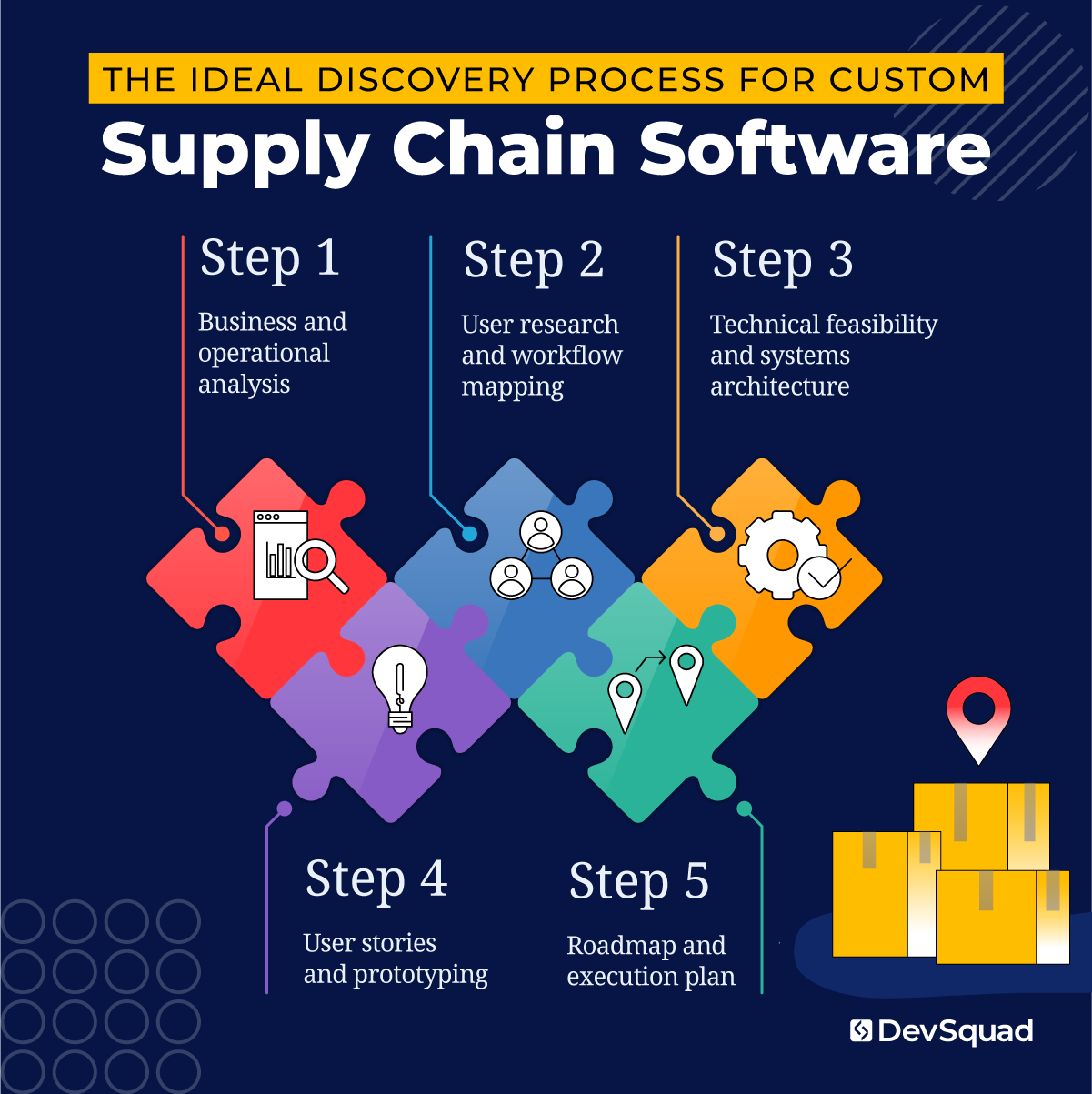
Below are the core steps in a discovery process tailored for custom supply chain software development:
Step 1. Business and operational analysis
Discovery begins with a clear understanding of how your supply chain works today and what outcomes you need tomorrow. This step maps the real-world processes behind procurement, production, inventory management, warehousing, logistics, and distribution.
During this phase, teams:
Identify core business goals driving the project
Document current supply chain workflows and pain points
Map constraints such as lead times, regulatory requirements, or internal dependencies
Review existing systems, integrations, and data structures
Understand the roles and responsibilities involved in daily operations
This analysis provides direction and makes sure the software reflects your actual supply chain, not an idealized version of it.
Step 2. User research and workflow mapping
Supply chain operations span a wide group of users, from planners and procurement teams to warehouse staff, transportation coordinators, and customer service reps. User research ensures the software supports their day-to-day responsibilities and reduces unnecessary work.
Teams typically conduct:
Workflow mapping to understand physical and digital processes
Journey mapping to reveal where delays, bottlenecks, or data gaps occur
Competitive or internal system reviews to identify usability opportunities
This step clarifies what “value” looks like for each group involved in the supply chain and helps avoid building features that do not support real operational needs.
Step 3. Technical feasibility and systems architecture
Supply chains rely on a large mix of systems such as ERP, WMS, TMS, EDI networks, and planning tools. Discovery must uncover how these systems interact and determine what architecture will support reliable, scalable integrations.
Technical teams evaluate:
Data sources, data quality, and data ownership
Integration requirements with internal systems and third-party partners
Automation opportunities that reduce manual workload
Performance, security, and compliance expectations
Infrastructure or cloud environments to support resilience and growth
The result is a detailed architecture that supports real-time data flow, operational visibility, and the specific business process automations your supply chain requires.
Step 4. User stories and prototyping
Once the technical foundation and user needs are clear, the discovery team translates insights into user stories that describe what each part of the software must accomplish. These user stories then guide the creation of an interactive prototype.
The prototype illustrates how workflows will function across:
Inventory and supply chain planning
Procurement and supplier management
Warehouse operations
Transportation and distribution
Reporting and analytics
Users interact with the prototype to validate assumptions and identify improvements before development begins. This avoids costly rework and aligns all stakeholders around the same vision.
Step 5. Roadmap and execution plan
Discovery concludes with a roadmap that outlines what will be built now, next, and later. Supply chain transformation often happens in stages, so prioritization is essential. The roadmap gives teams a clear sequence for development sprints, integration work, and user testing.
A strong supply chain technology roadmap typically includes:
Defined milestones and sprint cycles
A breakdown of features to build in early releases
Technical requirements for integrations and automations
Plans for scaling functionality across locations or business units
A long-term view of future improvements
This structured plan creates alignment, reduces risk, and supports a smoother development journey from concept to launch.
Common features of supply chain software
Common features of supply chain platforms are as vast as their use cases. Here’s a compressed list grouped by functionality:
Planning and forecasting
Planning tools provide the visibility and structure required to match supply with demand. Features typically include:
Demand forecasting
Inventory planning
Capacity planning
Sales and operations planning (S&OP)
Safety stock optimization
Seasonal and trend-based forecasting
Replenishment modeling
Procurement and supplier management
Procurement teams rely on structured processes and clear communication to support supplier relationships. Common procurement features are:
Purchase order creation and tracking
Supplier onboarding modules
Supplier scorecards
Contract management
RFQ and bidding workflows
Supplier compliance tools
Invoice matching and reconciliation
Inventory management
Accurate, real-time inventory data is one of the most essential components of supply chain performance. Features to achieve that include:
Real-time inventory visibility
Multi-location inventory tracking
Lot and batch tracking
Serialization
Inventory valuation tools
Cycle counting
Automatic replenishment triggers
Stock transfers and adjustments
Warehouse and fulfillment
Warehouse operations depend on speed, clarity, and precision. Key warehouse capabilities:
Warehouse management system (WMS)
Slotting and storage optimization
Pick, pack, and ship workflows
Barcode scanning and RFID support
Wave and batch picking
Labor management
Putaway and receiving workflows
Cross-docking
Yard management
Dock scheduling
Manufacturing and production
Manufacturers require software that mirrors their production processes and integrates tightly with supply chain data. Features that support this are:
Production scheduling
Work order management
Bill of materials (BOM) management
Material requirements planning (MRP)
Shop floor execution
Quality control checkpoints
Production line performance monitoring
Transportation and logistics
Logistics teams need real-time insight into shipment status, carrier performance, and cost. Typical logistics features include:
Route optimization
Carrier selection and rate comparison
Shipment tracking
Freight audit and settlement
Last-mile delivery management
Load planning
Customs and import or export documentation
Order and customer management
Order visibility and fulfillment accuracy shape customer satisfaction. Key order management features include:
Order management system (OMS)
Backorder handling
Order allocation rules
Customer-specific pricing or fulfillment logic
Customer notifications and tracking portals
Returned merchandise authorization (RMA)
Traceability, compliance, and risk
Industries with regulated supply chains require detailed visibility into product movement, quality standards, and documentation. These features often include:
End-to-end traceability
Chain-of-custody tracking
Recall management
Compliance reporting
Environmental and sustainability tracking
Supplier risk scoring
Disruption alerts
Automation and workflows
Automated workflows reduce manual effort, eliminate errors, and keep operations moving by triggering the right actions at the right time. Automation features include:
Rule-based decision automation
Exception management
Notifications and escalations
Workflow builders for custom processes
Approval routing
Integrations and connectivity
Supply chains rely on a wide range of systems. Integration capabilities often incorporate:
ERP integrations
WMS, TMS, and MES integrations
EDI connectivity
API management
Supplier and carrier data exchange
Marketplace or retail partner integrations
Analytics and reporting
Supply chain leaders depend on actionable data to drive improvements. Common analytics features include:
Operational dashboards
Predictive analytics
Real-time KPIs for logistics, warehousing, and procurement
Cost analysis and margin reporting
Lead time and on-time delivery metrics
Custom report builder
AI-driven and advanced features
Advanced technologies help organizations anticipate issues, automate complex decisions, and optimize their supply chains in ways that manual processes cannot. Advanced features currently include:
AI-powered planning
Demand sensing
Intelligent exception detection
Digital twin modeling
Computer vision for quality or warehouse monitoring
Autonomous mobile robot (AMR) coordination
AI-driven routing and scheduling
Best frameworks for developing custom SCM software
Choosing the right frameworks helps your engineering team build reliable, scalable, and adaptable supply chain systems. Below are the frameworks most often used for custom SCM software, starting with the one we recommend most.
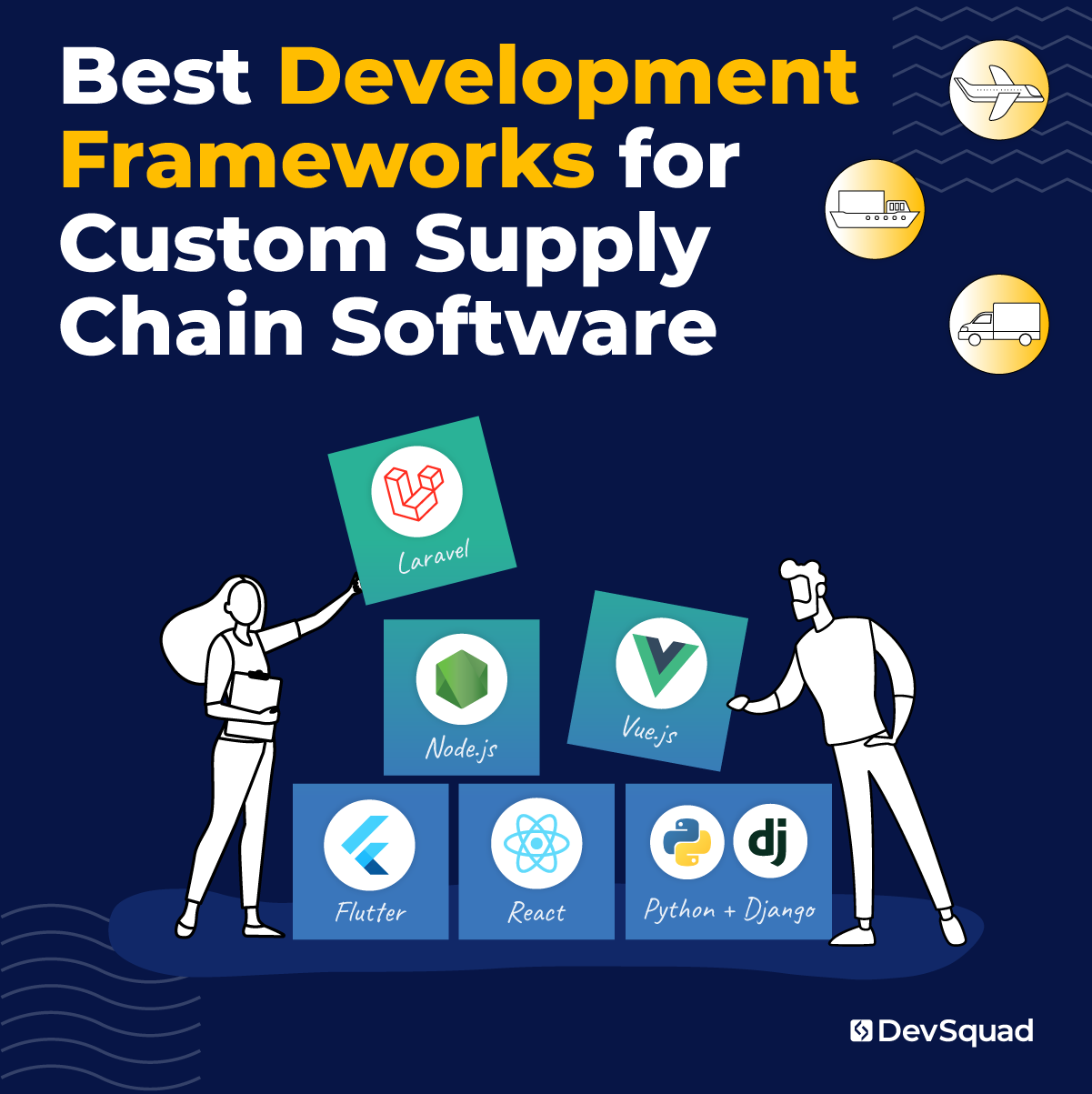
1. Laravel
Laravel is a modern PHP framework known for its clean architecture and developer-friendly ecosystem. It supports complex workflow logic, stable API development, and integrations with ERPs, WMS, TMS, and other supply chain systems. Its structure also helps teams build quickly without sacrificing quality.
Key strengths:
Clean, maintainable code structure
Fast development for complex business logic
Strong API capabilities for system integrations
Scalable for long-term operational growth
2. Node.js
Node.js is ideal for real-time supply chain workflows such as shipment updates, routing events, or any process that relies on stream-based communication. It excels in high-volume environments where speed and responsiveness matter.
Key strengths:
Event-driven architecture for real-time data
High performance under heavy transaction loads
Efficient for microservices and lightweight integrations
Strong ecosystem for logistics and tracking capabilities
3. Python + Django
Python is widely used in forecasting, optimization, simulation, and AI-driven planning. Django provides structure and security for backend development while supporting data-heavy supply chain workloads.
Key strengths:
Excellent for analytics, forecasting, and AI models
Mature libraries for optimization and machine learning
Clear architecture for predictable development cycles
Strong fit for digital twins and predictive planning tools
4. Vue.js
Vue.js is a flexible, approachable frontend framework well suited for supply chain interfaces. Dashboards, workflows, inventory screens, and operational tools benefit from Vue’s lightweight structure and fast rendering.
Key strengths:
Straightforward and fast to develop with
Smooth performance for data-heavy UI components
Easy to scale as features grow
Ideal for operational dashboards and workflow screens
5. React
React is a strong choice for sophisticated user interfaces that need high interactivity or real-time updating. Many enterprise applications use React because of its large ecosystem and proven reliability.
Key strengths:
Excellent performance for complex UI
Strong community and library support
Ideal for visibility, tracking, and analytics modules
Works well alongside microservices architectures
6. Flutter
Supply chain operations often require mobile apps for warehouse teams, drivers, and field staff. Flutter allows fast delivery of cross-platform mobile tools without maintaining separate codebases.
Key strengths:
Cost-effective cross-platform development
Support for barcode scanning, proof of delivery, and inventory tasks
Fast iteration cycles
Strong performance on both iOS and Android
Top agencies with custom supply chain software development services
Check out these top agencies offering custom SCM development, starting with DevSquad.
1. DevSquad
DevSquad builds custom supply chain software through a consulting-first approach that focuses on understanding operational challenges before writing code. Each engagement begins with structured discovery to map workflows, integrations, and data requirements. Development teams include strategists, designers, developers, QA engineers, and DevOps professionals who specialize in scalable architectures and AI-assisted development. The result is reliable, purpose-built SCM systems that support your immediate needs and long-term growth.
Key strengths:
Deep discovery process that clarifies operational and technical requirements
High-performing squads that move from prototype to production efficiently
Modern tech stacks with Laravel, Vue.js, and AI-assisted workflows
Flexible, fully managed development with no long-term contracts
2. Radixweb
Radixweb is a global development firm offering product engineering, custom software, modernization services, and AI and cloud solutions. With teams across the USA, India, and other regions, they work with clients in industries such as healthcare, fintech, HRtech, and manufacturing..
Key focus areas:
Product engineering and SaaS development
Enterprise applications and modernization
AI, data, and cloud-driven solutions
3. ScienceSoft
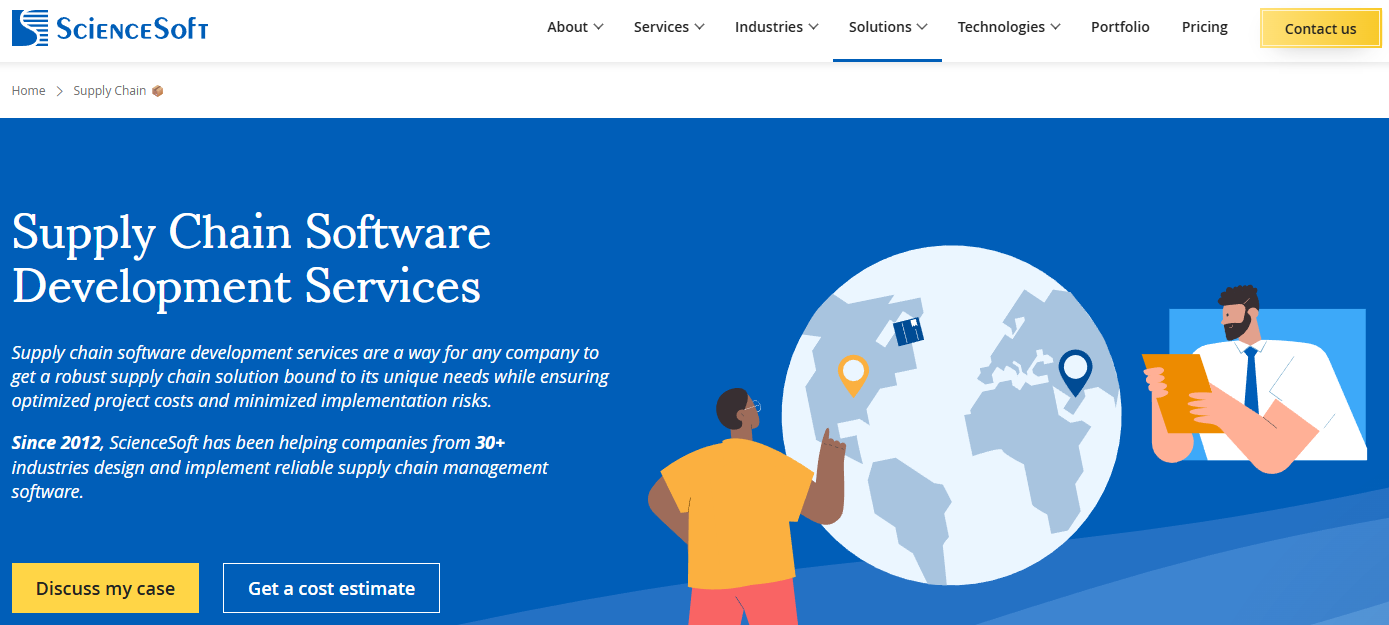
ScienceSoft is a long-established IT services firm that offers supply chain software development alongside a wide range of enterprise solutions. They work with companies across multiple industries and support projects that involve planning, inventory, logistics, procurement, analytics, and emerging technologies like AI, IoT, and blockchain.
Key focus areas:
Broad SCM capabilities across planning, logistics, and analytics
Enterprise integrations with ERP, WMS, TMS, and hardware systems
Large global delivery team supporting long-term transformation projects
4. Chetu
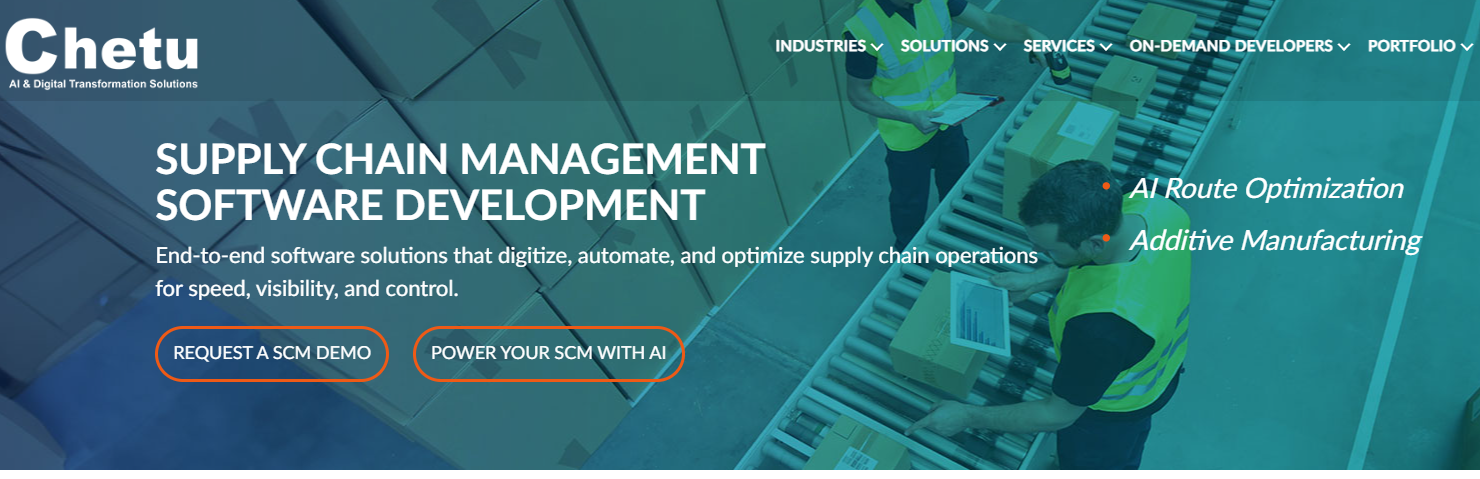
Chetu is a large development provider offering custom software across many industries, including supply chain, logistics, and manufacturing. Their SCM services span inventory management, warehouse workflows, logistics tracking, EDI integrations, and AI-enabled capabilities.
Key focus areas:
Broad SCM capabilities including WMS, TMS, MRP, and EDI
AI-driven features for forecasting, routing, and warehouse operations
Large developer base with global delivery
5. DBB Software
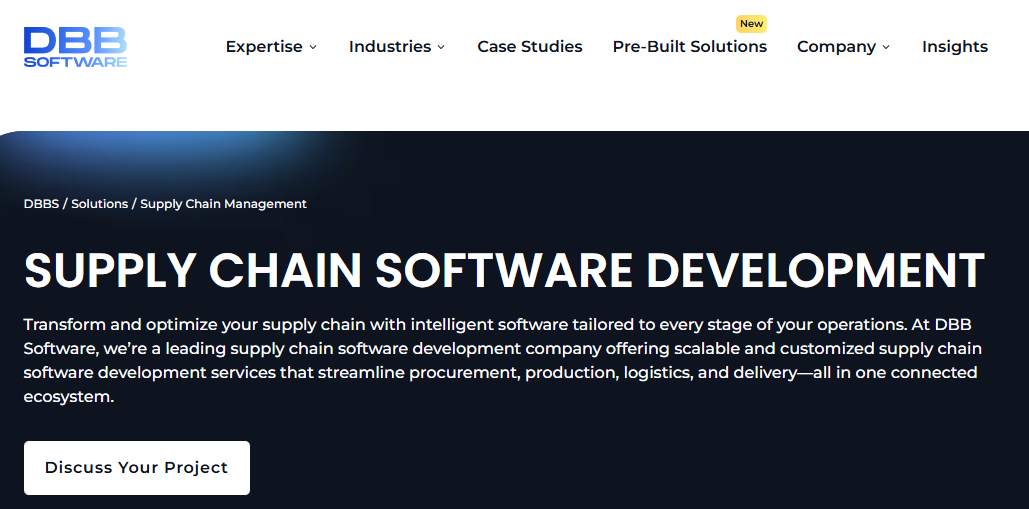
DBB Software is a development firm offering customized supply chain solutions that focus on visibility, automation, and system integration. Their services cover custom SCM platforms, inventory systems, logistics applications, analytics dashboards, and ERP or WMS connectivity.
Key focus areas:
Custom SCM platforms with workflow automation and real-time visibility
Integration services across ERP, TMS, and WMS systems
AI-enabled forecasting, routing, and optimization tools
Ready for your own custom SCM software solution? Learn more about our custom software development services.

Dayana Mayfield is a SaaS copywriter and content marketer specializing in SaaS marketing, positioning, and go-to-market strategy. She has consulted for over 195 SaaS companies, focusing on both traffic and conversions. She has been featured in Entrepreneur, Forbes, and Business Insider. Outside of work, Dayana writes SciFi novels and spends her evenings surviving auditions, rehearsals, and tech week as a proud theater mom.