
Your morning started in three portals. Routes in one. Carrier updates in another. Warehouse receipts in a spreadsheet that arrived by email. By 9 a.m., you're reconciling data that should connect automatically, and you haven't touched actual freight yet.
That coordination overhead is the signal that your tools have outgrown your operation. Or more accurately, your operation has outgrown your tools.
We've seen many logistics companies come to us after spending two or three years trying to patch this problem. By the time they reach out, they have a TMS for routing, a WMS for warehouse management, a carrier portal for freight, and a spreadsheet holding it all together. It works until it doesn't. And when it breaks, it breaks on a Friday afternoon with a shipment in transit and a client waiting on an update.
Custom logistics software fixes this by replacing the patchwork with a single internal platform built around how your operation actually runs, not how a SaaS vendor assumes it runs.
Below, I cover the potential of custom software for logistics and offer some guardrails on how to develop a successful internal-use product.
What is custom logistics software development?
Custom logistics software development is the process of designing and building technology that manages, tracks, and optimizes the movement of goods within your own organization. Unlike off-the-shelf logistics tools, which are made to fit a broad set of use cases, custom logistics software is built around your company's unique internal workflows, including your routes, warehouse processes, distributors, and communication systems.
This type of internal use software helps businesses that move or store physical goods improve visibility and control over their operations. It connects every stage of your logistics ecosystem (procurement, storage, fulfillment, and delivery) through one integrated platform.
The end result is a custom-built operating system for your logistics and supply chain management, designed to automate manual work, eliminate inefficiencies, and deliver real-time insights.
Why companies invest in custom logistics software
As logistics operations scale, complexity multiplies. Coordinating carriers, managing inventory, and tracking deliveries across systems become harder, and even modern SaaS platforms often add to the problem. These external solutions come with mounting subscription costs and force your team to adapt to their workflows instead of your own.
Custom logistics software, on the other hand, is built around your existing processes. It aligns with how your team operates, integrates with your internal systems, and evolves with your business. The software adapts to you, not the other way around.
Plus, AI-assisted development has made these custom solutions more attainable for SMBs. Faster build cycles, smarter automation, and modern frameworks like Laravel have reduced both cost and complexity. What used to be an enterprise-only advantage is now a practical investment for growing logistics and distribution companies.
How does logistics software differ from other types of software development?
While every software project starts with defining a problem and designing a solution, custom logistics software development comes with distinct challenges that set it apart from typical applications.
It bridges digital systems with physical movement. Logistics software must mirror real-world operations, syncing digital workflows with trucks, warehouses, and inventory in motion.
It requires flawless data accuracy and uptime. In logistics, even small data delays or errors can disrupt the entire supply chain, so the system must prioritize reliability and real-time updates.
It supports highly complex business rules. Every logistics operation has its own pricing, routing, and compliance logic that must be built directly into the product's architecture.
It integrates with legacy and modern systems alike. Logistics software connects ERPs, inventory tools, and shipping APIs into one platform that unifies operations across technologies and vendors.
Logistics management software is so much more than code. It's a connection between digital systems and physical operations, ensuring precision, and giving your team complete visibility and control across the supply chain.
When custom logistics software makes sense
Off-the-shelf tools were built for a standard operation. If yours isn't standard anymore, the question becomes how much longer you can afford to wait.
The signals that a custom build is the right call
Some of these will be familiar. Manual reconciliation between carrier portals and internal systems is consuming 10 or more hours per week. Your WMS vendor is sunsetting a reporting module your billing process depends on. A recent acquisition means two operations now run on different tools with no shared data layer. Your pricing or billing logic is too complex for any vendor to configure without a professional services engagement. Or your compliance requirements can't come out of a generic platform without manual exports.
Any one of those is a signal. Two or more, and you're past the inflection point.
A regional 3PL operator managing 12 warehouses and 300 client SKUs came to DevSquad after their WMS vendor stopped supporting the custom reporting module they depended on for client billing. Manual workarounds were adding 25 hours per week of reconciliation work across the operations team. DevSquad built a custom platform integrating real-time warehouse data, automated client billing logic, and a live operations dashboard per client. Reconciliation time dropped to under 3 hours per week.
What generic logistics software cannot do at scale
Your TMS has a workflow. Your WMS has a workflow. Neither one is your workflow. When your operation diverges from what the platform was designed for—and at scale, it always does—you end up in professional services engagements that are slow, expensive, and still don't fully close the gap.
Every platform has a carrier library. If a preferred regional carrier isn't in it, you're either building a custom integration on top of a licensed platform or bridging the gap manually. Reporting is the same: you can surface only the fields the vendor tracks. A custom KPI requires an export. And as the operation grows, per-user fees, transaction fees, and module add-ons compound.
The companies that get the most out of custom logistics software are the ones that start with operations, not technology. They come in knowing exactly what decisions they can't make right now because the data isn't there. That specificity is what lets us build something that actually moves the needle.
How to think about the investment before you build
Total the monthly cost of your current tool stack: TMS, WMS, carrier portals, integration middleware. Add the labor cost of manual reconciliation (hours per week times fully loaded rate). That's what the status quo costs each month. The question is whether that run rate, compounded over three to four years, exceeds what a custom platform would cost to build. For most complex operations, it does. See our custom software development costs guide for the full breakdown.
"Migrating from older systems is always a challenge. I suggest doing it in the smallest possible steps and really listening to the people that will use the system daily. Understanding their challenges and enhancing their experience is the key to a smooth transition." — Nelson Pereira, Technical Product Manager, DevSquad
Custom logistics software vs. TMS platforms
TMS platforms like MercuryGate, BluJay, and project44 are genuinely capable tools for standard freight operations. For a company whose workflows align with what the platform was built for, they work well. The inflection point is when your operation's complexity exceeds what the platform was designed for, and for many distribution, 3PL, and PE-backed logistics businesses, that point comes earlier than expected.
Workflow ownership
A TMS is built around a standard transportation workflow. When your operation deviates from that model (with custom rating logic, non-standard carrier relationships, and client-specific service requirements that don't map to the platform's fields), you end up in professional services engagements that are slow, expensive, and still don't fully fit. Custom logistics software is built around your actual workflow from the start. There is no deviation to accommodate because the platform was never designed for a different operation than yours. The software starts at your process, not the vendor's.
Integration limits
Every TMS has a carrier library and an integration catalog. If a preferred regional carrier isn't in it, your options are building a custom integration on top of a licensed platform (expensive, and constrained by what the platform exposes) or bridging the gap manually. Custom logistics software built API-first means integrations are designed around your actual carrier mix and partner ecosystem, not a vendor's pre-approved list. Every carrier relationship your operation depends on gets a purpose-built connection, not a workaround.
Total cost at scale
TMS licensing looks manageable at the start. Per-user fees, transaction fees, module upgrades, and professional services costs compound significantly as volume grows. A custom platform carries higher upfront development cost but no ongoing license fees, and every future change is fully owned. For operations past a certain scale, the math typically favors custom within three to four years. Run the numbers for your situation at our custom software development costs guide.
Where custom logistics software delivers the most operational value
There's no one-size-fits-all solution for logistics. Every company has its own mix of warehouses, carriers, and workflows that make generic SaaS tools hard to adapt. That's why more organizations are investing in custom logistics software development—to create internal systems that fit their exact operations and scale with growth.
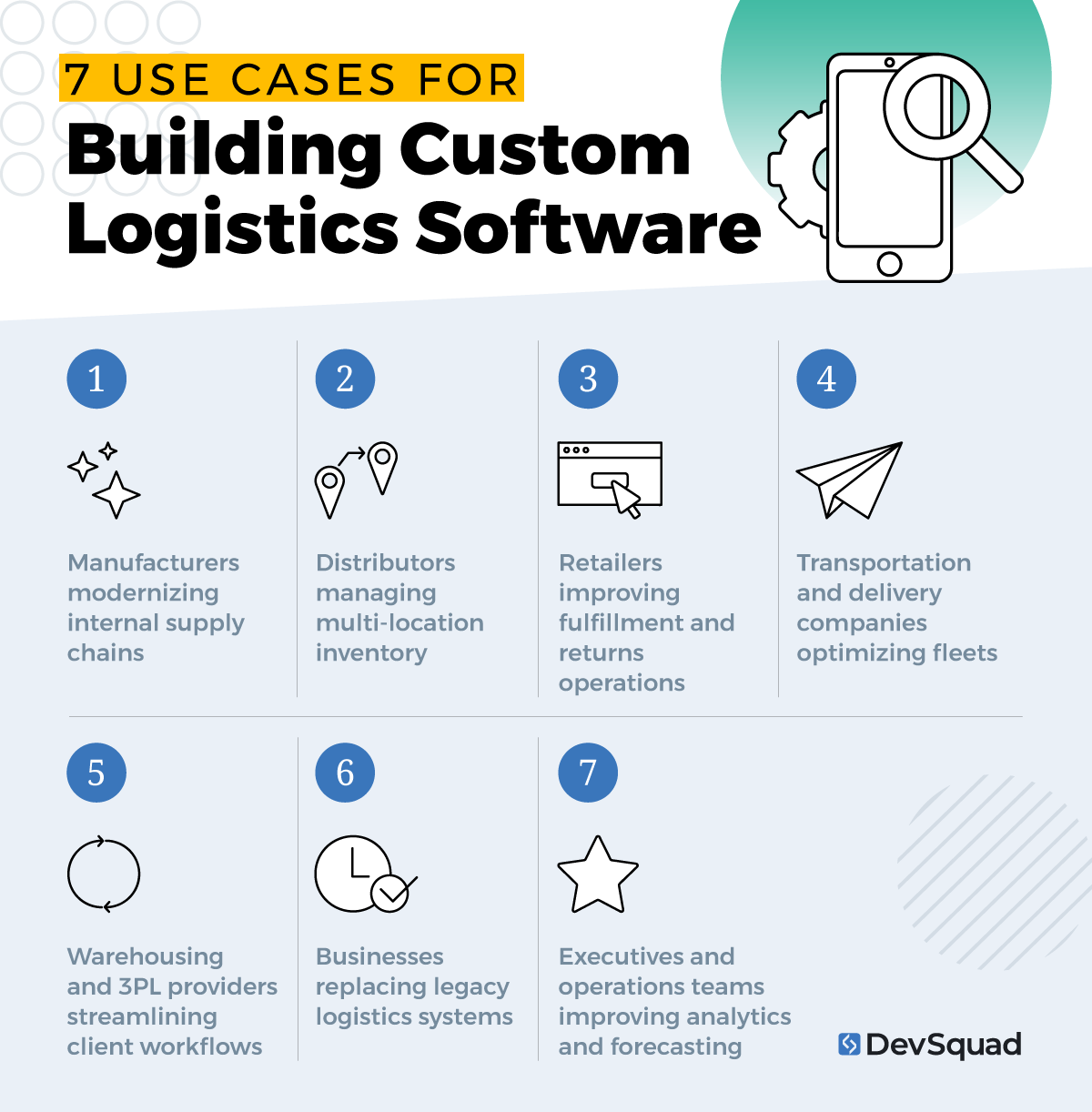 1. Manufacturers modernizing internal supply chains
Custom logistics systems connect procurement, production, and delivery in one platform. Teams gain real-time visibility into materials, schedules, and shipments, reducing downtime and improving on-time delivery rates.
2. Distributors managing multi-location inventory
A custom logistics management platform provides unified inventory tracking, automated stock transfers, and demand-based restocking rules—all designed around your business model and distribution network.
3. Retailers improving fulfillment and returns operations
Retail operations rely on speed and accuracy. Custom software syncs data between stores, warehouses, and ecommerce platforms to reduce order errors, accelerate returns, and strengthen the customer experience.
4. Transportation and delivery companies optimizing fleets
Internal fleet management systems automate routes, driver assignments, and maintenance schedules. This reduces fuel costs, improves delivery timing, and increases fleet utilization.
5. Warehousing and 3PL providers streamlining client workflows
Third-party logistics and warehousing companies manage multiple clients with different processes. Custom software enables real-time tracking, barcode and IoT integration, and automated communication for each client's unique workflow.
6. Businesses replacing legacy logistics systems
Outdated internal software slows operations and limits integration with modern tools. Rebuilding these platforms through custom logistics software development cuts maintenance costs and improves interoperability across the business.
7. Executives and operations teams improving analytics and forecasting
Custom dashboards unify logistics data like delivery times, warehouse performance, and cost metrics, so leaders can make faster, data-driven decisions and forecast with greater accuracy.
Across these use cases, the goal is the same: to bring logistics, transportation, and supply chain operations together in one streamlined system that increases efficiency and profitability.
The discovery process tailored to logistics management software
Building internal logistics software requires more than code. It demands a deep understanding of how your organization moves goods, manages data, and coordinates operations across teams. Logistics systems are deeply interconnected. They touch inventory, transportation, warehousing, accounting, and even customer service. A single missed dependency, such as an unaccounted-for data flow between a warehouse tool and a fleet tracking system, can derail the entire project.
A structured discovery process eliminates those blind spots. It creates a shared understanding of goals, requirements, and risks before development begins. Thus turning complexity into a clear, actionable plan. Here are the discovery steps to make that happen.
1. Stakeholder interviews and operations mapping
Discovery begins by uncovering how work actually happens inside your organization. This means moving beyond high-level assumptions to observe and document day-to-day logistics activities.
Meet with warehouse managers, dispatchers, drivers, and executives to capture different perspectives.
Identify pain points and inefficiencies that impact productivity or customer experience.
Document each department's goals and how they define success in logistics performance.
This early stage ensures that the resulting software reflects operational reality, not just a technical wish list.
"Learning the specific rules and guidelines of a business that has been running for a long time is the hardest part, not coding it. That is directly where the software success lies." — Ed Cavalcante, Technical Product Manager, DevSquad
2. Workflow and system analysis
Once stakeholder needs are understood, the next step is to assess how information flows between systems and where manual work slows things down. This analysis exposes opportunities for automation and integration while preserving the processes that already work well.
Map every workflow related to shipments, inventory, and communication.
Audit all existing tools—ERP systems, spreadsheets, databases, and third-party integrations.
Highlight redundancies, disconnected data, or workarounds your team uses to get things done.
3. Technical feasibility assessment
Before writing any code, technical feasibility must be confirmed to avoid expensive mid-project surprises. This step clarifies the technical scope and defines what's possible within your desired timeline and budget.
Evaluate network reliability, server capacity, and cloud infrastructure.
Review existing hardware (barcode scanners, RFID readers, IoT devices) and how they'll connect to the new system.
Identify external APIs and data sources that need integration, such as carrier platforms or inventory services.
Assess any compliance or security requirements relevant to data storage or transportation tracking.
4. Prototyping and roadmap creation
With requirements validated, the next step is to create a high-fidelity prototype and an actionable development roadmap. This allows you to validate the software's usability and value before committing full development resources.
Build an interactive prototype that reflects real user workflows and core functionality.
Gather feedback from logistics managers, dispatchers, and key end users to refine usability and data presentation.
Create a phased roadmap—such as Now, Next, Later—that prioritizes the most critical features first and reserves advanced capabilities for future releases.
The value of a structured discovery process
Following this kind of discovery process protects against wasted development effort and costly rework. It aligns technology decisions with business goals, validates assumptions early, and produces a roadmap that guides development with confidence. For logistics and supply chain organizations, this approach transforms a complex initiative into a clear, manageable path toward a fully integrated internal logistics system.
Common features to consider developing in your custom logistics software
When designing an internal logistics management system, the right features depend on your business model, existing tools, and operational bottlenecks. That said, several functions tend to deliver the greatest efficiency gains across most logistics environments.
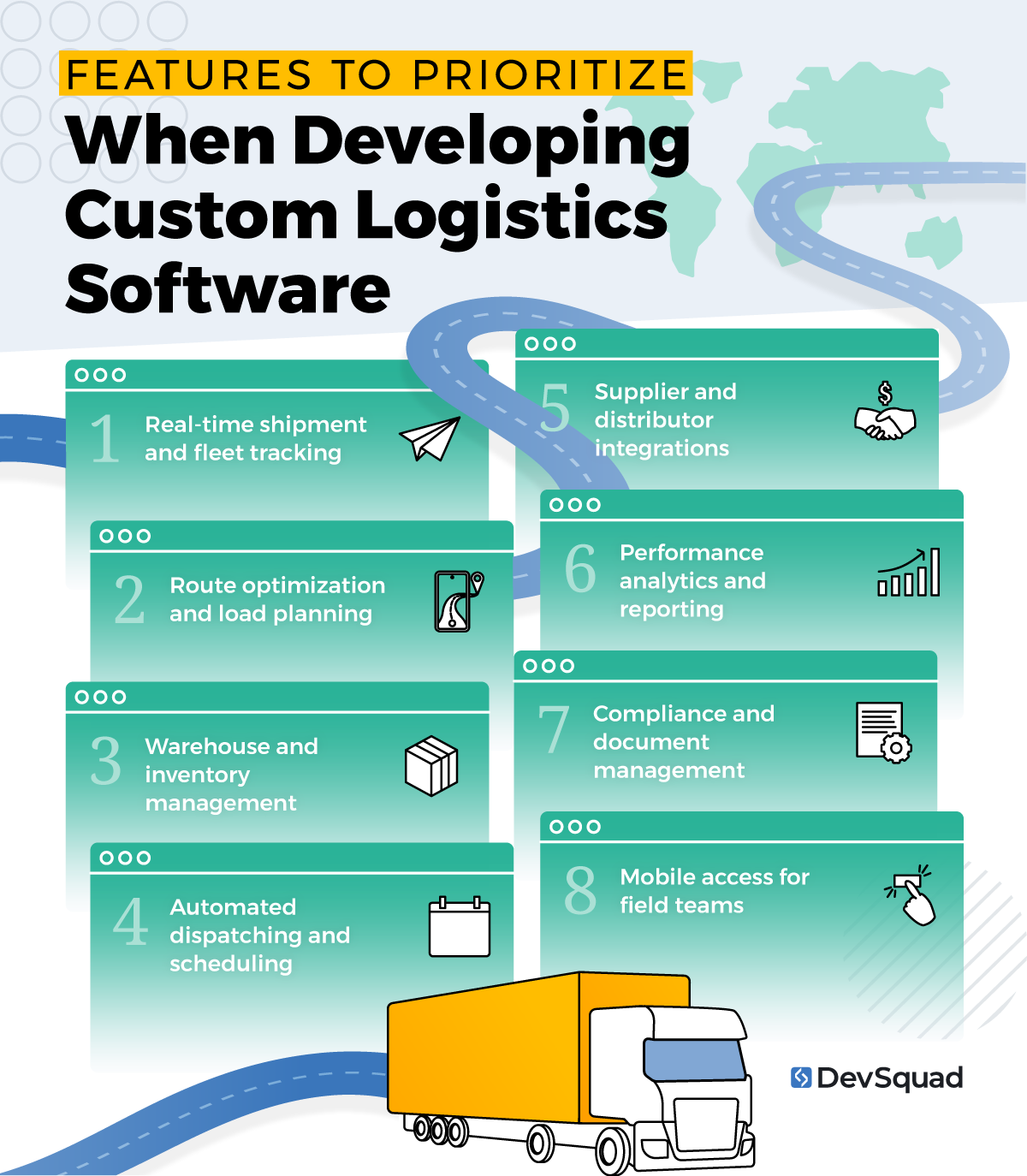
1. Real-time shipment and fleet tracking
Integrate GPS, telematics, and IoT data to provide live visibility into vehicle locations, delivery statuses, and route progress. Real-time tracking improves communication, reduces delays, and helps operations teams make data-driven adjustments on the fly.
2. Route optimization and load planning
Algorithms identify the most efficient delivery routes and optimize vehicle loading. Fuel consumption drops. Delivery speed improves. Transportation costs follow.
3. Warehouse and inventory management
Connect barcode scanners, RFID devices, and internal databases to track stock movement across all facilities. Automated alerts for low inventory, misplaced items, or overstock conditions help maintain balance and accuracy in supply.
4. Automated dispatching and scheduling
Drivers, shipments, and warehouse tasks get assigned automatically based on workload, proximity, or skill level. Manual coordination decreases. Idle time shrinks. On-time performance improves.
5. Supplier and distributor integrations
Centralize data from vendors, distributors, and third-party carriers through API integrations. When all partners connect to one internal platform, communication breakdowns stop being a daily management task.
6. Performance analytics and reporting
Delivery times, fuel usage, labor efficiency, route profitability, all consolidated in one place. Custom dashboards surface what matters so leaders can forecast demand and make faster decisions without pulling exports.
7. Compliance and document management
Permits, inspection forms, and proof of delivery documents live in secure, digital workflows. Automated version control and storage reduce errors and simplify audits.
8. Mobile access for field teams
Drivers, warehouse staff, and site managers need the system to work where they work. Real-time updates, digital signatures, and offline access keep field teams connected and eliminate the paper-based gaps that slow everything else down.
By prioritizing these capabilities during discovery and development, companies create an internal system that unites their logistics, transportation, and supply chain functions—removing silos, improving speed, and delivering a measurable return on investment.
The frameworks teams use to build custom logistics software in 2026
Selecting the right framework for custom logistics software development is about balancing speed, scalability, and maintainability. Logistics systems handle complex data streams, real-time tracking, and multiple integrations, all while supporting long-term growth. The wrong choice at the foundation creates technical debt that compounds as the operation scales.
Laravel is DevSquad's primary backend choice for custom logistics platforms. The reason comes down to business logic complexity. Routing rules with multiple variables, billing calculations that vary by client and carrier, carrier integration patterns that need to stay maintainable as APIs change — Laravel's architecture handles these cleanly. Its queue system, job scheduling, and built-in support for background processing make it well-suited to logistics workloads where real-time updates and async data syncs are constant requirements. The frameworks below are the best fit for logistics software development in 2026.
1. Laravel: best overall for internal logistics platforms
Laravel combines performance, security, and developer efficiency—making it ideal for logistics backends that power daily operations. Built on PHP, it's designed for rapid development and clear architecture.
Why it works well for logistics:
Excellent for managing queues, jobs, and scheduled updates (essential for shipment tracking).
Built-in support for APIs, authentication, and notifications.
Deep ecosystem (Horizon, Telescope, Sanctum, Nova) for monitoring and performance insights.
Integrates easily with PostgreSQL, Redis, and cloud infrastructure.
Strong global developer community for ongoing scalability.
Laravel offers a clean balance between speed to launch and long-term reliability—perfect for logistics and supply chain systems that evolve over time.
2. Vue.js: best for fast, intuitive operations dashboards
Vue is lightweight and approachable, making it an excellent choice for internal logistics dashboards and monitoring interfaces.
Strengths:
Simple to maintain and easy for teams to learn.
Great performance for real-time data visualization and tracking.
Pairs seamlessly with Laravel for end-to-end product builds.
Vue keeps interfaces fast and clean—ideal for logistics teams that need immediate visibility without the complexity of heavier frameworks.
3. React: best for analytics-heavy and multi-feature UIs
React excels when logistics software requires rich interactivity and complex data displays.
Where it shines:
Building real-time analytics views and interactive map-based tracking.
Supporting modular front-end development across multiple teams.
Backed by a massive community and strong hiring market.
React is perfect for organizations building multi-department platforms or data-driven visibility tools.
4. Node.js / NestJS: best for real-time, event-driven integrations
Node.js is the go-to for high-speed communication between logistics endpoints, while NestJS adds structure and scalability.
Use it when you need:
Constant real-time data syncs from carriers, sensors, or IoT devices.
Event-driven architecture for fast, asynchronous updates.
A fully JavaScript-based stack across backend and frontend.
Node/NestJS is especially useful for transportation and delivery companies where live tracking and rapid communication are mission-critical.
5. Python (Django or FastAPI): best for data-driven logistics platforms
Python's frameworks are ideal for operations that rely heavily on analytics or AI-powered decision-making.
Use cases include:
Predictive demand forecasting and route optimization models.
Integrating data science workflows directly into logistics tools.
Internal CRMs and management portals using Django's robust admin capabilities.
Python is the natural fit when your logistics software merges traditional operations with intelligent automation.
6. .NET: best for Microsoft-first enterprises
If your logistics team already relies on Microsoft infrastructure, .NET provides a strong, stable backbone for modernization.
Advantages:
Deep integration with Azure, Microsoft ERPs, and accounting tools.
High performance and security for enterprise-grade logistics systems.
Long-term reliability and corporate-level support.
.NET is the right choice for organizations that want to extend their existing Microsoft environment into logistics management.
7. Spring Boot: best for large, regulated, global operations
Spring Boot's Java foundation makes it a powerhouse for large-scale logistics networks that demand precision and uptime.
Best for:
Regulated industries such as energy, shipping, and manufacturing.
Multi-team, enterprise-grade architectures.
Systems requiring constant uptime and heavy transaction throughput.
Spring Boot is built for long-term stability in complex logistics environments where scale and governance come first.
"It is tempting to use a new software project as an opportunity to redesign everything, but that creates a big adoption problem. The first goal should be to understand the current process and make the transition as smooth as possible. Once the team is comfortable and the business is running on the new software, then you can start improving, automating, and simplifying." — Mauricio Kiyama, VP of Product
Logistics software development agencies worth considering in 2026
Five agencies consistently come up when distribution companies, 3PL operators, and PE-backed logistics businesses evaluate custom development partners. Each brings a different profile. Here's where they tend to fit.
1. DevSquad
 DevSquad builds custom software for logistics operators who need more than a configured SaaS platform. Every engagement starts with structured discover, including operations mapping, stakeholder interviews, and technical feasibility—before development begins. Modern frameworks including Laravel and Vue.js power the builds, with AI-assisted development compressing timelines. DevSquad has launched over 100 products since 2014, with logistics and distribution clients among the primary verticals.
2. BairesDev
 BairesDev provides large-scale software development services across more than 100 industries, including transportation and logistics. Their logistics solutions leverage AI, IoT, blockchain, and cloud computing to enhance supply chain visibility, optimize routes, and improve fleet performance. With over 4,000 engineers and nearshore delivery teams, the company builds ERP systems, mobile tools, and data analytics platforms for complex operations. BairesDev's strength lies in scale and speed tailored for big companies.
3. EffectiveSoft
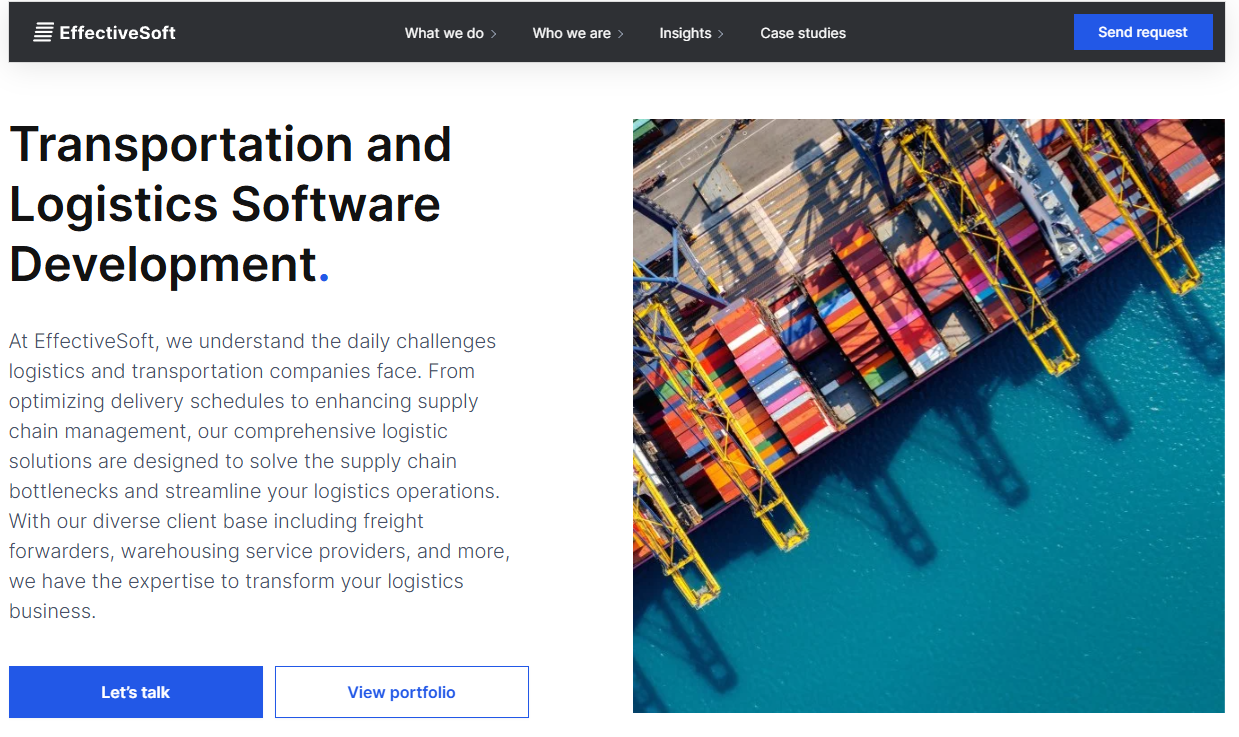 Known for its deep logistics specialization, EffectiveSoft develops tailored systems for freight, warehousing, and supply chain organizations. Their services include transportation management, logistics CRMs, analytics tools, and cloud-based platforms enhanced with AI, IoT, and blockchain capabilities. With an agile, analysis-driven process and a strong emphasis on security and quality assurance, the company delivers solutions that improve fleet tracking, automate workflows, and increase supply chain visibility across complex logistics environments.
4. Intellias
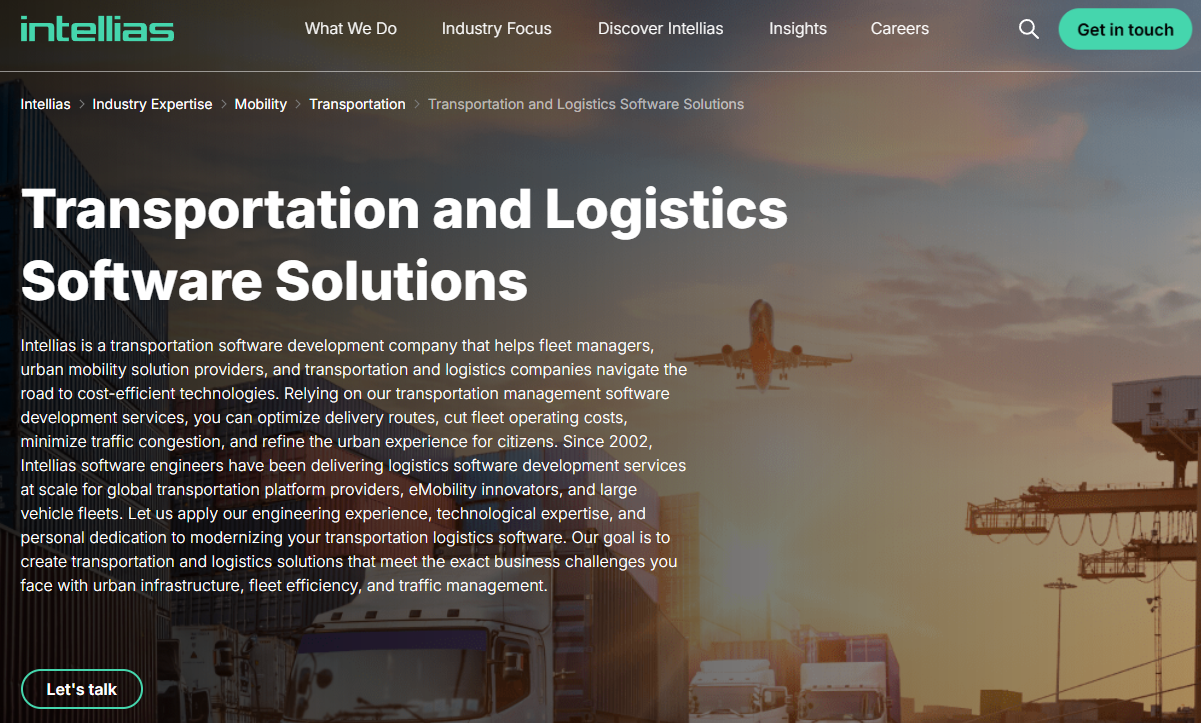 Intellias is a long-established transportation and logistics software company with deep expertise in mobility, fleet, and freight management solutions. Founded in 2002, the firm builds large-scale systems for route optimization, fleet efficiency, and real-time tracking using AI, IoT, and data analytics. Their capabilities span cloud architecture, DevOps, and embedded software for connected vehicles, helping clients digitalize supply chains and modernize transportation platforms. Intellias emphasizes partnership, scalability, and engineering precision—serving global logistics providers, eMobility innovators, and transportation technology leaders.
5. Mind Studio
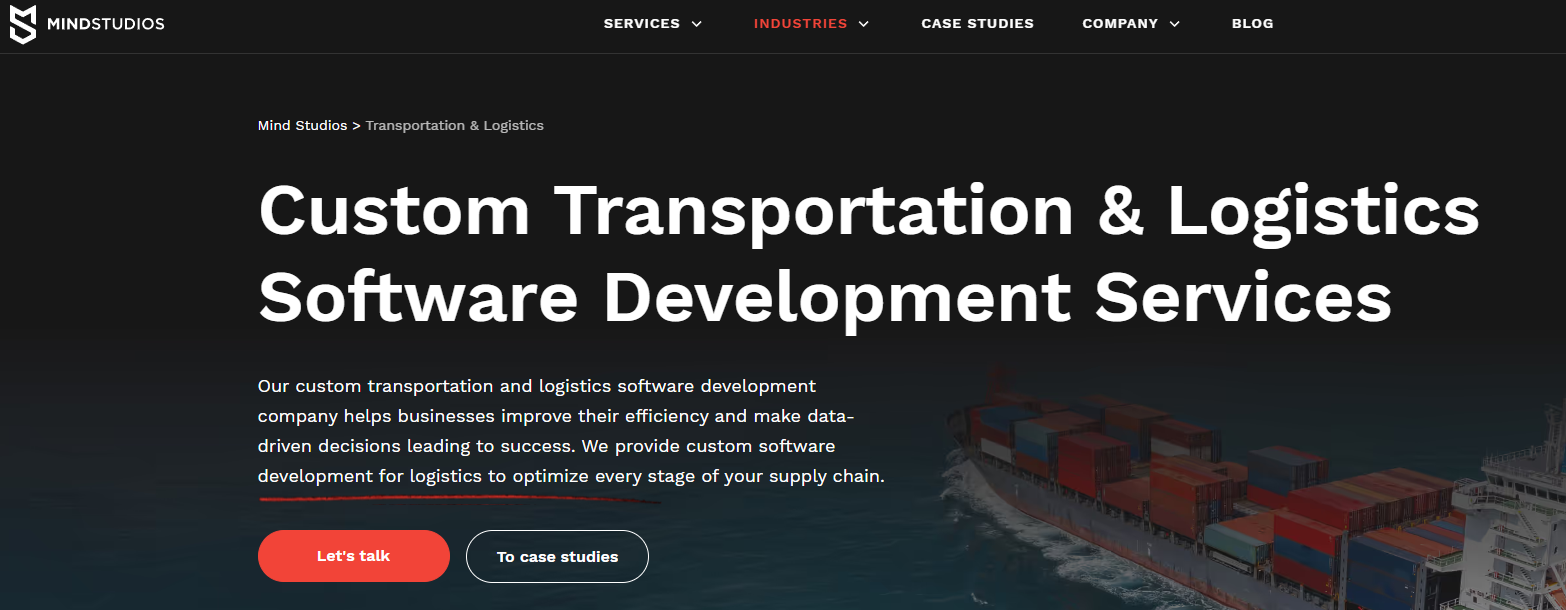 With more than a decade of experience in logistics and transportation software, Mind Studios builds tools that help businesses operate efficiently and make data-driven decisions. Their solutions span dispatching, fleet management, cargo tracking, warehouse management, and route optimization—all backed by AI, analytics, and ERP integration. The company focuses on collaboration, transparent communication, and on-time delivery, developing custom systems that enhance transparency, lower costs, and improve overall logistics performance.
Custom logistics software development FAQs
Timeline depends on scope. Discovery runs four to six weeks and covers operations mapping, technical feasibility, and prototyping. A core platform with shipment tracking, dispatch, and warehouse management integration typically takes four to six months for Phase 1. A full custom TMS with all carrier integrations may take eight to twelve months. Phased delivery is standard: the core ships first, so your team starts realizing value well before the full platform is complete.
Integration is usually the starting point, not a future phase. Custom software typically sits alongside existing tools first, connecting data layers and eliminating manual exports before any platform replacement happens. The approach is API-first: purpose-built connectors for your specific ERP, carrier systems, and warehouse tools. DevSquad has experience building custom connectors across logistics ecosystems, including ERPs like SAP and NetSuite. See our custom ERP software development guide for more on how these integrations are structured.
Three situations argue against a custom build: your operation is standardized enough that a generic TMS covers 80% or more of workflows without workarounds; your company is pre-scale and still validating its logistics model; or you don't have a clear internal owner to represent business requirements during discovery. Custom software built without operational input from the people who will use it consistently fails at the handoff.
Ready to build your own custom logistics software? Learn more about our custom software development services.

Phil Alves is the CEO and Founder of DevSquad and DevStats. He’s built and launched 100+ software products for bootstrapped founders, fast-growing startups, and enterprises. Phil writes about SaaS, product strategy, operational complexity, and building scalable development processes. He enjoys aviation, investing, and learning from other SaaS founders.