
Most CEOs assume custom software development costs are high by default. That assumption leads to the wrong decisions. The real issue isn’t cost—it’s understanding what drives it.
Custom software pricing varies widely. Some projects start around $50,000, while others exceed $400,000 depending on scope, integrations, and complexity. The average custom software project sits around $132,000 with timelines often stretching close to a year.
That range feels unpredictable. It shouldn’t.
The truth is simple. Custom software costs scale with decisions, not just development hours. Every feature, workflow, and integration increases complexity. Poor planning multiplies that cost fast.
At the same time, companies continue to overspend on fragmented SaaS stacks. They pay monthly for tools that don’t quite fit, then invest more time working around limitations.
This guide breaks down what custom software development really costs when you hire an external partner. You’ll see where your money goes, what drives pricing, and how to control it.
What makes up custom software development costs?
Custom software development costs include everything required to design, build, and launch software tailored to your business. This usually means internal tools—systems built to improve operations, automate workflows, or replace multiple SaaS products.
The scope matters. Internal tools often focus on efficiency and integration, while customer-facing products require more design, scalability, and performance investment. That difference alone can shift costs significantly.
The core components of custom software costs
Every custom project follows the same core phases. Each one contributes directly to the total investment.
Planning and discovery: defining the problem, users, and technical approach
UX/UI design: shaping how the product looks and works
Development and engineering: building the actual system
QA and testing: validating performance, security, and usability
Deployment and iteration: launching, learning, and improving over time
Skipping any of these steps doesn’t reduce cost—it delays it. Most rework comes from cutting corners early.
Custom software is a process, not a product
This is where most companies get it wrong. They treat custom software like a one-time purchase.
It’s not. It’s an evolving system that improves over time.
Research shows that structured discovery and planning can cost $10,000 to $100,000 upfront, but it prevents far larger losses during development. Smart companies invest early so they don’t overpay later.
Average custom software development costs in 2026
Custom software development costs vary widely, but credible benchmarks exist. According to the GoodFirms 2026 Custom Software Development Cost Survey, most projects fall between $30,000 and $100,000 for small to mid-sized builds, while more complex systems quickly exceed $100,000. Larger enterprise platforms often surpass $200,000 due to integrations, infrastructure, and scale.
The biggest factor is what you’re building.
Cost ranges by project size
Small projects: $20,000–$50,000
Mid-size projects: $50,000–$200,000
Larger custom systems: $100,000–$400,000+
Enterprise platforms: $400,000+
These ranges reflect increasing complexity, integrations, and performance requirements. A simple internal tool costs far less than a system that connects multiple departments and data sources.
Supporting benchmarks
The GoodFirms survey reinforces that pricing scales with complexity. Many AI-enabled or integration-heavy projects fall between $50,000 and $125,000, while enterprise-grade systems exceed $200,000.
Timeline context
Most custom software projects take several months to over a year depending on scope. Larger systems require more time for planning, architecture, and testing.
The key insight is simple. Cost varies based on complexity, not just size.
What drives custom software development costs?
Custom software costs come from decisions more than coding. Every choice you make from features to architecture to integrations shapes the final price more than the number of hours logged.
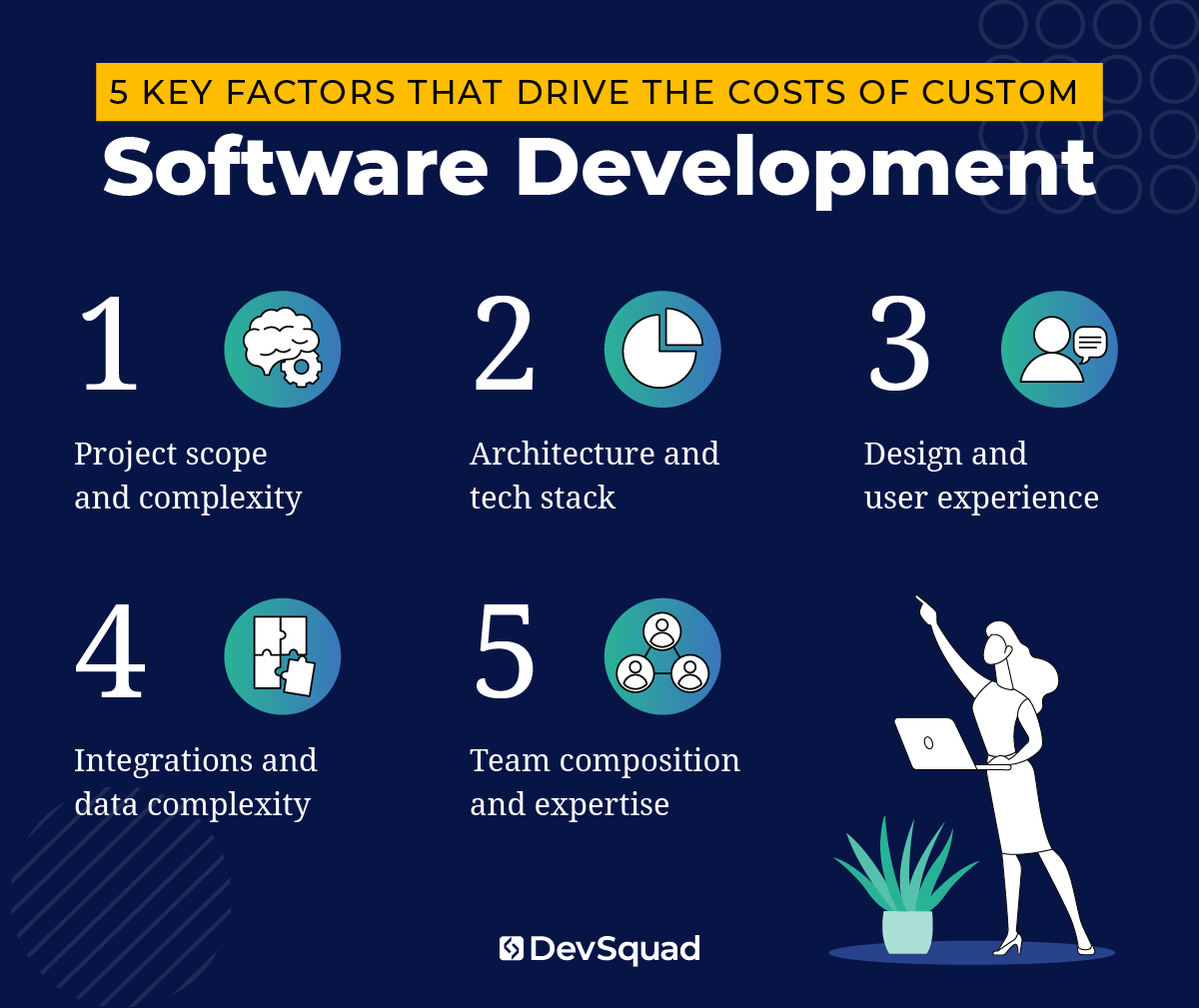
Project scope and complexity
Scope is the biggest driver. Every feature, workflow, and integration adds layers of effort.
Costs typically increase 10–20% with each added feature, especially when those features interact with each other. A simple internal tool stays lean. A system that connects departments, automates workflows, and handles real-time data gets expensive fast.
At DevSquad, we push hard on defining scope early. Most companies already have a “Frankenstack” of tools stitched together. We replace that complexity with one focused system instead of adding more layers.
Architecture and tech stack
Your architecture sets the foundation. A monolithic system costs less upfront. A microservices architecture offers flexibility but increases initial complexity.
The wrong choice creates long-term cost problems. You either overbuild and overspend, or underbuild and pay for it later in refactoring.
This is where experienced teams matter. Architecture decisions determine how expensive your software becomes over time.
Design and user experience
UX often looks like an easy place to cut costs. It’s not.
Poor design leads to confusion, inefficiency, and rework. You end up rebuilding features because users struggle to adopt them. Strong UX reduces friction and makes the system actually usable.
Integrations and data complexity
Integrations quietly drive costs higher. APIs, legacy systems, and third-party tools all require custom logic.
Many businesses rely on workarounds like manual exports, spreadsheets, disconnected systems. That’s where costs hide. Custom software eliminates those inefficiencies, but integrating everything correctly takes time and expertise.
Team composition and expertise
The team you hire directly impacts cost and outcome. Senior developers cost more upfront but solve problems faster and with fewer mistakes.
You also need more than developers. Product managers and designers shape the direction and prevent wasted effort.
At DevSquad, we build full squads that include product strategists, designers, developers, QA, and DevOps. That structure reduces rework and speeds up delivery because decisions happen early, not mid-build.
The hidden costs of custom software development
Most companies don’t go over budget because of obvious costs. They go over because of decisions made early that create expensive problems later.
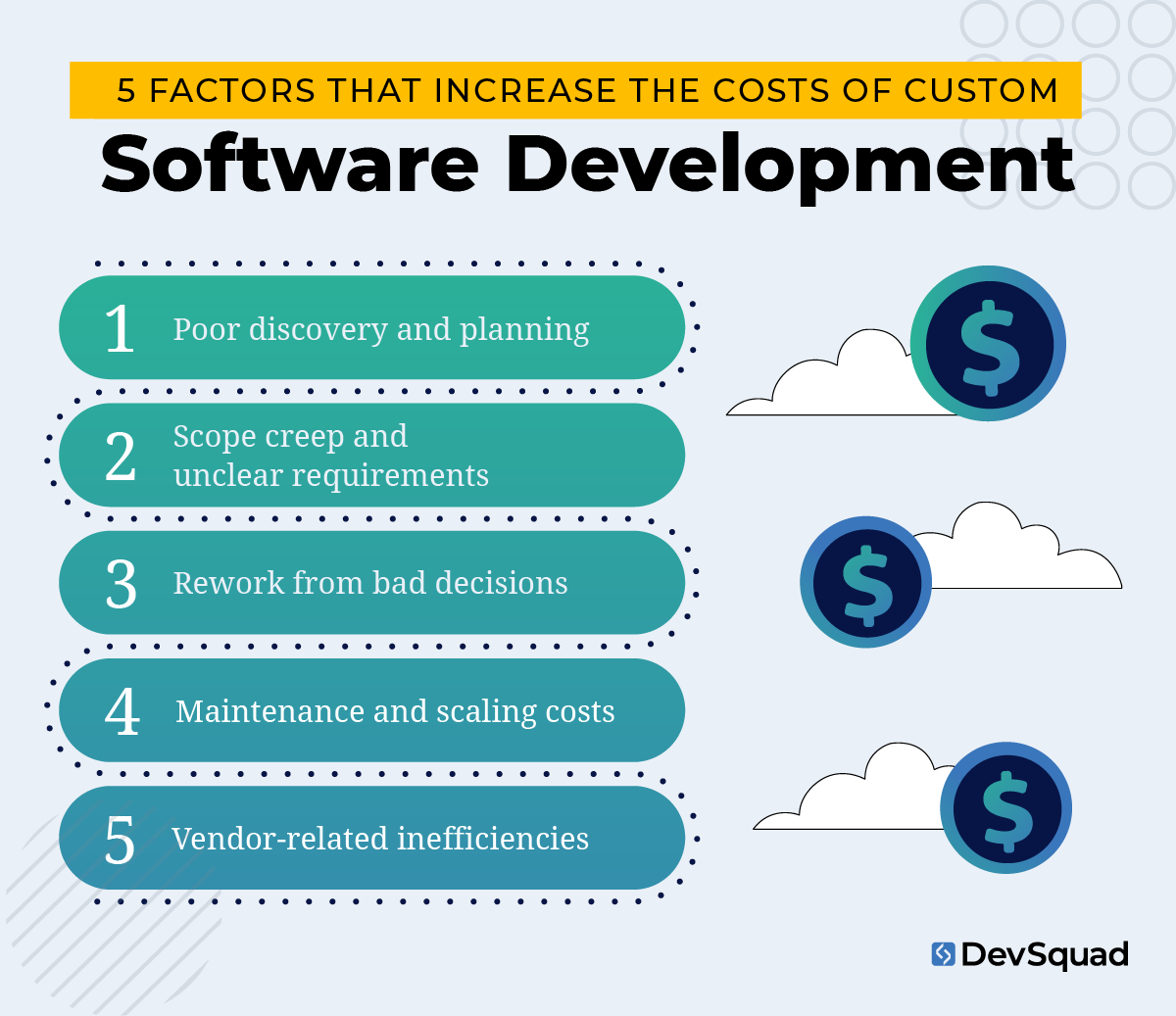
Poor discovery and planning
Skipping discovery feels like saving money. It’s not.
Proper discovery typically costs between $10,000 and $100,000, but it prevents building the wrong system entirely. Without it, teams guess on requirements, miss edge cases, and create gaps that surface later.
We’ve seen this firsthand. When teams invest more time upfront, they spend less time and money fixing problems during development.
Scope creep and unclear requirements
Unclear requirements open the door to scope creep. New features get added mid-project, priorities shift, and timelines stretch.
The impact is real. Scope creep increases development costs by 10–25%, especially when changes affect core workflows.
Clear planning keeps projects focused. Without it, costs spiral.
Rework from bad decisions
Rework is one of the most expensive hidden costs. It usually comes from weak product strategy or lack of user validation.
Teams build features they think users need, then rebuild them when reality doesn’t match assumptions. That doubles effort without increasing value.
Maintenance and scaling costs
Custom software doesn’t stop at launch. It requires updates, infrastructure, and security over time.
If the system wasn’t designed to scale, these costs grow quickly. What looked efficient early becomes expensive to maintain.
Vendor-related inefficiencies
The wrong development partner adds friction. Poor communication slows progress and creates misunderstandings.
Lack of ownership makes it worse. When no one takes responsibility for outcomes, the client absorbs the cost through delays and rework.
The pattern is clear. Hidden costs come from how the project is planned and managed.
Weighing cost against off-the-shelf pricing before you commit? Read custom vs. off-the-shelf software: what breaks first for the full cost, ownership, and scale comparison.
Hiring a custom software development agency: cost breakdown
Hiring an agency gives you speed, structure, and expertise, but the pricing can feel unclear if you don’t know how it works. Let’s break it down so you know exactly what you’re paying for.
Common pricing models
Agencies structure pricing in a few standard ways. The right model depends on how defined your project is and how much flexibility you need during development.
Fixed bid:
Set price for a defined scope
Works best for small, well-defined projects
Risk increases if requirements change
Time and materials
Pay based on hours worked
Flexible for evolving projects
Requires strong oversight and trust
Dedicated team (DevSquad-style)
Monthly rate for a fully managed team
Includes product, design, and engineering
Best for ongoing development and iteration
Typical hourly rates
Hourly rates vary based on geography, experience, and specialization. Understanding these ranges helps you evaluate quotes and spot outliers quickly.
$90–$160 per hour is the standard range
Senior talent and specialized roles sit at the higher end
Offshore teams may cost less, but often introduce communication tradeoffs
Monthly and project cost expectations
Costs scale based on team size, scope, and timeline. You’ll typically see pricing structured around either ongoing teams or fixed projects.
Dedicated team
$16,000–$80,000+ per month
Predictable cost for continuous delivery
Project-based work
Typically aligns with earlier ranges ($50k–$250k+)
One-time builds with defined scope
What you’re actually paying for
When you hire an agency, you’re not just paying for developers. You’re paying for a complete system that turns ideas into working software.
Product management to define what gets built
UX design to shape how it works
Engineering to build and integrate systems
QA and DevOps to maintain quality and performance
Why agencies can reduce total cost
Agencies may look expensive at first glance. But when you factor in speed, expertise, and efficiency, they often lower your total cost of ownership.
No hiring delays or recruitment costs
Immediate productivity from experienced teams
Proven processes that reduce rework and mistakes
The difference comes down to efficiency. A strong agency doesn’t just build faster—it helps you avoid building the wrong thing.
How AI is impacting custom software development costs
AI is changing how software gets built. It’s lowering software development costs, while shifting them to other areas. The biggest impact is simple: AI reduces execution cost, not decision cost.
Key shifts
AI now handles a large portion of repetitive development work. Tasks that used to take hours can now be completed in minutes.
Automation of coding tasks
Faster prototyping and iteration
The adoption numbers back this up. 91% of companies now use AI to cut development costs, and 61% expect budgets to drop by 10–25% as a result. For many businesses, especially those without internal engineering teams, the savings can be even higher.
What AI improves
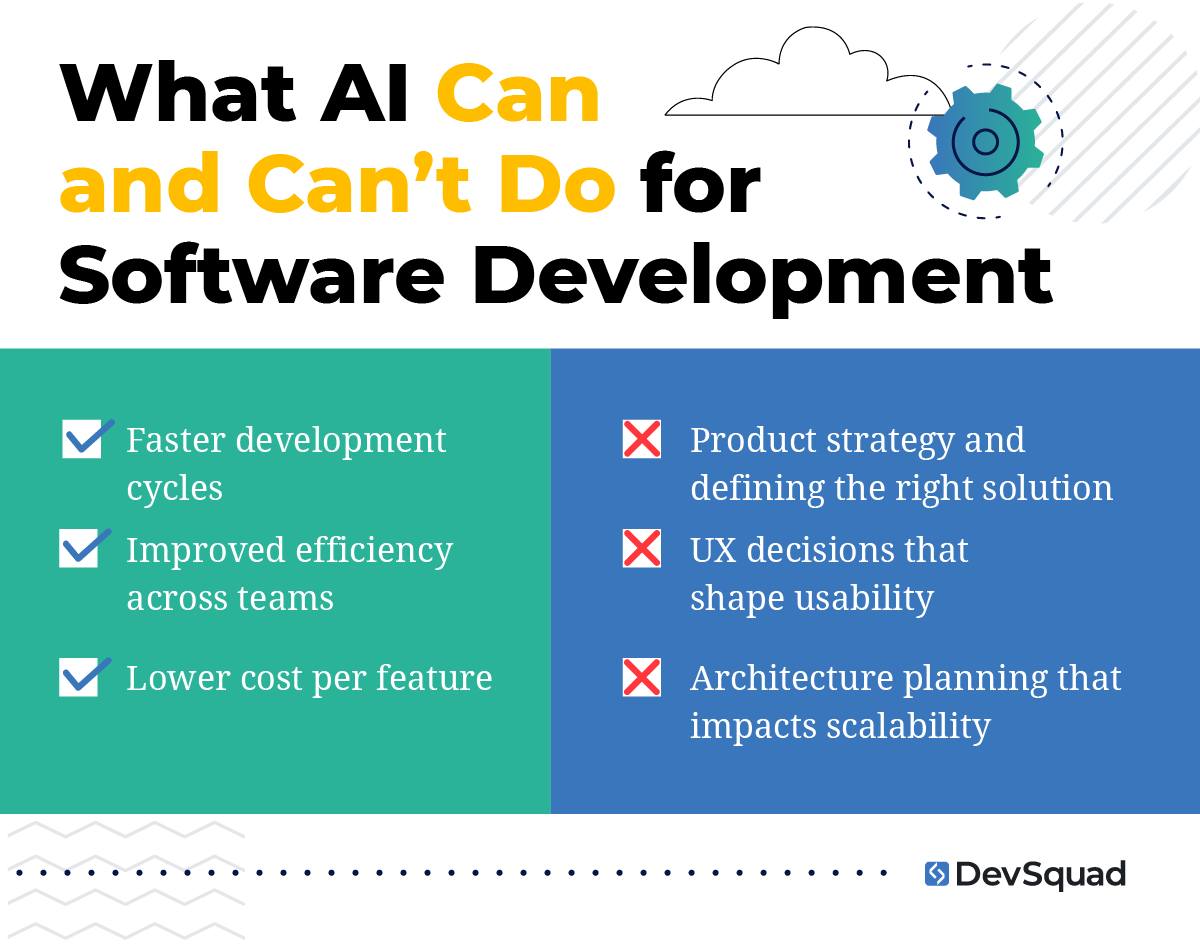
AI makes teams faster and more efficient. It reduces the cost of building features, but it doesn’t remove the need for direction.
Faster development cycles
Improved efficiency across teams
Lower cost per feature
This allows smaller teams to deliver more in less time. Projects that once required large teams can now move with fewer people and tighter timelines.
What AI does not replace
AI can generate code. It can’t decide what to build.
Product strategy and defining the right solution
UX decisions that shape usability
Architecture planning that impacts scalability
If these areas are weak, AI will only help you build the wrong system faster. That’s why the real leverage comes from combining AI-driven execution with strong product thinking.
How to reduce custom software development costs
Reducing costs means making smarter decisions before and during development. The teams that control costs best focus on clarity, not shortcuts.
Invest in discovery and planning
Planning drives everything. It aligns your team, defines priorities, and removes guesswork before development begins. The more clarity you create upfront, the less you pay for confusion later.
This is where most cost savings happen. Not during development—before it.
Build MVPs, not full systems
You don’t need everything on day one. A focused MVP gets you to market faster and reduces upfront investment.
Reduce initial development costs
Launch faster with core functionality
Expand based on real usage, not assumptions
An MVP forces discipline. It keeps your team focused on what actually matters and prevents overspending on features that may never deliver value.
Validate before development
Validation turns assumptions into data. It helps you avoid building features that users don’t need or won’t use.
Use prototyping to test concepts early
Gather user feedback before committing to code
Refine features before investing in development
This step saves more money than almost anything else. When you validate early, you eliminate expensive rework later.
Choose the right partner
The wrong partner increases costs, even if their rates look lower. You need a team that thinks strategically, challenges assumptions, and takes ownership of outcomes.
Strong partners guide decisions, which is what actually keeps projects on budget.
Use AI strategically
AI can accelerate development, but it doesn’t replace thinking. It works best when you use it to handle execution, not direction.
The real advantage comes from combining AI speed with strong product decisions. That’s how you reduce costs without sacrificing quality.
When custom software is worth the investment
Custom software isn’t always the right move. But when it is, it changes how your business operates. The companies that get this right build leverage.
The key is knowing where custom development actually creates value.
Best use cases
Custom software delivers the most value when it directly impacts how your business runs. These are the areas where off-the-shelf tools fall short.
Internal workflows that are unique to your operations
Replacing multiple SaaS tools with one unified system
Creating operational efficiency across teams and departments
These use cases compound over time. Every hour saved, every manual step removed, and every workflow improved turns into measurable ROI.
When it’s NOT worth it
Not every problem needs a custom solution. In some cases, building software adds unnecessary complexity.
Commodity tools like email, basic CRM, or accounting
Low-impact processes that don’t affect core operations
If the problem doesn’t create leverage, it’s not worth building.
Cost vs value framing
Most companies focus too much on upfront cost. The better question is long-term value.
Custom software functions as an asset. It improves efficiency, scales with your business, and reduces dependency on external tools. Over time, the ROI compounds as your team moves faster and operates with fewer constraints.
Frequently asked questions about custom software costs
How much does custom software development cost?
Custom software development costs typically range from $30,000 to $200,000+ depending on scope, complexity, and integrations. Smaller internal tools cost less, while enterprise systems exceed $400,000. The biggest cost drivers are features, workflows, and the level of customization required.
What is the average cost of custom software?
The average custom software project usually falls between $75,000 and $250,000. Many mid-sized internal tools land near $100,000–$150,000. However, this average varies widely based on complexity, integrations, and whether the system replaces multiple existing tools.
Why is custom software so expensive?
Custom software feels expensive because it’s built specifically for your business. You’re paying for product strategy, design, engineering, and integration, not just code. Costs increase with complexity, but the investment often replaces multiple tools and creates long-term efficiency gains.
What are the hidden costs of custom software development?
Hidden costs include poor planning, scope creep, rework, and ongoing maintenance. Weak product strategy often leads to building the wrong features. Over time, infrastructure, scaling, and updates also add cost, especially if the system wasn’t designed correctly from the start.
How long does custom software development take?
Most custom software projects take 3 to 12 months depending on scope and complexity. Smaller internal tools can launch in a few months, while larger systems take longer due to planning, integrations, and testing. Clear scope and strong planning can significantly reduce timelines.
Can custom software costs be reduced?
Yes, costs can be reduced by focusing on planning, building an MVP, and validating ideas early. Choosing the right development partner also prevents rework. The biggest savings come from building the right features first, not from cutting corners during development.
Does AI lower custom software development costs?
AI lowers custom software development costs by automating repetitive coding tasks and speeding up delivery. It reduces the cost per feature and allows smaller teams to do more. However, it doesn’t replace product strategy, UX decisions, or architecture planning.
Is custom software worth the investment?
Custom software is worth the investment when it improves core workflows or replaces multiple tools. It creates efficiency, reduces manual work, and scales with your business. Over time, the ROI often exceeds the initial cost through productivity gains and operational leverage.
If your tools are slowing you down, it’s time to rethink your system. Explore DevSquad’s custom software services and see what purpose-built software can do for your business.

Dayana Mayfield is a SaaS copywriter and content marketer specializing in SaaS marketing, positioning, and go-to-market strategy. She has consulted for over 195 SaaS companies, focusing on both traffic and conversions. She has been featured in Entrepreneur, Forbes, and Business Insider. Outside of work, Dayana writes SciFi novels and spends her evenings surviving auditions, rehearsals, and tech week as a proud theater mom.