
Most CEOs still think about software the same way they did ten years ago. You either buy SaaS subscriptions or take on the “huge expense” of building something custom. That framing no longer holds up.
Software development costs have shifted. AI now accelerates execution, and 91% of software companies use AI to cut development costs in 2026, according to a GoodFirms survey. What once required large teams and long timelines can now move faster with fewer resources.
At the same time, SaaS costs keep climbing. Teams stack tools to solve isolated problems, then spend more time managing those tools than improving operations. Monthly fees look small, but they compound into one of the most inefficient line items in the business.
This creates a new reality. For many internal workflows, building custom software is no longer the expensive option. It’s often the smarter financial decision.
That doesn’t mean you should build everything. It means you need a clearer view of real costs—upfront, ongoing, and hidden—plus how those costs behave when you can capitalize and amortize them.
At DevSquad, we focus on solving business problems first, then building the right software to support them. That’s how companies reduce waste and turn software development into a long-term advantage.
In this guide, we’ll break down software development costs so you can make the right call.
What makes up software development costs?
Software development costs include every resource required to plan, build, launch, and maintain a product. Most people think about developer salaries or agency fees. That’s only part of the picture.
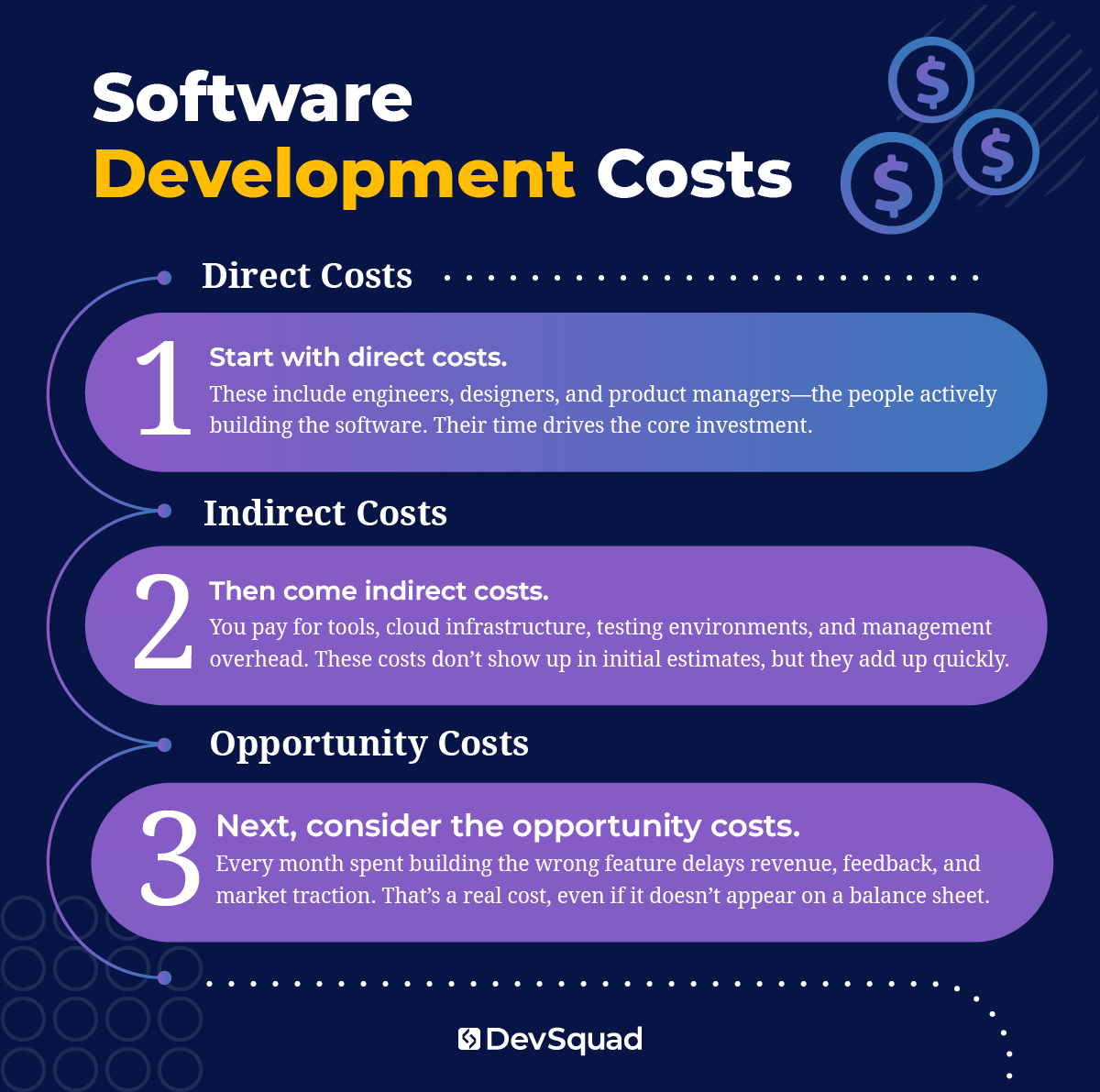
Start with direct costs. These include engineers, designers, and product managers—the people actively building the software. Their time drives the core investment.
Then come indirect costs. You pay for tools, cloud infrastructure, testing environments, and management overhead. These costs don’t show up in initial estimates, but they add up quickly.
Next, consider the opportunity costs. Every month spent building the wrong feature delays revenue, feedback, and market traction. That’s a real cost, even if it doesn’t appear on a balance sheet.
Most companies underestimate software development because they focus only on the first layer. They assume a linear build process, when in reality development is iterative. Teams build, test, learn, and rebuild.
They also overlook product strategy and UX. Poor decisions early on lead to expensive rework later. Fixing the wrong product costs far more than building the right one from the start.
Finally, many ignore long-term maintenance. Software isn’t a one-time project. It evolves, requires updates, and must scale with the business.
At DevSquad, we see this pattern constantly. Companies overspend not because development is expensive, but because they start without a clear strategy. Poor planning leads to wasted effort, while the right approach turns software development into a controlled, predictable investment.
Average software development costs by approach
Software development costs vary widely depending on how you build. The biggest mistake CEOs make is comparing only the upfront price, instead of the full cost over time. Let’s break down the three most common approaches.
In-house development team costs
An in-house team typically includes developers, a QA engineer, a product manager, and a designer. Even a small team quickly becomes expensive once you factor in fully loaded costs.
A single developer might cost $120,000–$180,000 per year when you include salary, benefits, and overhead. Multiply that across roles, and you’re easily looking at $500,000+ annually for a modest team.
Costs also accumulate over time. Hiring takes weeks or months, and new employees need ramp-up time before they produce meaningful output. During that period, you’re paying full price for partial productivity.
External software development agency costs
Agencies offer more flexibility. Common pricing models include fixed bids, time and materials, or a dedicated team model like DevSquad provides.
Real-world data shows that 66% of companies charge between $30,000 and $100,000 for small to mid-sized projects. Projects with AI capabilities or advanced integrations often fall between $50,000 and $125,000. Larger systems typically start at $100,000 and can exceed $200,000 for enterprise-grade platforms.
Agencies reduce costs in a few key ways. They start immediately, remove hiring overhead, and bring proven expertise. That combination leads to faster timelines and fewer costly mistakes. In many cases, outsourcing lowers total costs while speeding time to market.
SaaS subscription costs (the “default” option)
SaaS feels affordable because pricing starts low. But costs stack quickly as teams add tools for every function.
Over time, subscriptions creep upward. You pay for unused features, struggle with integrations, and adapt your workflows to fit the tool. Vendor lock-in makes switching expensive.
What looks like the cheapest option upfront often becomes the most expensive long-term.
The hidden costs of software development
Most companies don’t lose money on software because of obvious costs. They lose money in the gaps—where planning falls short, teams misalign, and systems don’t quite fit the business. These hidden costs add up fast.
Hidden costs of in-house teams
Hiring looks straightforward on paper. In reality, recruiting and retention take time, energy, and budget. Open roles delay progress, and turnover resets momentum.
Misalignment creates another layer of cost. Without strong product leadership, teams build features that don’t solve real problems. That leads to wasted sprints and unclear priorities.
Under-skilled teams add even more risk. When teams lack experience, they often need to rework large portions of the product. That doubles development time and inflates costs without improving outcomes.
Hidden costs of agencies (when done wrong)
Not all agencies operate the same way. Poor communication can slow projects down and create confusion around requirements.
Lack of ownership is another common issue. If the agency only executes tasks without thinking strategically, the burden shifts back to your internal team.
Misaligned incentives make things worse. When agencies focus on billable hours instead of outcomes, scope creep becomes inevitable. In fact, scope creep increases development costs by 10–25%, which highlights the importance of clear planning.
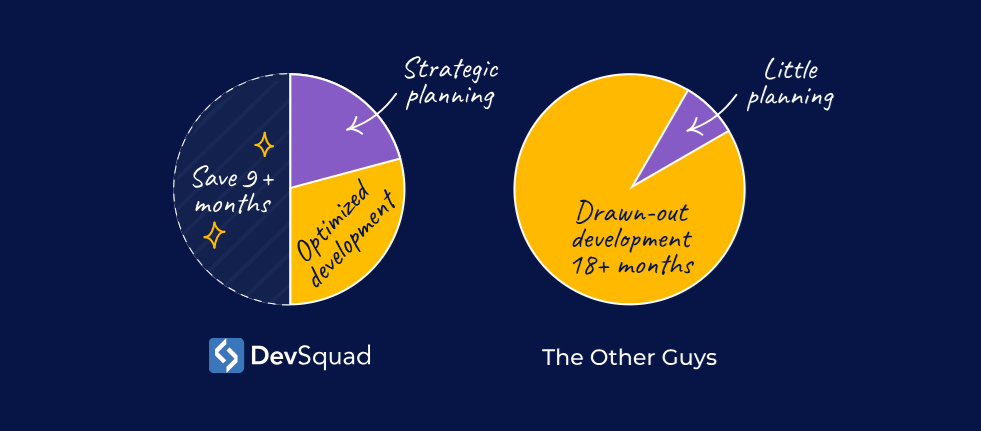
At DevSquad, we take the opposite approach. We spend more time upfront on discovery, planning, and product strategy so we can reduce waste during development. Strong planning keeps projects focused, timelines predictable, and costs under control.
Hidden costs of SaaS tools
SaaS tools introduce their own inefficiencies. You often pay for features you don’t use, while still missing the functionality you actually need.
Integrations create friction. Tools don’t always connect cleanly, which leads to manual workarounds and data inconsistencies.
Workflow inefficiencies slow teams down. Instead of supporting your processes, SaaS forces your team to adapt to the tool.
As you scale, costs rise. More users, more tools, and more complexity increase your monthly spend.
What you really need to know is that the cheapest option upfront is rarely the cheapest long-term. What matters most is developing the right software for your business.
Build vs buy in 2026: when custom software is actually cheaper
For years, the default advice was simple: buy software whenever possible. Building was seen as expensive, slow, and risky. That advice made sense in a different era.
Today, the economics have changed. AI speeds up development. Modern frameworks reduce complexity. And SaaS costs have quietly exploded across most organizations.
The real question is no longer “build or buy.” It’s: where does each approach actually make financial sense?
When SaaS makes sense
SaaS still works well for commodity tools. Email platforms, basic CRMs, accounting software—these don’t need customization to deliver value.
These tools solve standardized problems. You don’t gain a competitive edge by rebuilding them, and the cost to do so rarely makes sense.
In these cases, SaaS remains the most efficient option.
When custom development wins
Custom software becomes the better investment when the problem is specific to your business. Internal workflows are the biggest opportunity.
Most companies rely on a patchwork of tools to manage operations. Each tool solves one piece of the problem, but none solve the whole system. That fragmentation creates inefficiency.
Custom software consolidates those workflows. Instead of forcing your team to adapt to tools, the software adapts to your business.
It also creates differentiation. If your process gives you an edge, your software should reflect that. SaaS can’t deliver that level of alignment.
Cost comparison framework
SaaS looks cheaper because costs start small. But subscription stacking changes the equation over time.
Multiple subscriptions add up quickly (per user, per month)
Integration costs increase as your stack grows
Teams lose time switching between tools and managing workflows
Scaling requires upgrading plans, adding seats, and expanding usage
Custom software flips that model. You invest upfront, then manage ongoing maintenance at a lower, more predictable cost.
One system replaces multiple tools
Workflows match your business instead of forcing adaptation
Fewer integrations reduce complexity
Costs stabilize after the initial build
The real multiplier is efficiency. If your team saves even a few hours per week, that time compounds across the organization. Productivity gains often outweigh development costs.
At DevSquad, we help companies make this shift with confidence. Custom software should be viewed as operational leverage.
How AI is changing software development costs (without eliminating them)
AI has changed software development faster than most companies expected. But it hasn’t eliminated costs—it has shifted where those costs live.
Think of AI as a cost multiplier. It reduces the time it takes to execute, but it doesn’t remove the need for clear direction. If anything, it makes good decisions more valuable and bad decisions more expensive.
Key insights from Anthropic research
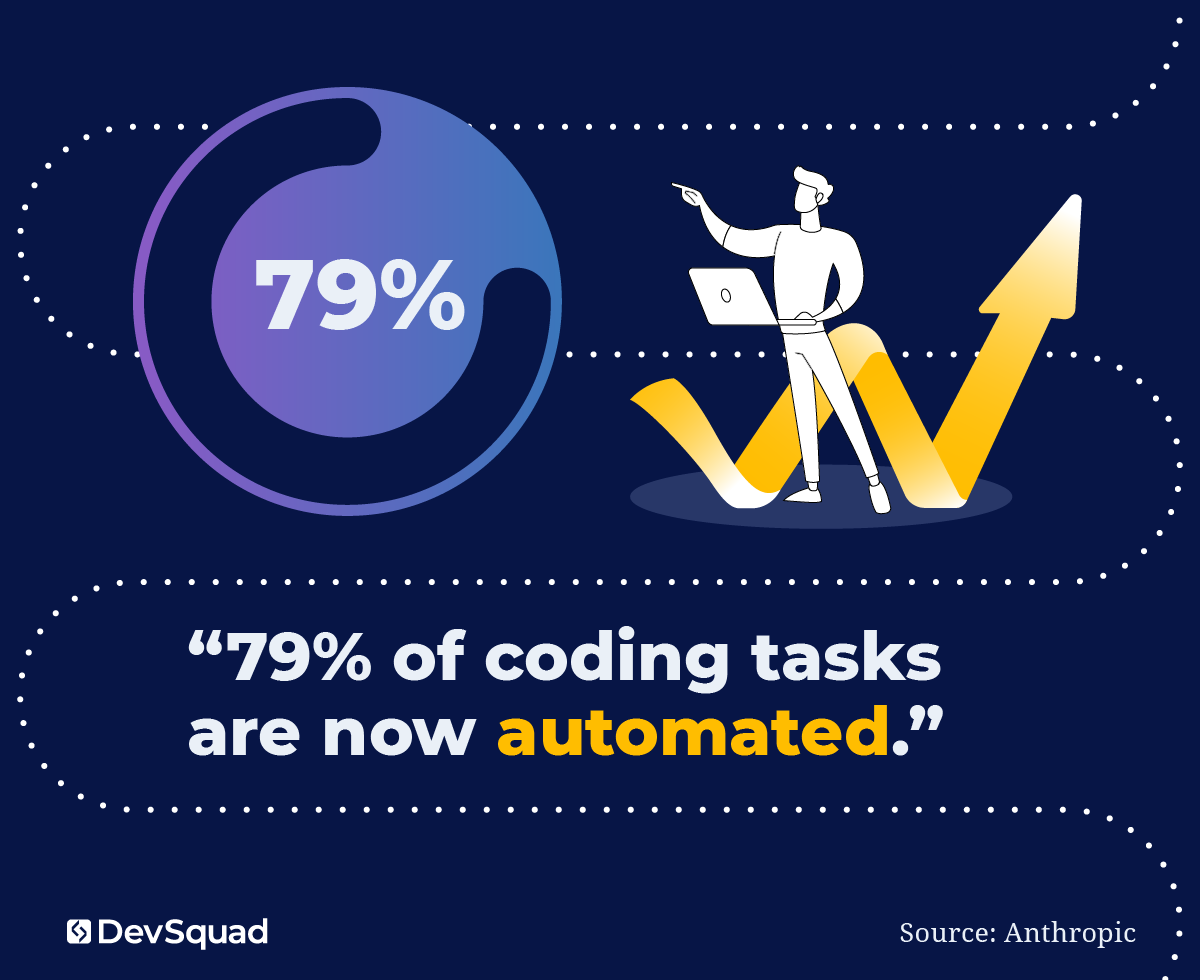
Recent research from Anthropic shows how quickly AI is reshaping development workflows. In some cases, up to 79% of coding tasks are now automated, especially when developers use specialized tools and agents (see the research here:).
The data also shows where AI is most effective. Developers use it heavily for UI components and application development, where patterns are easier to generate and reuse.
Adoption isn’t evenly distributed. Startups are moving faster, using AI to build and iterate quickly, while larger enterprises take a more cautious approach.
There’s also a clear financial expectation forming. According to GoodFirms, 61% of respondents expect AI to reduce software project budgets by 10–25%. For non-software businesses, the savings can be even higher because they start with less efficient processes.
What this means for costs
AI changes the cost structure of development in a few key ways:
Faster development cycles mean shorter timelines and quicker releases
Lower cost per feature as repetitive tasks get automated
Smaller teams can deliver the same output with the right tools
This creates real savings. Projects that once required large teams and long timelines can now move with fewer people and tighter scopes.
But what AI does NOT replace
AI improves execution, but it doesn’t replace critical thinking. The most important parts of development still rely on human expertise:
Product strategy and defining what to build
UX thinking and designing how it should work
Architecture decisions that impact scalability and performance
Ongoing iteration based on real user feedback
If these areas are weak, AI will simply help you build the wrong thing faster.
At DevSquad, we see this shift clearly. AI reduces execution cost, but it increases the importance of getting the product right. That’s why we dedicate more time to planning, discovery, and strategy—and less time to wasted development.
How to capitalize software development costs (and why it matters)
Most CEOs treat software development as an expense. That mindset limits how you evaluate cost and ROI. In reality, custom software can function more like an asset—if you structure it correctly.
Understanding capitalization changes how you compare build vs buy.
What it means to capitalize software development costs
Capitalizing software development costs means you record them as an asset on your balance sheet instead of an immediate expense. You don’t take the full hit upfront.
Instead, you spread the cost over time. This aligns the expense with the value the software delivers to your business.
What costs can be capitalized
Not every part of development qualifies. But once a project moves past early exploration, many costs can be included.
Development labor tied directly to building the product
Design and testing work during the implementation phase
These costs contribute to creating a usable asset, which is why they can be capitalized.
What cannot be capitalized
Early-stage work typically doesn’t qualify. That includes:
Research and discovery efforts
Ongoing maintenance and support after launch
These activities don’t create a standalone asset. They support the process, but accounting rules treat them as expenses.
Amortization basics
Once you capitalize software, you amortize it. That means you spread the cost over a defined period, often several years.
This reduces the impact on your financial statements. Instead of a large one-time expense, you recognize smaller costs over time. It creates a more accurate picture of profitability.
Why this changes the decision
This is where the economics shift.
SaaS subscriptions remain operating expenses. You pay every month, and the cost never goes away.
Custom software development costs are different. You invest upfront, then treat that investment as an asset that delivers value over time.
That distinction matters. It changes cash flow, financial reporting, and long-term ROI. More importantly, it reframes software development from a cost center into a strategic investment.
5 ways to reduce software development costs without sacrificing quality
Cutting costs in software development doesn’t mean cutting corners. It means making better decisions earlier and executing with discipline. The companies that win don’t spend less—they waste less.
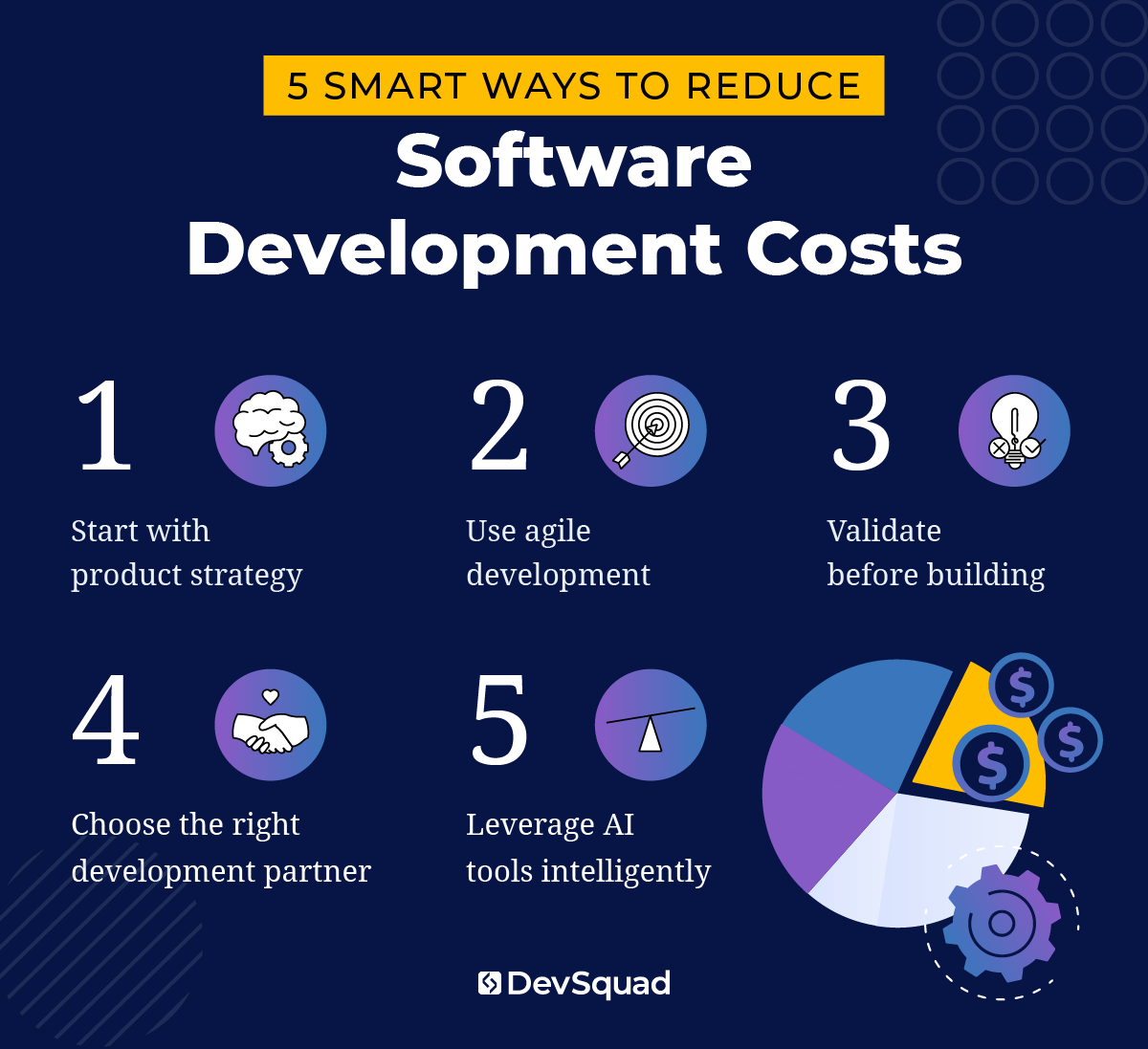
1. Start with product strategy
Most wasted development spend comes from building the wrong thing. If your product strategy is unclear, every sprint becomes a gamble.
A strong strategy aligns your team before a single line of code gets written. It defines the problem, the user, and the outcome.
Identify the core problem you’re solving
Define your ideal user and their workflow
Prioritize features based on real value, not assumptions
If you skip this step, you pay for it later in rework and missed opportunities. Learn more about building a strong product strategy.
2. Use agile development
Agile reduces waste by breaking work into smaller, testable pieces. Instead of betting everything on one big release, you iterate and improve continuously.
This approach helps teams adapt quickly. You catch mistakes earlier, adjust priorities, and avoid investing heavily in the wrong direction.
Agile also creates visibility. Everyone understands what’s being built and why, which keeps teams aligned and efficient. Explore the most critical agile product development practices.
3. Validate before building
You don’t need a full product to test an idea. Prototyping lets you validate concepts quickly and cheaply.
User feedback at this stage saves thousands in development costs. It also prevents you from launching features no one wants.
Create low-fidelity prototypes to test ideas early
Run user interviews to gather honest feedback
Iterate on concepts before committing to development
Validation reduces risk. It turns assumptions into data. See how low-fidelity prototyping can accelerate this process.
4. Choose the right development partner
The wrong partner increases costs, even if their rates look lower. Execution without ownership leads to misalignment, delays, and rework.
You want a partner who thinks strategically. Someone who challenges ideas, improves solutions, and takes responsibility for outcomes.
Look for teams that bring product, design, and engineering together. That combination reduces handoff friction and improves decision-making. Here’s how to evaluate software development agencies.
5. Leverage AI tools intelligently
AI can dramatically reduce development time. But it works best when paired with strong human judgment.
Use AI to speed up execution, not to replace thinking. It can generate code, assist with testing, and accelerate repetitive tasks.
At DevSquad, we integrate AI into our workflows to move faster and reduce costs. But we never rely on it to make product decisions. We focus on planning, strategy, and user experience first—because building the right product will always matter more than building it faster.
Choosing the right model for your business
There’s no one-size-fits-all answer. The right model depends on what you’re building and why it matters to your business.
Start by asking a few key questions. Is this a core workflow or a commodity function? Will building this create a real competitive advantage, or just replicate something that already exists? How much are you currently spending on SaaS—and what inefficiencies come with it? Do you need flexibility and scalability that off-the-shelf tools can’t provide?
Your answers will point you in the right direction. SaaS works best for standardized needs. In-house teams make sense when software is central to your business and you can support long-term investment. Agencies offer the fastest path when you need expertise, speed, and flexibility without the overhead.
The goal isn’t to pick one model forever. It’s about choosing the right model for the problem in front of you.
Software development costs FAQ
How much does software development cost in 2026?
Software development costs in 2026 typically range from $30,000 to $100,000 for small to mid-sized projects. More complex builds with AI, integrations, or custom workflows often range from $50,000 to $200,000+, depending on scope, team size, and timeline.
What are the average software development costs for a small business?
Small businesses usually spend between $30,000 and $100,000 on custom software. Costs depend on feature complexity, integrations, and design needs. Many companies start smaller with MVPs, then invest more over time as they validate and expand the product.
Is it cheaper to build or buy software?
Buying software is cheaper upfront, but building can be more cost-effective long term. SaaS subscriptions add up, especially with multiple tools. Custom software reduces inefficiencies, replaces several systems, and creates lasting value tailored to your business.
What are the hidden costs of software development?
Hidden costs include rework from poor planning, misaligned teams, and ongoing maintenance. For SaaS, hidden costs come from unused features, integrations, and workflow inefficiencies. These costs often exceed initial estimates and significantly impact long-term ROI.
Can software development costs be capitalized?
Yes, many development costs can be capitalized once a project moves beyond research. This includes engineering, design, and testing tied to building the product. Capitalization allows businesses to treat software as an asset instead of an immediate expense.
How long does it take to amortize software development costs
Software development costs are typically amortized over 3 to 5 years, depending on the expected useful life of the product. This spreads the expense over time, aligning costs with the value the software delivers to the business.
How is AI reducing software development costs?
AI reduces software development costs by automating repetitive coding tasks, speeding up development cycles, and allowing smaller teams to deliver more. It lowers the cost per feature, but still requires human oversight for strategy, design, and architecture decisions.
Should startups build internal tools or use SaaS?
Startups should use SaaS for standard functions like email or CRM, but consider building internal tools for unique workflows. Custom tools can replace multiple subscriptions, improve efficiency, and create competitive advantages as the business scales.
The new economics of software development
Software decisions are no longer about build vs buy. They’re about short-term expense vs long-term leverage.
Companies that rethink software development costs will outperform competitors. The winners will combine custom development, strong product strategy, and AI-assisted execution to build systems that scale, adapt, and create lasting operational advantage.
Learn more about our custom software development services.

Dayana Mayfield is a SaaS copywriter and content marketer specializing in SaaS marketing, positioning, and go-to-market strategy. She has consulted for over 195 SaaS companies, focusing on both traffic and conversions. She has been featured in Entrepreneur, Forbes, and Business Insider. Outside of work, Dayana writes SciFi novels and spends her evenings surviving auditions, rehearsals, and tech week as a proud theater mom.