
Hand your software build to the wrong outsourcing partner, and you can spend a year of budget on a system your team won't use. For operating businesses, the best custom software development companies in 2027 are DevSquad, Atomic Object, thoughtbot, Six Feet Up, and Goji Labs. DevSquad maps your operation and cuts the scope before a monthly team builds anything. Atomic Object staffs every project with senior people based in the US. thoughtbot builds in Rails while training your own engineers, and Six Feet Up specializes in complex Python and AI systems. Goji Labs helps established companies decide what to fix before they fund a rebuild.
You're not early, either. 35% of teams surveyed by Retool have already replaced at least one SaaS tool with a custom build. And 78% expect to build more custom internal tools in 2026. Even so, the right partner depends more on your situation than on anyone's ranking. A boutique firm gives you senior people and strategic input, while a larger firm like Simform or 10Pearls gives you scale at lower hourly rates. And because DevSquad wrote this list and put itself first, we held ourselves to the same evidence as every other company here.
Below, you'll find a side-by-side comparison table and the exact method we used to choose and rank each company. Each of the nine entries shows what the minimum budget buys, how the first weeks run, one result you can verify, and what clients criticize. After the rankings, a short guide matches companies to common situations. Then you'll get five questions to ask before you sign, plus answers to common questions about cost, timelines, and code ownership.
Custom software development companies compared at a glance
Start here to cut your options to two or three firms. Every figure comes from the company's Clutch profile, its own site, or its published case studies.
Company | HQ | Best for | Team model | Starting budget | Clutch rating |
DevSquad | Murray (Salt Lake City), Utah | Operators replacing SaaS and spreadsheets | Rapid Prototyping, then monthly squad | Month to month, scoped after Rapid Prototyping | 5.0 (2 reviews) |
Atomic Object | Grand Rapids, Michigan | US-only senior teams | Employee-owned consultancy teams | $25,000+ min; $150 to $199/hr | 4.9 (52) |
thoughtbot | New York (plus London) | Rails builds that train your team | Senior team embedded with yours | $10,000+ min; $150 to $199/hr | 4.9 (39) |
Six Feet Up | Fishers, Indiana | Python and AI-heavy systems | Small senior specialist team | $50,000+ min; $200 to $300/hr | 5.0 (27) |
Goji Labs | Los Angeles (plus New York) | Reworking platforms already in market | Strategy Sprint, then design and build | $50,000+ min; $150 to $199/hr | 5.0 (91) |
Saritasa | Irvine, California | Field and hardware-linked operations | Full-cycle team with a written plan | $50,000+ min; $100 to $149/hr | 4.8 (108) |
Designli | Greenville, South Carolina | Non-technical owners launching software | Small dedicated pod | $10,000+ min; $50 to $99/hr | 5.0 (83) |
Simform | Orlando, Florida | Mid-market cloud capacity | Dedicated teams, India delivery | $25,000+ min; $25 to $49/hr | 4.8 (86) |
10Pearls | Vienna, Virginia | Large regulated programs | Enterprise delivery teams | $50,000+ min; $25 to $49/hr | 4.9 (36) |
We update this list quarterly.
How we selected these custom software development companies (and why DevSquad is on its own list)
DevSquad wrote this list and ranks itself first. So hold us to the same three sources and the same weights as everyone else, and judge the result yourself.
I wrote this list knowing you'd discount the company at the top, and you should. Judge us on the same evidence as the other eight, and if one of them fits your business better, hire them.
Our three-source standard
Every company on this list had to pass the same check. First, its verified Clutch reviews, complaints included. Second, its own site, pricing, or process page. Third, at least one case study or client review with a specific outcome.
Homepages and logo walls didn't count as evidence. A list of famous clients tells you who signed a contract once. It doesn't tell you what got built, or whether it worked.
Where we couldn't confirm a figure, the entry says so. You'll see a few of those below. We'd rather show you a gap than fill it with a guess.
How we weighted each company
These weights reflect what an operating business needs from a partner, not what a funded startup needs.
Criterion | Weight | What we looked for |
Discovery and business-process fit | 25% | A defined step to learn your operation before quoting a build |
Verifiable delivery for operating businesses | 25% | Named or reviewed builds with an outcome, not just a launch |
Who actually does the work | 15% | Senior team, named roles, clear location |
Pricing transparency | 15% | Published minimums, rates, or packages |
Post-launch support and exit terms | 10% | Maintenance options, code ownership, help bringing work in-house |
Review evidence, including criticism | 10% | Review volume, recency, and recurring complaints |
Discovery carries the most weight for one reason. The most expensive mistake in custom software is building the wrong thing well.
"Some clients hand us every technical decision, from architecture to databases to servers, because reliability is the whole product. That kind of trust is earned by telling clients no. We work as consultants, so when a direction is wrong, we say it." — Vitor Carnello, Product Manager, DevSquad
Who we left out, and why
You'll see EPAM, BairesDev, ScienceSoft, Intellectsoft, and Toptal on other lists. They're capable firms. For a Fortune 500 program, or when you already have strong in-house product leadership, they can be the right call.
They're missing here for one reason. These firms mainly sell engineering capacity, so architecture, scope, and delivery risk usually stay with you. Toptal, for example, connects you with vetted freelancers, and you manage them yourself.
One respected boutique didn't make the cut for a different reason. Chicago's 8th Light has a strong reputation for modernizing risky code. But its Clutch profile has a single review and a $250,000 minimum, and we couldn't confirm a recent outcome. Under our three-source standard, that's not enough evidence to rank it.
I've watched operators hire twenty developers from a big outsourcing firm and still have nobody who owns the roadmap. Headcount isn't a product strategy.
Simform and 10Pearls made the list anyway. They're the scale options, for buyers who need a large team with a US headquarters. Want the wider field? See our broader list of software development agencies.
Our disclosure
DevSquad wrote this list and ranks itself first. No company paid for placement, and no company saw its entry before publishing. Entries 2 to 9 are ordered by the weights above. Ratings and minimums change, so check each Clutch profile before you sign.
The 9 best custom software development companies for 2027
Every entry follows the same format, so you can compare like for like. You'll see what it costs to start, how the first weeks run, and one result you can check. Then what clients praise and criticize, and who should skip that company. Each one ends with a link to the company's Clutch profile.
1. DevSquad: best for operating businesses replacing SaaS and spreadsheets
The best choice when you want someone to map your operation and cut the scope before a monthly squad builds it.
Founded | 2014 |
Team | Squads of 2 to 6 developers, plus QA and DevOps |
Engagement model | Starts with Rapid Prototyping, then month to month |
Monthly squads | Sized to your roadmap (UX/UI included, cancel anytime) |
Clutch rating | 5.0 (2 reviews, 2018) |
DevSquad has launched 100+ products and tools for custom software development clients.
What it takes to start. Rapid Prototyping comes first, and it ends with a decision, not a half-built product.
How the first weeks run. Rapid Prototyping is Phase 1. A Solutions Architect, Technical Product Manager, and Tech Lead define the problem and your users. You get a clickable prototype, a technical architecture, and a prioritized roadmap. Duration depends on complexity. A build squad follows, led by a technical product manager, with developers based in Latin America.
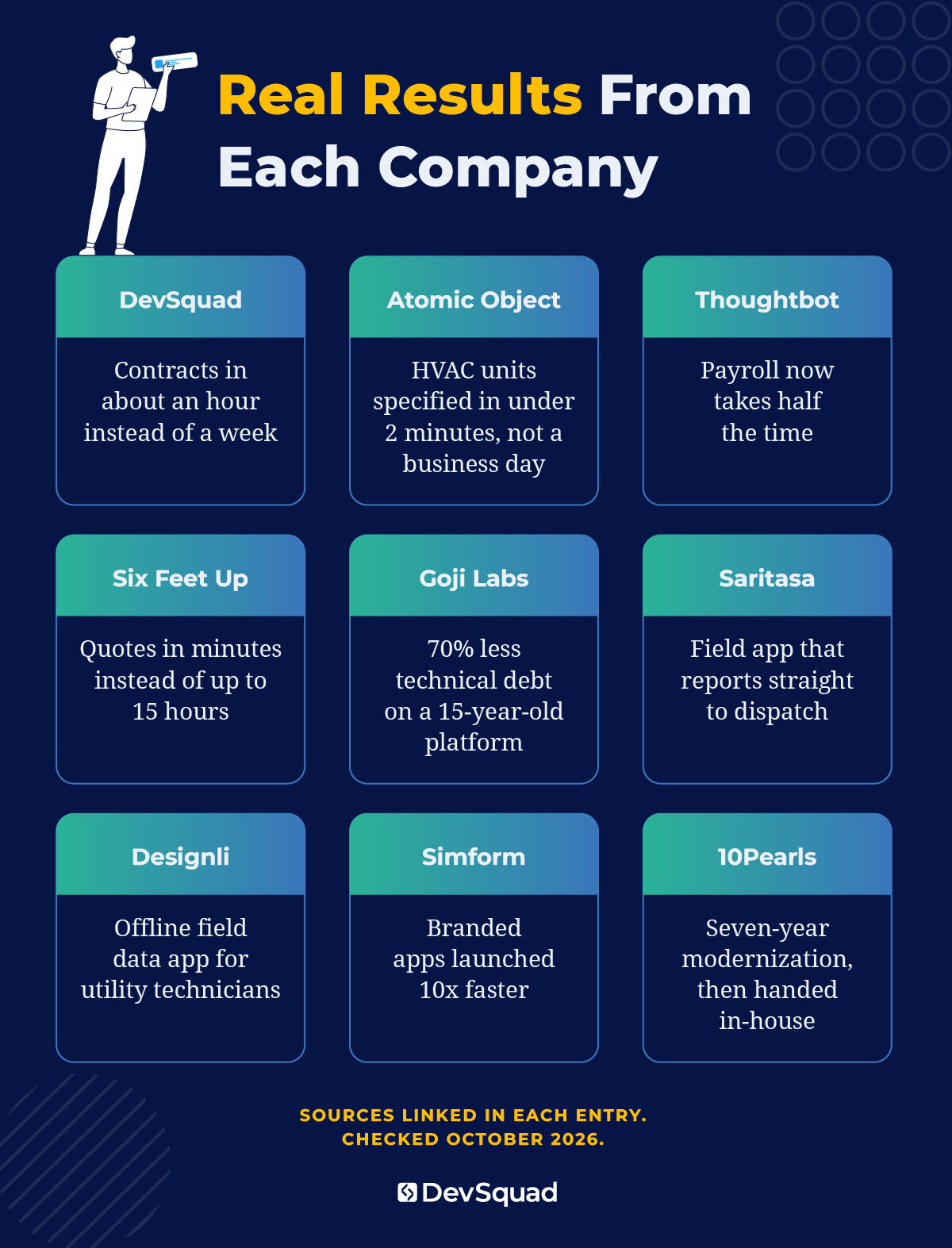
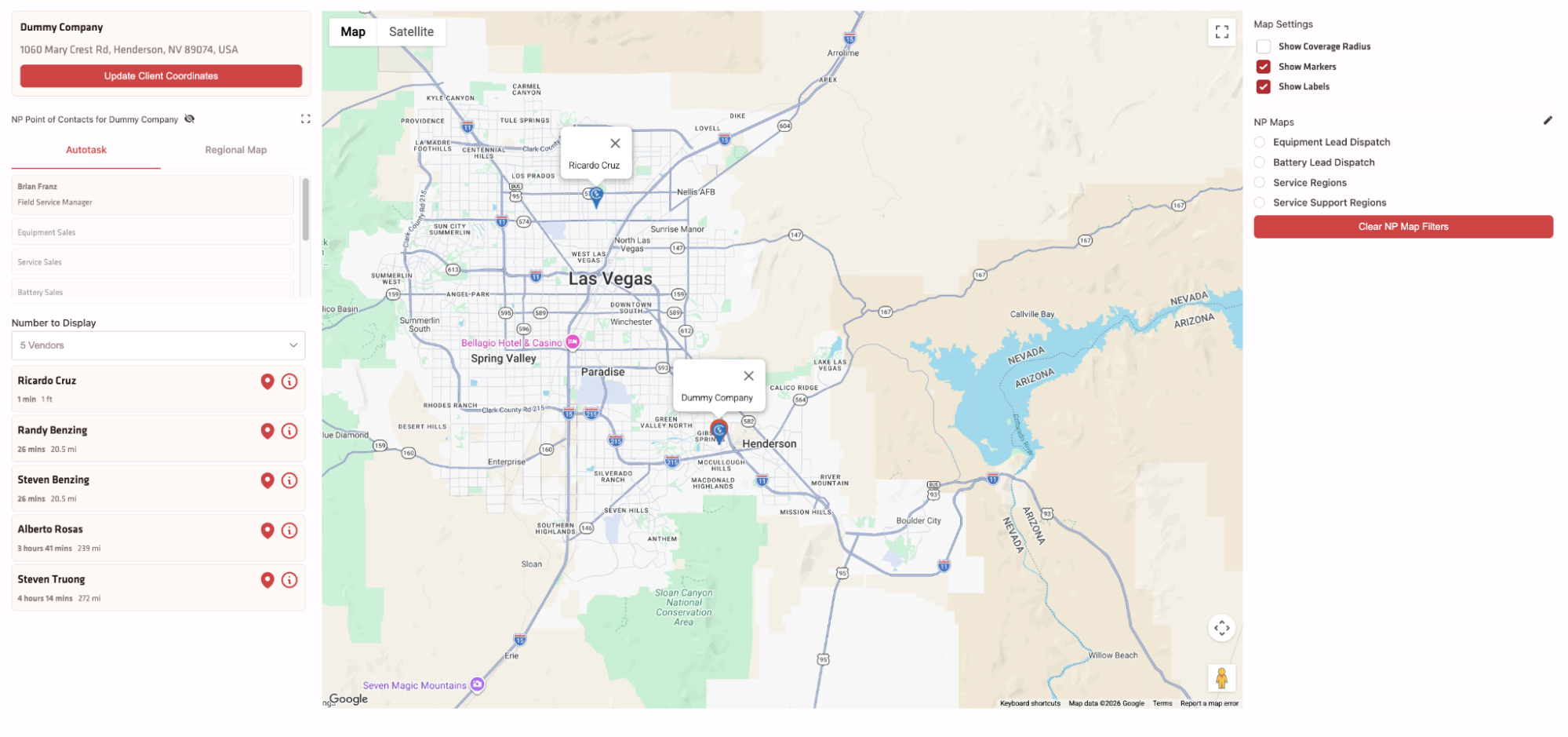
Proof. Nationwide Power runs battery systems for energy infrastructure across the US. It was paying per API request for a platform that couldn't run the business. A previous agency started a replacement and couldn't finish it. DevSquad moved every operational process into a custom platform and reduced the old tool to an archive connected by API. Contracts that took about a week now take about an hour. The full quote cycle dropped from one to two weeks to about three days.
 Helinet Aviation and Runway Fashion Exchange made similar moves away from software that didn't fit. Helinet replaced its off-the-shelf aviation platform, reached production in 7 months, and stopped paying for the old subscription. Runway now runs 15+ franchise stores on one platform, and DevSquad estimates staff spend about 80% less time pricing each item.
Who it's built for. DevSquad's case studies are operating businesses, not just startups: an energy services company, a helicopter operator, a clothing resale franchise. Each one was paying for software that didn't match how the business actually worked. The build started with that mismatch, not with a feature list.
What clients say. One Clutch reviewer called DevSquad the most transparent team he'd worked with. Another said the lead developer talked them out of features they didn't need, which saved money. The criticism: that client said the team initially struggled to keep track of project details until DevSquad added a dedicated person. Both reviews date from 2018, so read DevSquad's client reviews for the fuller, more recent record.
Choose DevSquad if you're replacing a stack of subscriptions or spreadsheets and want the scope challenged before you pay for a build.
Skip DevSquad if you want a fixed-price quote for a spec you've already written, or you need developers in a US office.
Sources: DevSquad on Clutch · DevSquad reviews
2. Atomic Object: best for US-only senior teams
The pick when you want every engineer and designer in the United States, from an employee-owned firm that's done this for 25 years.
Founded | 2001 |
Team size | 50 to 249 |
Minimum project | $25,000+ |
Hourly rate | $150 to $199 |
Clutch rating | 4.9 (52 reviews) |
Atomic Object is headquartered in Grand Rapids, with offices in Ann Arbor, Chicago, and Raleigh.
What your minimum buys. At the top of the rate band, $25,000 covers about 125 hours. That's discovery and a first slice, not a full system.
How the first weeks run. Atomic builds in short cycles and meets you every one to two weeks to review working software. If you're not ready to build, it also runs roadmap-first engagements. One utility-coordination nonprofit got a five-week discovery that ended in a board-ready technical roadmap.
Proof. Mojave Energy Systems used to answer every HVAC quote request by email, through an engineer, in no less than a business day. Atomic built a web selection and quoting tool. Customers now fully specify a unit in under two minutes. The tool has 860+ users and 4,500+ units quoted.
What real projects cost. Atomic's most common Clutch project size is $50,000 to $199,999, based on 37 reviews. Reviewers report spending anywhere from $20,000 to over $2 million.
What clients say. Reviewers praise project management, communication, and honesty in estimates and billing. The recurring criticism: some clients wanted clearer scoping up front to avoid budget overruns. One said the proposed timeline turned out slightly aggressive.
Choose Atomic Object if US-based ownership of the work is non-negotiable for you.
Skip Atomic Object if your budget can't support US senior rates over several months.
Source: Atomic Object on Clutch
3. thoughtbot: best for Rails builds that leave your team stronger
The pick when you want senior Rails engineers who build alongside your team and teach it as they go.
Founded | 2003 |
Team size | 50 to 249 |
Minimum project | $10,000+ |
Hourly rate | $150 to $199 |
Clutch rating | 4.9 (39 reviews) |
thoughtbot is headquartered in New York, with an office in London. It's owned by a perpetual purpose trust.
What your minimum buys. At the top of the band, $10,000 is about 50 hours. That's a discovery sprint, not a build.
How the first weeks run. thoughtbot often opens with a two-week discovery sprint. One recent client came out of it with a working prototype, not just a plan. After that, senior engineers embed directly in your workflow.
Proof. Clara connects families with in-home caregivers. thoughtbot built a fully automated payroll system for its domestic employers, and payroll now takes half the time. For a public-health nonprofit, thoughtbot moved a live platform from Heroku to AWS without customer downtime. It also mentored the client's team until it needed only a few specialists.
What real projects cost. thoughtbot's most common Clutch project is under $50,000, based on 31 reviews. Custom software engagements run larger: $200,000 to $999,999 across 7 reviews.
What clients say. Reviewers praise maintainable code and the mentoring of in-house engineers. Several call the pricing high. One client found discovery ran longer than expected. Another said thoughtbot's own AWS tooling added ramp-up time for new hires.
Choose thoughtbot if you plan to build an in-house team and want it trained by the people who wrote the code.
Skip thoughtbot if you don't want a Rails stack, or budget is your first filter.
Source: thoughtbot on Clutch
4. Six Feet Up: best for Python and AI-heavy systems
The pick for complex Python and Django systems, especially when data or AI sits at the center of the build.
Founded | 1999 |
Team size | 10 to 49 |
Minimum project | $50,000+ |
Hourly rate | $200 to $300 |
Clutch rating | 5.0 (27 reviews) |
Six Feet Up is a woman-owned company based in Fishers, Indiana. About half its work is custom software and 30% is AI development.
What your minimum buys. This is the highest rate band on the list. At the top of it, $50,000 buys about 165 hours of senior specialist time.
How the first weeks run. Six Feet Up works in short design, build, and demo cycles. One client described reviewing mockups with both executives and everyday users until feedback shifted from core workflows to edge cases.
Proof. An HVAC asset-intelligence company used to build some quotes by hand in spreadsheets, taking up to 15 hours each. After Six Feet Up built its calculation engine, those quotes take minutes. For a global professional services firm, a new resource planning tool replaced a decade of spreadsheets. Weekly allocations dropped from 30 minutes per person to about five.
Why the price can still make sense. You're paying for a small team where every person is senior. On a system that has to stay reliable for years, fewer and better hands can cost less than a cheaper team that needs rework.
What clients say. Reviewers praise senior engineers, clear documentation for handoff, and fast pivots when plans change. The criticisms are small but real: one review insight says junior staff need closer oversight, and some deliverables ran long.
Choose Six Feet Up if your system lives in Python and you want senior people on it.
Skip Six Feet Up if your system isn't Python-based, or your budget sits under $50,000.
Source: Six Feet Up on Clutch
5. Goji Labs: best for reworking a platform that's already in market
The pick for an established company that wants a hard look at an existing product before spending on a rebuild.
Founded | 2014 |
Locations | Los Angeles and New York |
Minimum project | $50,000+ |
Hourly rate | $150 to $199 |
Clutch rating | 5.0 (91 reviews) |
Goji Labs' 91 five-star reviews are the largest perfect-score base on this list. Its clients include publicly traded and PE-backed companies.
What your minimum buys. About 250 hours at the top of the band, enough for discovery, design, and a first release of a focused tool.
How the first weeks run. Every engagement starts with a fixed-fee Strategy Sprint, typically $20,000 to $50,000 over two weeks. It ends with a build decision. If a build isn't the right move, Goji says so.
Proof. For PE-backed Intterra, Goji cut technical debt by 70% on a 15-year-old platform serving 350+ emergency-response agencies. For trucking company Gypsum Express, it replaced a truck-loading process run on paperwork and Excel with a web-based system.
Why design matters for internal tools. Software your team avoids is software you paid for twice. If staff fall back to spreadsheets because the new tool is clumsy, the build failed, however clean the code is.
What clients say. Reviewers praise communication and a team willing to say no to scope. The recurring criticism: some projects ran over budget or timeline as scope evolved. One client also wanted more detail in billing.
Choose Goji Labs if you have a product in market and need to decide what to fix before you fund a rebuild.
Skip Goji Labs if you just want a build team to execute a spec. Goji itself says build-only requests are a poor fit.
Source: Goji Labs on Clutch
6. Saritasa: best for field and hardware-linked operations
The pick for operations that run in trucks, on job sites, or through physical devices.
Founded | 2005 |
Team size | 50 to 249 |
Minimum project | $50,000+ |
Hourly rate | $100 to $149 |
Clutch rating | 4.8 (108 reviews) |
Saritasa is headquartered in Irvine, California, with offices in Manhattan Beach and Tampa.
What your minimum buys. About 335 hours at the top of the band. Among the US-priced firms here, that's the most build time per minimum dollar.
How the first weeks run. After requirements and design, Saritasa delivers a written Development Plan with the timeline and approach before development begins. Its custom software packages start at $60,000 and include discovery, design, QA, and DevOps. Initial engagements typically run four to six months.
Proof. B.T. Trucking hauls dirt, sand, and gravel for contractors across California. Saritasa built an iOS and Android app that tracks haulers in the field and relays updates to dispatch. When the client tightened its deadline, Saritasa added developers to hit it. The client reported never getting a surprise bill.
What real projects cost. Clutch reviewers report investments from $5,000 to over $1 million. The most common range is $50,000 to $199,999, based on 91 reviews.
What clients say. Reviewers praise timeliness and flexibility. One client's budget froze for six months, and Saritasa picked up where it left off. The criticism: some clients say early scoping and cost estimates came in low.
Choose Saritasa if your operation happens on job sites and in vehicles, not just at desks.
Skip Saritasa if your first estimate has to be your final number.
Source: Saritasa on Clutch
7. Designli: best for non-technical owners launching software
The pick for an owner without a technical background who wants guarantees written into the engagement.
Founded | 2013 |
Team size | 50 to 249 |
Minimum project | $10,000+ |
Hourly rate | $50 to $99 |
Clutch rating | 5.0 (83 reviews) |
Designli is headquartered in Greenville, South Carolina. It also has locations in San Francisco, Dallas, Buenos Aires, and Mexico City. Its focus has moved toward non-technical founders building SaaS, so its fit for back-office tools is narrower than the firms above.
What your minimum buys. About 100 hours at the top of the band, enough for its planning phase and early design.
How the first weeks run. Designli's TractionLab promises a real user on a working first version within 30 days, or the next month is free. The 90-day program costs $93,450. Your first 14 days are fully refundable, and you can cancel with 30 days' notice.
Proof. NexGen Utility Solutions needed a field data app after its previous developer folded. Designli built a native iOS app that captures GPS coordinates and barcodes and works offline in poor coverage. The client reported that its technicians love using it.
What real projects cost. The most common Designli project on Clutch is under $50,000, based on 69 reviews.
What clients say. Non-technical owners praise weekly written reports and plain explanations of tradeoffs. One review insight suggests the visual design could track current trends more closely.
Choose Designli if you're non-technical and want the risk of the first month on the agency.
Skip Designli if your build is mostly integrations and back-office data, not a product people log into.
Source: Designli on Clutch
8. Simform: best for mid-market companies that need cloud capacity
The pick when you need a large team on AWS or Azure at offshore rates, with US account management.
Founded | 2010 |
Team size | 1,000 to 9,999 |
Minimum project | $25,000+ |
Hourly rate | $25 to $49 |
Clutch rating | 4.8 (86 reviews) |
Simform is headquartered in Orlando, Florida, with its main development center in Ahmedabad, India.
What your minimum buys. About 510 hours at the top of the band, among the most raw hours on this list.
How the first weeks run. Simform describes a co-engineering model, where its engineers work alongside your team rather than behind a handoff.
Proof. For Digital Natives, Simform consolidated separate branded apps into one Azure codebase. The company now launches branded apps 10x faster.
Credentials. Simform holds AWS SaaS Competency status and is an Azure Expert Managed Services Provider. It reports an average engagement length of two years.
What clients say. Reviewers praise structured project management and value. Some mention time zone and cultural challenges.
Choose Simform if you already know what to build and need engineering hours at scale.
Skip Simform if you need strategy and process mapping more than engineering capacity.
Source: Simform on Clutch
9. 10Pearls: best for large, regulated programs that need a US-headquartered partner
The pick for larger organizations in healthcare or financial services that want enterprise scale with a US head office.
Founded | 2004 |
Team size | 1,000 to 9,999 |
Minimum project | $50,000+ |
Hourly rate | $25 to $49 |
Clutch rating | 4.9 (36 reviews) |
10Pearls is headquartered in Vienna, Virginia, with delivery teams across Latin America, Pakistan, and London.
What your minimum buys. About 1,000 hours at the top of the band. Reviewers' actual projects run far larger, as shown below.
How the first weeks run. One healthcare client described a two-day design studio with 30 of its stakeholders. Wireframes and a clickable demo came next, before full development.
Proof. A global consulting firm used 10Pearls for seven years to modernize its trial-presentation software. It then brought development in-house. 10Pearls also helped AARP modernize its caregiver program with a web and mobile platform.
What real projects cost. The most common 10Pearls project on Clutch is $200,000 to $999,999, based on 29 reviews.
What clients say. Reviewers praise flexibility and strong project management. The criticisms: some early engagements had onboarding friction, and one long-term client saw point-of-contact turnover.
Choose 10Pearls if you're running a large program with compliance requirements.
Skip 10Pearls if you're a mid-market company with a budget under six figures.
Source: 10Pearls on Clutch
Which company fits your situation
Rank matters less than fit. A firm at #6 can be the right choice for your project, and #1 can be wrong.
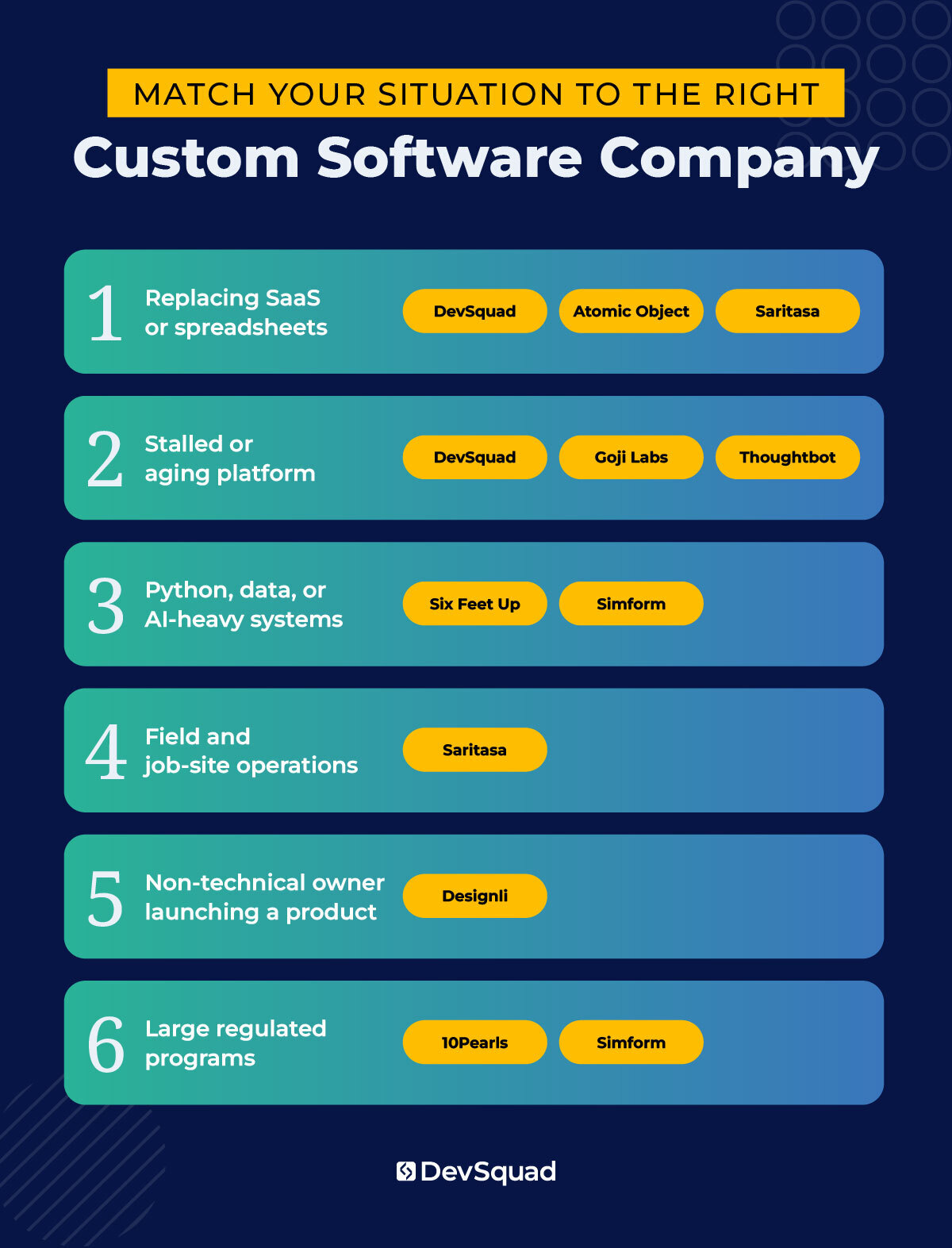
If you're replacing SaaS subscriptions with internal tools, or retiring a pile of spreadsheets, start with DevSquad, Atomic Object, and Saritasa. All three have shown work on systems that run a business day to day.
Is a previous build stalled, half-finished, or aging badly? Look at DevSquad, Goji Labs, and thoughtbot. DevSquad finished the platform Nationwide Power's previous agency couldn't. Goji cut technical debt by 70% on a 15-year-old platform. thoughtbot migrated a live system to AWS without downtime.
Your system is built in Python, or data and AI are the core of it? Six Feet Up and Simform are the strongest fits.
Is your work in vehicles and on job sites? Saritasa has built field apps that report straight back to dispatch. Are you a non-technical owner launching a product? Designli writes guarantees into the first 30 days.
For large regulated programs, 10Pearls and Simform bring the scale.
Building a SaaS product or an MVP instead? Different lists answer that better: see the best SaaS development companies and best MVP development companies.
5 questions to ask before you sign
Every company on this list will sound good on a sales call. These questions show you the differences. Ask them word for word, and listen for the weak answers. For a fuller process, see how to vet a custom software development partner.
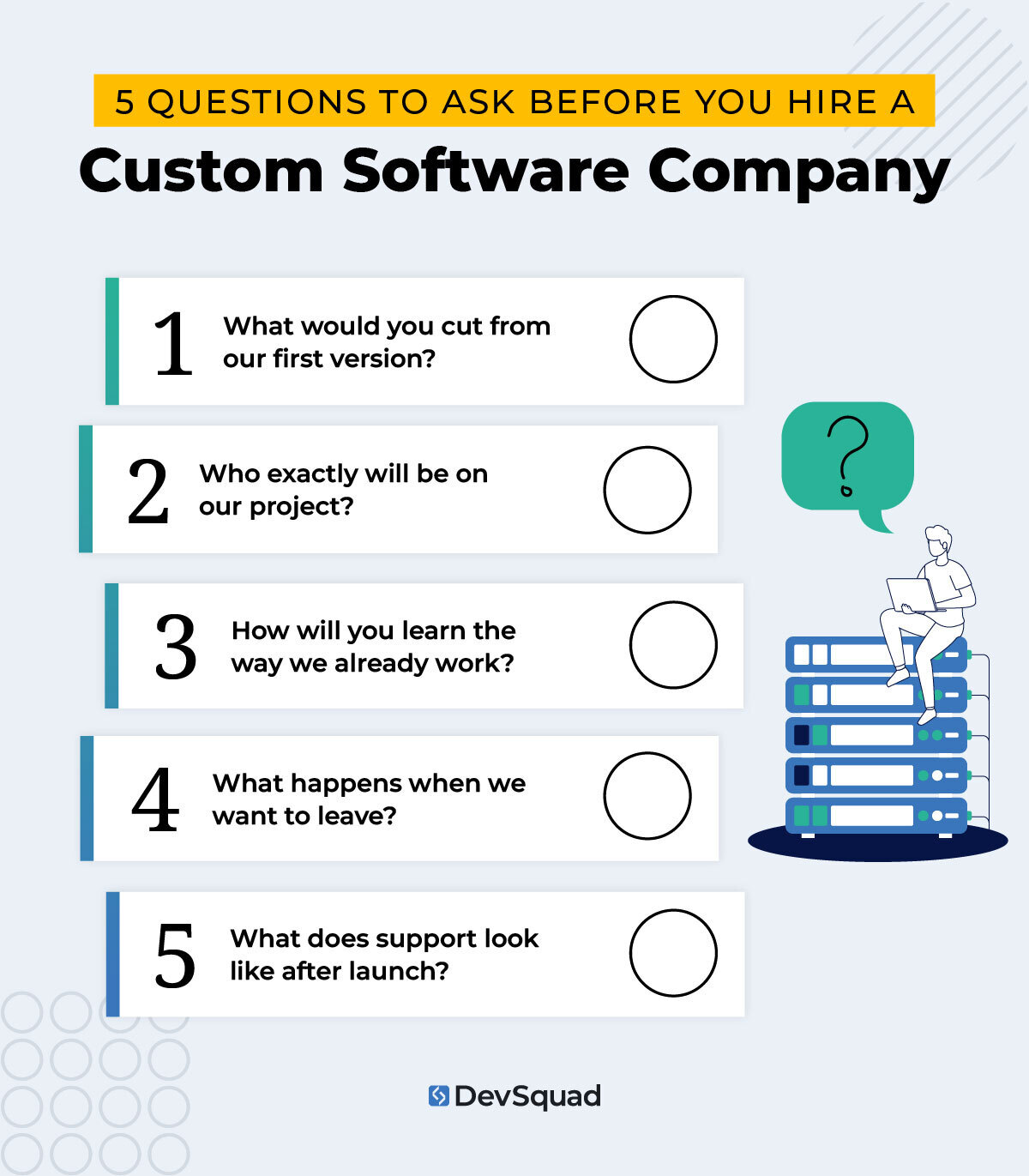
"What would you cut from our first version?"
A strong partner proposes a smaller first release and tells you why. A weak one quotes everything on your list, because a bigger scope is a bigger invoice.
The best question I hear on sales calls is "what would you cut?" If a firm can't answer it in the first meeting, they're quoting your spec, not your business.
Push for specifics. Which features would they hold back, and what would trigger building them later?
"Who exactly will be on our project?"
Ask for names, roles, seniority, and locations in writing. A pitch deck full of senior faces means nothing if juniors write your code.
A good answer names one person who owns the roadmap, such as a product manager or tech lead. A weak answer offers a coordinator who passes messages between you and the developers.
Then ask what happens if that person leaves mid-project. Who takes over, and how much of your context goes with them? A firm that has thought about this will answer quickly. One that hasn't will promise it won't happen.
"How will you learn the way we already work?"
Your current process probably works better than it looks. It just lives in the wrong places. A good partner studies it before redesigning anything, and a weak one jumps straight to features.
Listen for questions about your people, not your software. Who enters this data? Who checks it? What happens when it's wrong? Those questions mean the firm is mapping your operation.
"Your process often works fine. It just lives across a pile of spreadsheets. Our job is to study how your team uses them and move that same flow into one system, in the same order, with the same steps." — Sandro Boçon, Product Manager, DevSquad
"What happens when we want to leave?"
Ask who owns the code, the cloud accounts, and the documentation. Then ask whether the firm will help you bring the work in-house. A good partner treats your exit as a normal outcome.
The red flag is any part of your system that only runs on the vendor's own framework. That's a subscription with extra steps.
"Not every client needs to stay with us long term, and that's a good outcome. Some businesses need one custom system built well, and then they need us to be finished. If they can run it themselves after launch, we did the job right." — Caio Alves, Product Manager, DevSquad
"What does support look like after launch?"
Can you drop to a maintenance plan? Pause development between budget cycles? Scale the team up for a busy quarter? A good answer gives you options that match how your business spends money. A weak one assumes a permanent retainer.
Ask for an example from a current client. A firm with real post-launch options can name a business that moved to maintenance and came back later.
Custom software development companies FAQs
Starting budgets on this list range from a $10,000 minimum (thoughtbot, Designli) to $50,000+ (Six Feet Up, Goji Labs, Saritasa, 10Pearls). Hourly rates run from $25 to $300. DevSquad starts with Rapid Prototyping, then moves to a monthly squad scoped to your roadmap. For a full breakdown, see our guide to custom software development costs.
It depends on scope and how strict your rules are, not just the number of screens. As one example, Helinet Aviation's custom operations platform reached production in 7 months. It replaced an off-the-shelf system in a regulated industry. Ask every firm on your shortlist for a timeline from a comparable build, not a generic estimate.
Choose a boutique firm when you need strategy, process mapping, and senior people on your calls. Choose a large outsourcing company when you already know exactly what to build and have your own product leadership. The large firm sells capacity. The boutique firm should also own the thinking.
You should. Get it in writing before you sign: full ownership of the source code, documentation, and cloud accounts, transferred on payment. Watch for any framework or runtime the firm keeps a license to. If your system can't run without it, you don't fully own your software.
Yes, and it can be the smarter move. A good partner builds only the piece your current platform can't do, then connects the two. Your existing data stays where it lives. If you're weighing that path, our build vs. buy guide walks through it.
A staff augmentation firm rents you developers, and you manage them. A custom software development company owns the outcome: discovery, design, build, QA, and launch. If you don't have someone in-house who can run a development team, you need the second kind.
Start with the problem, not the vendor
The right custom software development company understands your operation before it talks about technology. Rank, review counts, and logo walls come second.
Here's a simple next step. Pick two or three firms from the situation map above. Ask each one the five questions. Compare the answers, not the pitch decks.
If DevSquad makes your shortlist, Rapid Prototyping is the low-risk way to test the fit. You'll leave with a prototype, an architecture, and a roadmap, whether you build with us or not. For a full development project, learn more about our approach to custom software.

Phil Alves is the CEO and Founder of DevSquad and DevStats. He’s built and launched 100+ software products for bootstrapped founders, fast-growing startups, and enterprises. Phil writes about SaaS, product strategy, operational complexity, and building scalable development processes. He enjoys aviation, investing, and learning from other SaaS founders.