
HR should not feel like damage control.
If your team is juggling spreadsheets, disconnected HR software solutions, manual approvals, and siloed data, the problem is not your people. It is your systems.
As your company grows, human resources software must support more complex workflows, tighter compliance requirements, and more advanced payroll and compensation structures.
Custom HR software gives you control. It allows you to build around your workflows, integrate with your existing tech stack, and create structured HR case management and reporting processes that actually reflect how your business operates.
This guide breaks down what custom HR software is, when to consider it, how to approach discovery, which frameworks to use, and which agencies can help you build it.
What is custom HR software?
Custom HR software is a human resources software platform built specifically for your organization’s workflows, policies, and growth plans.
Instead of forcing your team to adapt to a generic SaaS tool, custom HR software is designed around how your business actually operates. It connects your hiring, onboarding, payroll and compensation, performance management, compliance, and internal processes into one system that fits your structure.
Most small to medium businesses start with off-the-shelf HR software solutions. These tools work well at first. But as your team grows, processes get more complex. You may need:
Unique approval chains
Custom reporting for leadership
Specialized HR case management workflows
Integration with accounting, ERP, or CRM systems
Role-based access controls for compliance
At that point, patching together multiple systems becomes inefficient and risky.
Custom software development allows you to build a human resources software platform that matches your exact needs rather than bending your business around someone else’s product roadmap.
How custom HR software differs from off-the-shelf solutions
Off-the-shelf HR platforms are built for broad markets. They are designed to serve thousands of companies across different industries. That means they prioritize common features over tailored workflows.
Custom HR software is different in three important ways:
The software is built around your workflows
It integrates into your tech stack
When done right it is designed for long-term scalability
These three differentiators mean you define how it's going to work, what it will work with, and how it will evolve alongside your business operations. It becomes an extension of your operations and an asset to your businesses as a whole.
When does a business need custom HR software?
When should a business consider custom HR software?
Not every company needs fully custom HR software. But there are clear signs that off-the-shelf HR software solutions are starting to slow you down.
If your HR team spends more time managing tools than managing people, it is time to look at alternatives.
It’s also important to note that custom software development is not as cost-prohibitive as it once was. AI-assisted development, modern frameworks, and reusable components have significantly reduced build time. In many cases, the long-term cost of custom HR software is comparable to maintaining multiple SaaS subscriptions plus the operational inefficiencies that come with them.
You should consider custom HR software if:
You rely heavily on spreadsheets to fill feature gaps
You have manual processes for compliance tracking
Your payroll and compensation structure is complex
You manage frequent employee relations issues and need structured HR case management
You operate in a highly regulated industry
Your reporting needs go beyond standard dashboards
Your current human resources software does not integrate cleanly with accounting or ERP systems
When your systems are fragmented, your data is fragmented. Custom HR software gives you control over both.
7 significant use cases for a custom human resources software platform
Businesses rarely need custom HR software just for the sake of it. They need it because specific operational challenges are slowing them down, increasing risk, or limiting growth.
Below are seven high-impact use cases where a custom human resources software platform makes a measurable difference.
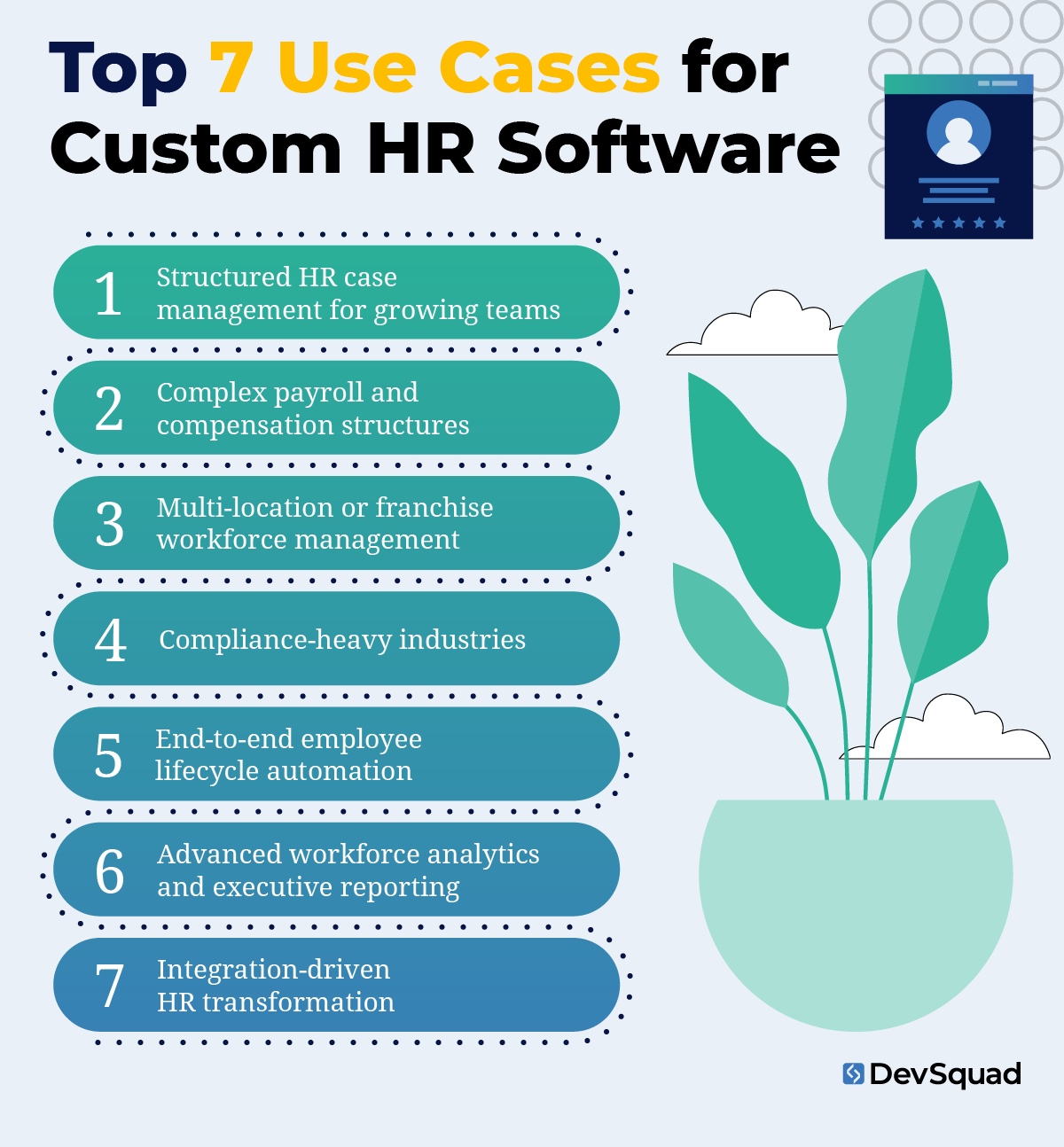
1. Structured HR case management for growing teams
As your company grows, employee relations issues become more frequent and more complex. Complaints, investigations, performance warnings, and policy violations need to be documented carefully.
Many SMBs still manage HR case management through email threads, shared folders, or spreadsheets.
That creates:
Inconsistent documentation
Missed follow-ups
Compliance exposure
Lack of visibility for leadership
A custom HR case management system can:
Standardize intake forms
Assign cases automatically
Track escalation paths
Store documentation securely
Generate compliance-ready reports
This protects your company and gives your HR team clarity instead of chaos.
2. Complex payroll and compensation structures
If you operate across multiple states, manage commissions, offer bonuses tied to performance metrics, or run multiple subsidiaries, standard payroll tools can fall short.
Custom HR software allows you to:
Automate unique payroll and compensation calculations
Connect performance data directly to incentive payouts
Manage location-specific tax logic
Integrate with accounting systems in real time
Instead of exporting data between platforms, your payroll and compensation processes live inside a controlled system built around your business model.
3. Multi-location or franchise workforce management
Businesses with multiple locations often struggle with inconsistent hiring, onboarding, and compliance processes.
A custom human resources software platform can:
Centralize policies while allowing location-specific controls
Standardize onboarding workflows
Track certifications and training across sites
Provide leadership with consolidated reporting
This gives executives visibility across the organization without forcing every location into rigid processes that do not fit their needs.
4. Compliance-heavy industries
Healthcare, finance, manufacturing, and government-adjacent organizations deal with strict documentation and audit requirements.
With custom software development, you can:
Automate required policy acknowledgments
Track mandatory certifications and expirations
Create audit-ready documentation trails
Trigger alerts for regulatory deadlines
Compliance becomes part of the system architecture, not an afterthought.
5. End-to-end employee lifecycle automation
Disconnected systems create friction at every stage of the employee journey.
Recruiting happens in one tool. Onboarding paperwork lives somewhere else. Performance reviews are tracked manually. Exit processes are inconsistent.
Custom HR software allows you to unify:
Recruiting pipelines
Offer approvals
Onboarding documentation
Performance reviews
Promotions and role changes
Offboarding workflows
By connecting the full lifecycle, your human resources software becomes a strategic asset instead of just an administrative tool.
6. Advanced workforce analytics and executive reporting
Leadership teams need more than headcount reports.
They want to understand:
Turnover trends by department
Compensation distribution
Time-to-hire metrics
Performance and retention correlations
Cost per employee
Custom HR software allows you to build reporting layers tailored to your KPIs. Data from payroll and compensation, recruiting, and HR case management can be consolidated into one executive view.
Better data leads to better decisions.
7. Integration-driven HR transformation
Many SMBs do not have a “bad” HR system. They have too many disconnected ones.
HR data may need to sync with:
ERP systems
Accounting platforms
Time tracking tools
Benefits providers
CRM systems
Identity and access management platforms
When these systems are loosely connected, manual reconciliation becomes the norm.
Custom software development allows you to treat integration as a core requirement. APIs, automation layers, and secure data flows are designed into the platform from the start.
This reduces errors, eliminates duplicate entry, and gives you a single source of truth.
The custom HR software solution discovery process
Discovery is the heart of every custom software build. Taking the time to truly understand what it is that your software is going to accomplish brings it to life.
A successful project starts with structured discovery. The goal is to understand your operations, risks, reporting needs, and long-term growth plans before development begins.
Here is what that process should include.
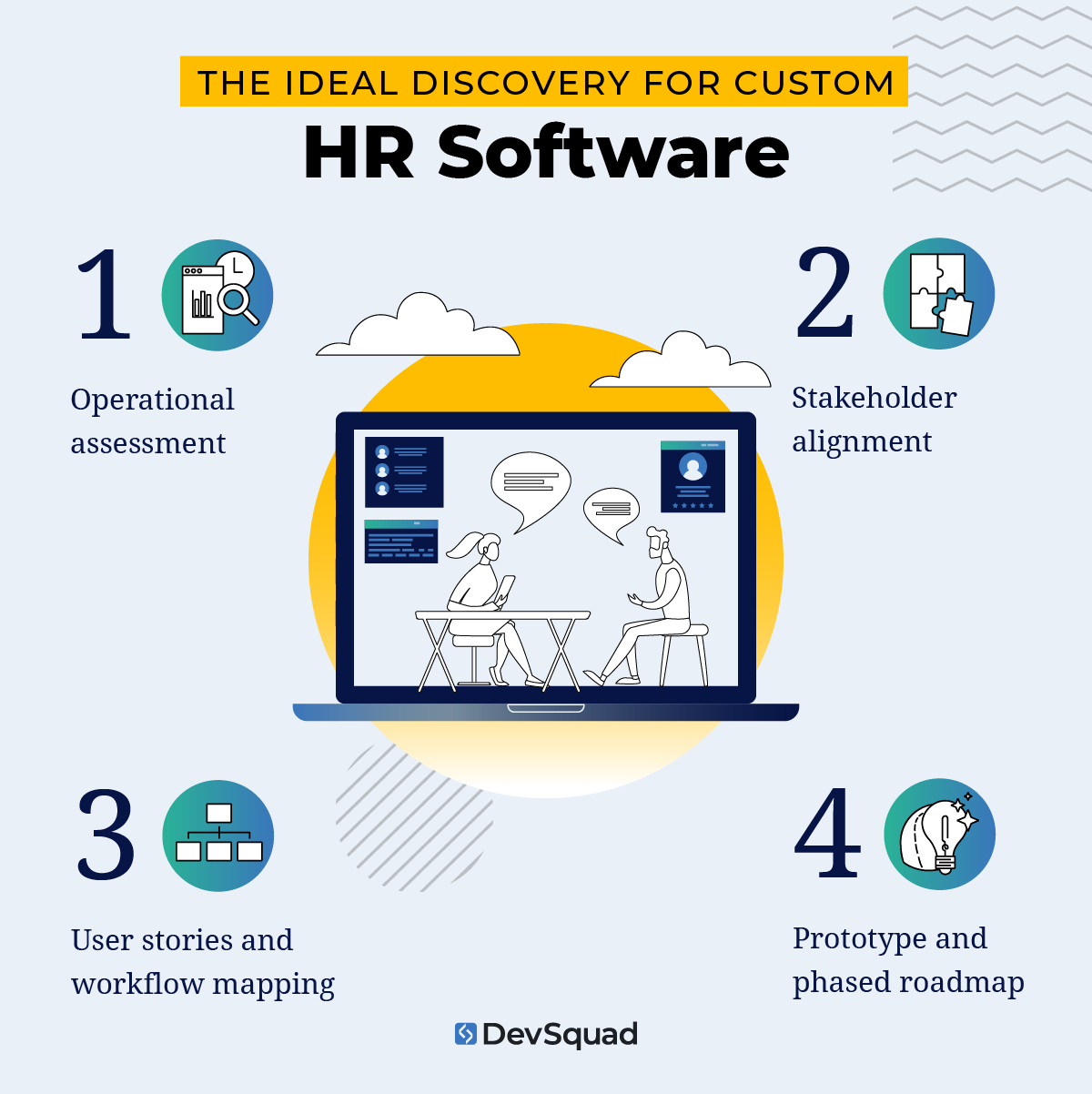
1. Operational assessment
Start by evaluating your current human resources software environment.
This includes:
Existing HR software solutions
Manual workflows and spreadsheet dependencies
Payroll and compensation processes
HR case management procedures
Compliance requirements
Integration points with ERP, accounting, and other systems
The objective is to identify bottlenecks, duplicate work, compliance exposure, and disconnected systems. In many cases, the core issue is fragmented data rather than missing features.
2. Stakeholder alignment
HR does not operate in isolation. Finance, operations, IT, and executive leadership rely on accurate workforce data.
Discovery should include structured sessions with key stakeholders to clarify:
Business goals
Reporting requirements
Approval hierarchies
Security and role-based access controls
Short-term priorities versus long-term scalability
Without alignment at this stage, custom software development can drift away from business objectives.
3. User stories and workflow mapping
Next, translate real-world processes into clear user stories.
For example:
How is an employee complaint submitted, documented, and escalated?
How are bonuses calculated and approved?
What triggers a compliance review?
How does onboarding differ by department or location?
Mapping workflows visually exposes inefficiencies before they are built into the system.
4. Prototype and phased roadmap
Before full development begins, create a high-fidelity prototype and a phased roadmap.
This allows you to:
Validate workflows
Confirm feature priorities
Sequence development logically
Plan budgets with greater accuracy
Rather than building everything at once, focus first on high-impact areas you’ve identified and then expand in phases.
Custom HR software should be implemented strategically, not all at once. A structured discovery process makes that possible.
Primary features to support a solid HR management platform
When building custom HR software, clarity matters. That’s the point of going through the discovery process. What you discover will lead you towards the features to build. That said, there are many common features—especieally in HR—that arise time and again.
Below is a comprehensive list of primary features commonly included in a custom human resources software platform.
Core employee management
These features form the foundation of your human resources software and control how employee data is structured, accessed, and maintained.
Employee records management
Role-based access controls
Organizational chart management
Identity and access management integration
Mobile access and employee self-service portal
Recruiting and onboarding
This group of features supports hiring efficiency and ensures new employees are brought into the organization in a structured, compliant way.
Applicant tracking system
Job posting and requisition management
Resume parsing and candidate scoring
Interview scheduling and feedback collection
Offer letter generation and approvals
Digital onboarding workflows
Document management and e-signatures
Policy acknowledgment tracking
Background check integrations
Time, payroll, and compensation
These features manage workforce time, benefits, and payroll and compensation processes with accuracy and automation.
Time and attendance tracking
PTO and leave management
Benefits administration
Payroll and compensation management
Commission and bonus calculation engines
Multi-state or multi-country payroll support
Direct deposit and tax document management
Expense reimbursement management
Performance and employee development
This category focuses on measuring performance, supporting growth, and aligning employee contributions with company objectives.
Performance review management
Goal tracking and OKR alignment
360-degree feedback tools
Promotion and role change workflows
Training and certification tracking
Learning management system integration
Employee engagement surveys
HR case management and compliance
These features protect the organization by standardizing documentation, investigations, and regulatory tracking.
HR case management
Incident and investigation tracking
Disciplinary action documentation
Compliance tracking and audit logs
Automated compliance alerts
Analytics and executive reporting
Advanced reporting tools provide leadership with real-time insight into workforce performance and financial impact.
Workforce analytics dashboards
Executive reporting tools
Custom report builder
Headcount forecasting tools
Compensation benchmarking analytics
Integrations and automation
These features connect your custom HR software to the rest of your tech stack and eliminate manual processes.
Integration with ERP systems
Integration with accounting platforms
Integration with CRM systems
API access for third-party tools
Data export and migration tools
Workflow automation engine
Custom approval routing
Data encryption and security controls
AI-assisted reporting and forecasting
Multi-location management controls
A strong custom HR software platform does not need every feature on this list. It needs the right features, configured to match how your business actually operates.
Best frameworks for custom software development that supports HR operations
Choosing the right framework is just as important as defining the right features. Custom HR software must be secure, scalable, integration-friendly, and capable of handling sensitive workforce data. The framework you choose directly impacts performance, long-term maintenance costs, and development speed.
Below are the top frameworks commonly used for custom software development that supports HR operations.
1. Laravel
Laravel should be at the top of the list for most SMB-focused custom HR software projects.
Laravel is a PHP framework known for clean architecture, built-in security features, and rapid development capabilities. It is particularly well-suited for:
Complex business logic such as payroll and compensation calculations
Role-based access controls
Workflow automation
API-driven integrations
Secure document management
Laravel’s ecosystem allows teams to build structured, maintainable applications without unnecessary complexity. It also supports AI-assisted development tools and reusable components that reduce build time and cost.
For businesses building internal human resources software, Laravel offers the right balance between flexibility and long-term stability.
2. .NET (ASP.NET Core)
For organizations operating in Microsoft-heavy environments, ASP.NET Core is a strong option.
It integrates seamlessly with:
Microsoft Azure
Active Directory
Office 365
Enterprise security frameworks
.NET is often preferred by mid-sized to larger organizations that require high levels of security, compliance controls, and enterprise-grade infrastructure. It performs well for compliance-heavy HR case management systems and large payroll environments.
3. Node.js
Node.js is well suited for highly interactive, real-time HR platforms.
It excels when:
Real-time notifications are required
Employee dashboards need dynamic updates
Integration with multiple APIs is central to the system
Node.js can be a strong choice for integration-driven HR transformation projects where multiple systems must communicate efficiently.
4. Ruby on Rails
Ruby on Rails remains a viable option for rapid MVP development and internal HR tools.
It supports fast iteration and clean development practices. However, for highly complex payroll and compensation logic or heavy compliance environments, Laravel or .NET often offer stronger long-term scalability.
5. React and modern front-end frameworks
While back-end frameworks power the system logic, front-end frameworks such as React are critical for user experience.
HR teams rely on intuitive dashboards, structured forms, and streamlined workflows. A strong front-end framework supports:
Employee self-service portals
Executive analytics dashboards
Mobile-responsive design
The best framework depends on your existing infrastructure, internal technical capabilities, and long-term roadmap. However, for most small to medium businesses building custom HR software, Laravel provides the strongest combination of flexibility, security, and cost efficiency.
However, the right development partner will lead you through discovery and help you find the right framework for your business.
Top 5 agencies for custom HR software development
Choosing the right partner for custom HR software is as important as defining the right features. Human resources software touches payroll and compensation, compliance, employee data, and executive reporting. You need a team that understands business operations, not just code.
Below are five agencies known for custom software development.
1. DevSquad
DevSquad specializes in custom software development for growing businesses that need more than surface-level solutions. With a consulting-first approach, every engagement begins with structured discovery, workflow mapping, and roadmap planning before development starts. Their teams focus on building scalable platforms that support complex operations, integrations, and compliance-heavy environments. For companies investing in custom HR software, DevSquad brings strategic planning, modern frameworks like Laravel, and long-term product thinking to the table.
2. Chudovo
Chudovo provides custom HR software development services including HRIS, HRMS, recruitment systems, payroll management, and workforce management tools. They offer end-to-end development, legacy modernization, SaaS transition support, and third-party integrations. Their approach includes requirement analysis, agile development, and ongoing maintenance. Chudovo works across multiple industries and focuses on helping organizations digitize HR workflows and improve operational efficiency.
3. Innowise
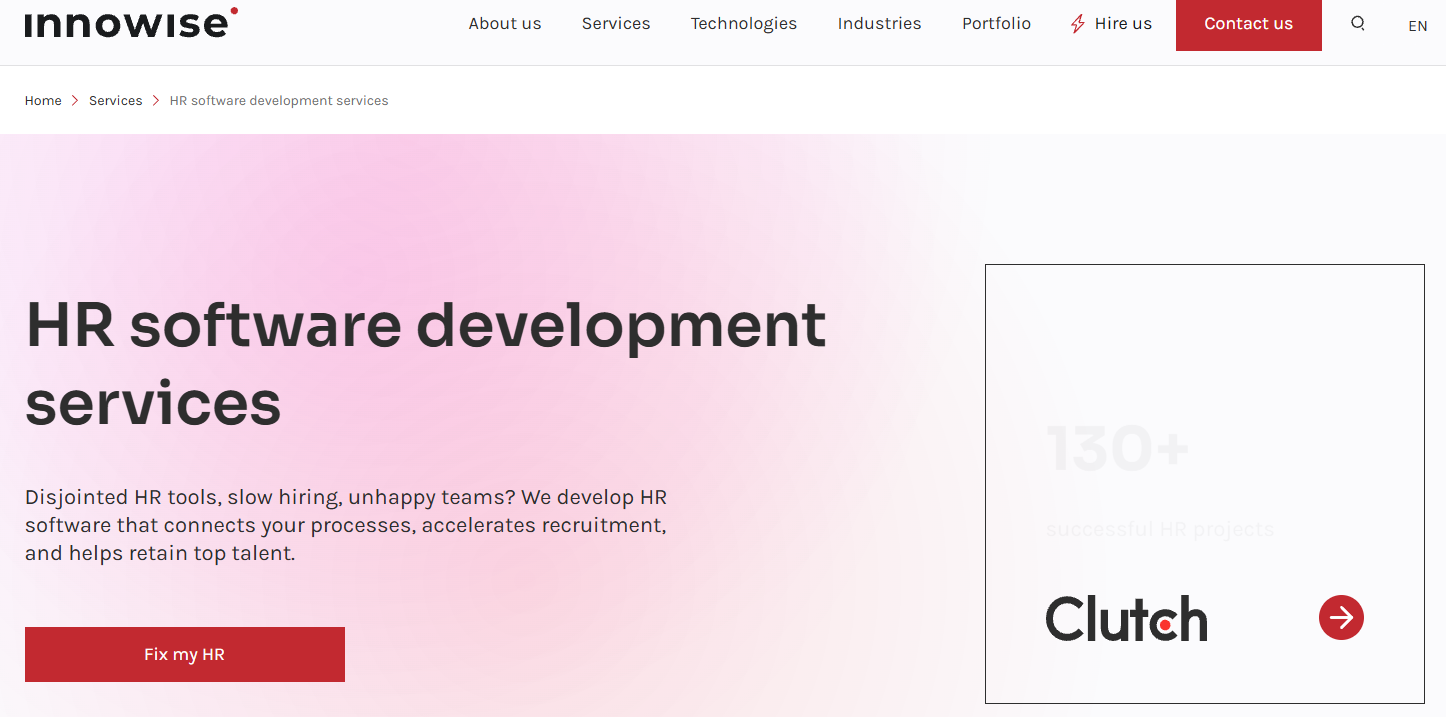
Innowise offers HR software development services including custom HRM systems, payroll and compensation automation, time tracking, LMS platforms, and HR system integrations. Their process covers project scoping, prototyping, development, QA, deployment, and post-launch support. Innowise focuses on process automation, data-driven decision-making, and scalable HR solutions designed to integrate with broader enterprise systems.
4. Itransition
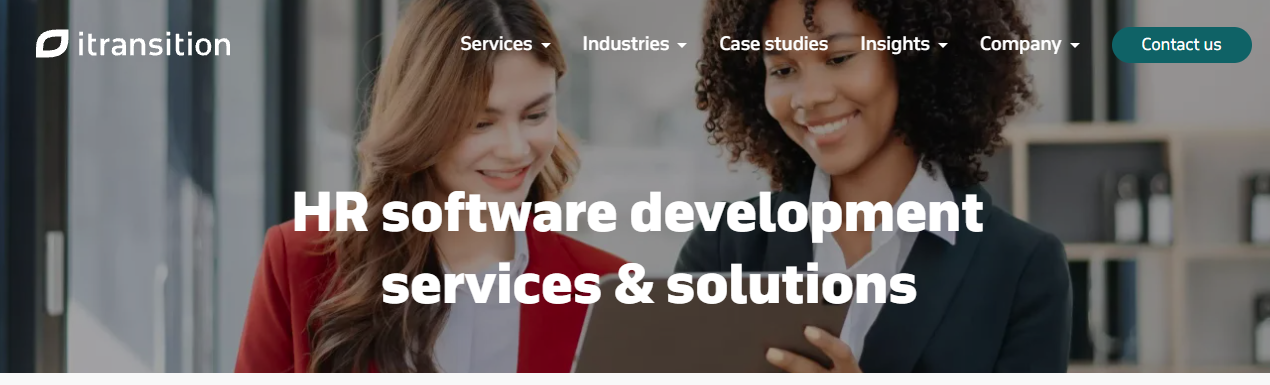
Itransition provides end-to-end HR software development services, including talent acquisition platforms, onboarding systems, compensation and payroll management, time tracking, performance management, and HR analytics. They support both standalone tools and all-in-one HR management systems. Their capabilities also include AI-driven automation, system integrations, consulting, and ongoing support, with a focus on compliance, scalability, and enterprise-grade implementation processes.
5. Go Wombat
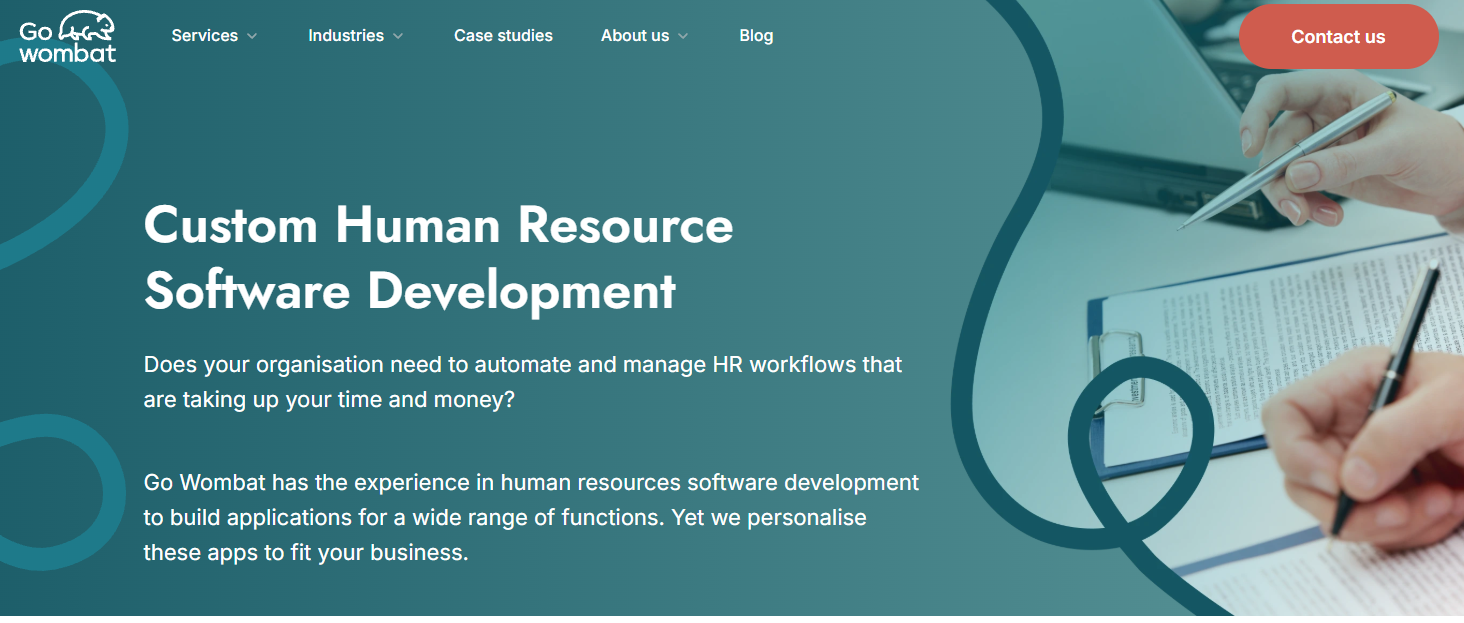
Go Wombat provides custom human resource software development tailored to each organization’s workflows. Their services include HRMS platforms, payroll and time-tracking modules, recruitment systems, learning and development tools, and internal communication features. They also offer consulting, system upgrades, and full-cycle product development. Go Wombat focuses on building personalized HR applications designed to automate manual processes and improve workforce management efficiency.
Ready to build your own custom HR software? Learn more about our custom software development services.

Dayana Mayfield is a SaaS copywriter and content marketer specializing in SaaS marketing, positioning, and go-to-market strategy. She has consulted for over 195 SaaS companies, focusing on both traffic and conversions. She has been featured in Entrepreneur, Forbes, and Business Insider. Outside of work, Dayana writes SciFi novels and spends her evenings surviving auditions, rehearsals, and tech week as a proud theater mom.