
Custom FinTech software development is reshaping how organizations operate, compete, and serve customers. Whether the goal is to modernize legacy systems, streamline internal processes, or launch an entirely new digital product, financial teams need more than generic tooling. They need secure, scalable, and adaptable solutions built around real user workflows and strict regulatory requirements.
In this guide, we break down what custom FinTech development really involves—from core use cases to the discovery process, essential features, the best frameworks, and the top agencies capable of bringing these products to life.
If you’re planning to build or upgrade financial software, this is your roadmap.
What is custom FinTech software development?
Custom FinTech software development is the process of building technology solutions specifically for the financial industry. That is applications that are tailored to an organization’s unique model, compliance requirements, and customer needs. Unlike off-the-shelf tools, custom-built FinTech products are engineered to align with exact workflows and integrate seamlessly with existing systems.
Custom FinTech solutions typically:
Power core financial operations including digital banking, payments, lending, wealth management, and insurance.
Handle sensitive data with advanced encryption, access controls, and real-time monitoring.
Manage complex transactions with precision, ensuring compliance with ever-changing financial regulations.
Deliver intuitive user experiences that foster trust, loyalty, and long-term engagement.
Eliminate vendor lock-in, giving organizations full control over their infrastructure, data, and future integrations.
Enable continuous innovation through agile architecture and adaptable integrations.
Additionally, FinTech is an industry defined by change. From evolving compliance standards to rapid shifts in customer expectations, financial products must do more than meet current needs—they have to anticipate future ones. This constant evolution has made adaptability one of the most valuable qualities of any successful FinTech solution.
Why adaptability defines successful FinTech products
Sustained success in FinTech depends on building adaptable, forward-looking systems. They must:
Scale with new regulations and changing compliance standards across multiple regions.
Accommodate rapid customer growth without compromising performance or security.
Integrate with third-party APIs for open banking, blockchain, and payment gateways.
A custom approach allows teams to build flexible architectures capable of evolving with market demands, something that is nearly impossible with out-of-the-box software.
Ultimately, custom FinTech software development is about control. It gives organizations full ownership of their technology stack, enabling faster iteration, sharper compliance oversight, and differentiated user experiences that stand out in a crowded digital landscape.
22 use cases for custom FinTech software
Custom business financial software development opens the door to countless innovations across the financial landscape. Whether it’s helping banks modernize their operations, empowering startups to deliver new digital experiences, or enabling enterprises to meet complex compliance standards, custom-built solutions deliver precision, flexibility, and long-term scalability.
Below are 20 leading use cases where organizations are gaining measurable results through tailored FinTech development.
Banking and payments
Financial institutions are transforming how money moves and how customers interact with their finances. Custom software enables secure, compliant, and user-friendly platforms that scale with demand and regulatory change.
Digital banking platforms – Build web and mobile applications for account management, transfers, and personalized financial insights.
Payment gateways and processing systems – Create secure, scalable platforms for handling transactions and supporting multi-currency operations.
Peer-to-peer (P2P) payment apps – Enable direct transfers between users with real-time balance updates and fraud prevention.
Remittance and cross-border payment systems – Simplify global transfers with compliance-ready solutions for AML and KYC requirements.
Mobile wallets – Develop secure, user-centric wallet applications that support contactless payments, QR codes, and loyalty integration.
Lending and credit management
Custom lending solutions streamline risk assessment, underwriting, and collections by automating data-heavy processes. These platforms also enhance transparency for both lenders and borrowers.
Loan origination and underwriting software – Automate credit scoring, document processing, and approval workflows using advanced analytics.
Buy now, pay later (BNPL) systems – Build installment-based lending products that integrate directly with merchants and payment processors.
Risk management dashboards – Centralize risk data and predictive analytics for real-time portfolio monitoring.
Debt collection automation – Use intelligent workflows and AI to prioritize collections and improve recovery rates.
Wealth management and investment
Modern investors expect instant access to data and personalized advice. Custom-built wealth and investment platforms deliver that experience through real-time analytics, automation, and responsive interfaces.
Robo-advisory platforms – Use algorithms to manage investments and deliver personalized portfolio recommendations.
Trading and brokerage systems – Support high-performance order execution, market data integration, and user analytics.
Portfolio management dashboards – Provide unified views of client assets, liabilities, and performance metrics.
Insurance and InsurTech
The insurance industry is embracing digital transformation to simplify claims, improve policy management, and personalize coverage. Custom software helps automate workflows and reduce fraud while maintaining regulatory accuracy.
Policy management systems – Centralize customer data and automate underwriting, renewals, and compliance reporting.
Claims automation platforms – Leverage machine learning to speed up claims verification and flag fraudulent activity.
Usage-based insurance (UBI) systems – Use IoT or telematics data to calculate premiums based on individual behavior or usage.
Regulatory technology (RegTech)
Compliance remains one of the most resource-intensive aspects of financial operations. Custom RegTech tools reduce manual oversight, streamline audits, and adapt quickly to new regulatory frameworks.
Compliance monitoring and reporting tools – Automate reporting for standards such as GDPR, PCI DSS, SOX, and others.
KYC/AML verification systems – Implement automated identity verification and screening during customer onboarding.
Audit trail management – Maintain tamper-proof records using blockchain or immutable database technologies.
Emerging and data-driven solutions
As technology advances, financial organizations are turning to data and automation to unlock new efficiencies and user experiences. Custom FinTech solutions make it possible to deploy these innovations securely and at scale.
Blockchain and digital asset platforms – Support cryptocurrency wallets, tokenized assets, and smart contract management.
AI-driven financial assistants – Deliver automated insights, budgeting tools, and fraud alerts through conversational interfaces.
Financial data aggregation and analytics – Unify data from multiple systems to provide real-time visibility into performance and customer behavior.
Embedded finance solutions – Integrate financial services such as lending, payments, or insurance directly into non-financial platforms.
The financial software development discovery process
Before development begins, every successful FinTech project starts with a discovery phase—a structured sprint that minimizes risk, validates direction, and establishes a technical and business foundation for success. In financial software, this stage is especially critical because it ensures that security, compliance, and usability are built into the product from the start.
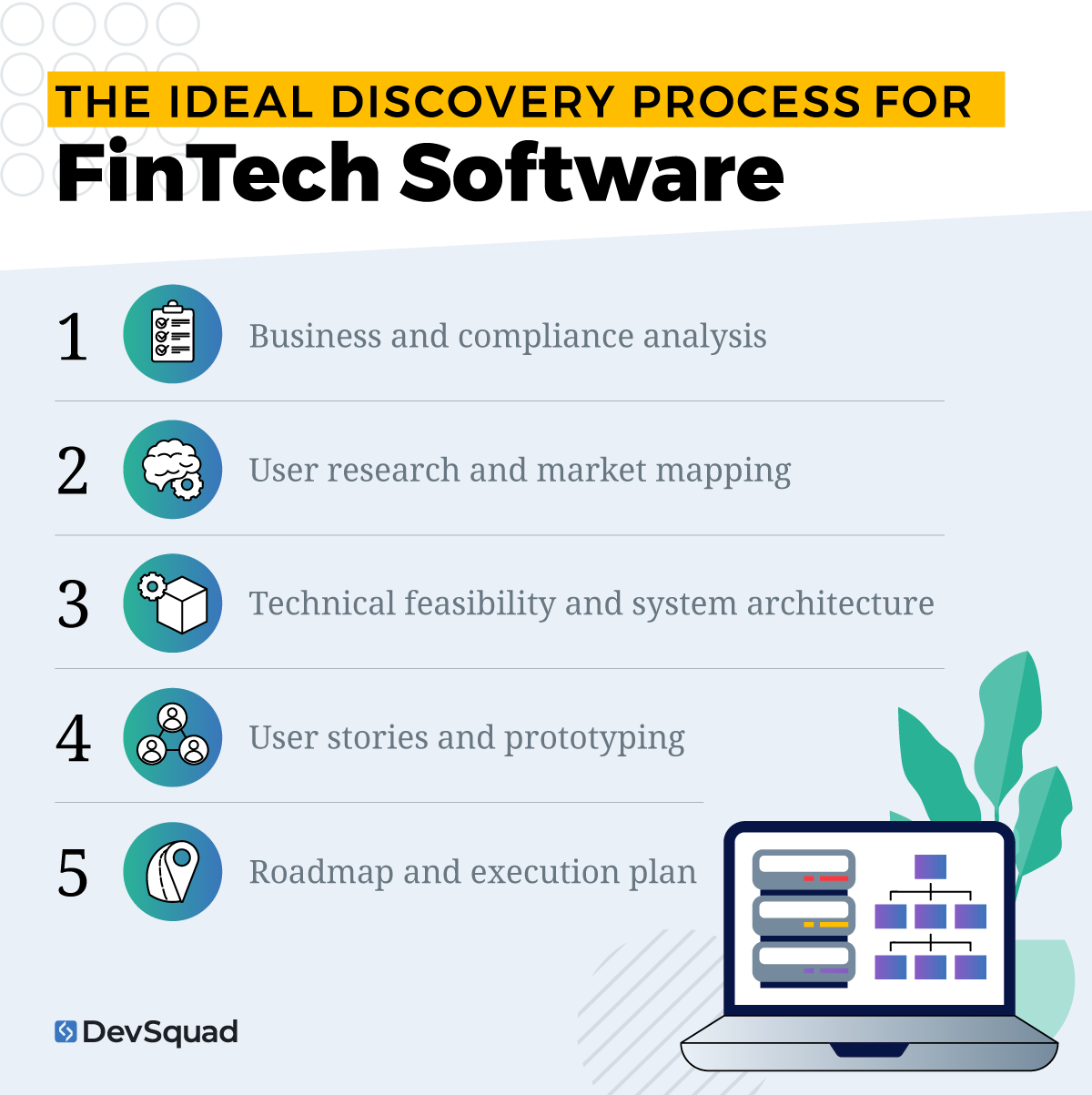
Below are the core steps in a discovery process tailored for custom FinTech development:
1. Business and compliance analysis
The process begins with understanding the organization’s goals and the financial environment it operates in. This step sets direction and defines the guardrails for compliance and scalability.
Identify the business objectives driving the project.
Map key financial processes and current pain points.
Outline compliance requirements such as PCI DSS, SOX, GDPR, or PSD2.
Evaluate existing systems and data dependencies that could impact modernization.
This phase ends with a clear, documented foundation—so every future decision aligns with both business outcomes and regulatory standards.
2. User research and market mapping
Next comes validation through context. The discovery team dives into user behavior and market expectations to confirm the product is solving the right problem.
This often includes:
Interviewing representative users such as borrowers, investors, or account managers.
Conducting journey mapping to visualize how users move through key tasks.
Benchmarking existing products to identify usability gaps and feature opportunities.
The insights gathered here define what “value” looks like for the target audience—and prevent building features that don’t resonate or comply with user needs.
3. Technical feasibility and system architecture
With direction and user insights in place, the next focus is feasibility. Technical leads analyze current infrastructure and plan the architecture that will power the new platform.
A well-defined architecture at this stage prevents future rework and provides a reliable foundation for ongoing iteration. Additionally for FinTech, this step is where scalability, security, and compliance intersect.
Key outcomes include:
A defined tech stack (often starting with Laravel, supported by frameworks like Node.js, React, or Python as needed).
A plan for data storage, integrations, and automation pipelines.
Security and performance requirements embedded directly into the architecture.
4. User stories and prototyping
At this point, the product vision becomes tangible. Business objectives are translated into detailed user stories, outlining how each feature contributes to the product’s overall goals. From there, the team builds an interactive high-fidelity prototype that simulates the user experience and demonstrates how data, workflows, and interfaces will function together.
Stakeholders and test users interact with the prototype, providing early feedback that drives refinements before coding begins. This visual validation aligns decision-makers, clarifies expectations, and helps confirm that the product is worth building in its current form.
5. Roadmap and execution plan
With requirements and feedback in place, the discovery process culminates in a comprehensive roadmap. This plan defines what will be built now, what comes next, and what will follow later, creating a clear “Now, Next, Later” framework for development.
The roadmap outlines sprint cadence, milestones, and technical deliverables, ensuring alignment across all stakeholders. For financial organizations, this structured plan balances speed with precision, enabling a focused path to a market-ready product while maintaining transparency throughout development.
Common features of custom financial software solutions
FinTech platforms share a core set of capabilities that support security, compliance, money movement, analytics, and user experience. The features below are grouped by the functional areas most commonly found across banking, lending, payments, wealth management, insurance, and internal financial systems.
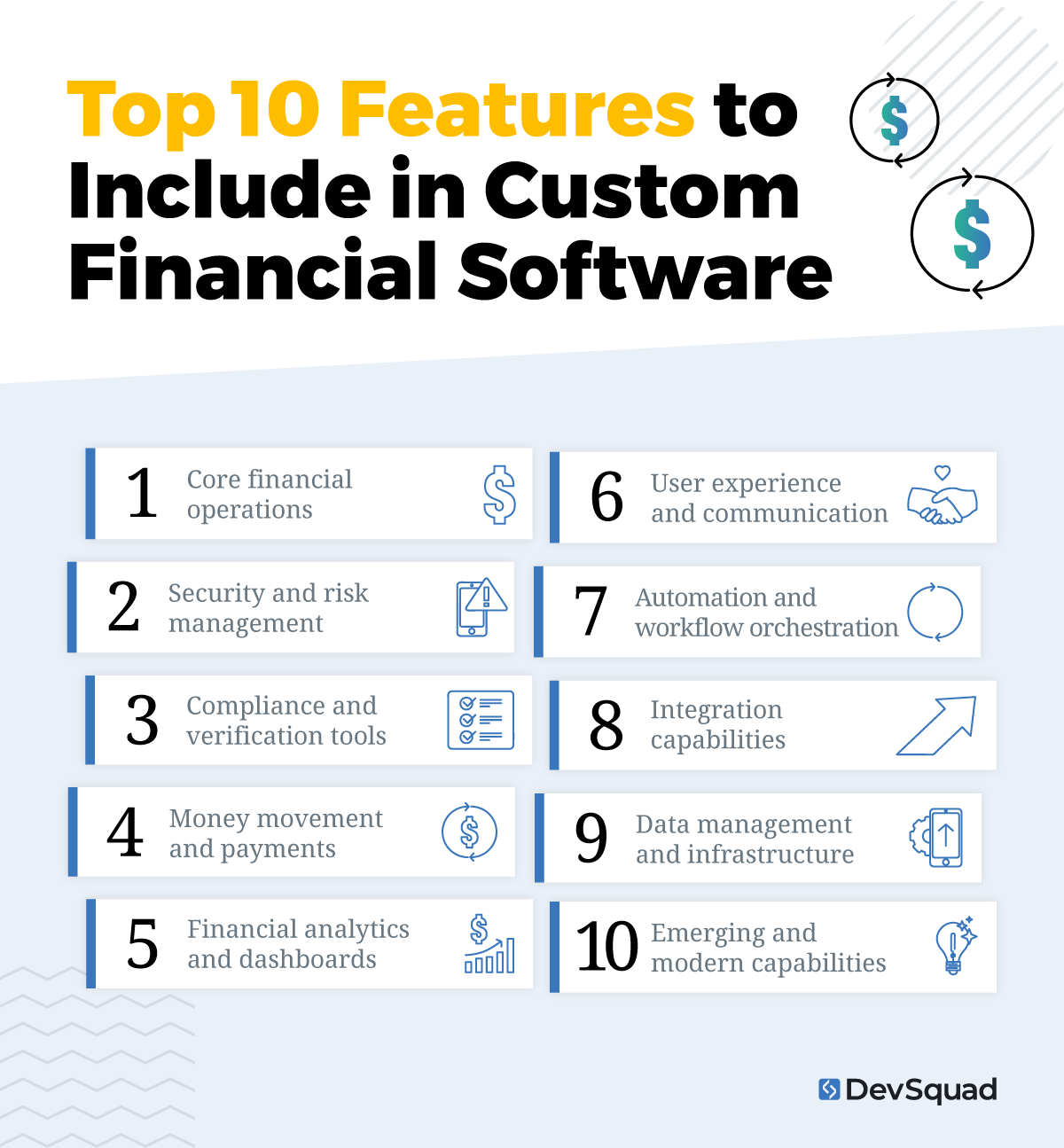
Core financial operations
These features support the day-to-day financial activities that keep platforms running smoothly. Common examples are:
Transaction processing
Account management dashboards
Multi-currency support
Payment scheduling and automation
Security and risk management
Security is the foundation of any financial platform, and modern solutions require multiple layers of protection. These capabilities include:
Multi-factor authentication (MFA)
Role-based access controls (RBAC)
End-to-end encryption
Fraud detection and anomaly monitoring
Audit trails and immutable logs
Secure API management
Compliance and verification tools
Built-in compliance features reduce manual oversight and minimize regulatory exposure. These safeguards typically feature:
KYC (Know Your Customer) verification
AML (Anti-Money Laundering) checks
Automated regulatory reporting
Identity verification integrations (ID scan, biometrics, liveness detection)
Data retention and privacy controls aligned with GDPR, SOX, PCI DSS, and PSD2
Money movement and payments
These capabilities allow users and organizations to move money securely and efficiently. Common payment-related features are:
ACH, wire, and real-time payments
Card processing and tokenization
Payout management and batch payments
Integration with payment gateways
Open banking connections
Financial analytics and dashboards
Financial organizations rely on visibility to understand performance, risk, and user behavior. These analytics modules often involve:
Real-time financial dashboards
Risk scoring and credit modeling
Portfolio performance analytics
Cashflow forecasting
Customizable reporting tools
User experience and communication
Trust in financial products is shaped by clarity, ease of use, and communication. UX-focused capabilities commonly support:
Intuitive onboarding flows
Notification systems (email, SMS, in-app)
Document management and e-signature integrations
Chat or support modules
Multi-device responsive interfaces
Automation and workflow orchestration
Automation helps reduce manual effort and create more consistent operations. These automation features often include:
Approval workflows
Automated underwriting or risk evaluation
Recurring billing and subscription management
Smart routing for tasks and requests
Integration capabilities
Custom financial software frequently connects with internal software, partner platforms, or external networks. Integration features typically involve:
Banking APIs and open banking networks
Core banking systems
CRM, ERP, and accounting platforms
Data aggregation services
Blockchain networks and digital wallet infrastructure
Data management and infrastructure
At the platform level, strong infrastructure ensures resilience, compliance, and scalability. These foundational capabilities are:
Encrypted data storage
Event-driven architectures
High availability and redundancy
Disaster recovery and backup systems
Scalable cloud infrastructure
Emerging and modern capabilities
Forward-looking FinTech products often incorporate advanced technologies. These modern components can include:
Machine learning models for insights and predictions
AI-driven chatbots or assistants
Smart contract automation
Tokenized asset management
7 best frameworks for developing custom FinTech software
Choosing the right framework is one of the most important decisions in FinTech development. Financial products demand scalability, security, clean architecture, and long-term maintainability. Below are the top frameworks used to build reliable, compliant, and user-friendly financial software—ranked with the strongest option first.
1. Laravel (PHP)
Laravel stands out as the leading backend framework for FinTech because of its stability, clean architecture, and built-in security features. Its opinionated structure accelerates development without sacrificing quality, making it ideal for platforms that require precision and long-term maintainability.
Key strengths:
Robust authentication and authorization out of the box
Clear MVC architecture that keeps large codebases manageable
Excellent support for queues, event-driven workflows, and background jobs
Mature ecosystem with packages for payments, API development, and compliance-driven features
Strong testability and predictable long-term support
Laravel gives financial teams a secure, scalable foundation—perfect for transaction-heavy or compliance-focused products.
2. Node.js
Node.js is well suited for real-time financial activity such as payment processing, balance updates, trading interactions, and asynchronous tasks.
Key strengths:
Non-blocking architecture for handling thousands of concurrent operations
Large ecosystem for API development and data integrations
Ideal for microservices and event-driven FinTech architectures
It's especially useful when performance and responsiveness are critical.
3. React
For front-end interfaces, React remains one of the most reliable solutions. Its component-based architecture keeps complex interfaces fast, modular, and easy to scale.
Key strengths:
Excellent performance for data-rich dashboards and financial visualizations
Strong support for forms, onboarding flows, and interactive components
Continuously maintained by an active developer community
React is often paired with Laravel or Node.js to deliver responsive, user-friendly financial applications.
4. Python (Django + FastAPI)
Python frameworks are a natural fit for analytics-heavy or AI-powered FinTech products.
Key strengths:
Django provides strong security defaults and a batteries-included structure
FastAPI offers high-performance APIs ideal for machine learning inference
Extensively used for credit modeling, fraud detection, and data pipelines
Python is often used alongside another primary backend to power advanced financial logic and risk modeling.
5. Go (Golang)
Go is increasingly popular for FinTech platforms that require low latency and high throughput.
Key strengths:
High performance suitable for trading engines and real-time data pipelines
Strict typing and simple concurrency patterns
Lightweight services that scale easily under heavy load
Go is a strong choice for building the most performance-critical parts of a financial system.
6. Ruby on Rails
Although no longer the default choice for startups, Rails still shines in situations where teams want rapid development without unnecessary complexity.
Key strengths:
Fast prototyping for early-stage FinTech concepts
Convention-over-configuration philosophy that reduces decision fatigue
Mature libraries for payments, authentication, and background jobs
Rails remains a good fit for lighter-weight financial tools or internal enterprise systems.
7. .NET Core
For enterprises that need deep integration with corporate infrastructure or Windows-based systems, .NET Core delivers reliability and performance.
Key strengths:
Enterprise-grade security and long-term support
Strong performance for large-scale APIs and financial workflows
Ideal for teams already invested in Microsoft systems
.NET Core is a consistent choice for financial institutions with legacy systems or regulatory pressure around ecosystem consistency.
Top 5 agencies offering custom financial development services
Below are five agencies known for their fintech software development services. These summaries highlight their general positioning, while the first listing outlines what sets DevSquad apart in this space.
1. DevSquad
DevSquad specializes in building high-performance financial software through a strategy-first approach. Every engagement begins with a structured discovery sprint to validate concepts, map compliance requirements, and define a scalable technical foundation. Teams include product strategists, technical product managers, UX designers, senior developers, QA engineers, and DevOps support—creating a full product squad dedicated to solving complex financial challenges.
Key strengths:
Comprehensive discovery and prototyping before development
Dual-track agile for continuous validation and iteration
Strong expertise in modern, secure, and scalable tech stacks
Focus on long-term maintainability, clarity, and user experience
DevSquad builds financial products that support real-world operations, eliminate technical bottlenecks, and deliver clean, reliable architectures that grow with the organization.
2. BairsDev
BairesDev is a large outsourcing provider that supplies software developers, designers, and QA specialists across a wide range of technologies. Their model centers on staff augmentation and flexible team scaling, making them a fit for companies that need additional engineering capacity for their fintech development services rather than a dedicated partner to lead product strategy or end-to-end development.
3. Emerline
Emerline is a software development firm that supports financial organizations with custom platforms, mobile apps, and compliance-focused solutions. Their services range from data visualization and analytics to digital banking, embedded finance, and KYC/AML tools. With a large team and a broad service offering, they often work with companies looking for a general development partner rather than a focused product squad.
4. ScienceSoft
ScienceSoft is an established IT services company that builds custom fintech software solutions for banks, insurers, and financial services organizations. Their offering spans client-facing apps, complex processing systems, fraud detection tools, analytics platforms, and compliance-oriented software, often incorporating AI, big data, and cloud technologies. They are a fit for enterprises seeking a broad, traditional consulting and implementation partner across multiple financial domains.
5. 10Pearls

10Pearls is a digital development company that delivers fintech software spanning digital banking apps, payment solutions, wealth platforms, RegTech, and AI-enhanced financial tools. Their positioning centers on end-to-end delivery—from strategy and UX to engineering and support—for organizations that want a single vendor to design, build, and evolve their financial systems alongside broader digital initiatives.
Ready for your own custom FinTech software solution? Learn more about our custom software development services.

Dayana Mayfield is a SaaS copywriter and content marketer specializing in SaaS marketing, positioning, and go-to-market strategy. She has consulted for over 195 SaaS companies, focusing on both traffic and conversions. She has been featured in Entrepreneur, Forbes, and Business Insider. Outside of work, Dayana writes SciFi novels and spends her evenings surviving auditions, rehearsals, and tech week as a proud theater mom.