
Healthcare organizations are under pressure to move faster, operate more efficiently, and manage increasingly complex data and workflows. At the same time, expectations around patient experience, compliance, and interoperability continue to rise. Software is no longer just a support tool—it’s a core part of how care is delivered and scaled.
That shift is reflected in market growth. The population health management sector is expected to rise to $663.75 billion by 2034, driven by demand for better data visibility, coordinated care, and technology that supports long-term outcomes rather than isolated encounters.
Custom healthcare software development plays a central role in this evolution. It allows healthcare organizations and medical SaaS companies to build systems around real clinical and operational needs, support HIPAA compliant software requirements, and create platforms that can grow as care models, regulations, and patient expectations change.
A strategic investment, not just a technical one
Custom healthcare software development is not about technology for technology’s sake. It’s a strategic decision to support better care delivery, smoother operations, and long-term growth.
When done correctly, custom software becomes an asset your business owns and controls. It evolves with you, instead of holding you back.
In the next sections, we’ll break down specific use cases, must-have healthcare software features, and how the discovery process works in healthcare projects so you can decide if a custom approach makes sense for your organization.
What is custom healthcare software development?
Custom healthcare software development is the process of designing and building software specifically for healthcare organizations, rather than forcing your workflows to fit inside off-the-shelf tools. Instead of adapting your business to generic software, you get a product built around how your clinicians, staff, and patients actually work.
This approach matters more in healthcare than in almost any other industry. You’re dealing with sensitive patient data, strict regulations, complex workflows, and people who don’t have time to fight with clunky systems. Custom healthcare software development gives you control over all of that.
At its core, custom healthcare software development focuses on three things:
Solving a real operational or patient-care problem
Supporting compliance requirements like HIPAA compliant software standards
Scaling as your organization grows or evolves
That could mean building a medical SaaS platform from scratch, modernizing a legacy electronic health record (EHR) system, or creating a new telehealth platform that integrates with your existing tools.
How custom healthcare software differs from off-the-shelf tools
Off-the-shelf healthcare software can work for basic needs. The problem is that most growing healthcare businesses don’t have basic needs for very long.
Generic tools are built for the “average” customer. Healthcare organizations are rarely average. You may have:
Unique care delivery models
Specialized reporting or billing requirements
Custom integrations with labs, devices, or insurers
Internal workflows that give you a competitive edge
Custom healthcare software development allows you to preserve what makes your operation effective, instead of watering it down to match someone else’s assumptions.
For example, EHR development is a common reason teams move toward custom builds. Many EHR platforms are overloaded with features you’ll never use yet you still pay for. A custom EHR or EHR-adjacent system focuses only on the workflows that matter to your clinicians and administrators.
The role of modern frameworks and AI-assisted development
Today’s custom healthcare software is not built the same way it was even five years ago.
Modern frameworks like Laravel healthcare app stacks allow teams to build secure, scalable applications faster than older technologies ever could. Laravel is especially well-suited for medical SaaS and healthcare platforms because it supports clean architecture, strong security patterns, and long-term maintainability.
On top of that, AI-assisted development has changed how custom software gets built. This doesn’t mean generating large blocks of code automatically. The real value is in how AI tools support developers behind the scenes.
AI-assisted development helps streamline and accelerate processes like:
Debugging and identifying issues faster
Analyzing logs and performance bottlenecks
Improving test coverage and quality assurance
Reducing repetitive manual work during development
The result is lower development costs and faster timelines, without cutting corners on quality or compliance. For healthcare organizations that need to be careful with budgets, this has made custom healthcare software development far more accessible than it used to be.
25 use cases for custom healthcare software
Custom healthcare software development is used across many parts of the healthcare ecosystem. These use cases represent the most common and high-impact ways healthcare organizations invest in custom solutions today. They are grouped by function, but in practice, many organizations address multiple categories within a single platform or roadmap.
Clinical systems and care delivery
Clinical software must support real-world care delivery without adding friction. Custom development aligns systems like EHRs and care coordination tools with how clinicians actually work.
Custom EHR development designed around specialty-specific workflows
Clinical documentation systems that reduce manual data entry
Care coordination platforms for multi-provider organizations
Clinical decision support tools embedded in provider workflows
Patient engagement and virtual care
Patient-facing software plays a major role in access, communication, and continuity of care. Custom development allows organizations to design telehealth platforms and digital experiences around their specific care model.
Telehealth platforms built for specific visit types or care models
Patient portals with custom scheduling, intake, and messaging
Secure patient communication and follow-up systems
Remote patient monitoring dashboards and data views
Administrative, billing, and operational efficiency
Operational inefficiencies often stem from disconnected systems and manual processes. Custom healthcare software development helps streamline workflows, reduce overhead, and improve visibility across teams..
Revenue cycle and billing software tailored to internal workflows
Insurance eligibility, authorization, and referral management tools
Workflow automation for intake, documentation, and approvals
Internal operational dashboards for staff and leadership
Compliance, security, and data management
Healthcare software must be secure, auditable, and compliant by design. Custom development provides tighter control over data access, reporting, and HIPAA compliant software requirements.
HIPAA compliant software platforms with custom access controls
Audit logging, compliance reporting, and risk tracking systems
Secure document and patient data management solutions
Healthcare SaaS and platform development
Some organizations build software products, not just internal tools. Custom healthcare software development supports medical SaaS and platform businesses that need scalability, integrations, and long-term flexibility.
Medical SaaS platforms serving a specific healthcare niche
API-first healthcare platforms designed for integrations
Multi-tenant healthcare applications built for scale
Medical device integration and IoT-enabled care
Last but no least by any means. Medical devices generate critical data that must be captured, transmitted, and acted on reliably. Custom healthcare software development is what makes this space so transformative. Things like real-time data ingestion, and secure storage of device-generated data are absolutes in this space.
Use cases in this category focus on connectivity, monitoring, and operational reliability.
Medical device integration with healthcare software platforms
IoT-enabled remote patient monitoring (RPM)
Real-time device data ingestion into EHR systems
Device-generated alerts and clinical notifications
Connected medical devices for home-based care
Medical device data pipelines for analytics and reporting
Compliance and audit tracking for medical device data
31 important healthcare software features to consider
Healthcare software features define how safely, efficiently, and accurately an organization operates. Feature decisions directly affect compliance, revenue, clinician workload, and patient experience. When planning custom healthcare software development, these feature areas deserve deliberate attention.
Security and HIPAA compliance
Healthcare software must meet HIPAA compliant software requirements at every level. Core features include:
Encryption
Audit logging
Secure authentication
Strict control over data access and sharing.
These capabilities should reflect real operational roles and data sensitivity, not generic permission models.
Role-based access and workflow control
Healthcare organizations rely on clearly defined responsibilities. Software must support that structure.
Important healthcare software features include:
Role-based access
Approval flows
Task routing
Workflow states designed for clinicians, billing teams, administrators, and leadership.
Clear boundaries reduce errors and speed up daily work.
Medical billing and revenue cycle features
Medical billing is a highly structured, rules-driven process. Software must support accuracy, traceability, and payer-specific logic.
Key healthcare software features in this area include:
Charge capture
Coding workflows
Claim submission
Denial management
Payment reconciliation
Reporting.
Tight alignment between clinical data and billing workflows is essential for financial performance.
Integrations and interoperability
Healthcare systems depend on reliable data exchange. Software must support structured, consistent integrations.
Important features include:
API management
Data synchronization
Support for standards like HL7 and FHIR.
These capabilities are especially critical for EHR development, telehealth platforms, and medical SaaS products that rely on real-time information.
Patient-facing functionality
Patient-facing features shape access to care and ongoing engagement. These tools must be clear, secure, and easy to use.
Common healthcare software features include:
Scheduling
Secure messaging
Digital intake
Consent management
Virtual visit interfaces
Feature design should align with the organization’s care delivery model.
Reporting and operational visibility
Healthcare leaders need visibility into operations, compliance, and performance. Software must make this information accessible without friction.
Key features include:
Role-specific dashboards
Operational reporting
Audit views
Data exports
This is especially important for organizations operating across multiple locations or service lines.
Internal AI tools and workflow automation
AI has a role inside healthcare software when it supports staff and improves operational efficiency. These tools assist workflows rather than replace decision-making.
Examples include:
Billing review assistance
Documentation support
Anomaly detection
Operational triage
Pattern analysis across large datasets.
When implemented carefully, these features reduce manual effort while maintaining control and oversight.
The custom healthcare software development discovery process
Discovery is where healthcare software succeeds or fails. At DevSquad, discovery is not a formality. It’s a structured process designed to reduce risk, surface constraints early, and align business, clinical, and technical decisions before development begins.
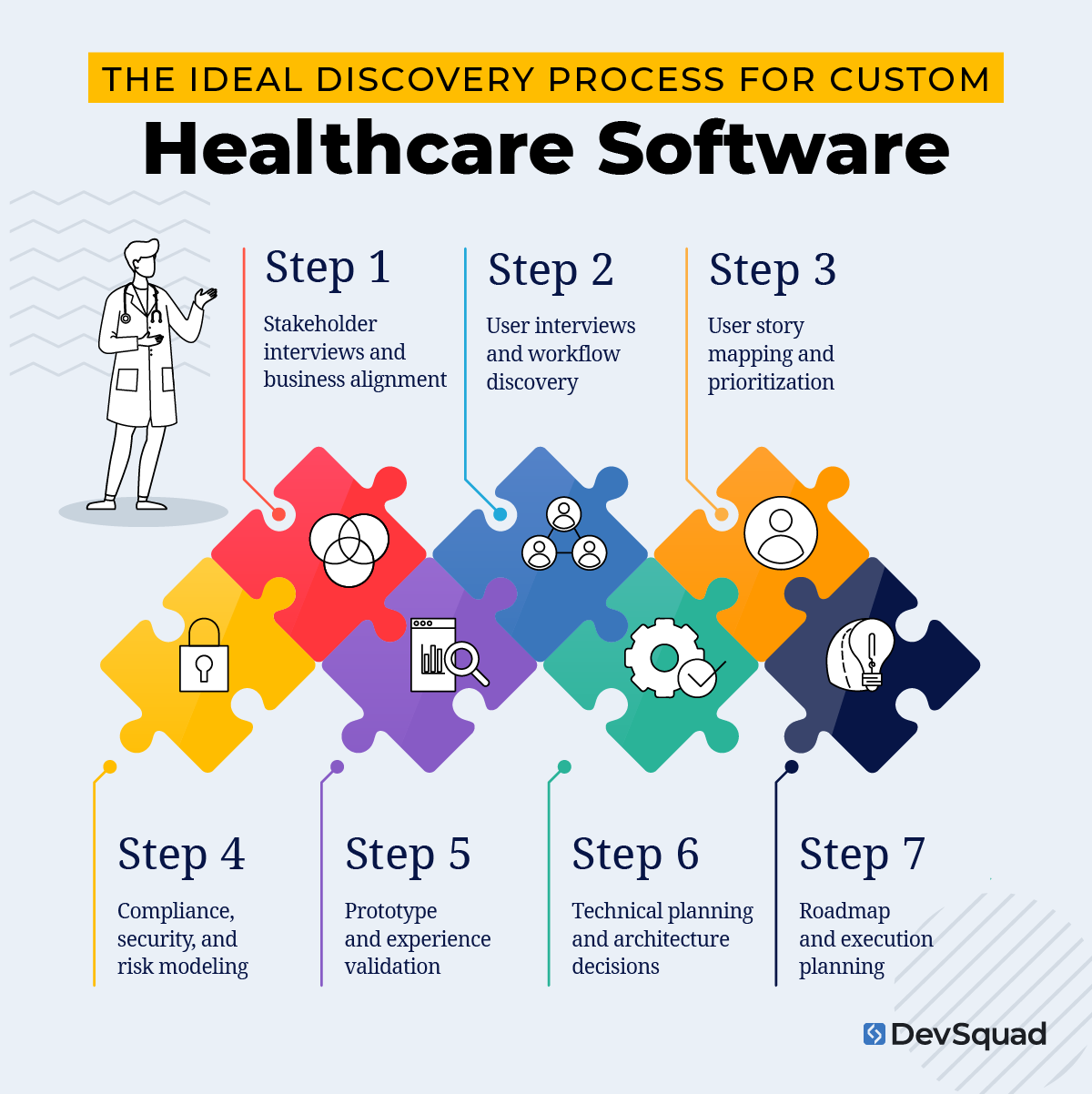
This process reflects how we approach custom healthcare software development in practice.
Step 1: Stakeholder interviews and business alignment
Discovery begins with stakeholder interviews and discovery questions. These conversations focus on business goals, operational pain points, compliance concerns, and long-term vision.
This step aligns leadership, operations, and technical stakeholders around a shared definition of success. In healthcare, misalignment here leads to costly scope changes later.
Step 2: User interviews and workflow discovery
Next, the focus shifts to the people who will actually use the software. This includes clinicians, billing teams, administrators, and support staff.
Here you map real workflows, edge cases, and decision points. This is where clinical processes, medical billing complexity, and operational handoffs are fully understood.
Step 3: User story mapping and prioritization
Once workflows are clear, discovery moves into user story mapping. Requirements are translated into clear, testable user stories tied to real outcomes.
This step defines:
What the system must do
Who it serves
How success is measured.
It also forces prioritization, which is critical for healthcare projects with competing demands.
Step 4: Compliance, security, and risk modeling
Healthcare-specific risks are addressed early. This includes defining:
HIPAA compliant software requirements
Access controls
Audit needs
Data handling rules.
Don’t layer compliance on later—design it directly into user stories and workflows so it’s enforced by the system itself.
Step 5: Prototype and experience validation
For complex healthcare workflows, words are not enough. DevSquad uses both low-fidelity prototypes and high-fidelity prototypes to validate assumptions around usability, data flow, and system behavior.
This step helps stakeholders see how the software will actually work and provides early feedback before development resources are committed.
Step 6: Technical planning and architecture decisions
With validated workflows and features, the team defines the technical approach.
This includes establishing the:
Architecture
Integrations
Framework selection
For many projects, this means planning around modern stacks like a Laravel healthcare app, plus integration strategies for EHR development, billing systems, and telehealth platforms.
Step 7: Roadmap and execution planning
Discovery concludes with a clear roadmap. Features are organized into phases with defined goals, dependencies, and timelines. From here, production begins.
DevSquad uses dual-track agile here, allowing discovery and development to continue in parallel. That way the roadmap stays up to date and the highest impact features are the first to see the light of day.
Best frameworks for developing custom healthcare software solutions
To keep a healthcare build clean, maintainable, and compliant, the stack should be boring in the best way: proven frameworks, strong security patterns, and straightforward integration support. Here’s a tight set of options that work well for custom healthcare software development.
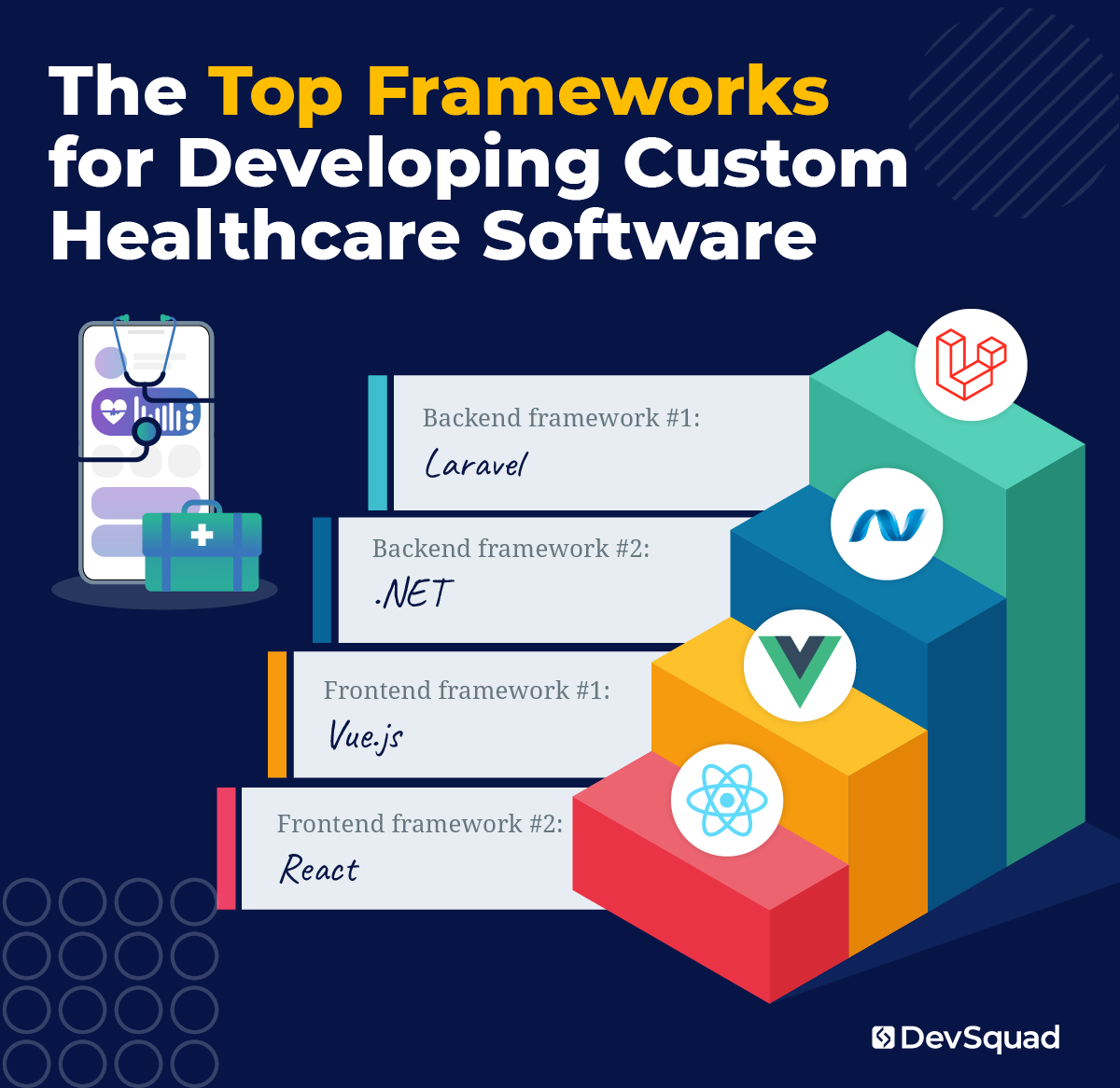
Backend framework #1: Laravel
If you want speed without sacrificing structure, Laravel is a strong default. It’s a great fit for building a Laravel healthcare app because it supports clean architecture, mature authentication patterns, queueing/background jobs, and a predictable approach to APIs.
Where Laravel shines in healthcare:
Secure, role-based access patterns (clinicians vs billing vs admin)
Audit-friendly backend workflows (event logging, change history)
API-first builds for portals, mobile apps, and integrations
Backend framework #2: .NET
For healthcare organizations that need enterprise-grade architecture, deep Microsoft ecosystem support, or long-lived internal platforms, .NET is a solid choice. It’s commonly used in healthcare environments that already standardize on Azure, Microsoft identity, or existing .NET systems.
Where .NET shines in healthcare:
Large-scale, long-term platforms with strict governance
Strong identity/security tooling and enterprise integration patterns
High-throughput services and complex domain logic (like billing rules)
Frontend framework #1: Vue.js
Vue is lightweight, fast to develop in, and ideal for complex forms and workflows (which healthcare has plenty of). It pairs well with Laravel and is great for admin-heavy apps where usability and speed matter.
Where Vue shines in healthcare:
Clinical/admin dashboards
Complex intake flows and multi-step forms
Role-specific interfaces without overengineering
Frontend framework #2: React
React is a great choice when you need a highly modular UI, shared components across multiple apps, or a larger frontend team. It’s also common for medical SaaS products that anticipate long-term UI evolution.
Where React shines in healthcare:
Multi-surface products (web app + portal + internal tools)
Design systems and reusable component libraries
Complex, interactive patient and staff experiences
Top 5 healthcare software development agencies
Choosing a healthcare software development agency is a strategic decision. The right partner understands healthcare workflows, compliance requirements, and long-term product thinking. The wrong one focuses only on code and leaves critical decisions unresolved until they become expensive problems.
The agencies below were selected based on healthcare experience, discovery rigor, technical execution, and the ability to build software that holds up in regulated environments. DevSquad leads the list for its consulting-first approach and consistent results with custom healthcare software development.
1. DevSquad
DevSquad specializes in custom healthcare software development with a strong focus on discovery, product strategy, and execution clarity. Rather than acting as an order-taking development shop, DevSquad operates as a long-term product partner for healthcare organizations and medical SaaS companies.
What sets DevSquad apart is its structured discovery process. Every engagement begins with stakeholder interviews, user interviews, user story mapping, and technical planning. This approach reduces risk early, especially for complex initiatives involving EHR development, medical billing workflows, and telehealth platforms.
DevSquad builds on modern, proven frameworks, with Laravel often used as the backend foundation for healthcare platforms that require clean architecture, strong access control, and long-term maintainability. Teams also leverage AI-assisted internal tools to streamline debugging, testing, and issue triage, which lowers development costs without compromising quality or compliance.
Healthcare organizations work with DevSquad when they need:
HIPAA compliant software designed into the product from day one
Clear alignment between clinical, operational, and business goals
A roadmap-driven approach instead of open-ended development
A partner that understands both medical SaaS and internal healthcare systems
DevSquad is particularly well suited for small to mid-sized healthcare organizations and founders who need clarity, speed, and a product that can evolve as regulations and care models change.
2. Belitsoft
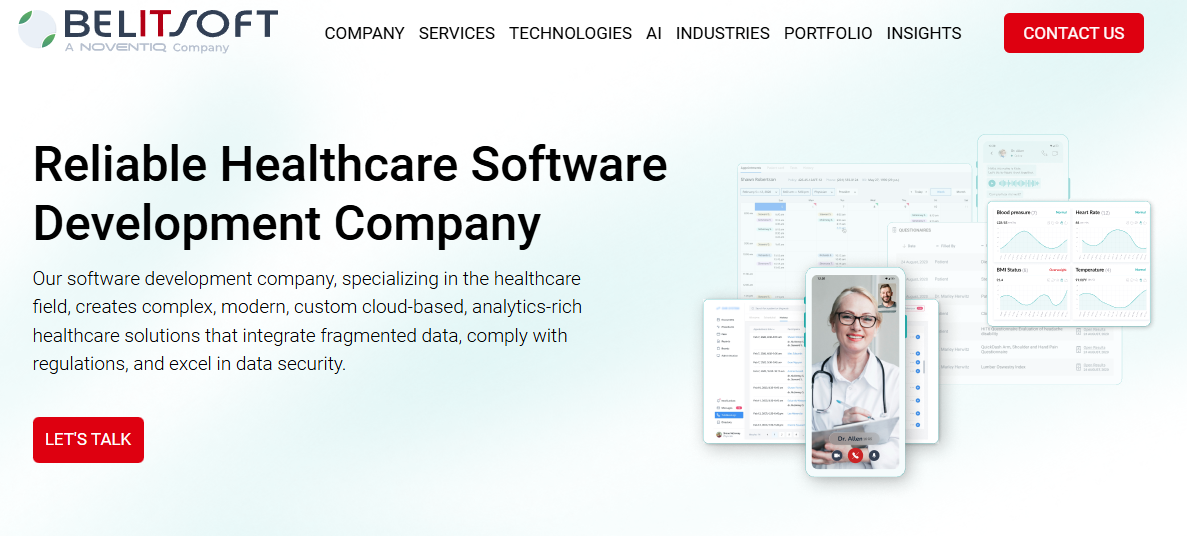
Belitsoft is a healthcare software development company with deep experience in data-heavy, interoperability-driven platforms. The team works across EHR development, healthcare analytics, population health, and AI-enabled healthcare systems, with a strong emphasis on cloud-native architecture and regulatory compliance. Belitsoft supports the full lifecycle, from prototyping and modernization to long-term maintenance, and frequently works on projects involving HL7, FHIR, and complex data integrations. The company is well suited for healthcare organizations building analytics-rich platforms, health data infrastructure, and large-scale medical SaaS products that require strong backend engineering and interoperability expertise.
3. A&I Solutions
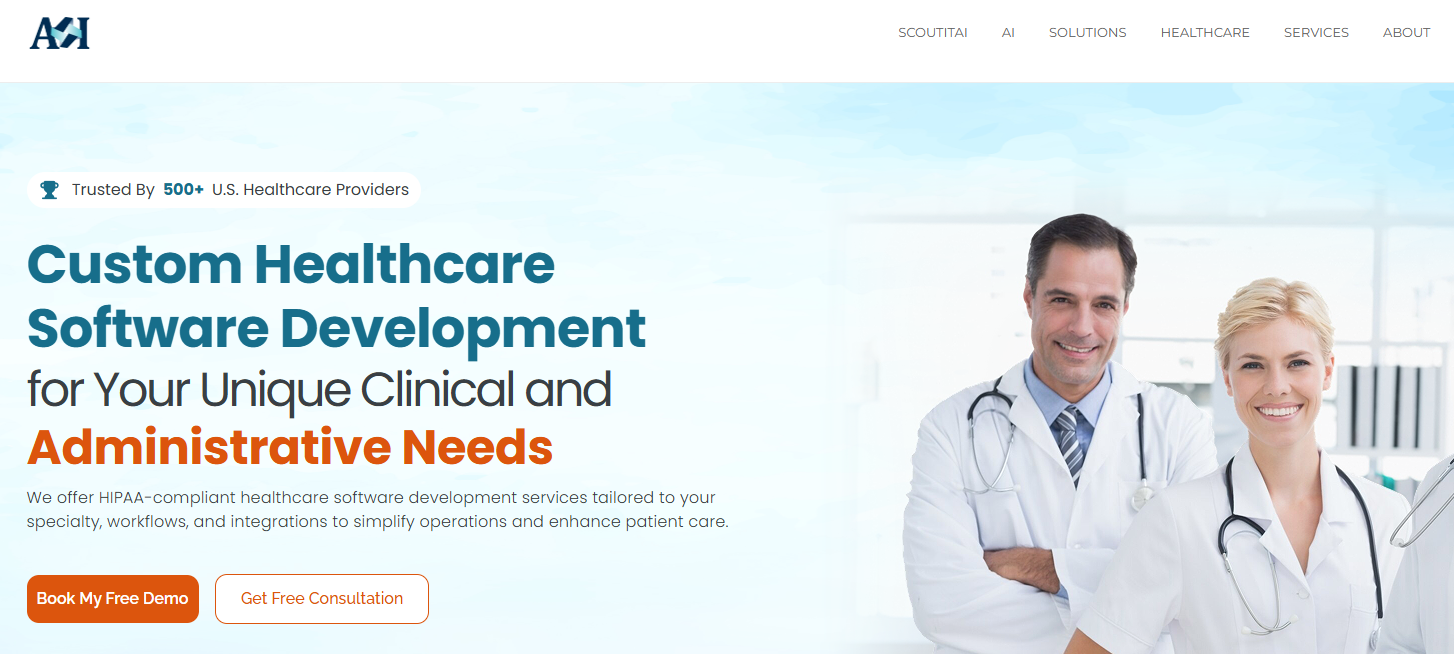
A&I Solutions focuses on custom healthcare software development for clinical and administrative operations, with experience building EHR/EMR systems, care coordination platforms, patient experience applications, and revenue cycle management tools. The company emphasizes workflow-specific design, interoperability, and regulatory alignment, supporting standards such as HL7 and FHIR. A&I Solutions works closely with healthcare providers to digitize manual processes, streamline documentation, and improve operational efficiency. Their projects often involve specialty-specific workflows, patient engagement tools, and integrations with existing healthcare systems, making them a fit for organizations looking to modernize internal platforms while maintaining compliance and clinical usability.
4. Heinsohn Xelerator
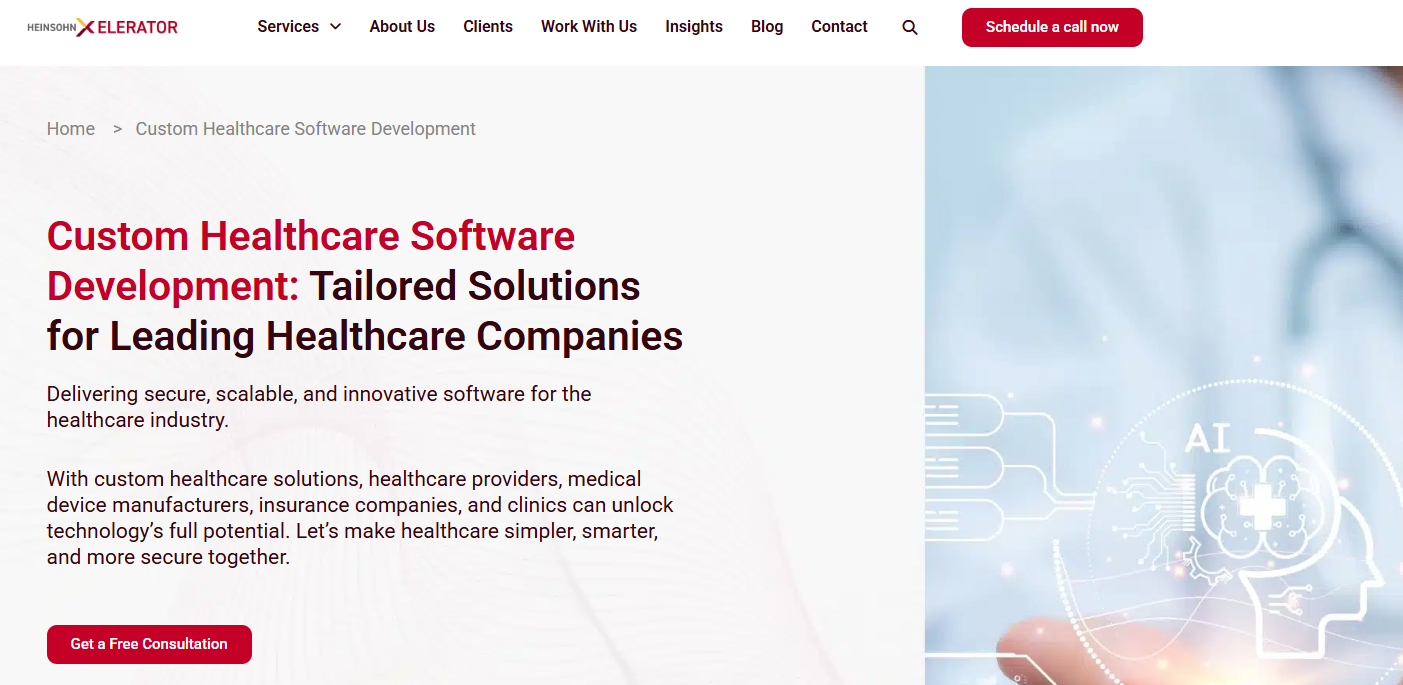
Heinsohn Xelerator provides custom healthcare software development services for providers, insurers, pharmaceutical companies, and clinics. The firm focuses on building secure, scalable systems that handle sensitive patient data while meeting regulatory requirements such as HIPAA and GDPR. Their work spans clinical platforms, administrative systems, and integration-heavy healthcare solutions, with an emphasis on interoperability and long-term scalability. Heinsohn Xelerator also supports modernization efforts, cloud-based deployments, and ongoing maintenance, making them a fit for healthcare organizations looking to evolve legacy systems while maintaining operational stability and compliance.
5. EffectiveSoft
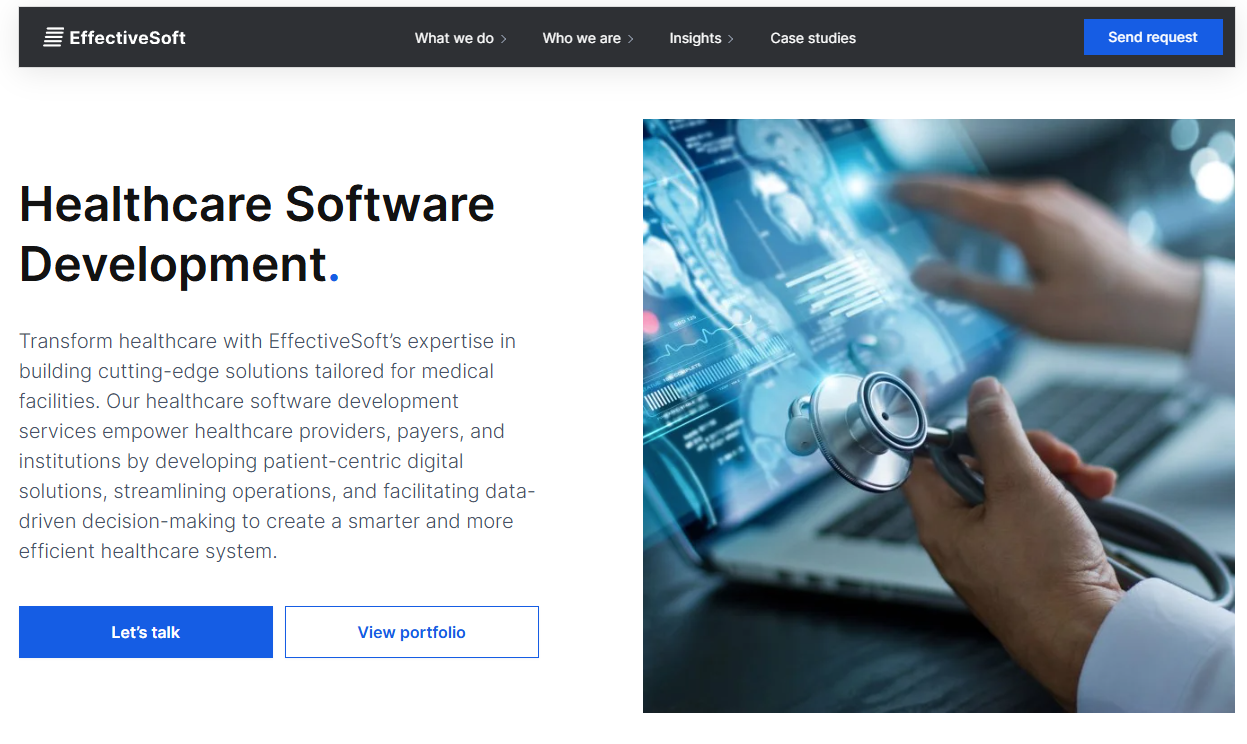
EffectiveSoft provides custom healthcare software development services for providers, payers, life sciences companies, and medical institutions. The company supports consulting, custom development, system integration, and legacy modernization, with experience across EHR/EMR platforms, patient management systems, healthcare analytics, and medical device software. EffectiveSoft emphasizes compliance with healthcare regulations and builds solutions designed to handle sensitive patient data securely. Their work often involves integration-heavy environments, cloud-based platforms, and data-driven healthcare applications, making them a fit for organizations seeking scalable, long-term healthcare systems backed by structured delivery and ongoing support.
Ready to build your own custom healthcare software? Learn more about DevSquad’s approach to custom software development.

Dayana Mayfield is a SaaS copywriter and content marketer specializing in SaaS marketing, positioning, and go-to-market strategy. She has consulted for over 195 SaaS companies, focusing on both traffic and conversions. She has been featured in Entrepreneur, Forbes, and Business Insider. Outside of work, Dayana writes SciFi novels and spends her evenings surviving auditions, rehearsals, and tech week as a proud theater mom.