
Manufacturing operations are more complex than ever. Production lines connect to inventory systems. Procurement impacts scheduling. Quality control feeds compliance reporting. A single delay on the shop floor can ripple across purchasing, fulfillment, and revenue. Yet many manufacturers still rely on rigid ERP and MES platforms that were designed for the average company, not for your specific workflows.
Off-the-shelf systems force teams to adapt to predefined logic. They add layers of customization, subscription costs, and integration headaches. Over time, the software begins to control the process instead of supporting it.
That is why more manufacturing leaders are building internal platforms tailored to how their business actually runs. Custom manufacturing software reflects real production environments and operational goals.
In this guide, we will define what custom manufacturing software is, outline the discovery process, explore key features, review the best frameworks, and highlight top development partners.
What is custom manufacturing software?
Custom manufacturing software is a purpose built digital system designed around how your factory actually operates. Unlike generic ERP systems that attempt to serve every industry, custom manufacturing software reflects your production model, workflows, machines, and reporting structure. It supports the way your teams plan, build, inspect, store, and ship products without forcing you into predefined logic.
A manufacturing system typically refers to the operational engine that runs production, inventory, and execution. A manufacturing platform is broader. It connects multiple systems and departments into one unified environment where data flows cleanly across the organization.
Custom software can be built strictly for internal use, giving you full ownership and control. That differs from commercial SaaS tools, which are subscription based and built for mass adoption.
According to Deloitte, 86 percent of manufacturing executives believe smart factory initiatives will be the main driver of competitiveness in the next five years.
Custom manufacturing systems help unify:
Production planning
Inventory management
Logistics coordination
Quality and reporting data
The result is clarity, speed, and operational control.
How custom manufacturing software differs from off-the-shelf ERP
Off the shelf ERP systems are built for the average manufacturer. That means rigid workflows, fixed modules, and predefined logic. If your operation does not fit the template, your team adjusts instead of the software. Custom manufacturing software flips that model. It is built around configurable logic that mirrors your real production environment.
Generic ERP platforms often come with feature bloat. You pay for tools you never use while critical operational gaps remain. A custom system stays focused on what drives throughput, quality, and profitability.
Subscription stacking is another hidden cost. Manufacturers end up layering MES, inventory tools, reporting dashboards, and third party integrations just to make data usable.
With a custom system, you control the architecture, own the source code, and build long term flexibility into your operation.
Who needs custom manufacturing software?
Custom manufacturing software is not just for large enterprises. It is for manufacturers whose operations no longer fit inside rigid systems or spreadsheets. When workflows are specialized, high mix, or tightly regulated, generic tools create friction instead of efficiency.
According to the National Association of Manufacturers, 78 percent of manufacturers say they are increasing investment in digital technologies to stay competitive.
Custom solutions are especially valuable for:
Discrete manufacturers in automotive, electronics, and aerospace
Process manufacturers in food, chemical, and pharmaceutical sectors
Engineer to order and make to order operations
Mid-sized manufacturers outgrowing spreadsheets and legacy platforms
If your processes are unique, your software should be too.
Why manufacturers invest in custom software development
Manufacturers do not invest in custom software for novelty. They invest because operational pressure demands smarter systems that remove friction and support growth.
Eliminating inefficiencies on the shop floor
Manufacturers invest in custom software to remove bottlenecks that slow production and increase costs. When workflows are automated and aligned with real operations, teams spend less time managing systems and more time producing value.
Replacing outdated legacy systems
Legacy platforms are expensive to maintain and difficult to extend. Custom development allows manufacturers to modernize their core system without carrying forward old limitations or technical debt.
Gaining real time visibility across departments
Disconnected tools create blind spots between production, inventory, procurement, and finance. A unified system provides accurate data in real time so leaders can make faster, more confident decisions.
Aligning business and tech around end user experience
Successful manufacturers understand that software exists to support the people using it. Custom systems are built around the needs of operators, planners, and managers, aligning technology decisions with operational outcomes.
Signs your current manufacturing system is holding you back
If your software creates more work than it removes, it is time to take a hard look at your system. These warning signs show that your current setup may be limiting growth instead of supporting it.
Manual data entry and disconnected systems: Teams should not be retyping production numbers into spreadsheets or copying data between platforms. Disconnected tools increase errors, waste labor hours, and prevent clean data flow across departments.
Inaccurate inventory or production reporting: When inventory counts do not match physical stock or production reports arrive late, decisions suffer. Reliable operations depend on real time, accurate data.
Slow implementation of process changes: If small workflow updates require weeks of configuration or outside consultants, your system is too rigid. Manufacturing requires agility.
High licensing costs across multiple tools: Stacked subscriptions for ERP, MES, reporting, and inventory systems drain budget without delivering unified visibility.
If these issues sound familiar, your manufacturing software is not supporting your operation, it is slowing it down.
Long-term advantages of owning your manufacturing platform
Owning your manufacturing platform changes the trajectory of your business. Instead of adapting to a vendor’s roadmap, you define the architecture, control the codebase, and decide how the system evolves. Full ownership means no hidden limitations, no forced upgrades, and no licensing restrictions that block innovation.
A custom platform also gives you scalable infrastructure that grows with your operation. As you add production lines, facilities, suppliers, or distribution channels, your system expands with you. You are not constrained by seat counts, rigid modules, or expensive customization layers.
There is also a strategic advantage. Your workflows, production logic, and operational data become part of your intellectual property. According to McKinsey, companies that fully integrate digital technologies into operations can increase productivity by up to 30 percent.
Finally, owning your system reduces reliance on third party vendors. You gain flexibility, negotiating power, and long term stability, all while building technology that directly supports your competitive edge.
The discovery process for custom manufacturing software
Manufacturing systems are not typical SaaS tools. They connect production lines, people, compliance requirements, hardware, and financial reporting. That complexity requires a deeper discovery process than most software projects.
In manufacturing, software directly impacts machines, shifts, inventory, and customer commitments. One missed dependency can disrupt production or distort reporting. Discovery must map physical workflows to digital systems with precision.
Structured validation prevents costly rework. When stakeholders align early and assumptions are tested before development, the result is a system built around operational reality, not theory.
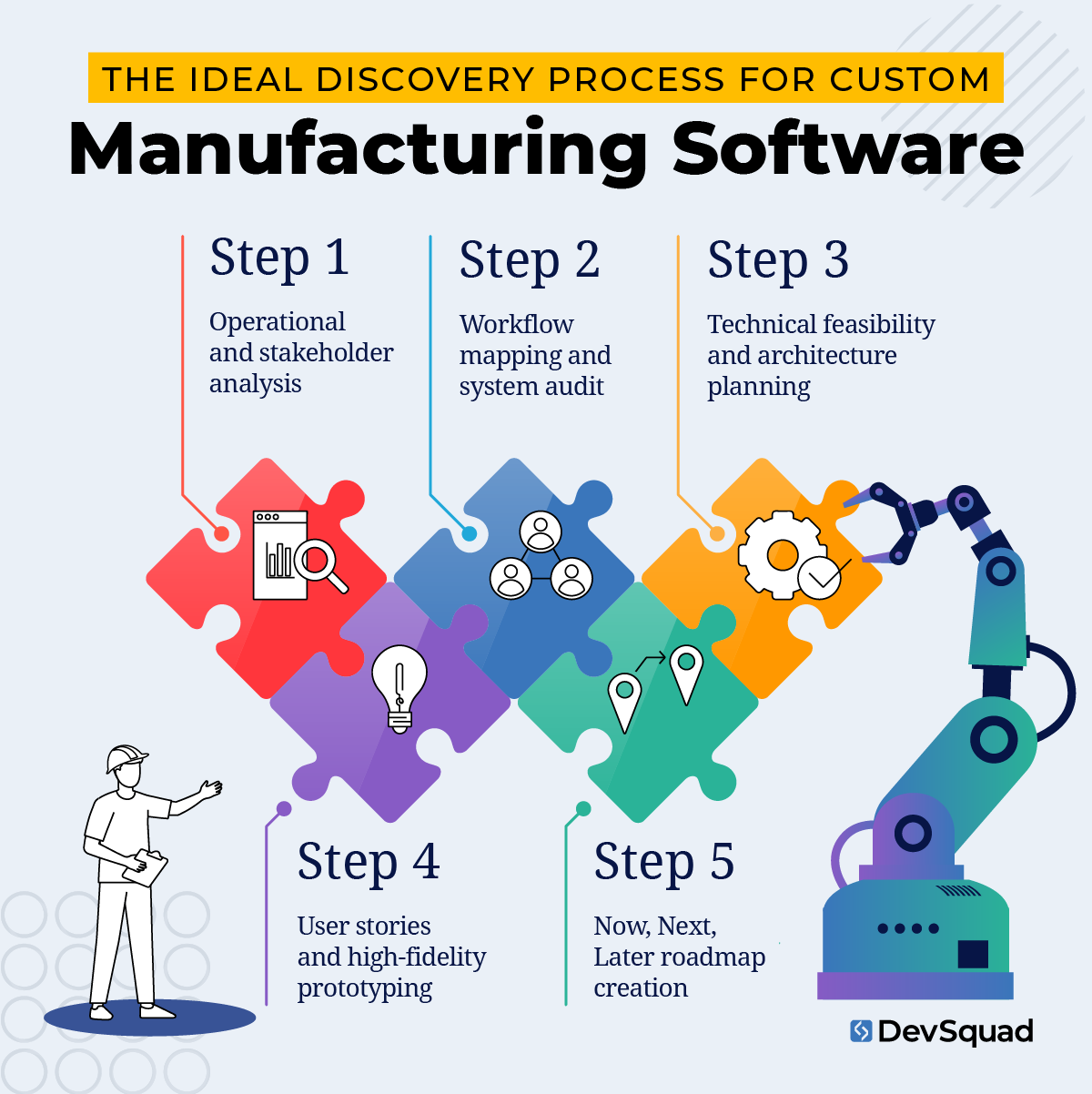
Step 1. Operational and stakeholder analysis
This phase begins on the ground, not in a conference room. You need direct insight from the people who run the operation daily.
Interview plant managers, production supervisors, procurement leads, warehouse managers, and finance stakeholders
Map production lines, shift schedules, escalation paths, and reporting flows
Identify bottlenecks, downtime causes, and hidden spreadsheet workarounds
Define measurable business goals such as throughput improvement, reduced scrap rate, or inventory accuracy targets
This step clarifies how work actually gets done. It also surfaces the difference between documented processes and real world execution. Those gaps are where custom software creates the most value.
Step 2. Workflow mapping and system audit
Once operational insight is captured, the next step is to document the current technology landscape. Most manufacturers operate a mix of ERP, MES, WMS, legacy databases, and spreadsheets. Each tool owns part of the truth, but none provides full visibility.
Document how data flows between systems. Identify where information is duplicated, delayed, or manually transferred. Look for integration points that are fragile or unsupported. Evaluate where automation could eliminate repetitive tasks or reduce human error.
This stage also defines system boundaries and dependencies. Not every function must be rebuilt. Some systems may remain in place and integrate into the new platform. The goal is clarity. You need a complete map of what exists before designing what comes next.
Step 3. Technical feasibility and architecture planning
With workflows defined, the technical foundation must be evaluated. Manufacturing environments demand stability, performance, and secure data handling.
Decide on infrastructure strategy, whether cloud, on premise, or hybrid environments
Evaluate hardware integrations including IoT sensors, barcode scanners, PLCs, and machine interfaces
Define API requirements for ERP, accounting, supplier systems, and logistics platforms
Assess compliance obligations and security standards relevant to your industry
Architecture planning is not about choosing tools based on trend. It is about selecting frameworks and infrastructure that support real time updates, high transaction volumes, and long term scalability. A manufacturing system must be reliable under pressure.
If IoT sensors and machine interfaces are part of your evaluation, our guide to SaaS IoT platforms breaks down when a platform fits and when a custom layer makes more sense.
Step 4. User stories and high-fidelity prototyping
After operational and technical clarity is achieved, insights are translated into structured user stories. This step transforms abstract goals into actionable requirements.
Convert production pain points into clear user stories tied to measurable outcomes
Validate proposed interfaces with operators, planners, and supervisors
Prototype dashboards, job tracking modules, inventory screens, and reporting views
Use interactive prototypes to reduce risk before development begins
High fidelity prototyping allows stakeholders to see the system before it is built. Users interact with workflows, provide feedback, and identify gaps early. This approach prevents expensive changes during development and creates confidence across teams.
Step 5. Now, Next, Later roadmap creation
Discovery concludes with a practical roadmap. Manufacturing transformation rarely happens in a single release. It requires structured phases that deliver value quickly while supporting long term strategy.
Define a focused MVP for version one. Prioritize features that improve visibility and eliminate manual work. Establish automation and reporting capabilities that deliver measurable gains early. Phase integrations strategically to reduce disruption across departments.
Finally, establish clear performance benchmarks. Whether the goal is reduced downtime, improved inventory accuracy, or faster order fulfillment, metrics must be defined before development begins. This creates accountability and aligns technology investment with operational outcomes.
A disciplined discovery process transforms complexity into clarity. For manufacturing companies, that clarity is the difference between another failed implementation and a system that truly powers the business.
Our approach to custom supply chain software follows a similar process.
Common features of custom manufacturing software systems
Custom manufacturing software must reflect how your operation actually runs. Features vary by manufacturing type, whether discrete, process, or engineer to order. The system should be modular so components can expand as operations grow. Most important, every feature should deliver measurable operational impact, not inflate a checklist.
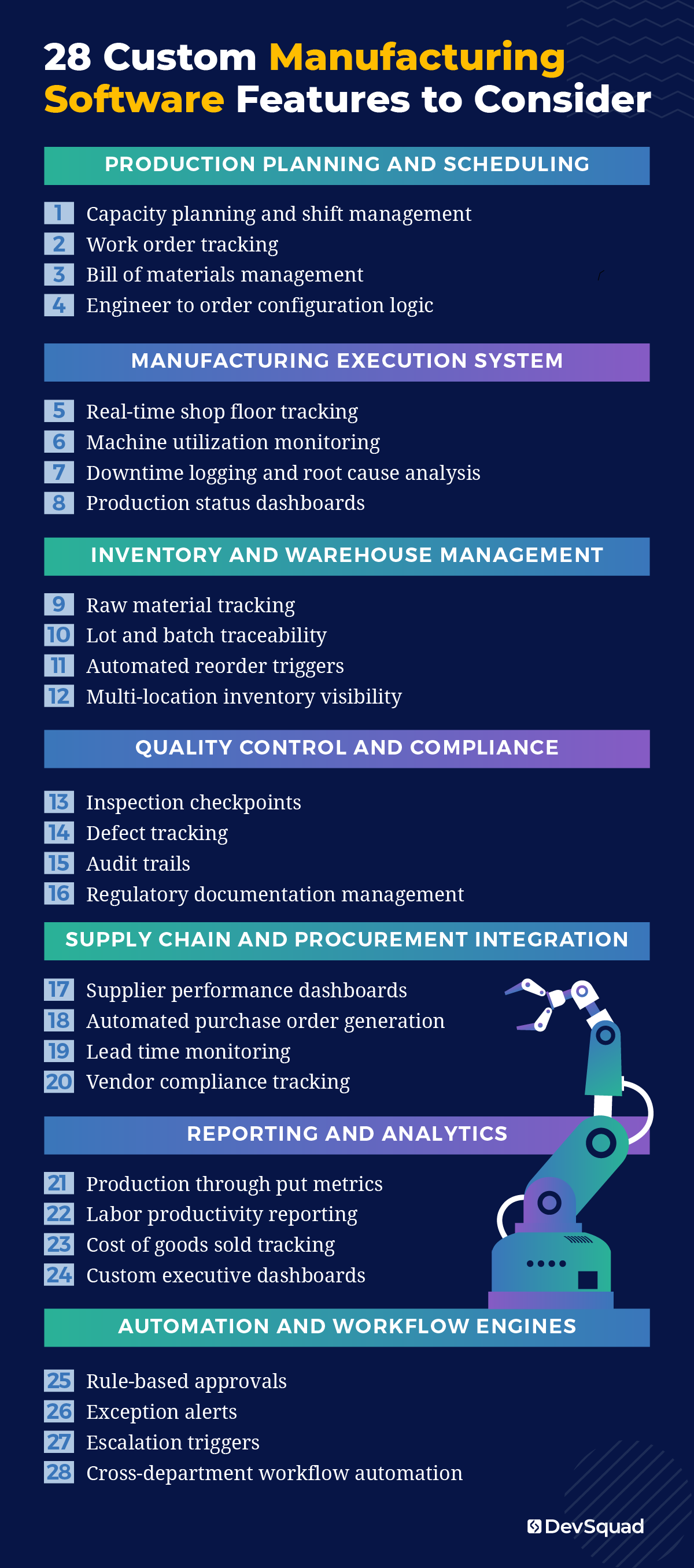
Production planning and scheduling
Production planning tools coordinate materials, labor, and machine capacity with real demand and delivery timelines.
Capacity planning and shift management
Work order tracking
Bill of materials management
Engineer to order configuration logic
Manufacturing execution system functionality
MES capabilities connect the digital platform directly to shop floor performance and production output.
Real-time shop floor tracking
Machine utilization monitoring
Downtime logging and root cause analysis
Production status dashboards
Inventory and warehouse management
Inventory systems protect material accuracy and support efficient movement across facilities.
Raw material tracking
Lot and batch traceability
Automated reorder triggers
Multi-location inventory visibility
Quality control and compliance
Quality management features maintain standards and support regulatory accountability.
Inspection checkpoints
Defect tracking
Audit trails
Regulatory documentation management
Supply chain and procurement integration
Procurement integrations strengthen supplier coordination and reduce material risk.
Supplier performance dashboards
Automated purchase order generation
Lead time monitoring
Vendor compliance tracking
Reporting and analytics
Reporting tools transform operational data into decision-ready insight.
Production throughput metrics
Labor productivity reporting
Cost of goods sold tracking
Custom executive dashboards
Automation and workflow engines
Workflow engines eliminate manual coordination and enforce process consistency.
Rule-based approvals
Exception alerts
Escalation triggers
Cross-department workflow automation
Best frameworks for developing custom manufacturing software
Choosing the right framework is not a technical afterthought. It directly impacts scalability, maintenance costs, and system performance under pressure. Manufacturing platforms must balance real time responsiveness with fast development cycles, while protecting long term maintainability. The frameworks below are proven choices for building reliable, adaptable manufacturing systems.
1. Laravel: best overall for manufacturing platforms
Laravel is our top choice for manufacturing platforms because it handles complex business logic without creating architectural chaos. It allows teams to move quickly while keeping code structured and maintainable. For manufacturers replacing legacy systems, that balance matters.
Clean architecture for complex business logic
Strong API support for ERP, MES, and WMS integrations
Queue management for background jobs and production updates
Fast development cycles with long term maintainability
Laravel gives manufacturers a stable backbone that can evolve with operations.
2. Vue.js: best for operational dashboards
Vue.js is ideal for operational dashboards where speed and clarity matter. It performs well in shop floor environments and is easy to scale across modules. Its simplicity makes ongoing iteration efficient.
Lightweight performance for shop floor screens
Real time data visualization
Seamless pairing with Laravel
Vue keeps interfaces fast, responsive, and easy to expand.
3. React: best for complex enterprise interfaces
React excels in large enterprise environments with complex user interfaces. It supports modular design, making it easier to build multi department systems. Its ecosystem is mature and widely supported.
Modular UI components
Strong ecosystem for analytics heavy systems
Scales across multi department platforms
React is a strong choice when manufacturing platforms require deep interactivity.
4. Node.js / NestJS: best for real-time event systems
Node.js and NestJS are built for real time communication and event driven systems. They handle high volumes of concurrent updates efficiently. This makes them valuable in production environments with constant machine feedback.
Event driven architecture
Ideal for IoT heavy manufacturing environments
High concurrency support
For real time event processing, this stack delivers speed and reliability.
5. Python (Django / FastAPI): best for AI-driven manufacturing systems
Python frameworks shine when manufacturing systems incorporate analytics and machine learning. They support predictive models and advanced data processing. This makes them useful in AI driven operations.
Predictive maintenance models
Demand forecasting
Integration with machine learning workflows
Python enables intelligent automation inside manufacturing systems.
6. .NET: best for Microsoft-first manufacturers
For manufacturers invested in Microsoft ecosystems, .NET offers strong integration and enterprise stability. It performs well in regulated and security sensitive industries. Many enterprise IT teams are already familiar with it.
Deep Azure integration
Enterprise level security
Long term corporate stability
.NET is a practical choice for Microsoft first organizations.
7. Spring Boot: best for global, large-scale operations
Spring Boot is designed for high scale, global operations. It supports large transaction volumes and strict governance requirements. This makes it common in highly regulated manufacturing sectors.
High transaction throughput
Enterprise grade architecture
Strong governance and compliance support
Spring Boot is best suited for complex, global manufacturing environments that demand precision and uptime.
AI-assisted development vs no-code manufacturing platforms
AI-assisted development is changing the game for manufacturers who have outgrown rigid no-code platforms. Instead of stacking expensive software subscriptions that only partially fit their workflows, businesses can now invest in custom-built systems tailored to their exact processes, often at a lower long-term cost. This shift allows companies to allocate resources toward software that directly supports their operations rather than paying for generic tools with unnecessary features.
No-code tools often struggle in complex manufacturing environments where performance, scalability, and deep system integrations are critical. As operations grow, these platforms can become slow, limiting, and difficult to customize beyond surface-level features. Workarounds and add-ons may temporarily solve gaps, but they rarely provide the flexibility required for highly specialized production workflows.
AI-assisted development accelerates the creation of fully custom systems while maintaining full architectural control. Companies gain software designed around their operations rather than forcing their operations to adapt to prebuilt templates. This approach supports stronger performance, greater flexibility, and long-term scalability while reducing reliance on multiple subscription platforms.
How to measure ROI from custom manufacturing software
Custom manufacturing software delivers measurable ROI when performance improvements are tied directly to operational outcomes. One of the clearest gains comes from reduced downtime and improved throughput. Real-time visibility into machines, workflows, and bottlenecks allows teams to address issues faster and keep production moving.
Companies often see lower inventory carrying costs as better coordination reduces excess stock and minimizes overproduction. Faster production cycle times also contribute to revenue growth by increasing capacity without expanding overhead. In addition, improved forecasting accuracy helps align purchasing, staffing, and scheduling decisions with actual demand.
Operational KPIs to track
To measure impact, manufacturers should monitor machine utilization rate, on-time production completion, scrap and defect rates, and labor productivity metrics. Tracking these KPIs before and after implementation provides clear data on efficiency gains, cost savings, and overall operational performance improvements tied directly to the custom system.
Top 5 agencies for custom manufacturing software development
Choosing the right development partner is critical for manufacturers investing in custom software to improve efficiency, scalability, and operational control.
1. DevSquad
DevSquad stands out for its consulting-first approach to custom manufacturing software development. The team prioritizes clarity and strategy before writing a single line of code, ensuring systems align with operational goals and long-term scalability. Manufacturers benefit from structured planning, modern architecture, and fully managed delivery teams.
Consulting-first approach with deep discovery
Structured planning before development begins
Modern stacks including Laravel and Vue.js
Fully managed squads with strategists, TPMs, developers, QA, and DevOps
AI-driven workflows and scalable architecture
DevSquad focuses on building tailored platforms that reduce downtime, improve visibility, and support performance at scale.
2. ScienceSoft
With deep experience in enterprise environments, this firm supports complex manufacturing digital transformation initiatives. ScienceSoft specializes in ERP and MES integrations that connect production data, supply chain systems, and reporting tools into unified platforms. The company is frequently selected for large-scale modernization projects where legacy infrastructure must be upgraded without disrupting daily operations.
Its portfolio includes predictive maintenance systems, production planning tools, and plant-level analytics platforms. A strong emphasis on security, compliance, and performance makes ScienceSoft a solid choice for mid-sized to large manufacturers seeking structured implementation processes and long-term technology roadmaps.
3. Chetu
Chetu provides custom manufacturing software development with flexible engagement models and broad industry coverage. The company supports ERP systems, supply chain platforms, and production management tools tailored to operational needs.
Broad industry coverage
Flexible staffing models
ERP and supply chain development
Chetu’s scalable team structure allows manufacturers to extend internal resources or fully outsource development initiatives. Their experience across multiple verticals enables them to adapt solutions to different regulatory and operational requirements while maintaining cost efficiency.
4. Radixweb
Focused on product engineering and cloud modernization, this company helps manufacturing organizations transition from legacy systems to scalable, cloud-based platforms. Radixweb works with businesses seeking improved operational visibility, system integration, and long-term digital transformation strategies.
Its cross-industry development capabilities allow teams to apply best practices from multiple sectors to manufacturing use cases. Services often include application re-engineering, modernization of outdated infrastructure, and performance optimization to support growth and scalability.
5. Itransition
Itransition delivers manufacturing ERP and execution system development for large enterprise environments. With global delivery teams and experience managing complex, multi-location engagements, the company supports digital transformation initiatives at scale.
Their expertise includes production management platforms, supply chain systems, and enterprise-level analytics solutions. Itransition is often chosen by organizations requiring extensive integration capabilities and governance structures. Their structured processes and international footprint make them well suited for large manufacturers with global operational demands.
Owning your custom manufacturing platform gives you a long-term strategic advantage with full control, scalability, and performance built around your operations.
Learn more about our custom software development services and start with a structured discovery and roadmap planning process guided by DevSquad’s consulting-first approach.

Dayana Mayfield is a SaaS copywriter and content marketer specializing in SaaS marketing, positioning, and go-to-market strategy. She has consulted for over 195 SaaS companies, focusing on both traffic and conversions. She has been featured in Entrepreneur, Forbes, and Business Insider. Outside of work, Dayana writes SciFi novels and spends her evenings surviving auditions, rehearsals, and tech week as a proud theater mom.