
Need a better way to serve your clients, streamline communication, and cut down on back-and-forth emails? A custom client portal could be the solution.
In this guide, we’ll break down what it is, how it works, and how to build one that fits your business—plus the top agencies that can bring it to life.
What is custom client portal software?
Custom client portal software is a private, secure area where your clients can log in to view and manage their interactions with your business. It gives them a centralized place to access documents, track progress, communicate with your team, and get the information they need without having to email or call.
Unlike off-the-shelf solutions, custom portals are built specifically for your business and your clients. They can match your workflows, support your branding, and integrate with your internal systems. This creates a smoother experience for your clients and helps your team operate more efficiently behind the scenes.
Example use cases of a custom client portal include:
A branded client portal for an accounting firm might include secure file sharing, task updates, and tax filing timelines.
A service-based SaaS might build a client dashboard to show onboarding progress, invoices, and support tickets.
A marketing agency offers client portals to provide visibility into campaign performance, task status, and billing.
What do these examples have in common? The software acts as a digital extension of your business. And as such, the portal software should integrate into your system — not the other way around..
Industries that benefit from offering custom client portals
A wide range of industries can improve efficiency, reduce friction, and increase customer satisfaction by offering a custom client portal. These portals give clients a secure, branded experience while giving internal teams more time to focus on delivering value.
Here’s how different industries benefit from building their own portal:
Client portal software for accountants
Accounting firms work with sensitive financial data, tight deadlines, and recurring document requests. A custom accounting software portal allows firms to streamline these processes, maintain professionalism, and reduce administrative overhead.
Key uses of a client portal for this industry:
Uploading and downloading tax documents
Collecting digital signatures
Tracking project and filing status
Sharing invoices and payment links
Client portal software for marketing agencies
Agencies juggle campaign deliverables, creative approvals, and performance reporting. A custom portal creates one place where clients can access progress updates and assets without constant back-and-forth, leading to better transparency and faster feedback cycles.
Key uses of a client portal for this industry:
Sharing campaign assets and creative files
Tracking task and project status
Providing campaign performance metrics
Centralizing client communication
Managing revision requests
Uploading brand guidelines
Client portal software for SaaS companies
For SaaS companies, the client experience doesn’t end at sign-up. In this high churn industry a customer portal improves onboarding, reduces support burden, and increases retention by putting account management and resources at users’ fingertips.
Key uses of a client portal for this industry:
Displaying onboarding progress
Managing subscription and billing
Centralizing support tickets
Delivering training or onboarding materials
Client portal software for Law firms
Legal clients expect confidentiality and clear communication. A custom portal allows firms to provide secure access to case files and reduce delays, while also protecting sensitive information.
Key uses of a client portal for this industry:
Uploading legal documents
Providing access to case updates
Messaging with attorneys
Client portal software for Healthcare providers
A secure patient portal acts as an extension to customized healthcare software in a way that improves the care experience while minimizing admin work. Patients get easier access to records and communication, which increases trust and reduces missed appointments or misunderstandings.
Key uses of a client portal for this industry:
Viewing test results
Messaging with providers
Managing appointments
Accessing visit summaries and prescriptions
Uploading insurance or ID documents
Client portal software for Property management
Property managers deal with a large volume of tenant and owner communication. A portal that acts as an extension to the broader property management software helps them handle requests, share updates, and automate repetitive interactions.
Key uses of a client portal for this industry:
Submitting and tracking maintenance requests
Viewing lease documents
Processing rent payments
Sharing building notices
Client portal software for real estate firms
Real estate transactions involve high-stakes decisions and constant updates. A portal that ties into the broader real estate software helps agents and brokers provide a smoother client experience, from initial search through closing.
Key uses of a client portal for this industry:
Sharing property listings
Tracking document status
Messaging with agents
Uploading and reviewing offers
And so many more…
In reality, any business that involves repeated client interactions can benefit from a custom client portal. Whether you're providing professional services, managing long-term client relationships, or handling sensitive data, a portal helps you deliver a smoother experience and operate more efficiently.
10 common features to include in a client dashboard
Every custom client portal is unique to the business and its users. That is where the discovery process comes in (more on this later). There are however several core features that show up again and again.
The most common features found in client portal software:
Secure login and user roles
Document sharing and file uploads
Messaging and communication
Task or project tracking
Payment and billing tools
Forms and data collection
Notifications and alerts
Reporting and analytics
Knowledge base or help center
Branding and personalization
Think of these common features as a starting template. They act as a base that you can use to shape and mold into the custom solution that fits your business exactly.
The ideal discovery process for custom client portal development
A successful client portal isn’t built by guessing what clients need. It’s shaped by real insight and a clear execution plan. At DevSquad, discovery is the core of every product—it’s a structured process designed to reduce risk, align teams, and validate the right features before a single line of code is written.
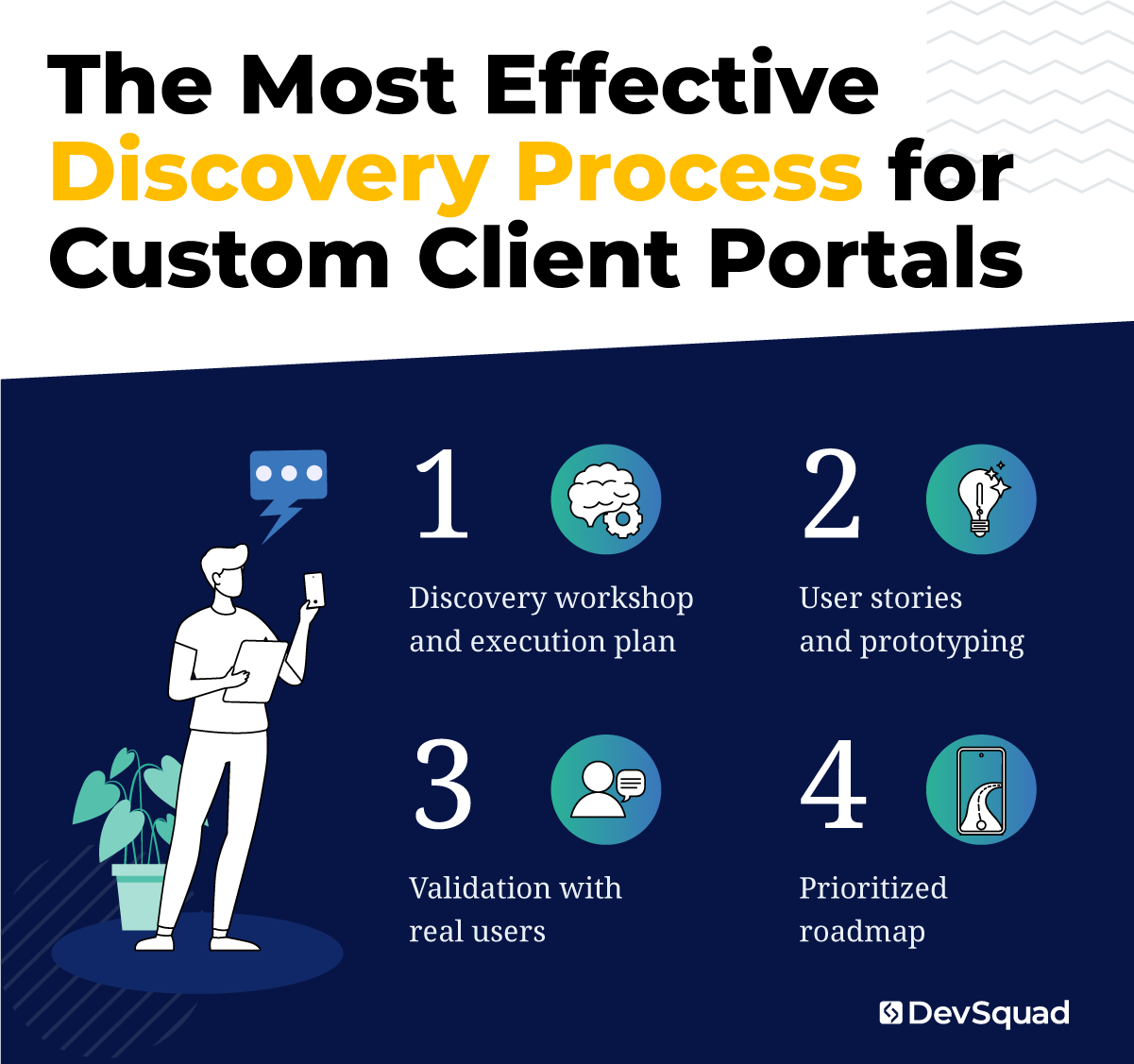
Here’s how we approach discovery for custom client portal software:
1. Discovery workshop and execution plan
We start by analyzing your business challenges, user needs, and internal workflows. A solutions architect leads the process, reviewing existing tools or systems (if any) and identifying opportunities for automation, simplification, or integration. The result is a tailored execution plan built around your business.
2. User stories and prototyping
Next, a product manager writes user stories to document what the portal needs to do for both your clients and your internal team. Meanwhile, a UX designer creates a high-fidelity prototype so you can visualize the experience before we build it. This is where gaps get identified and ideas start to click.
3. Validation with real users
You’ll gather feedback directly from the people who will use the portal—your clients. DevSquad trains your team on how to test the prototype, ask the right questions, and document insights. This feedback loop ensures you’re building something people will actually use.
4. Prioritized roadmap
At the end of discovery, you come out with a Now / Next / Later roadmap. This helps you go to market quickly with the highest-impact features first, then continue to evolve your portal based on feedback and usage.
Best frameworks for building your own custom client portal
Choosing the right tech stack is critical when developing a client portal that’s secure, scalable, and easy to maintain. The right frameworks will speed up development, reduce bugs, and help your portal perform reliably.
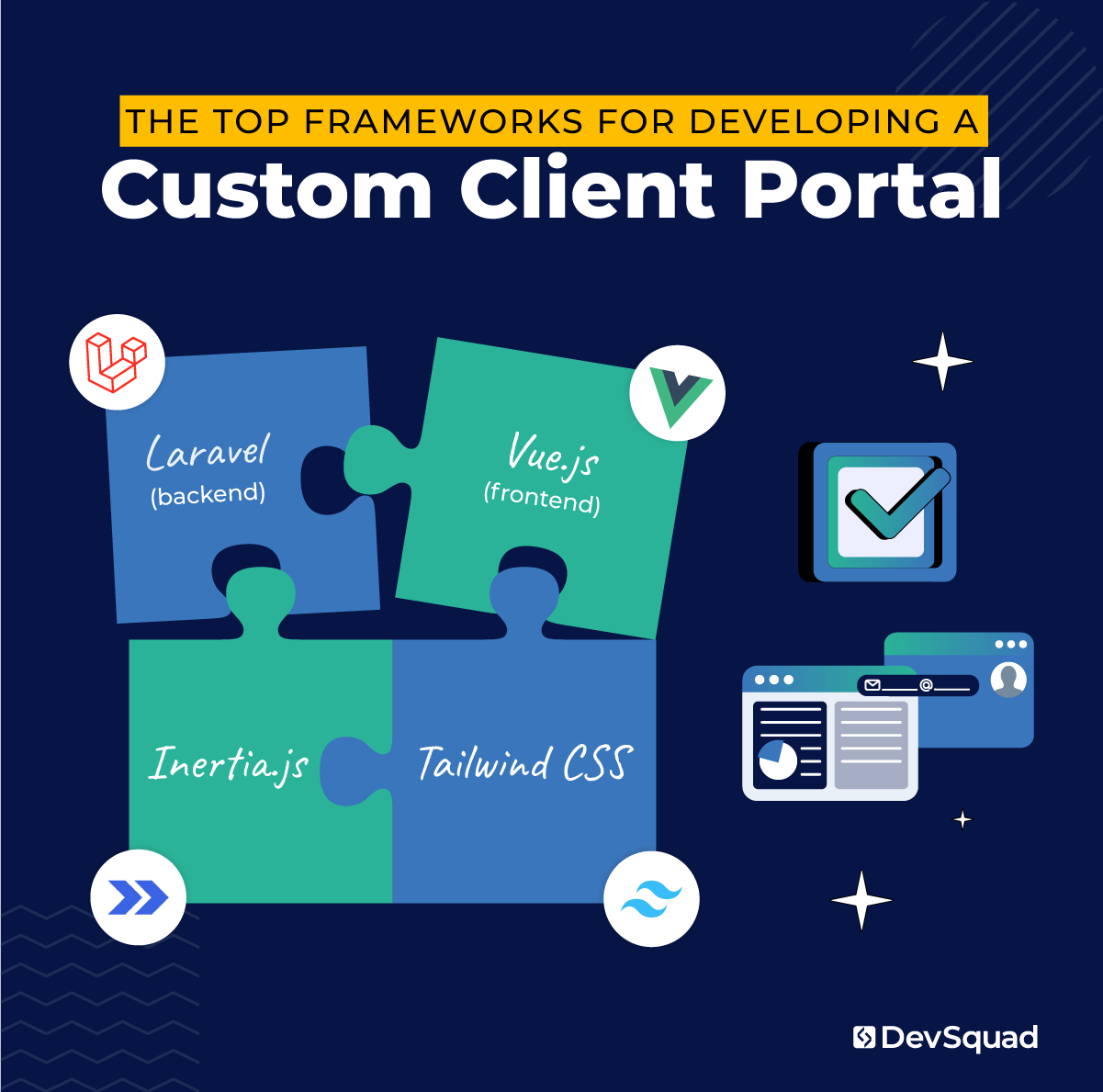
Here are the best frameworks to consider, starting with our favorite.
1. Laravel (backend)
Laravel is our go-to backend framework for client portal software. It’s clean, modern, and efficient, and it helps developers build fast, secure apps with less overhead. Laravel has built-in support for authentication, user roles, routing, and database management, which means you don’t have to reinvent the wheel to deliver essential features. It’s ideal for custom portals that need to scale and integrate with other tools.
2. Vue.js (frontend)
For a seamless, responsive client experience, Vue.js is a lightweight and flexible frontend framework that pairs well with Laravel. It’s great for building dynamic dashboards and user interfaces that feel smooth and modern without adding unnecessary complexity.
3. Tailwind CSS
Tailwind makes it easy to create polished, consistent UI components that follow your branding. It speeds up frontend development and helps maintain a clean design system across your portal.
4. Inertia.js
When using Laravel and Vue together, Inertia.js allows us to build modern single-page applications (SPAs) without needing a separate API layer. It simplifies development and creates a smoother user experience.
Top 5 agencies for custom client portal software development
If you’re not building with your own in-house team, choosing the right development partner is a critical step. You need a firm that not only understands custom software—but also brings the right mix of product thinking, UX design, and backend experience.
Here are five top agencies for building custom client portal software, starting with our team at DevSquad.
1. DevSquad
DevSquad is a product development firm that builds custom portals and SaaS platforms using a consulting-first approach. Each engagement starts with a discovery sprint, high-fidelity prototype, and prioritized roadmap. With dedicated squads made up of senior-level talent, DevSquad focuses on creating scalable, user-friendly software with speed and precision. All without bloated timelines or long-term contracts.
2. ScienceSoft
With experience in portal development dating back to 2005, ScienceSoft builds custom web portals across industries including healthcare, finance, and retail. They offer end-to-end services from consulting through deployment, with expertise in both platform-based and fully custom solutions. Their team supports everything but they do lean more heavily into the enterprise arena.
3. Andersen
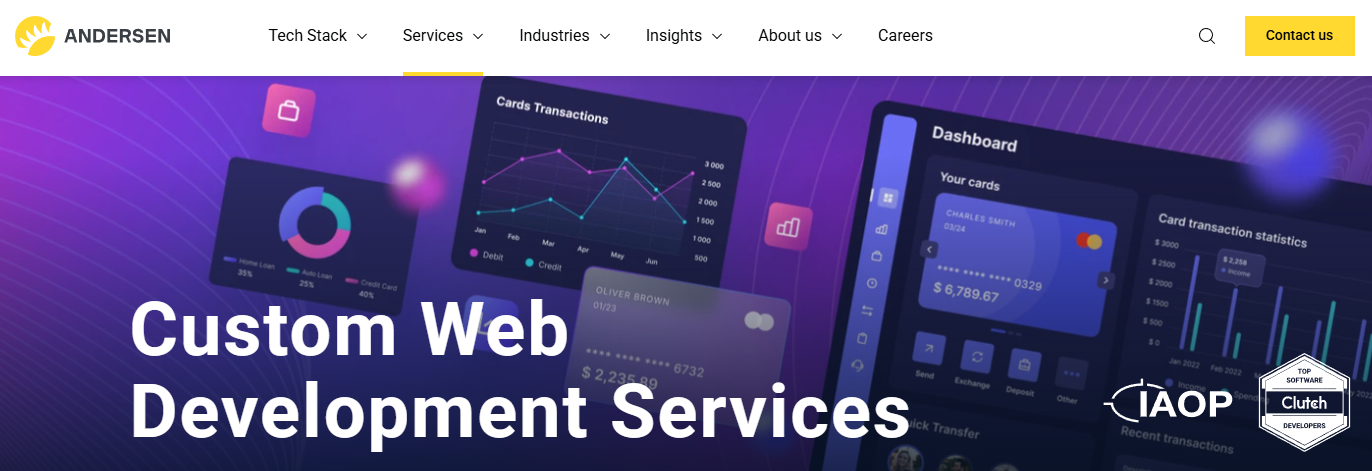
Andersen is a global software development firm with a large in-house team and a strong focus on enterprise-grade web applications. Their custom portal development process includes discovery, UX/UI design, full-stack engineering, and post-launch support. Andersen serves industries like finance, healthcare, and real estate, offering scalable solutions with flexible team structures and extensive technology capabilities.
4. Orases
Orases is a custom software firm with over 25 years of experience building scalable web portals. They focus on highly tailored solutions designed to meet specific business and compliance requirements. Orases offers full-cycle services including strategy, UX/UI design, development, and long-term support, with a strong track record across regulated and complex industries.
5. Fluent Consultants
Fluent Consultants has specializes in custom portal development, with a focus on creating intuitive, self-service experiences. They guide clients through discovery, design, development, and deployment with a process built around usability and integration. Fluent works across industries to deliver customer portals that streamline communication and drive digital transformation.
Ready for your own custom client portal? Learn more about our custom software development services.

Dayana Mayfield is a SaaS copywriter and content marketer specializing in SaaS marketing, positioning, and go-to-market strategy. She has consulted for over 195 SaaS companies, focusing on both traffic and conversions. She has been featured in Entrepreneur, Forbes, and Business Insider. Outside of work, Dayana writes SciFi novels and spends her evenings surviving auditions, rehearsals, and tech week as a proud theater mom.