
With the global property management market poised to reach $39 billion by 2030, there is no lack of motivation to differentiate your business and streamline your workflows.
The tech world sees this windfall and the outdated costly legacy systems just ready to be updated. SaaS upon SaaS is being turned out which has really helped improve efficiency and workflows. But, those recurring costs just keep climbing and your needs are not fully met.
Luckily, that game is starting to change. With the advancement of AI-assisted development, what was once reserved for the enterprises is now within reach for the rest. That is custom software for your property management business.
In this guide, we cover:
What custom property management software is
Important use cases for management workflows
Common features to benefit your operations
Development frameworks and agencies ready to help you build
Let’s dive in.
What is custom property management software?
Custom property management software is built specifically for your business — tailored to match your workflows, portfolio, team structure, and growth goals. Rather than adapting your operations to fit the limits of a generic platform, you design a system around how your business actually runs.
For property managers handling mixed portfolios, navigating multiple jurisdictions, or needing to automate complex workflows, custom software is a practical solution. It’s an investment in long-term efficiency, full data ownership, and a better experience for both your team and your tenants.
With AI-assisted development now streamlining how software is built, the cost of a tailored platform can be competitive with the subscription and integration costs SMBs already spend on a stack of property management SaaS tools.
Custom property management software vs property management SaaS
Property management SaaS platforms are designed for the mass market. They offer a range of features like rent collection, maintenance tracking, and lease management that are ready to go with minimal setup. For many landlords and managers, that convenience is enough.
In response to growing demand, some SaaS products now include limited customization: the ability to change field labels, add a logo, or create custom workflows. While helpful, these are surface-level changes that don’t fundamentally alter how the software operates. The core product is still shared across thousands of users, and your ability to shape it around your business is limited.
With custom property management software, you’re not renting space in someone else’s system, you’re building your own.
Here are a few key differences:
Ownership: When you build custom software, you own the codebase. It becomes a business asset that you control.
Flexibility: You can develop exactly what you need: a tenant portal with your brand and UX, a landlord dashboard that tracks the KPIs that matter to you, or a real estate investor dashboard that connects to other tools you already use.
Integration: Custom platforms can pull data from accounting systems, CRM tools, IoT devices, and more.
Scalability: As your business grows, your software can evolve with it. You’re not locked into pricing tiers, user caps, or rigid feature sets.
Ultimately, it comes down to control. SaaS makes sense when your needs are basic and fixed. But if your business is growing, diversifying, or simply wants to own its tech stack, custom property management software puts you in the driver’s seat.
25 important use cases for workflow automation software
Use cases for workflow automation in property management software vary as much as the properties being managed. Whether you manage mixed portfolios, operate in regulated markets, or simply want a better experience for your tenants and team, custom property management software gives you more control. Below are the most valuable use cases organized by function, showing how a tailored platform can support and streamline every part of your operations.
Operations and maintenance
Managing properties at scale means coordinating teams, vendors, and recurring tasks — often across different locations or asset types. Custom software helps you reduce errors, respond faster, and keep costs under control with tools designed specifically for how your team works.
Automated vendor dispatching for maintenance
Centralized task management across properties
Integrated key and access control tracking
Maintenance cost allocation per unit or owner
Dynamic rules for maintenance approvals
Inventory and supply chain tracking for in-house teams
Field technician mobile workflows.
Leasing and tenant experience
Your lease process is more than paperwork — it's your first impression. A custom system allows you to build smoother, branded experiences that improve tenant satisfaction and shorten vacancy cycles. From applications to renewals, everything can be designed around your leasing flow.
Custom online application workflows
Branded tenant portal
Automated lease renewals and rent increases
Self-scheduling for showings and inspections
Custom tenant communication workflows
Automated verifications and credit checks
Financial control and ownership reporting
When you're managing properties for multiple owners — or running multiple entities yourself — manual reporting can quickly become a bottleneck. Custom real estate software gives you better financial visibility and tighter control over profitability, fee structures, and reporting requirements.
Owner-specific dashboards for real estate investors
Automated fee and revenue sharing calculations
Cash flow forecasting tools for each asset
Multi-entity accounting and reporting
Real-time unit-level profitability tracking
Escrow and reserve account tracking
Compliance, audits, and regulatory workflows
If you operate in regulated markets or manage affordable housing, compliance is non-negotiable. Custom property management software can help automate rule-heavy workflows, reduce risk, and make audits easier.
Automated workflows for HUD, LIHTC, USDA, and local programs
Audit-ready document storage and version control
Custom compliance reports and exports
Automated alerting for compliance deadlines
Role-based access control and permission logs
Automated tracking of fair housing and accessibility issues
10 common features that support property management workflows
Below are some of the most common and valuable features developed for property managers, landlords, and real estate investors.
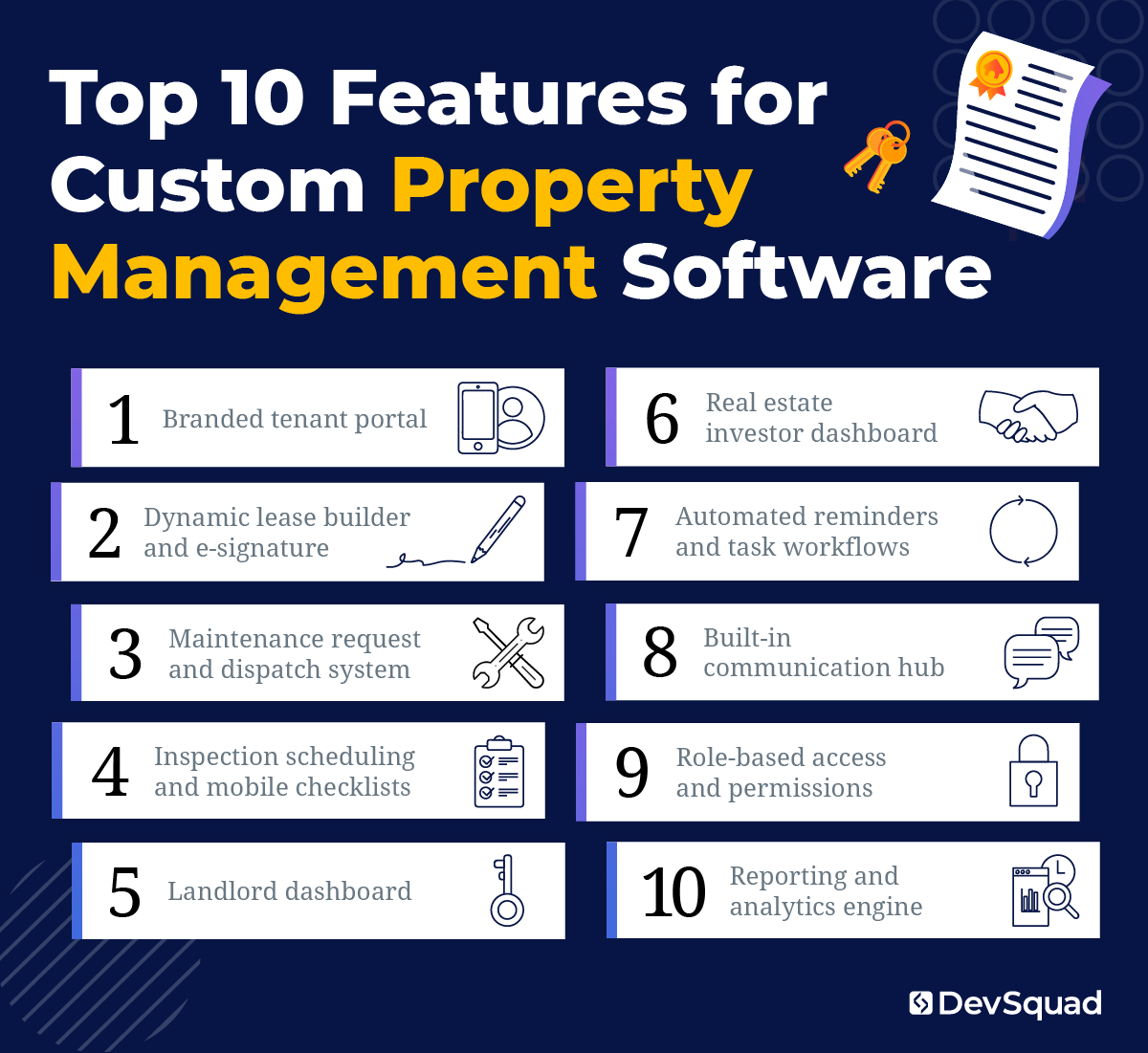
1. Branded tenant portal
A tenant portal is one of the most valuable components in any property management system. With a branded experience, tenants can pay rent, submit maintenance requests, view documents, and communicate with your team — all from one place. When designed around your policies and processes, tenant portal features improve tenant satisfaction and reduce time spent answering repetitive questions.
2. Dynamic lease builder and e-signature
A dynamic lease tool allows your team to generate lease agreements using templates tied to unit data, legal requirements, or program-specific rules. With built-in e-signature and automated storage, it eliminates the back-and-forth of manual document handling while keeping records clean and accessible.
3. Maintenance request and dispatch system
This feature lets tenants submit detailed maintenance requests and enables your team to route those requests to in-house techs or approved vendors based on custom logic. You can attach photos, assign priority levels, and trigger alerts.
4. Inspection scheduling and mobile checklists
Custom scheduling tools allow your team to plan unit inspections, track progress, and manage tenant notifications. Technicians or staff can use mobile-friendly checklists during inspections to document findings, flag follow-ups, and store reports directly in the system.
5. Landlord dashboard
A landlord dashboard provides property owners with a high-level view of their portfolio, tailored to the metrics they care about most. Whether they self-manage or work with a property management team, landlords can track rent collection, occupancy rates, maintenance tickets, and lease expirations in one place. When built as part of your custom platform, this dashboard reflects your exact reporting structure and makes it easier for landlords to stay informed without requesting updates manually.
6. Real estate investor dashboard
For investors who own multiple properties or participate in ownership groups, a real estate investor dashboard can highlight key financials like net operating income, internal rate of return (IRR), capital expenditures, and distributions. Investors can log in to see performance by property or across their entire portfolio — with the ability to download custom reports or monitor trends. This kind of visibility builds trust, reduces admin time, and supports stronger investor relationships.
7. Automated reminders and task workflows
From lease renewals to compliance deadlines, automated reminders help prevent missed tasks. These workflows can be applied across departments — leasing, maintenance, finance — and can be triggered based on dates, status changes, or tenant actions.
8. Built-in communication hub
Messaging is often scattered across emails, texts, and phone calls. A built-in communication hub consolidates tenant and team conversations in one place. With logging and filtering, your team can manage follow-ups, track message history, and reduce miscommunication.
9. Role-based access and permissions
As your team grows or diversifies, controlling who sees what becomes essential. Role-based access settings allow you to manage permissions by user type (admin, maintenance tech, leasing agent, accountant, etc.) and reduce the risk of unauthorized access or accidental changes.
10. Reporting and analytics engine
Custom reporting gives you full visibility into operations, finances, leasing performance, and compliance. Whether it’s unit-level profitability, lead conversion trends, or maintenance response times, the analytics engine can surface trends that guide better decision-making.
The custom property management software discovery process
A sound discovery process is what separates a strategic, high-performing software product from a costly misstep. Jumping into development with only a loose idea often leads to tools that don’t fit your workflows, don’t solve the right problems, or are too clunky to use day-to-day.
Discovery is where your software starts to take shape as a working solution grounded in how your business operates. This phase involves research, validation, planning, and prototyping — all before any code is written. For property management businesses, the discovery process must align closely with your portfolio type, team structure, and operational model.
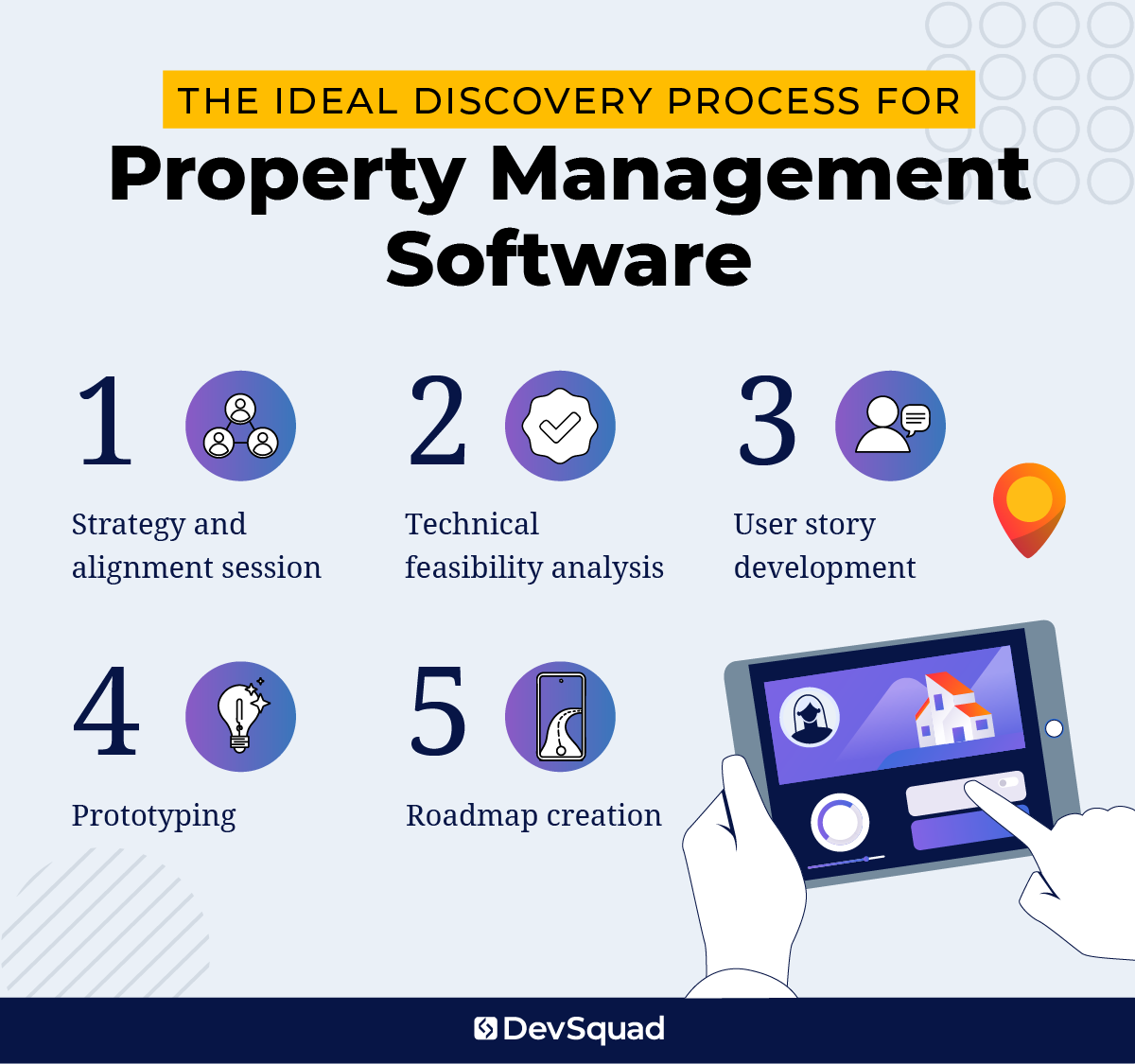
Here’s what that process looks like at DevSquad:
1. Strategy and alignment session
A product strategist works directly with stakeholders to understand the business model, define goals, and outline what success looks like. In property management, this includes identifying primary user roles — like leasing agents, maintenance staff, property owners, and tenants — and aligning the software with how your team operates across units, locations, and regulatory environments.
2. Technical feasibility analysis
Next, a technical architect evaluates the systems and tools you’re already using, such as accounting software, CRM platforms, payment processors, or IoT devices like smart locks and thermostats. If you work with government housing programs, any data or compliance systems tied to HUD or USDA workflows are also reviewed. The goal is to confirm what integrations are needed, how data will flow, and whether your infrastructure supports the planned solution.
3. User story development
Each feature is mapped to real-world behavior using clear user stories. This keeps the scope practical and ensures that every element serves a real purpose. For example:
“As a tenant, I need to submit a maintenance request and see when it’s scheduled so I don’t miss the technician.”
“As a property owner, I want to log in and view monthly financials by unit or building.”
User stories like these keep the project focused on actual outcomes, not just technical features.
4. Prototyping
A UX designer creates a clickable high-fidelity prototype that reflects the proposed flows and interface. This prototype can be shared with internal users (like leasing agents or portfolio managers) or tested with select tenants or owners to gather early feedback. It’s much easier — and more cost-effective — to adjust the product here than after development begins.
5. Roadmap creation
Finally, the team develops a Now-Next-Later roadmap. This breaks the project into strategic phases so the first version or Minimal Viable Product (MVP) includes the most critical features — like leasing workflows, dashboards, or compliance tools — while leaving room for future updates based on real usage and team feedback.
When discovery is handled properly, development doesn’t feel like guesswork. You know exactly what you're building, who it’s for, and how it supports your business. That’s what turns software from just another tool into a core part of how your operation runs and grows.
Best frameworks for developing property management and real estate software
Choosing the right development framework is one of the most important technical decisions in a custom software project. It impacts how quickly your platform can be built, how well it performs, and how easily it evolves alongside your business.
Property management software has to do a lot. That means the frameworks you choose need to balance speed, flexibility, performance, and long-term maintainability.
Here are the top frameworks developers use to build scalable, custom property management platforms — starting with DevSquad’s top choice for the backend.
1. Laravel (Backend)
Laravel is a PHP-based framework known for clean code, fast development cycles, and strong security features. It’s an ideal foundation for property management software because it’s built to handle complexity.
Many property management platforms use Laravel to support features like tenant portals, landlord dashboards, custom reporting tools, and compliance modules. With its mature ecosystem and active developer community, Laravel is a smart choice when you want to move quickly without sacrificing long-term stability.
Why it works for property management:
Rapid development for custom workflows
Strong support for multi-role permissions and security
Scales well across growing property portfolios
2. Vue.js (Frontend)
Vue is a frontend framework that pairs extremely well with Laravel. It’s lightweight and flexible, making it a great choice for building tenant-facing portals, maintenance dashboards, and investor views that need to look good and work fast.
Vue allows you to create responsive, mobile-friendly interfaces without overcomplicating the code. It's especially effective when building platforms that need to work equally well for staff in the field and users on the go.
3. React (Frontend)
React is another popular frontend framework used when projects call for more advanced interactivity or larger interface components. If your platform includes real-time data visualization, dynamic financial reporting, or interactive dashboards for owners and investors, React is a great fit.
Its modular structure also makes it easier to maintain and scale the front end as your feature set expands over time.
4. Node.js (Backend Alternative)
Node.js is often used for real-time applications and can be a good fit for platforms that prioritize speed and live updates, such as tenant messaging, self-guided tour scheduling, or collaborative maintenance tracking. It’s a backend alternative to Laravel, and while it's powerful, it's best suited to teams already working in JavaScript across the stack.
5. Flutter (Cross-platform Mobile)
If mobile access is a major part of your business model — whether for tenants, maintenance staff, or property owners — Flutter allows you to build high-performance iOS and Android apps from a single codebase.
It’s especially useful for building tools like mobile inspection checklists, push notification systems for rent reminders, or field-ready maintenance interfaces that sync in real time with your backend.
Top 5 agencies for custom property management software development
The success of your custom property management software depends heavily on the team that builds it. Not every development agency takes the time to understand your day-to-day workflows, compliance needs, or end users. The best partners lead with strategy, build only what’s needed, and deliver maintainable systems that can evolve with your business.
Below are five agencies known for delivering reliable, high-impact software with a clear focus on long-term value and process-driven development.
1. DevSquad
DevSquad is a product-focused development partner that helps property management companies and SaaS businesses build scalable software from scratch. The team goes beyond coding — they shape product strategy, validate ideas, and manage delivery using a proven agile framework. Every project starts with a hands-on discovery sprint to align the tech with your business operations and goals.
Property management clients benefit from DevSquad’s use of modern frameworks like Laravel and Vue, along with AI-assisted development tools that increase speed and reduce waste. Their modular codebase supports feature rollouts over time, without needing full rebuilds. DevSquad offers a dedicated squad model with no long-term contracts, giving businesses the flexibility to scale development without sacrificing quality or momentum.
2. Binary Studio
Binary Studio offers property management software development with over 20 years of experience in real estate solutions. Their teams support everything from custom PMS platforms to mobile apps and IoT integration. They offer flexible engagement models and emphasize long-term support. Ideal for companies that need to augment an internal team or start with a standalone project scope.
3. IBR Infotech
IBR Infotech develops custom property management software for residential, commercial, and mixed-use portfolios. Their solutions include trust accounting, maintenance automation, tenant communication tools, and real-time financial reporting. They also offer experience with third-party integrations and cloud-based platforms. Best suited for companies looking for a broad-feature platform with flexible customization options.
4. Glorium Technologies
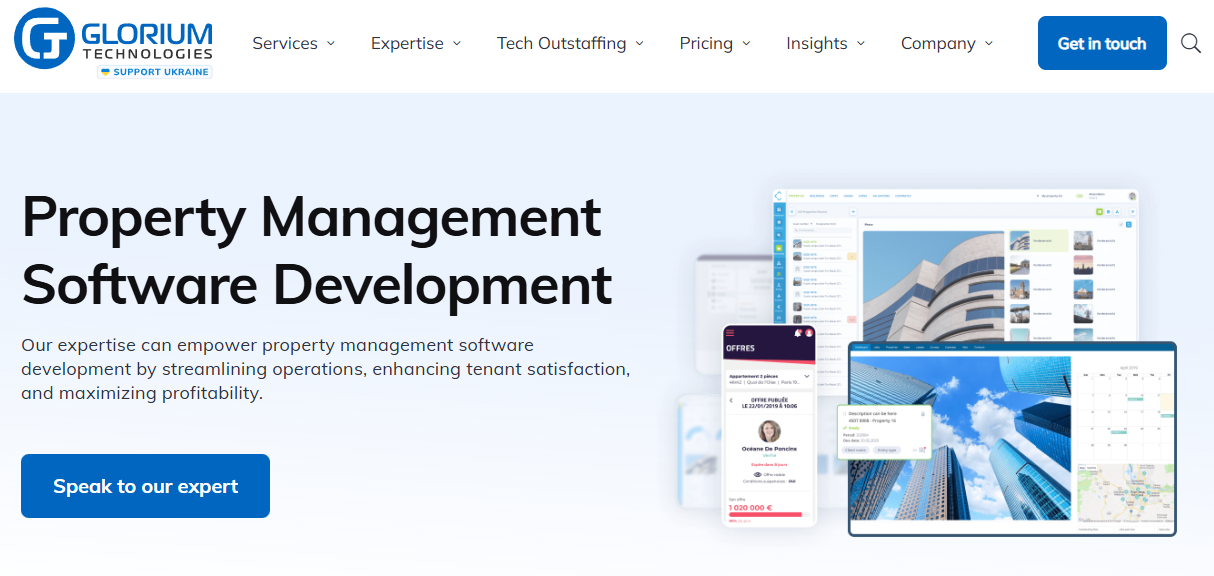
Glorium Technologies develops custom property management software for residential, commercial, and vacation rental use. Their solutions cover tenant management, rent collection, maintenance, and reporting. With experience in real estate CRMs, cloud-based systems, and mobile apps, they offer modular development for various property types. A suitable option for teams with complex or mixed portfolios seeking technical breadth.
5. Hexagon IT Solutions
Hexagon IT Solutions builds property management software with a focus on automation, analytics, and integrated digital presence. Their systems often include dashboard tools, maintenance tracking, and communication features, with added support for SEO and website development. A fit for property managers looking to pair operational tools with marketing and visibility enhancements.
Ready for your own custom property management software solution? Learn more about our custom software development services.

Dayana Mayfield is a SaaS copywriter and content marketer specializing in SaaS marketing, positioning, and go-to-market strategy. She has consulted for over 195 SaaS companies, focusing on both traffic and conversions. She has been featured in Entrepreneur, Forbes, and Business Insider. Outside of work, Dayana writes SciFi novels and spends her evenings surviving auditions, rehearsals, and tech week as a proud theater mom.