
Building a competitive real estate business today requires more than strong listings and great agents, it demands the right technology. Custom real estate software gives brokers, property managers, investors, and PropTech leaders the tools to streamline operations, boost agent productivity, and deliver standout customer experiences. If you build the homes rather than sell them, our guide to custom home builder software covers the workflows that come with a buyer inside the build.
Unlike off-the-shelf tools, a custom platform is built around your internal processes and long-term strategy.
In this guide, we break down everything you need to know before investing in custom development. You’ll learn what custom real estate software is, how a proper discovery process protects your investment, and which features and frameworks drive real ROI. We also highlight top use cases, technologies to consider, and five agencies that specialize in building solutions for the real estate industry.
What is custom real estate software
Custom real estate software refers to purpose-built digital solutions tailored to meet the specific needs of real estate businesses, brokers, agents, and property management firms. Unlike off-the-shelf platforms, custom tools are designed around internal processes, business goals, and user expectations. This ultimately gives companies greater control over functionality, scalability, and integration.
These platforms can include a wide range of features, from real estate CRMs and listing automation tools to mobile real estate apps and backend solutions that support agent productivity and operational efficiency. Whether managing residential sales, commercial leasing, or property maintenance, custom software allows real estate teams to optimize workflows, automate repetitive tasks, and deliver better experiences to clients and stakeholders.
Custom solutions also allow for seamless integration with third-party services like Multiple Listing Service (MLS) databases, payment processors, marketing platforms, and customer portals. This eliminates data silos and makes day-to-day operations faster and more efficient.
Top reasons to create custom software for your real estate business
The cost of custom development has dropped significantly, and the reason is clear: AI-assisted coding has dramatically improved development efficiency. Modern development teams can now build and maintain software with a speed and accuracy that rivals—or even undercuts—the cumulative cost of monthly SaaS subscriptions used across a real estate company.
Instead of managing a patchwork of disconnected tools for CRM, listing automation, agent communication, and client management, a custom real estate software solution consolidates essential features into one streamlined platform. This means lower long-term costs, fewer logins, and a much smoother experience for your team.
But cost savings are only one part of the equation. Here are more compelling reasons to invest in custom real estate software:
1. Centralized control over your internal processes
Out-of-the-box tools force your team to adapt to the software’s limitations. With custom software, the reverse is true—your tech adapts to the way your business already runs. Internal use software results in smoother workflows and less time spent on workarounds or tool-switching.
2. Improved agent productivity
Tailored features like smart lead routing, internal messaging, and on-the-go access via a mobile app allow agents to spend less time managing tools and more time closing deals.
3. Seamless integration with MLS and third-party systems
Your custom solution can be built to sync with MLS listings, marketing automation platforms, payment gateways, and more. Thus making your operations faster, more efficient, and easier to scale.
4. Enhanced customer experience
Purchasing real estate is stressful enough on its own. Build client portals with live listing updates, secure document storage, and messaging tools that match the way modern buyers and sellers expect to interact with agents.
5. Better long-term ROI
With the right development partner, you’ll own the source code. You’re not locked into someone else’s roadmap or pricing model. As your business grows, your software evolves alongside it—without paying more per user or dealing with surprise feature removals.
6. Competitive advantage in the proptech space
If you're building technology as a core part of your real estate brand or business model, owning your software gives you a significant edge in differentiation, IP, and investor appeal.
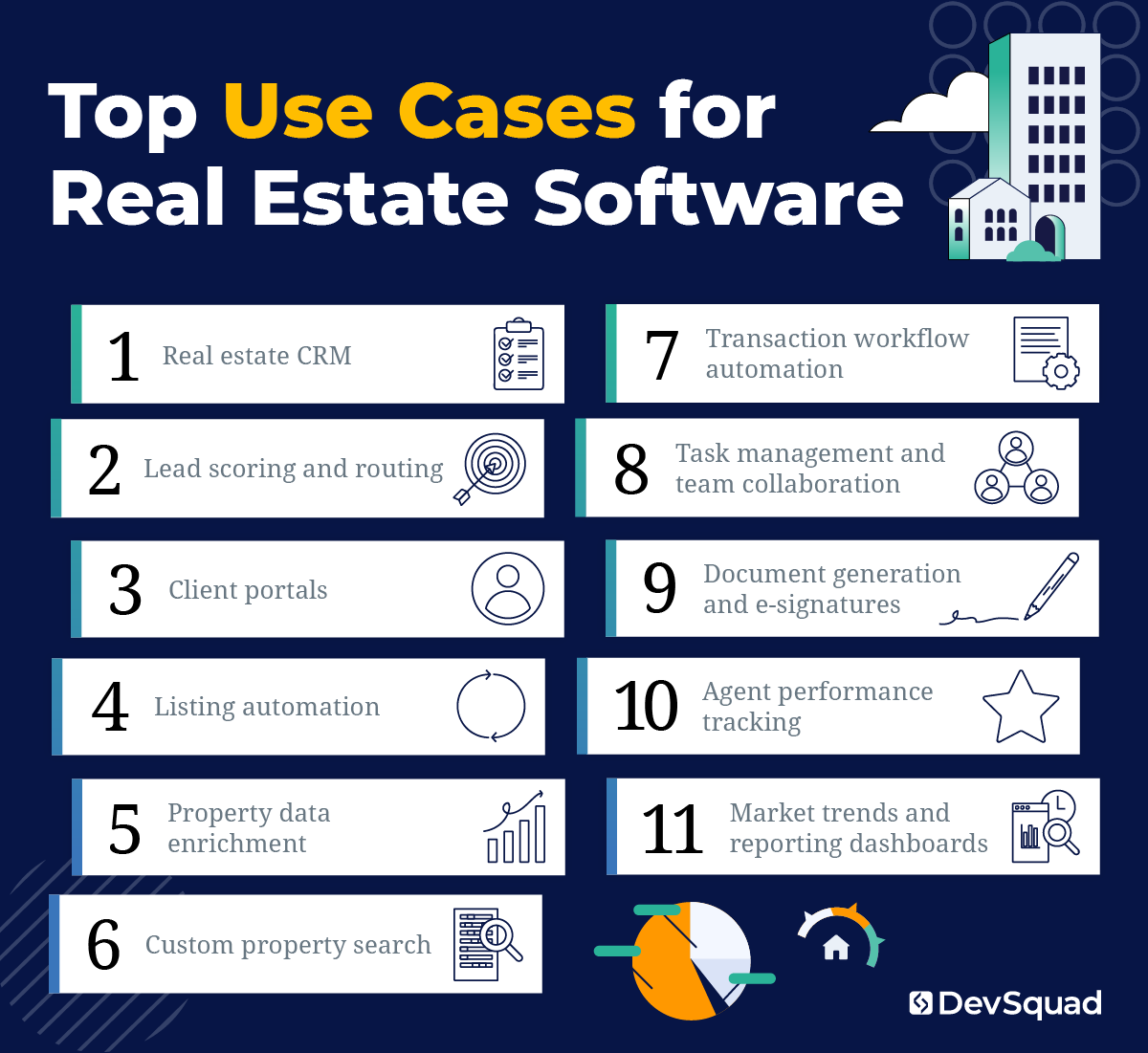
11 use cases for real estate software
Custom-built software allows real estate businesses to consolidate tools, streamline operations, and build better client experiences. Below are 11 strategic use cases grouped into the key functional areas of a real estate operation.
Client relationship and sales
Custom software can help you convert more leads and deliver a smoother client experience, from the first interaction to post-sale follow-up.
Real estate CRM – Manage leads, automate follow-ups, and track deal progress in a centralized system tailored to your sales process.
Lead scoring and routing – Automatically score and assign leads to the right agents based on location, listing type, or deal value.
Client portals – Provide buyers and sellers with a branded digital space to access listings, upload documents, and communicate with agents securely.
Listing and property management
Simplify and enhance how you manage and publish property data across your business and client-facing platforms.
Listing automation – Pull data from MLS feeds and automate listing updates across your website, CRM, and marketing tools.
Property data enrichment – Add neighborhood stats, school info, walk scores, and historical pricing using third-party API integrations.
Custom property search – Let users filter properties by niche-specific criteria like HOA fees, energy efficiency ratings, or zoning restrictions.
Operational efficiency and internal processes
Reduce overhead and avoid errors by building software that mirrors and improves your internal operations.
Transaction workflow automation – Automate offer review, document compliance, and closing timelines to avoid delays and dropped deals.
Task management and team collaboration – Centralize assignments, due dates, and team communication in one internal dashboard.
Document generation and e-signatures – Auto-generate contracts and disclosures, then route them for signature using built-in or integrated tools.
Analytics and business intelligence
Custom dashboards and reporting tools can give you real-time insights to guide better business decisions.
Agent performance tracking – Monitor close rates, commissions, lead conversion, and productivity in a way that aligns with your team’s structure.
Market trends and reporting dashboards – View trends in pricing, listing velocity, and buyer activity across zip codes or property types.
The custom real estate software development discovery process
A sound discovery process is what separates a high-performing, strategic software product from a costly misstep. Diving into development with a vague idea typically produces a tool that doesn’t match your workflows, doesn’t solve your problems, or is too complex for daily use.
Discovery is where a potential solution is shaped into a viable product. This phase involves research, validation, planning, and prototype creation—all before a single line of code is written. In custom real estate software, discovery must be tightly aligned with your business strategy and the real-world behaviors of your agents, buyers, sellers, and back-office team.
Here’s what a strong discovery process typically includes:
1. Strategy and alignment session
A product strategist works with stakeholders to define business goals, identify primary user types, and clarify what success looks like. For real estate, this often includes aligning internal processes with agent workflows and evaluating how software will fit into the day-to-day realities of property transactions.
2. Technical feasibility analysis
Before moving forward, a technical architect reviews any existing systems, APIs, data structures, or MLS integrations that the product will need to connect with. This ensures that what’s being planned can actually be built, and built efficiently.
3. User story development
Every feature is framed through the lens of real user behavior. For example:
“As a listing agent, I need to upload a new property and have it automatically syndicate to all marketing platforms.”
This prevents bloated features and keeps the project grounded in user outcomes.
4. Prototyping
A UX designer develops a high-fidelity, clickable prototype based on the agreed features and flows. This prototype can be tested internally or with real agents and clients to gather feedback early, and before any engineering resources are committed.
5. Roadmap creation
The team builds a clear Now-Next-Later roadmap, breaking the project into logical phases. This allows the product to launch faster, with essential features first, and leaves room for iteration based on user feedback.
When discovery is handled properly, you enter development with clarity. You know what you're building, who it’s for, and how it fits into your operations. That’s the difference between another underused app and a tool that drives real growth.
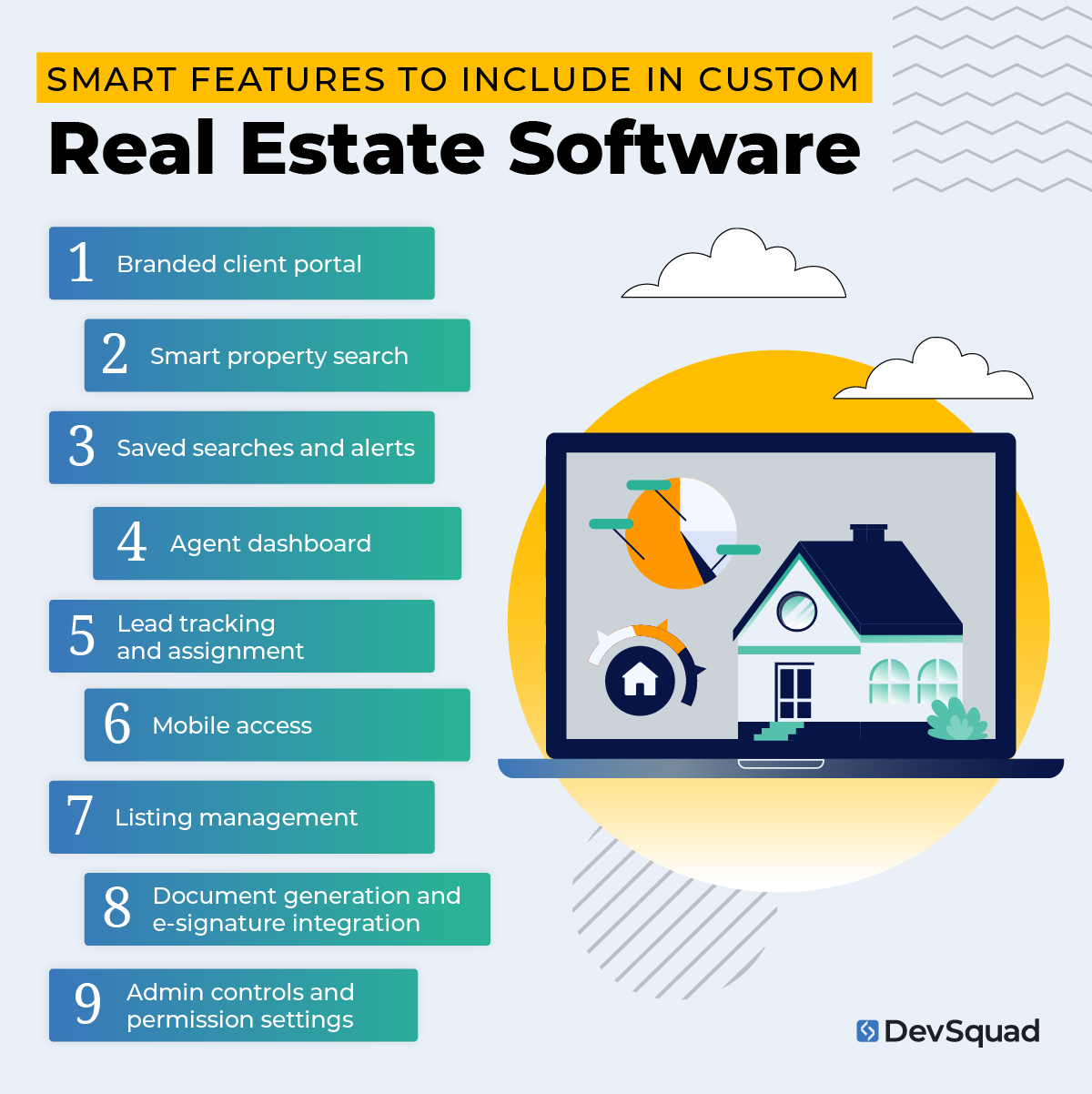
9 common features to consider in a custom real estate app
The right feature set helps you launch faster and build smarter. While what you will build will be based upon your discovery, the way your team works, and how your clients expect to interact with your brand, there are common features that apply to the industry. Below are the most common and strategic features that real estate businesses include in their first custom software release.
For client experience
Modern buyers and sellers expect real-time access to listings, updates, and communication. These features focus on delivering a clean, branded user experience that builds trust and convenience.
Branded client portal – A secure space where buyers and sellers can message their agent, view listing updates, upload documents, and track deal status.
Smart property search – Filter listings by price, location, and niche-specific criteria (like HOA fees, square footage, or school zones) with a clean, intuitive UI.
Saved searches and alerts – Allow users to save favorite listings and receive instant alerts when new properties match their criteria.
For agent productivity
Agents work in fast-paced, mobile environments. These features help them stay focused, close deals faster, and avoid toggling between disconnected tools.
Agent dashboard – Give agents a real-time view of their deals, tasks, communications, and performance metrics—all in one place.
Lead tracking and assignment – Automatically assign and prioritize leads based on predefined rules (zip code, property type, price range).
Mobile access – Native or mobile-responsive access for agents to manage showings, communicate with clients, and update listings on the go.
For operational efficiency
Back-office teams need structure and automation to scale effectively. These features support listing management, document workflows, and user access controls.
Listing management – Input new properties, sync with MLS, and push listings to your site or marketing channels with minimal duplication of work.
Document generation and e-signature integration – Auto-generate key documents and collect signatures directly in the app through tools like DocuSign or HelloSign.
Admin controls and permission settings – Set access rules and data visibility for admins, agents, and assistants which helps manage compliance and reduce risk.
5 best frameworks for developing software solutions for real estate
Choosing the right development framework is one of the most important technical decisions you'll make. It affects how quickly your product is built, how easily it can be maintained, and how adaptable it will be to future needs. For real estate platforms—where workflows, integrations, and user experience are paramount—speed and flexibility matter just as much as security and performance.
Here are top frameworks to consider, starting with the one most often chosen for its reliability, rapid development potential, and developer community:
1. Laravel (Backend)
Laravel is a PHP-based framework that’s known for its elegant syntax, extensive library of pre-built functions, and unmatched productivity for teams. It’s particularly well-suited for real estate applications because it accelerates the development of custom features like listing automation, role-based permissions, document generation, and CRM logic. With Laravel, you also get robust security features, native API support, and easy integration with modern frontend tools.
Why it works for real estate:
Fast to build and easy to maintain
Well-documented and widely supported
Ideal for data-heavy platforms with evolving business logic
2. Vue.js (Frontend)
Vue pairs naturally with Laravel and is often used to create clean, responsive user interfaces for real estate search filters, client dashboards, and admin panels. It's lightweight, highly flexible, and great for building fast-loading, interactive applications that work well on desktop and mobile.
3. React (Frontend)
React is a powerful alternative to Vue.js, especially when building highly interactive features or large-scale interfaces. Its reusable component architecture makes it a strong choice for listing displays, dynamic maps, and custom CRM views.
4. Node.js (Backend Alternative)
Node.js is popular for real-time applications and is commonly used with NoSQL databases. It can be a strong fit for real estate platforms that prioritize live updates—such as showing scheduling, live chat, or collaborative document review. However, it's often a better fit for teams that already work in JavaScript across the stack.
5. Flutter (Cross-platform Mobile)
If a mobile-first strategy is a priority, Flutter allows for the development of high-performance iOS and Android apps from a single codebase. It’s ideal for building native-like agent tools or client apps with rich UI, like saved listing alerts and push notifications.
5 top custom real estate software development agencies
The success of your custom real estate software depends heavily on who builds it. Not all development agencies take the time to deeply understand your workflows, internal processes, and end users. The best partners lead with strategy, avoid feature bloat, and deliver maintainable software that supports long-term growth.
Below are five agencies known for delivering custom software solutions, with a clear emphasis on process, reliability, and real-world results.
1. DevSquad
DevSquad is a product-focused development partner that helps real estate businesses and SaaS founders build high-performing software from the ground up. The team doesn’t just take orders—they guide product strategy, validate ideas, and build with proven agile systems. Every engagement begins with a discovery sprint to align tech with business goals. Development is led by technical product managers and supported by a vetted team of developers, QA engineers, and DevOps specialists.
Real estate clients benefit from DevSquad’s use of modern frameworks like Laravel, AI-assisted development tools, and a modular codebase that’s built for iteration. With no long-term contracts and a dedicated squad model, companies can move fast without sacrificing quality.
Best for: Companies that want a fully managed product team that thinks beyond code and builds with business outcomes in mind.
2. Ascendix Tech

Ascendix Tech has over 16 years of experience developing custom real estate software, with a strong focus on automating internal workflows for property managers, brokers, and investment firms. Their services span CRM development, mobile apps, cloud migration, and AI-powered tools such as document processing, lease abstraction, and chatbots. The company also offers consulting and legacy system modernization.
Best for: Real estate firms seeking tailored CRM systems, AI enhancements, or modernization of legacy platforms.
3. Mind Studios
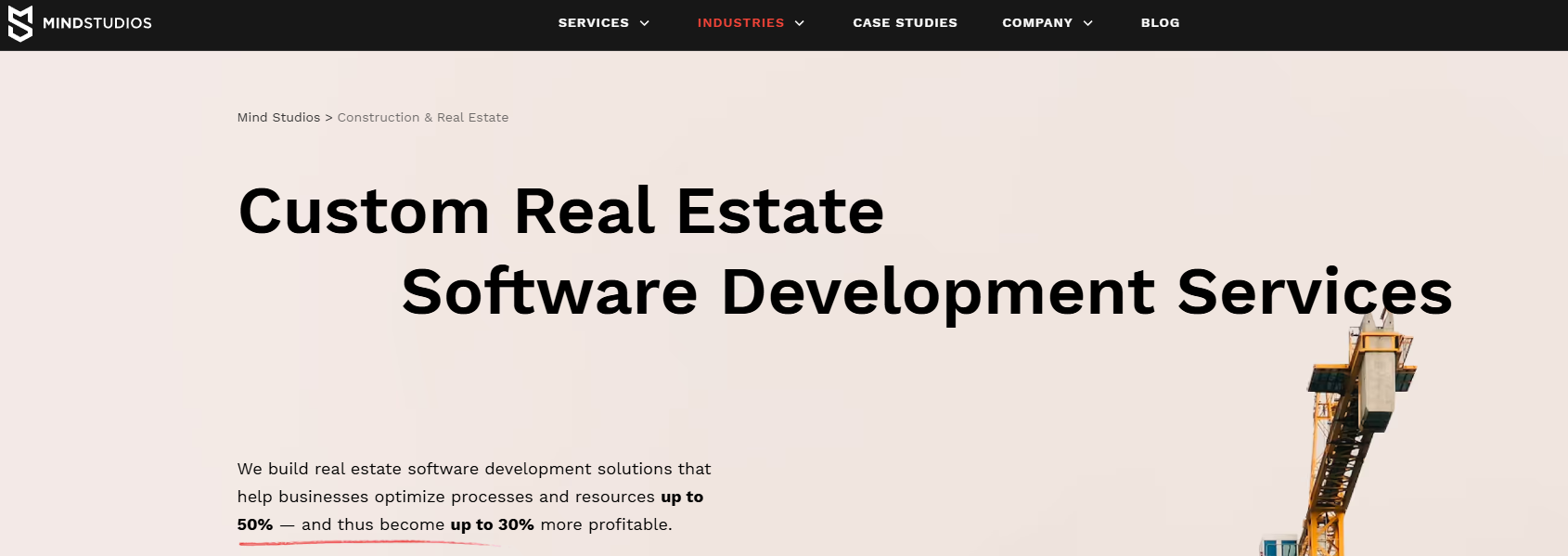
Mind Studios builds custom real estate software for a variety of sectors, including residential, commercial, industrial, and PropTech. Their service offering includes property management systems, CRM platforms, marketplace integrations, and mobile applications. They emphasize cost optimization and claim to help clients reduce operational overhead by up to 50%.
Best for: Teams with a clear product vision that need an execution partner for real estate or PropTech platforms.
4. Vention
Vention delivers custom real estate software for commercial and residential property firms, with services ranging from property management platforms to mobile apps and security control systems. Their team builds cloud-based tools, CRMs, and ERP solutions with support for MLS/IDX integrations, and offers expertise in emerging tech such as AR/VR, AI, and IoT.
Best for: Mid-sized to enterprise real estate companies looking to modernize systems or build property tech platforms using emerging technologies.
5. Tech.us
Tech.us is a long-standing software development company offering real estate solutions across property management, CRM, ERP, and system modernization. With over 25 years in the industry and more than 1,500 completed projects, they focus on integrating advanced technologies like AI, ML, and blockchain into business-specific real estate software.
Best for: Established firms seeking digital transformation or tech-enabled process automation across multiple real estate operations.
Ready for your own custom real estate software solution? Learn more about our custom software development services.

Dayana Mayfield is a SaaS copywriter and content marketer specializing in SaaS marketing, positioning, and go-to-market strategy. She has consulted for over 195 SaaS companies, focusing on both traffic and conversions. She has been featured in Entrepreneur, Forbes, and Business Insider. Outside of work, Dayana writes SciFi novels and spends her evenings surviving auditions, rehearsals, and tech week as a proud theater mom.