
Accounting sits at the center of every business decision, yet most teams still rely on systems that were never designed for the way they operate today. Generic tools can’t support complex revenue models, industry-specific workflows, multi-entity structures, or the level of real-time insight leaders expect.
That’s why more organizations are turning to custom accounting software, financial systems built around their exact processes, not someone else’s template.
But building software for your financial operations is a high-stakes project. The workflows are intricate, the data is sensitive, and the integrations are mission-critical. You need clarity on what this type of development involves, which features matter most, and how to choose the right technology and partners to move from idea to a scalable financial platform.
This guide covers everything—from use cases to discovery, feature sets, frameworks, and the top agencies capable of delivering this kind of solution. If you’re evaluating whether to upgrade your accounting infrastructure, this is your blueprint.
What is custom accounting software?
Custom accounting software is a purpose-built financial system designed specifically for a company’s internal workflows, reporting needs, and compliance requirements. Instead of relying on off-the-shelf tools that force teams to adapt their processes, internal accounting software is engineered around the business itself.
This matters because every organization handles financial data differently. Whether you’re tracking revenue across multiple entities, managing complex payroll rules, or trying to connect siloed systems, generic tools often fall short. Custom accounting software solves that gap by supporting the exact financial operations your team needs to run smoothly.
Modern accounting teams demand accuracy, speed, and visibility. When the software is built for internal use software—rather than the mass market—you get cleaner data, fewer manual workarounds, and the ability to automate financial tasks that traditional systems simply can’t handle. This approach becomes even more essential in industries with unique needs, like fund accounting or farm accounting, where workflows are far from standard.
How custom accounting software supports growth
As your business evolves, your financial system must evolve with it. The right custom accounting software is positioned to do just that. As your business grows, the system can grow with it. With the right development approach, you can integrate with existing tools, expand modules, and introduce new automations without disrupting your team or piling on technical debt. This creates a scalable foundation that strengthens decision-making and accelerates growth over time.
Use cases for custom accounting software solutions
Custom accounting software solutions give organizations the flexibility and precision they can’t get from generic tools. Below are the most common use cases for internal accounting software across industries.
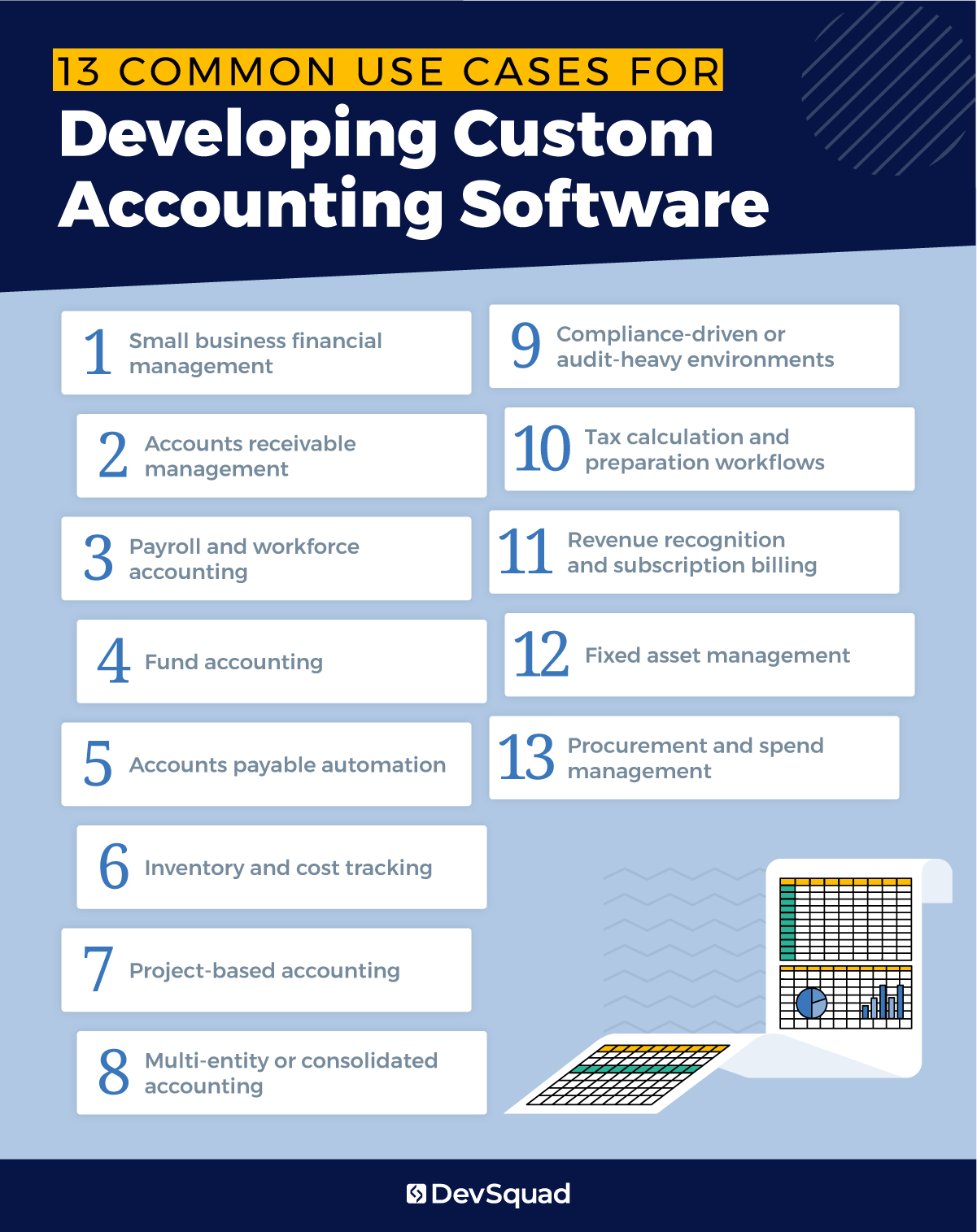
1. Small business financial management
Small businesses often outgrow spreadsheets and basic tools quickly. Custom accounting systems help them automate invoicing, track expenses, simplify reconciliation, and access real-time reporting. By tailoring features to how the business actually works, teams eliminate manual steps and reduce errors.
2. Accounts receivable management
Custom solutions streamline invoicing, automate follow-ups, and provide clearer visibility into cash flow. Companies with complex billing models benefit the most—subscription plans, variable pricing, retainers, or multi-stage billing are easier to manage with purpose-built workflows.
3. Payroll and workforce accounting
When pay structures go beyond simple salary and hourly compensation, generic tools fall short. Internal accounting software supports contractor payments, variable pay, compliance rules, location-based tax requirements, and any custom workflow tied to employee financials.
4. Fund accounting
Organizations handling restricted funds need precise tracking and transparent reporting. Custom solutions help teams allocate funds correctly, maintain compliance, and generate audit-ready reports that reflect their exact structure.
5. Accounts payable automation
From purchase orders to vendor payments, AP processes are often slowed down by manual checks and disconnected systems. Custom accounting software can integrate approval workflows, automate matching, flag exceptions, and reduce processing times.
6. Inventory and cost tracking
For product-based businesses, financial accuracy depends on tightly connected accounting and inventory systems. Custom platforms can integrate POS, warehouse, and manufacturing data to track real margins, forecast costs, and support better decision-making.
7. Project-based accounting
Industries like construction, consulting, engineering, and professional services rely on accurate project-level financial insights. Custom software supports job costing, time tracking, resource allocation, phased billing, and profitability reporting tailored to each business model.
8. Multi-entity or consolidated accounting
Franchises, holding companies, and multi-location organizations often build internal accounting software to manage intercompany transactions and consolidated reporting. This eliminates complex manual spreadsheets and helps leaders make decisions based on real-time, unified financials.
9. Compliance-driven or audit-heavy environments
Finance, healthcare, government, and other regulated industries benefit from custom audit trails, automated compliance checks, and internal controls. These capabilities reduce risk and support cleaner, faster audits.
10. Tax calculation and preparation workflows
Companies with complex tax obligations need engines that support jurisdiction-specific rules, automated filings, and accurate reporting. Custom accounting software helps prevent mistakes and simplifies compliance.
11. Revenue recognition and subscription billing
For SaaS, membership-based businesses, and marketplaces, revenue recognition rules are rarely straightforward. Custom systems automate recognition schedules, integrate with billing platforms, and support financial reporting that aligns with regulatory standards.
12. Fixed asset management
Organizations with large asset portfolios need accurate depreciation schedules, lifecycle tracking, and maintenance reporting. Custom solutions make it easier to manage high-value assets without relying on disconnected spreadsheets.
13. Procurement and spend management
Procurement workflows often vary widely across organizations. With custom accounting software, companies can align vendor onboarding, budgeting, approvals, and spend visibility in one connected system.
The discovery process for developing custom accounting software
Developing custom accounting software requires a clear, structured discovery process. Financial systems touch every part of the business, so the goal is to remove ambiguity early and build alignment around functionality, integrations, compliance requirements, and long-term scalability.
A strong discovery phase also prevents scope drift, reduces technical risk, and gives stakeholders a realistic plan for what the software will support both now and later.
Step 1: Understand business goals and financial workflows
Before writing user stories or mapping the interface, the team starts by gaining clarity on the organization’s goals. This includes how leaders measure financial health, what gaps exist in current tools, and what must change for the business to operate more effectively. From there, the discovery team evaluates each workflow—AP, AR, payroll, fund accounting, revenue tracking, inventory, tax, and more—to document what needs to be automated or improved.
Step 2: Identify technical constraints and integration requirements
Accounting software rarely stands alone. Most organizations rely on CRM systems, payroll tools, banking feeds, inventory management platforms, or ERP systems. During discovery, the development team reviews existing technology, API availability, data structures, and any compliance considerations that may influence how integrations are built.
Step 3: Map user roles, permissions, and internal controls
Financial systems require precision and accountability. The discovery phase includes mapping out user types—accountants, controllers, payroll teams, operations staff, managers, or auditors—and defining what each role can access. Businesses with heavy compliance needs may require advanced logging, approval workflows, or multi-entity access rules.
Step 4: Build user stories and early experience flows
Once goals, workflows, and roles are clearly defined, the team begins converting this information into user stories. These stories break complex financial processes into manageable tasks that developers can estimate and plan. A UX designer then creates experience flows that show how users will move through the software.
Step 5: Develop a high-fidelity prototype
Using the user stories and experience flows, the design team builds a clickable prototype that mirrors the future product. This allows stakeholders to validate the interface, test assumptions, and identify gaps before development begins.
Step 6: Create a Now-Next-Later roadmap
With a validated prototype, the team creates a phased roadmap. This defines the initial release (Now), upcoming enhancements (Next), and long-term capabilities (Later). For accounting systems that touch multiple departments, a phased approach supports steady progress while adapting to new insights and operational needs.
Common features associated with custom accounting software
Custom accounting software gives organizations the freedom to build a financial system that matches how they operate. Instead of relying on rigid templates or generic modules, teams can implement the exact capabilities they need for accuracy, automation, and better decision-making. While every solution is built around unique workflows, most custom accounting systems include core features like the ones below.
General ledger: A flexible ledger structure that supports a customized chart of accounts, automated entries, and clean financial data.
Accounts payable: Vendor management, purchase orders, matching, approvals, and payment processing built around your internal workflow.
Accounts receivable: Invoicing, payment collection, reminders, customer account tracking, and reconciliation tailored to your billing model.
Payroll and compensation: Support for multi-state rules, variable pay, contractor payments, and compliance requirements specific to your workforce.
Budgeting and forecasting: Scenario planning, variance tracking, and real-time financial modeling tied to operational data.
Inventory and cost accounting: Integrated stock tracking, margin insights, and accurate costing for product-based businesses.
Revenue recognition: Automated schedules and compliance-friendly reporting for subscription billing, phased projects, or usage-based pricing.
Fixed asset management: Custom depreciation schedules, lifecycle tracking, maintenance history, and capital planning tools.
Multi-entity and consolidation: Unified financial reporting, intercompany eliminations, and visibility across subsidiaries or locations.
Audit trails and controls: Role-based permissions, transaction histories, approval logs, and compliance workflows aligned with industry standards.
Reporting and dashboards: Real-time visibility into financial performance with dashboards designed for your leadership structure.
Integrations: Connections to CRMs, ERPs, payroll systems, banking feeds, warehouse tools, or any internal application your teams rely on.
7 best frameworks for developing custom accounting solutions
Building custom accounting software requires a tech stack that’s reliable, scalable, and capable of handling sensitive financial data. The right framework improves development speed, reduces long-term maintenance, and supports integrations across the business.
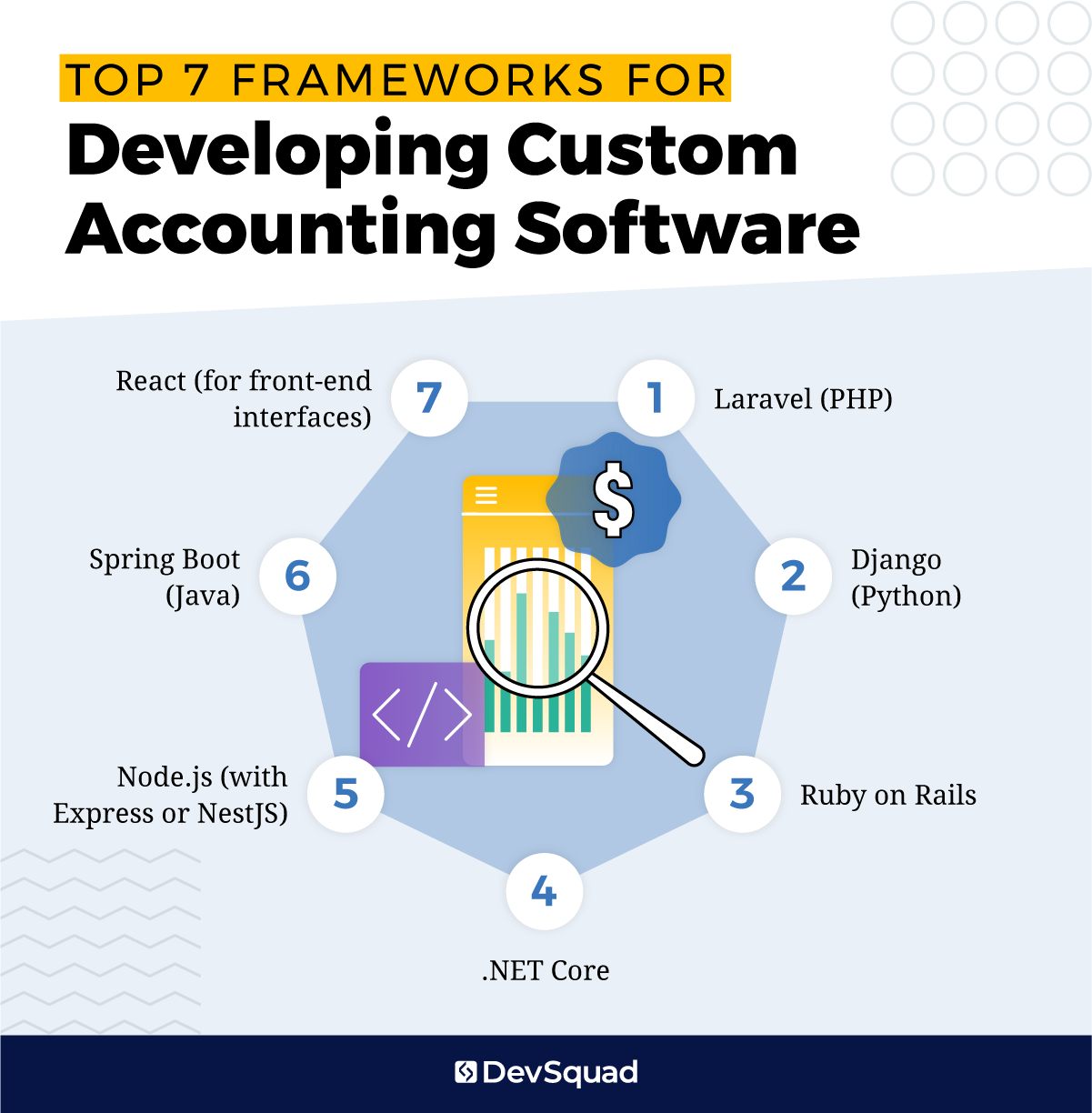
Here are the seven frameworks most commonly used for high-quality accounting software development.
1. Laravel (PHP)
Laravel is a top choice for accounting systems because of its expressive syntax, strong security features, and robust ecosystem. Its built-in authentication, queue management, caching, and database tools make it ideal for financial workflows that depend on accuracy and stability. Laravel’s modular structure also supports rapid feature development and clean scalability as financial needs evolve.
2. Django (Python)
Django offers a secure, high-level framework with strong data modeling, built-in admin tools, and predictable performance. Its “batteries included” architecture helps teams build complex accounting workflows faster, while Python’s ecosystem supports advanced analytics, forecasting engines, and machine learning models.
3. Ruby on Rails
Rails is known for rapid development and clean conventions, making it suitable for startups and mid-market companies building internal accounting software. The framework’s maturity, large library ecosystem, and emphasis on developer productivity help teams move quickly without sacrificing structure.
4. .NET Core
For enterprise environments, .NET Core offers high performance, strong type safety, and seamless integration with Microsoft systems. Organizations with strict compliance needs often choose .NET because it supports large-scale financial operations, advanced reporting, and secure integrations with Active Directory and other enterprise infrastructure.
5. Node.js (with Express or NestJS)
Node.js is a strong choice for real-time financial operations and event-driven workloads. Frameworks like NestJS add structure, while Express supports lightweight builds. Businesses that need fast APIs, scalable microservices, or quick integrations often gravitate toward Node-based solutions.
6. Spring Boot (Java)
Spring Boot is built for enterprise-grade applications with heavy processing requirements, strict compliance demands, or complex multi-entity accounting logic. Its security features, stability, and ability to handle large datasets make it a reliable choice for long-lived systems.
7. React (for front-end interfaces)
While not a backend framework, React is widely used to create financial dashboards, reporting views, and accounting interfaces. Its component-driven structure supports clean UI logic and gives teams the flexibility to build dynamic, high-performance user experiences that pair well with any backend framework.
Top 5 agencies that build custom software
Choosing the right development partner is one of the most important decisions when building custom accounting software. Financial systems carry high stakes—accuracy, compliance, integrations, and long-term scalability all depend on a team that can balance strategy with execution. While many agencies offer general development services, only a select group takes a consulting-first approach and builds products that stand the test of time.
Below is a curated list of leading agencies offering accounting software development service.
1. DevSquad
DevSquad is a consulting-first development firm specializing in custom software for organizations that need clarity, scalability, and long-term reliability. Every engagement begins with a tailored discovery and planning phase, where a solutions architect analyzes the codebase, maps financial and operational workflows, and develops a clear execution plan.
From there, DevSquad’s fully managed squads include strategists, designers, developers, QA engineers, and DevOps professionals. This team structure supports smooth transitions from prototype to production while keeping the focus on user experience and business outcomes. The firm leverages modern, developer-favorite frameworks and a library of pre-built features to move faster without sacrificing quality.
With no long-term contracts, ongoing discovery sprints, and a disciplined approach to reducing feature bloat, DevSquad is a top choice for organizations wanting accounting software development solutions or modernized existing financial systems.
2. Chetu
Chetu is a large-scale development firm that delivers custom accounting software for businesses across many industries. Their teams build modules for AP, AR, payroll, inventory accounting, and fund accounting, plus add-ons that extend the capabilities of existing platforms. They also handle integrations with systems like QuickBooks, NetSuite, Xero, and other ERP solutions.
3. Elinext
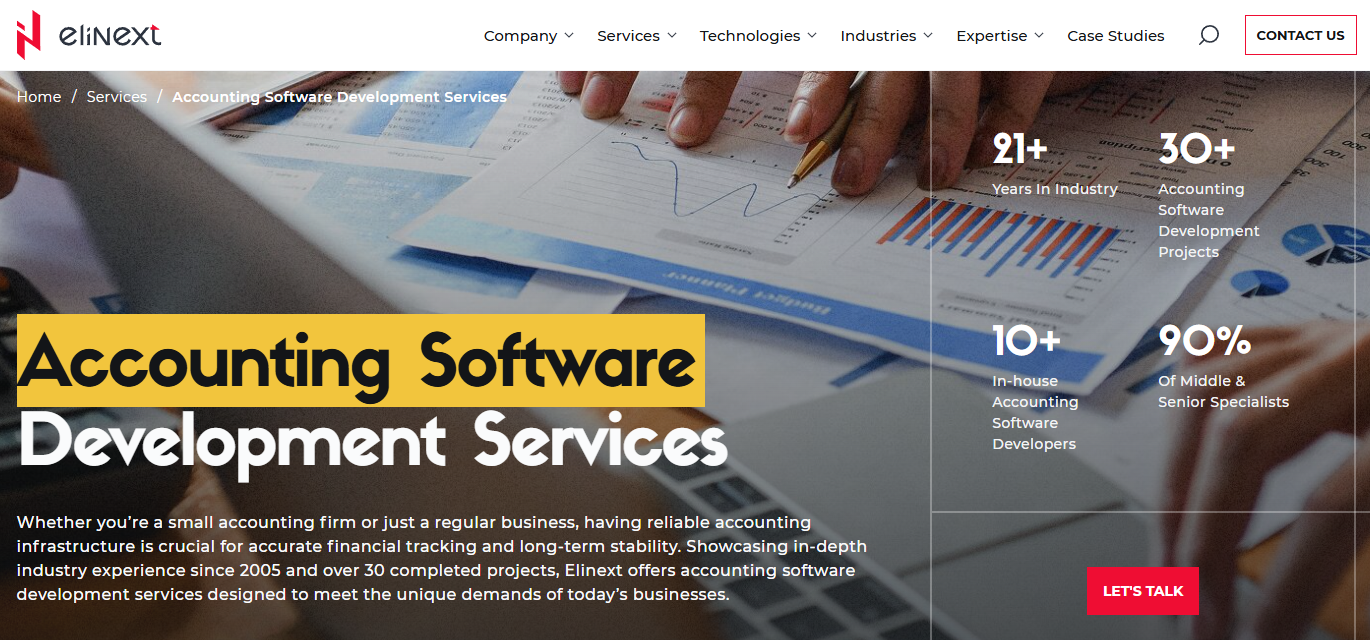
Elinext is a long-standing software development company with experience delivering custom accounting systems across finance and related industries. Their teams build modules for invoicing, payroll, fund accounting, AR workflows, and broader financial operations that require automation or modernization. They also support organizations with custom AIS design, mobile accounting applications, and integrations with third-party financial platforms.
4. ScienceSoft
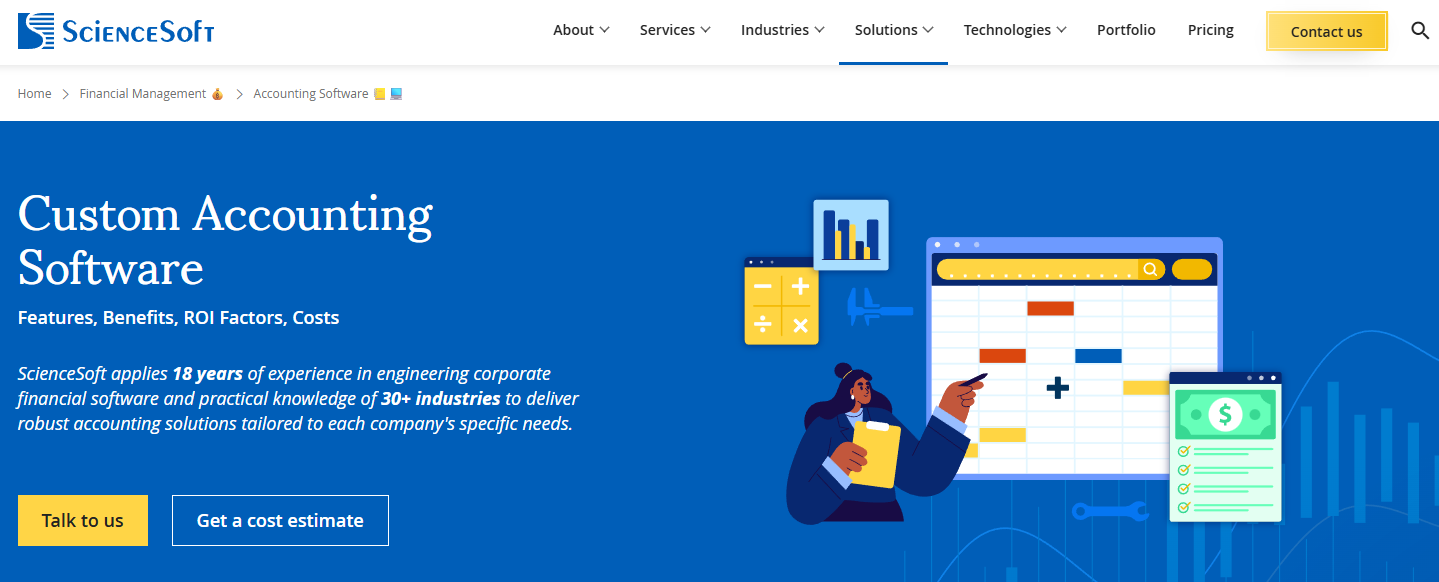
ScienceSoft is an established software engineering firm with deep experience in corporate financial systems. They focus on building custom accounting software for mid-market and enterprise organizations, often covering complex workflows such as multi-entity accounting, rule-based journal entries, tax management, reconciliation, and financial reporting. Their team also supports integrations with CRM, HR, inventory, asset management, and other business-critical systems.
5. Accounting Seed
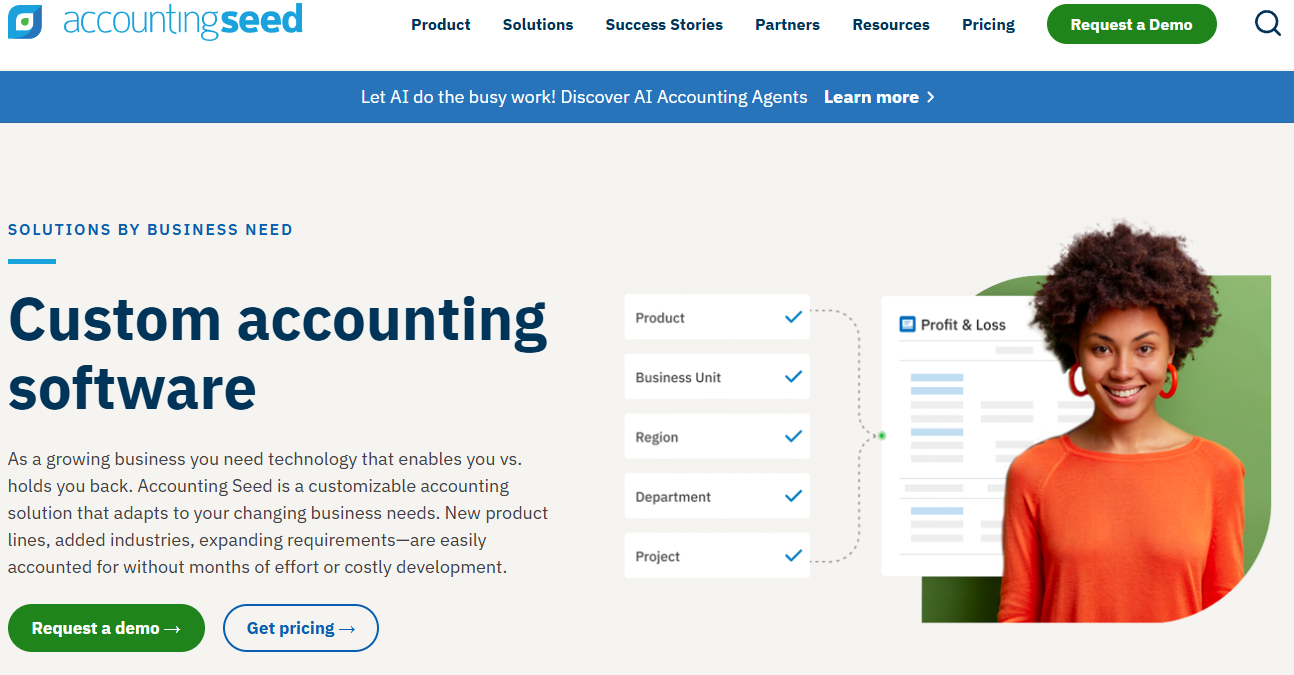
Accounting Seed is a financial management platform built natively on Salesforce, offering customizable accounting tools for businesses that want flexibility without heavy development. Because it operates within the Salesforce ecosystem, teams can configure workflows, automate financial processes, and create custom reports using the platform’s built-in tools. While not fully custom (i.e. Salesforce based), they are an option to consider if you are already using the Salesforce platform.
Ready for your own custom accounting software solution? Learn more about our custom software development services.

Dayana Mayfield is a SaaS copywriter and content marketer specializing in SaaS marketing, positioning, and go-to-market strategy. She has consulted for over 195 SaaS companies, focusing on both traffic and conversions. She has been featured in Entrepreneur, Forbes, and Business Insider. Outside of work, Dayana writes SciFi novels and spends her evenings surviving auditions, rehearsals, and tech week as a proud theater mom.