
You know the system has to go. Picking who replaces it is the harder call.
Here are the five application modernization companies to shortlist first:
DevSquad: rewrites and partial replacements of internal tools and SaaS products
Clean Coders Studio: incremental, test-driven migration
Keyhole Software: senior, US-only teams on Java, .NET, and COBOL
Zoolatech: modernization capacity across several workstreams
Kitrum: live products past version one
Devox Software and Simform round out the ranking. Each one fits a specific situation, and the entries below spell out which.
This list is for mid-market operators and SaaS teams. You're running an aging internal tool, or a product that has outgrown its first version. Maybe the vendor stopped updating it. Maybe your team spends more time patching than building. You are probably not running hundreds of applications on a mainframe. If you are, skip ahead to the section on global systems integrators.
Want to see how DevSquad runs this work before reading further? Our legacy modernization services page walks through the process.
Before you read on, know that DevSquad wrote this list and ranks itself first. The methodology section shows how every company was judged, us included, against the same criteria.
Quick comparison of the top application modernization companies
Read the "Best for" column before the rank. A company built for your modernization path will serve you better than a higher-ranked one built for someone else's.
Company | HQ | Best for | Team model | Starting budget | Clutch rating |
|---|---|---|---|---|---|
DevSquad | Murray, Utah | Internal tools and SaaS products that need a rewrite or partial replacement | Managed squad (TPM, tech lead, QA, design included) | Rapid Prototyping and month-to-month development, not published | 5.0 (2 reviews) |
Clean Coders Studio | Scottsdale, Arizona | Incremental strangler fig migration with test-driven refactoring | Studio team, pay per feature | Not published | No Clutch profile found |
Keyhole Software | Lenexa, Kansas | Senior, US-only teams on Java, .NET, and COBOL systems | Full-time senior US consultants | Undisclosed; $100 to $149/hr | Not yet reviewed |
Zoolatech | Miami, Florida | Modernization capacity across several workstreams at once | Team extension and managed delivery | $50,000+ | 4.9 (18 reviews) |
Kitrum | Florida | Live products past version one, alongside an existing engineering team | Managed delivery or team augmentation | $25,000+ | 5.0 (63 reviews) |
Devox Software | Miami, Florida | AI-assisted audits and re-architecture of aging operational systems | Dedicated teams | $50,000+; audit packages from $25,000 | 5.0 (45 reviews) |
Simform | Orlando, Florida | Azure-heavy .NET and Java product platforms | Co-engineering PODs | $25,000+ | 4.8 (88 reviews) |
Clean Coders Studio has no Clutch profile, and Keyhole's profile has no reviews yet.
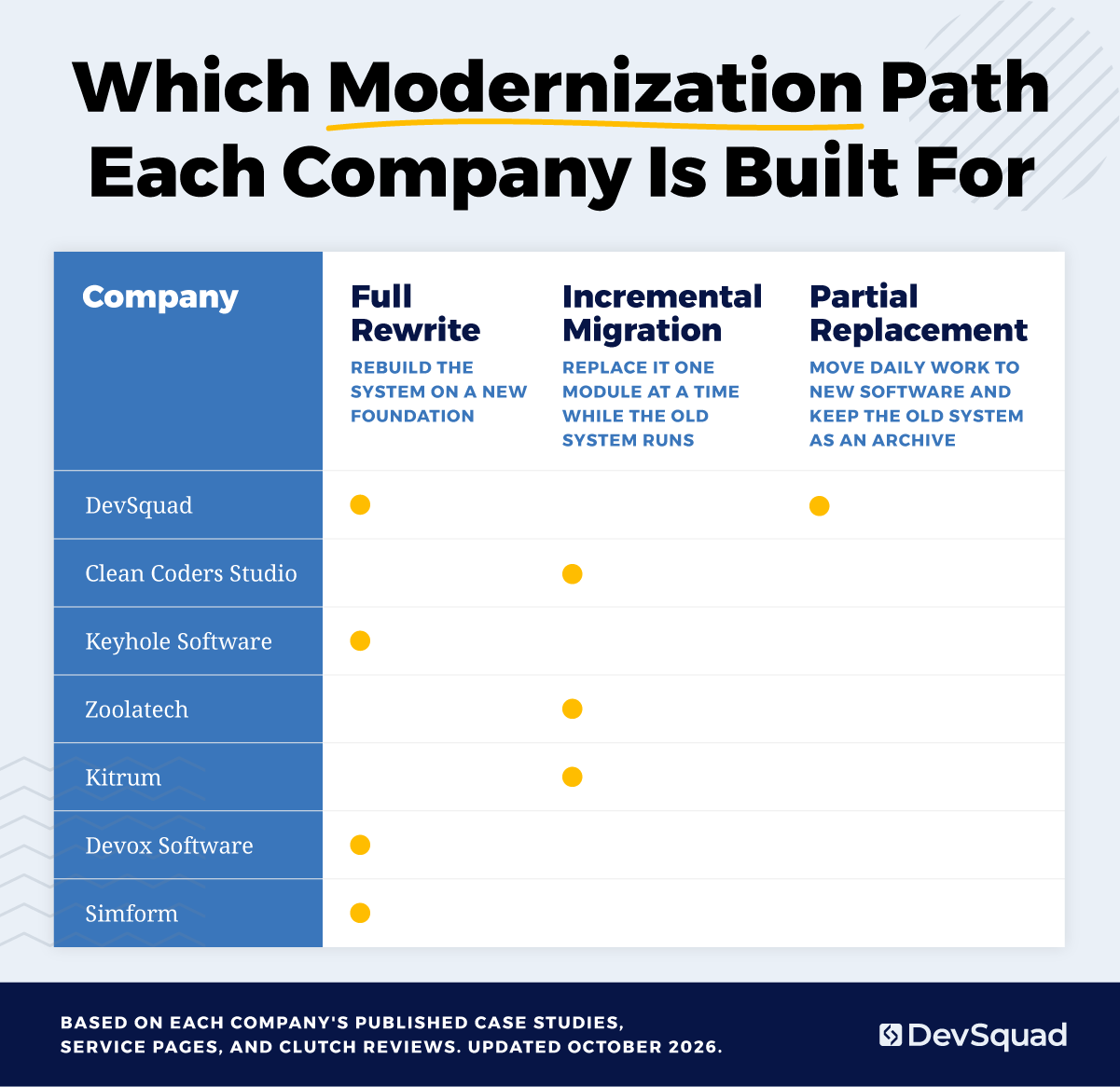
Budget and ratings narrow the field, but your modernization path decides the winner. A company built for incremental migration will struggle with a rewrite that has no fallback, and the reverse is just as true. Find your path in the chart below, then shortlist only the companies with a dot in that column.
 How we chose these companies
You've probably read three of these lists already. Each one ranked its author first.
This one does too, so here is exactly how every company was scored:
Modernization range (30%): can they rewrite, migrate incrementally, and replace partially?
Published, verifiable proof (25%): named clients, dated outcomes, figures you can check.
Fit for mid-market budgets and team sizes (20%)
Cutover and QA discipline (15%)
Post-launch support and handover (10%)
Why a mid-market list at all? Small and mid-sized businesses held the largest revenue share of the application modernization services market in 2025.
That market was valued at USD 24.3 billion in 2025 and is projected to reach USD 83.5 billion by 2033.
Yet the rankings you'll find still lead with enterprise systems integrators. We left those firms out of the ranking and gave them their own section below. Every company here was judged on its own published case studies, service pages, and Clutch profile. Where we couldn't verify a figure, we left it out rather than repeat a claim. Cutover discipline carries real weight in the scoring, because it's the hardest thing to judge from a website. These criteria work for any legacy software modernization company you evaluate, including ones outside this list.
When I evaluate a modernization partner, I skip the stack list and ask how they tested the last system they cut over. Any team can make new code run, but far fewer can prove it behaves like the old system on its worst day.
Still deciding whether to modernize at all? Start with our software modernization guide.
Need a partner for a brand-new build instead? Compare the best software development agencies for new products.
The 7 best application modernization companies for mid-market teams
Every entry follows the same order. You get a verdict, the facts at a glance, what the minimum buys, and what the first weeks look like. Then come the proof, what clients say, and who should choose or skip the company. Company-reported figures are labeled that way.
1. DevSquad
Verdict: Choose DevSquad when the honest answer is a rewrite or a partial replacement of an internal tool or SaaS product.
At a glance | |
|---|---|
HQ | Murray, Utah |
Engagement | Rapid Prototyping, then monthly build squads |
Starting price | |
Contract | Month to month, with a downgrade to maintenance after launch |
Clutch rating | 5.0 from 2 reviews |
Best for | Internal tools and SaaS products that need a rewrite or partial replacement |
What the minimum buys: Rapid Prototyping starts at an affordable rate, with duration set by complexity. You leave with a problem and user definition, a clickable prototype, technical architecture, and a prioritized roadmap.
Build squads follow are billed month-to-month. The rate depends on how many developers you need. Every tier includes a technical product manager, tech lead, QA, UX/UI design, and an AI coding assistant.
First weeks: Rapid Prototyping comes first. Your first weeks end with a prototype and a roadmap you can hold up against the old system. Production code waits until that roadmap is agreed.
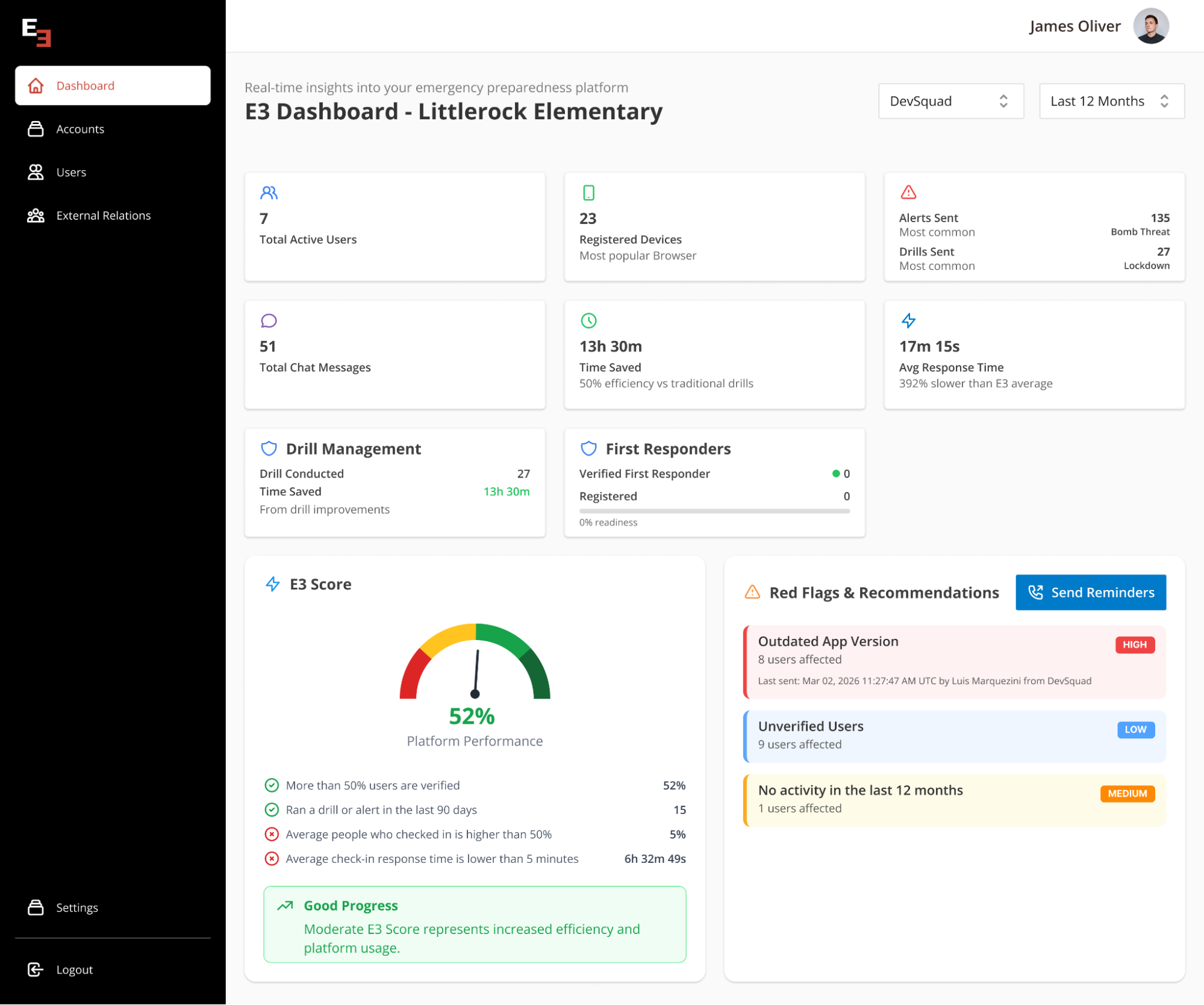
Proof: The Emergent 3 case study shows a rewrite with no safety net. Emergent 3's stalled safety app served roughly 50,000 users and was approaching $1M in ARR. We rewrote it from scratch and launched in five months, against a four-month estimate. V2 couldn't run beside V1, so there was no gradual rollout and no fallback. The data migration went through without a hitch.
 What clients say: Rewrites after a failed build are familiar ground. Swell came to DevSquad after two previous development teams fell short, and its founder describes what followed:
"DevSquad helped us rebuild the product from the ground up, took the product to market, and added new features and iterated on that. They took us through that whole process. They feel ownership in our product." — Drew Sparks, Founder and CEO, Swell
Choose DevSquad if you want one managed team to own a rewrite or partial replacement, from scope cuts to cutover. Skip DevSquad if you're modernizing a mainframe or COBOL estate.
2. Clean Coders Studio
Verdict: Clean Coders Studio is the pick when you can't afford a big-bang cutover and want test-driven, module-by-module migration.

At a glance | |
|---|---|
HQ | Scottsdale, Arizona |
Founded | 2010, by Micah Martin and Robert C. Martin |
Pricing model | Pay per feature, with a bug-free guarantee |
Minimum project | Not published |
Clutch rating | No Clutch profile found |
Best for | Incremental strangler fig migration |
What the minimum buys: Clean Coders doesn't publish a minimum. It prices per feature, so your spend tracks delivered work. Ask how a "feature" is defined on a migration, where much of the effort is plumbing nobody sees.
First weeks: The studio offers a free assessment, and its process opens with an audit of your legacy architecture and dependencies. Ask what that audit produces and whether you keep it if you walk away.
Proof: The studio replaces legacy systems one module at a time using the strangler fig pattern. Each new module runs beside the old system until it's validated, with data migration, parallel running, and a rollback plan in every phase. Co-founder Robert C. Martin wrote Clean Code, a standard text on maintainable software. We couldn't find a named modernization case study to verify.
What clients say: We couldn't find a Clutch profile for Clean Coders Studio. Ask for two references from migrations similar to yours. In fairness, Clean Coders publishes its own modernization list and ranks itself first. So do we, so weigh both lists accordingly.
Choose Clean Coders if the old system has to keep running until the very last module moves. Skip it if you need a full rewrite fast. Months of parallel running cost money every month they last.
3. Keyhole Software
Verdict: Pick Keyhole Software when every engineer must be US-based and your stack includes Java, .NET, or COBOL.
At a glance | |
|---|---|
HQ | Lenexa, Kansas |
Founded | 2008 |
Team size | 50 to 249 (Clutch) |
Minimum project | Undisclosed (Clutch) |
Hourly rate | $100 to $149 (Clutch) |
Clutch rating | Not yet reviewed; named a 2026 Clutch Top 15 firm for application modernization |
Best for | US-only teams on older enterprise stacks |
What the minimum buys: Keyhole doesn't publish a minimum. Its Clutch listing shows $100 to $149 an hour, the highest rate on this list. Every $10,000 buys roughly 67 to 100 hours of senior, US-based engineering time.
First weeks: Keyhole starts by evaluating system complexity, operational risk, and your modernization goals. It decides where AI-assisted modernization actually helps before using it. Its six defined approaches run from minimal infrastructure changes to full rewrites.
Proof: Keyhole migrated Kansas City Southern Railway's large-scale COBOL systems to a .NET Core microservices architecture. It also modernized AMC Theatres' digital platform across mobile and web. On COBOL estates, the people who understand the code are getting harder to find. A senior team that already reads it lowers the risk of losing rules nobody wrote down.
What clients say: Keyhole's Clutch profile has no client reviews yet, so you'll need to ask for references. Clutch did name it a 2026 Top 15 firm for application modernization. Keyhole says 78% of last year's projects came from repeat clients, and every consultant is a full-time employee averaging 17+ years of experience.
Choose Keyhole if you require US-only teams and carry COBOL, Java, or older .NET in the stack. Skip it if your product runs on a modern web stack. That depth may be more than you need, so ask which case study looks most like your system.
4. Zoolatech
Verdict: Pick Zoolatech when you need modernization capacity across several workstreams at once.
At a glance | |
|---|---|
HQ | Miami, Florida |
Founded | 2017 |
Team size | 250 to 999 (Clutch) |
Minimum project | $50,000+ (Clutch) |
Hourly rate | $50 to $99 (Clutch) |
Clutch rating | 4.9 from 18 reviews |
Best for | Multi-team modernization programs |
What the minimum buys: The minimum is $50,000, or roughly 500 to 1,000 hours at Zoolatech's Clutch rates. The most common project size among its reviews is over $1 million, and 80% of its listed clients are enterprises. That tells you where the firm does its best work: long, multi-team engagements.
First weeks: Its service page describes modernization consulting that starts with a dependency map. It also captures legacy behavior as tests before anyone changes the code, then extracts services from the running monolith using the strangler pattern.
Proof: Procore's Director of Engineering reports on Clutch that Zoolatech upgraded 186 repositories to the company's latest design system. The team moved 95% of Procore's web pages onto it, which the reviewer calls the fastest design system adoption in the company's history. Zoolatech also reports more than 300 modernization, AI, and cloud-native projects, and Pandora's vendor manager calls it a key technology partner on Clutch.
What clients say: Zoolatech's Clutch reviews average 4.9, with reviewers praising timely delivery and the caliber of its engineers. The one recurring criticism is communication across cultural lines. The Procore reviewer felt some issues weren't raised quickly enough.
Choose Zoolatech if you're running parallel modernization workstreams and need more engineers fast. Skip it if you have one internal tool and a small budget. Ask for the two case studies closest to your system, then ask to speak with those clients.
5. Kitrum
Verdict: Your product is live, your team is shipping, and the codebase is fighting back. Pick Kitrum when you want senior help beside your own engineers.
At a glance | |
|---|---|
HQ | Florida |
Founded | 2014 |
Minimum project | $25,000+ (Clutch) |
Hourly rate | $50 to $99 (Clutch) |
Clutch rating | 5.0 from 63 verified reviews |
Best for | Live products past version one, with an in-house team |
What the minimum buys: At $50 to $99 an hour, the $25,000 minimum covers roughly 250 to 500 engineering hours. The most common project size in Kitrum's Clutch reviews runs $50,000 to $199,999.
First weeks: Kitrum doesn't publish its onboarding steps, so settle ownership early. Who reviews whose pull requests? Who decides when a refactor is done? Get those answers in week one, not month four.
Proof: Kitrum focuses on what comes after version one: legacy and brownfield modernization, V2 development, and stabilizing AI-written code. Clutch reviews describe it rebuilding and improving an existing prototype of a B2B hiring platform. Another describes moving a loan product's frontend from Angular to React.
What clients say: Kitrum's 63 verified Clutch reviews average 5.0. Reviewers single out a proactive, responsive team and strong project management.
Choose Kitrum if you have engineers who know the system and need senior help working alongside them. Skip it if you'd rather hand the whole modernization to one accountable team. Compare it against the managed options above.
6. Devox Software
Verdict: Not sure yet what's actually wrong with the old system? Pick Devox Software when you need an audit before you decide what to rebuild.
At a glance | |
|---|---|
HQ | Miami, Florida |
Founded | 2018 |
Team size | 50 to 249 (Clutch) |
Minimum project | $50,000+ (Clutch); fixed-price modernization packages from $25,000 |
Hourly rate | $50 to $99 (Clutch) |
Clutch rating | 5.0 from 45 reviews |
Best for | Aging operational systems that need an audit first |
What the minimum buys: Devox publishes fixed-price legacy modernization packages on Clutch:
$25,000, 2 weeks: code and architecture audit, plus a modernization roadmap and risk matrix
$50,000, 4 weeks: adds static analysis, a tech-debt score, and a pilot refactor of 3 critical modules
$100,000, 8 weeks: adds a pilot refactor of 10 modules, containerization, and a zero-downtime strategy
First weeks: Devox opens with an audit. Its Clutch reviews describe full audits of a legacy booking platform and a legacy transportation management system before any re-architecture began. Ask whether you own the audit findings if you hire someone else to build.
Proof: Macwilco Entertainment, an Austin-based booking company, hired Devox to modernize its legacy booking and management platform. According to the CEO's Clutch review, the rebuilt platform runs over 40% faster and system downtime has been eliminated. Another review describes a transportation management system modernization that included migrating data out of the legacy database.
What clients say: Devox's 45 Clutch reviews average 5.0, with reviewers praising its communication and timely delivery. The criticisms are early: some clients saw delays sourcing specific roles at the start, and a few mention time-zone friction.
Choose Devox if nobody on your team can explain the old system end to end. Skip it if you already know what to build and need a team to execute.
7. Simform
Verdict: Does your platform run on .NET or Java, with a future on Azure? Look at Simform.
At a glance | |
|---|---|
HQ | Orlando, Florida |
Founded | 2010 |
Team size | 1,000 to 9,999 (Clutch) |
Minimum project | $25,000+ (Clutch) |
Hourly rate | $25 to $49 (Clutch) |
Clutch rating | 4.8 from 88 reviews |
Best for | .NET and Java product platforms committing to Azure |
What the minimum buys: At $25 to $49 an hour, the $25,000 minimum covers roughly 500 to 1,000 hours. The most common project size in Simform's Clutch reviews is under $50,000.
First weeks: In one Clutch review, an education company describes Simform starting a registration platform rebuild. The team reviewed the existing platform, identified areas to refactor, and assigned a full development and QA team.
Proof: Testimonial Tree's CTO reports on Clutch that Simform rewrote its legacy app in 4 to 6 months. The rewrite replaced MS SQL stored procedures with a service-oriented middleware. Simform also reports a last-mile logistics modernization on Azure with 45% faster feature rollouts and a production cutover under four hours. It holds Azure Expert MSP status.
What clients say: Simform's 88 Clutch reviews average 4.8, with praise for communication and on-time delivery. The most common criticism is thin requirements gathering at the start, and some reviewers mention time-zone friction.
Choose Simform if you're committing to Azure and want a large bench to draw from. Skip it if you need senior attention on a small system. Ask who will actually sit on your team before you sign.
When a global systems integrator is the better fit
Running hundreds of applications, or IBM Z workloads? You need a different shortlist.
Accenture, IBM, and Infosys lead the enterprise modernization rankings for a reason. They're built for mainframe estates, application portfolios spread across countries, and transformation programs that run for years.
We left them out of this ranking because they solve a different problem. A 40-person operations team modernizing one internal tool doesn't need a multi-year transformation program. Neither does a SaaS company rewriting its product. You'd be paying for program management built for a portfolio you don't have. Spend that budget on the system itself.
If your estate looks like theirs, start there. If it looks like one or two systems your business can't run without, the seven software modernization companies above are the better fit.
How to choose an application modernization company
A ranking gets you to a shortlist. The vendor interview tells you who can actually cut you over.
A wrong pick is expensive, and the cost of maintaining legacy systems keeps running while you recover. Ask every company on your shortlist these five questions. Listen for specifics: names, dates, numbers, and what went wrong. A vendor who answers every question with a methodology slide hasn't been tested by a real cutover yet.
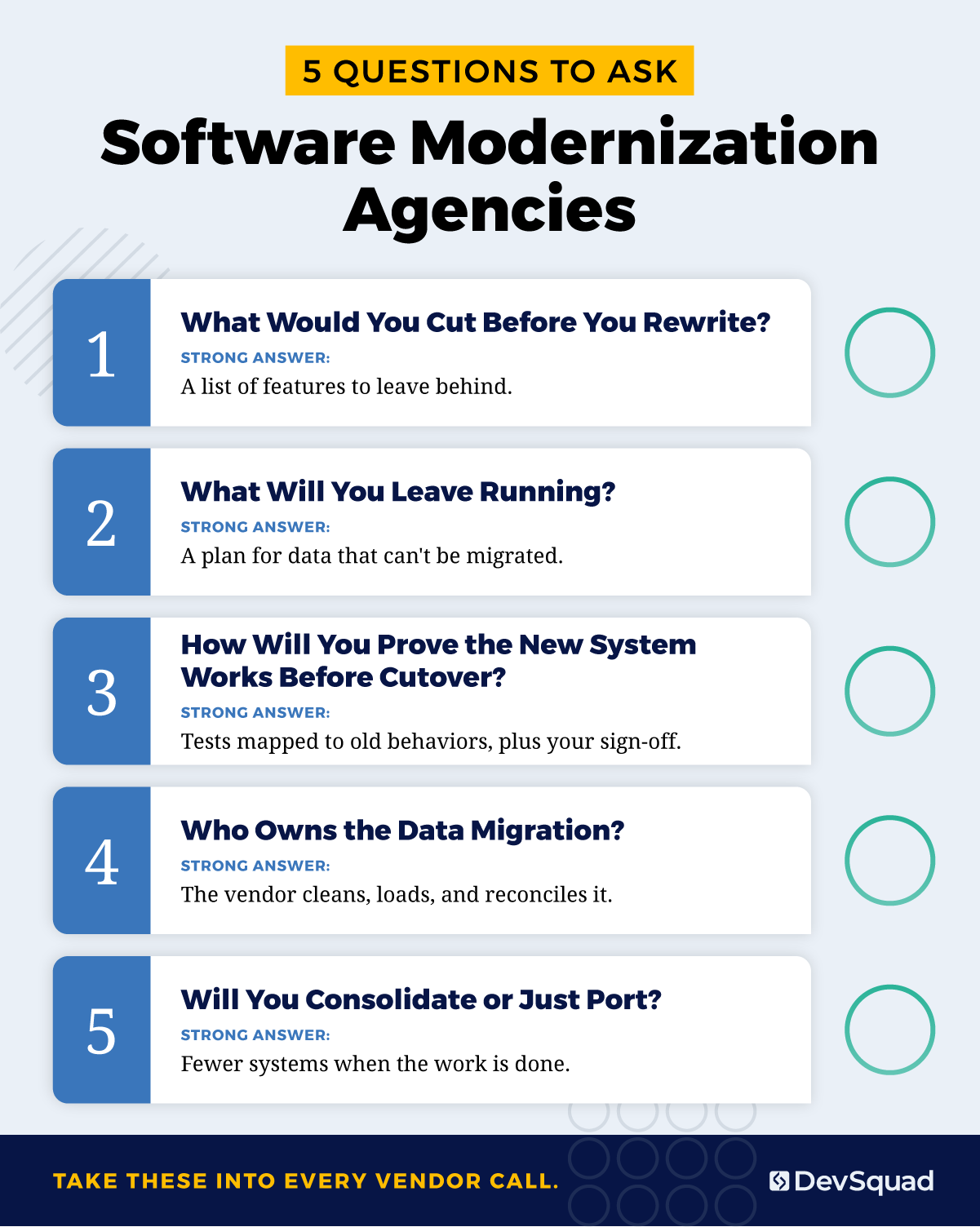
Ask what they would cut before they rewrite
A strong partner shrinks your scope before quoting it. Features nobody uses still cost money to rebuild, test, and migrate. Your first discovery meeting should end with a list of things you're leaving behind.
On Emergent 3, the meeting that saved the most time had nothing to do with architecture: we asked the founder what nobody used anymore. Every feature we stripped out was one less thing to rebuild, test, and migrate before a cutover with no fallback.
Once that cut list exists, it becomes the input to your application modernization roadmap. Everything that survives the cut gets sequenced. Everything else stays in the old system's history. You can still bring a dropped feature back later, once real users ask for it.
What does a weak answer sound like? A quote for a one-to-one rebuild of every screen you have today. That vendor is pricing a copy of your old system. Ask them which features they'd recommend dropping. If they can't name one, they haven't looked closely at how you work.
Ask what they will leave running
Some of your old system should stay exactly where it is. A good partner tells you which part, and why.
Nationwide Power was paying AutoTask by the API request and couldn't move its 15 years of client history out of the platform. A previous agency had started a replacement and couldn't finish it. DevSquad moved every operational process into a custom platform and left AutoTask running as an archive, connected by API for specific requests only. Contracts that took about a week now take about an hour.
That's a partial replacement. The old vendor still holds the records. It just doesn't run the business anymore.
A weak answer is "we migrate everything." If you hear it before anyone has checked whether your current vendor will release the data, keep looking. Ask these instead, and get the answers in writing:
What happens if the export fails?
Which records have to stay reachable, and for how long?
What will the connection back to the old system cost each month?
A vendor who has done partial replacements will have answers ready. One who hasn't will promise a clean migration and find out the truth mid-project, on your budget.
Ask how they will prove the new system works before cutover
"It passed QA" and "it matches the old system" are two different claims. Ask the vendor which old behaviors the new system was tested against. Then ask who on your side signs off before cutover.
I still review the test plan before a cutover the way I review pull requests, line by line. If nobody can show me which old behaviors the new system was checked against, the release isn't ready, no matter how clean the code looks.
Parity-first sequencing is what makes that sign-off possible.
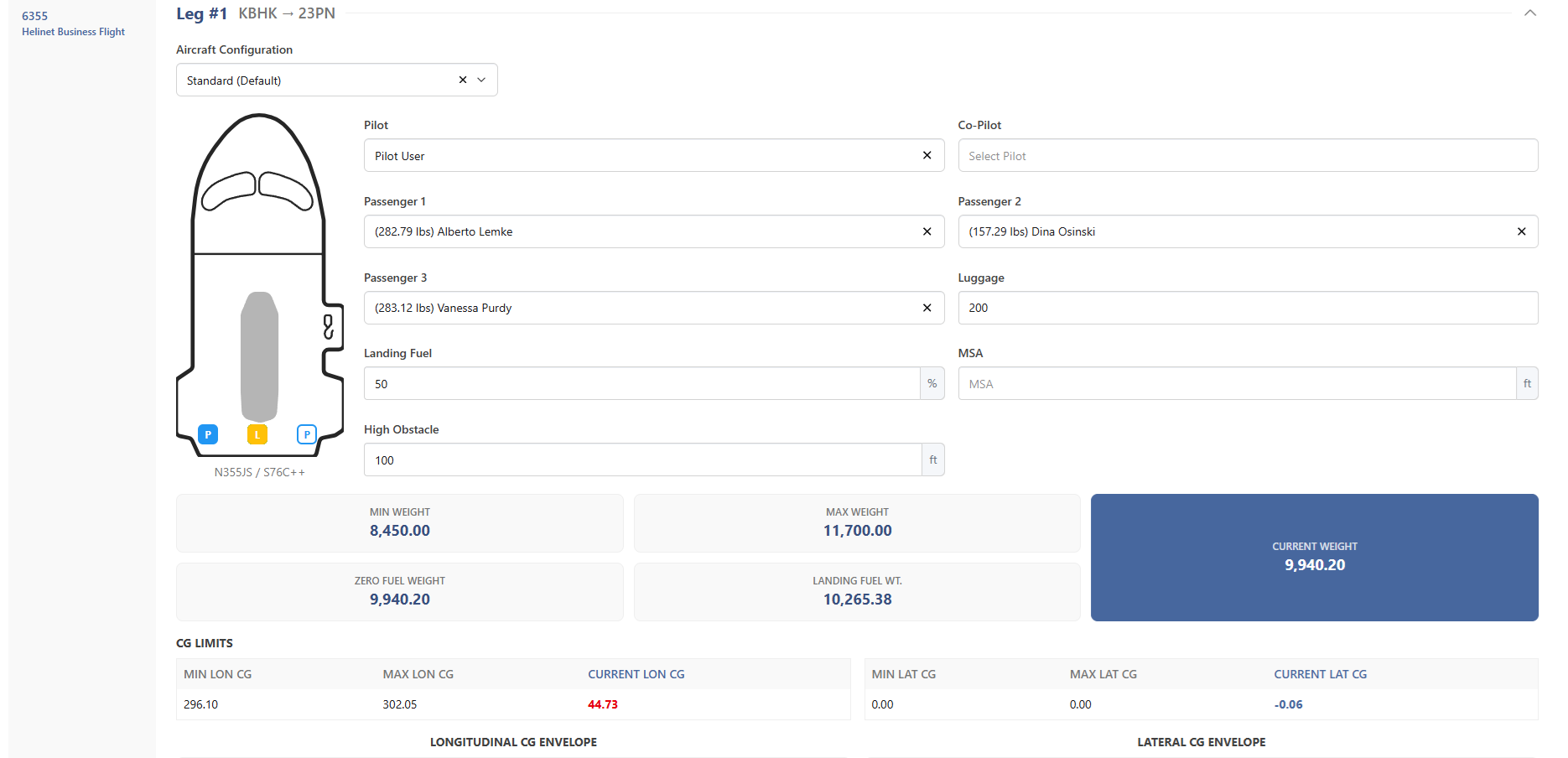
Helinet Aviation couldn't leave Veryon until its new platform covered everything Veryon already did. DevSquad built parity first: aircraft registries, weight and balance, pre-flight checks, and flight logs. Development began in June 2025, and the platform went into production in January 2026. Reporting and a client messenger came after launch, once the remaining gaps were clear.
The order mattered. Helinet's team could switch only when nothing they relied on was missing. New features earned their place after that. Ask your vendor for the same sequence in writing: parity list first, launch criteria second, new features last. Then hold them to it when someone asks for a shiny feature before launch.
Ask who owns the data migration
Your timeline slips at the data migration. If a vendor hands you an import template, they've handed the risk back to you.
Ask three things. Who cleans the data? Who normalizes and loads it? How will the vendor confirm nothing is missing before go-live?
"Getting the data right is not a step you delegate to the customer. When we launched a platform for a multi location consignment retail franchise, the real work was not training. It was data. Every store exported whatever list it had, and we normalized it and loaded it store by store, because self-service imports would not have come through complete." — Sandro Boçon, Product Manager, DevSquad
A strong answer names a person on the vendor's team who owns completeness. It also includes a reconciliation step you can check yourself, location by location or account by account.
A weak answer sounds like "you'll export it, we'll import it." That puts the dirtiest part of the project on your team. It lands right before launch, when your team has the least time to spare.
Ask whether they will consolidate or just port
Your legacy problem might be three systems doing one job. Port each one to a new stack, and you keep all three, plus the duplicate work between them.
"When a business runs one process across several separate systems, the cost is not the licences. A private college had grown a separate portal for each of its offerings over more than ten years, and each one aged badly. Adding a language meant doing it several times. Nothing could change without changing everywhere." — Flavio Pano, Product Manager, DevSquad
So ask whether the vendor will propose consolidating before rebuilding. A strong answer maps your processes first. Then it shows how many systems you'll run when the work is done. Fewer is the goal.
If the proposal ends with the same number of systems you started with, you're paying to repaint the sprawl.
Consolidation also changes the cost of every future change. One system means one place to add a field, one place to fix a bug, and one set of permissions to manage. Ask the vendor to show you that math.
Modernizing a SaaS product vs. an internal tool
You can hire the same company for the same rewrite on the same timeline. The risk still changes depending on who feels the cutover. So should the questions you ask on your shortlist calls, starting with who carries the risk on launch day.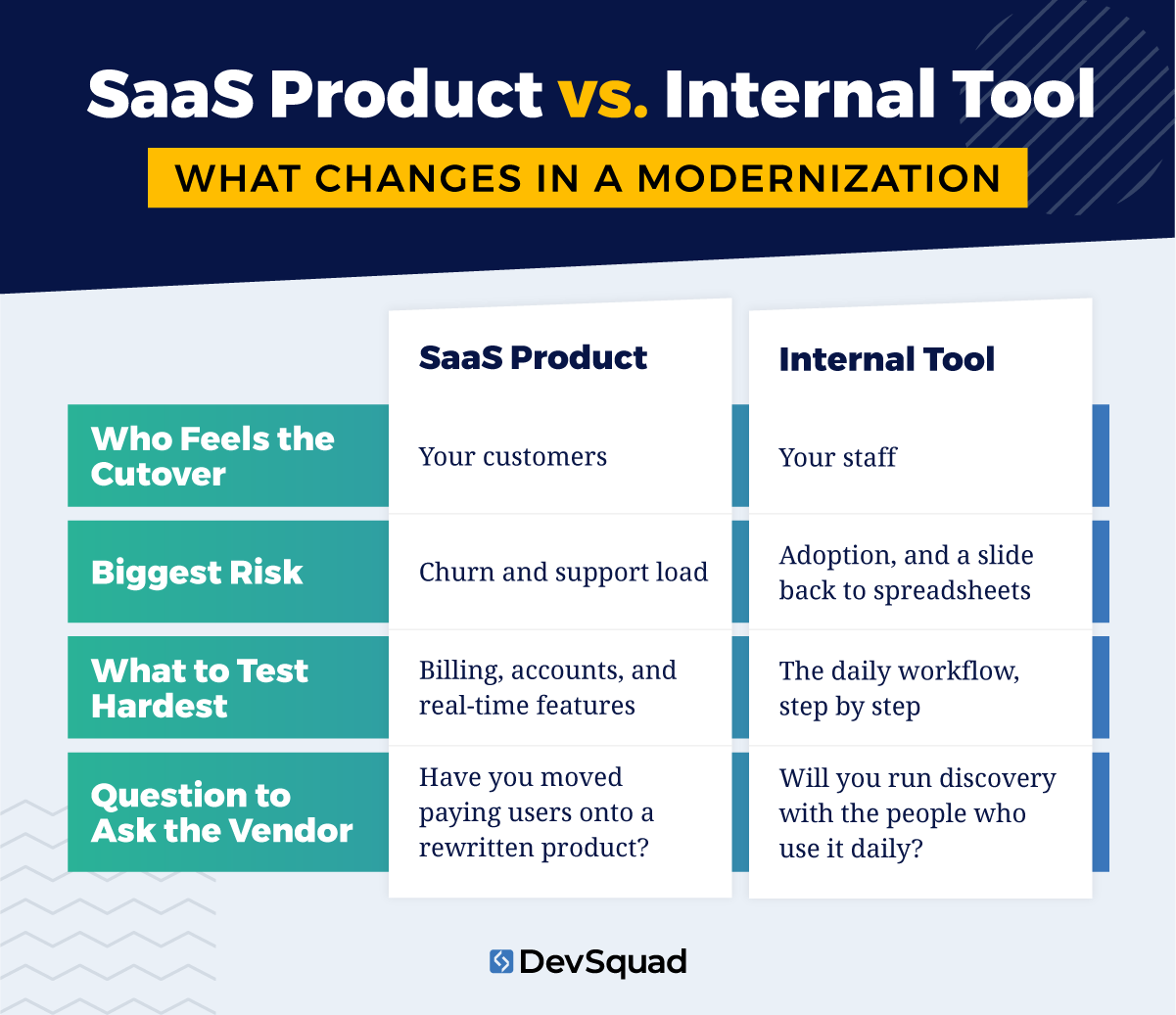
When your customers feel the cutover
When you modernize a SaaS product, cutover day is a customer event. Renewals, support volume, and churn all ride on it.
As covered in the DevSquad entry, Emergent 3 moved every user at once with no fallback. That only works when testing has already done its job.
Shortlist companies with proven cutover discipline and a plan for telling customers what's changing, and when. Then ask one screening question: have you ever moved paying users onto a rewritten product? A vendor who has will answer with dates, user counts, and what went wrong. Also ask how they handle the first week after launch. Who watches the support queue, and how fast do fixes ship? Your customers will judge the new product by that first week.
When your own team feels it
When you modernize an internal tool, the risk is adoption. Your staff go back to spreadsheets the first time the new system misses a step they rely on. Nobody files a ticket. The workaround just quietly returns.
That changes what you shortlist for. Look for companies that run workflow discovery with the people who use the system every day, as well as the managers who approved the budget. Ask to see how they document a workflow before building it. If the answer is a feature list with no user steps, expect adoption trouble. Then ask who trains your team.
Still choosing between rehosting, refactoring, rebuilding, or wrapping? Our guide to custom software modernization walks through each path. Still sizing the problem? These legacy system examples show what other companies faced before they modernized.
Application modernization companies FAQs
Hourly rates among the companies on this list run from $25 to $149. Published minimums range from $25,000 to $50,000. Fixed-price discovery and audit phases run from about $25,000 to $100,000, depending on depth. Managed teams billed monthly typically cost $16,000 to $40,000 a month, depending on seniority and team size. Ask each company for a scoped first phase before committing to a full program. Then compare what each phase includes, since deliverables matter more than the rate.
It depends on the path you choose. Emergent 3's full rewrite launched in five months. Helinet's replacement began development in June 2025 and reached production in January 2026. Incremental migrations follow a different clock, since the old and new systems run side by side until the last module moves. Ask each vendor for dated examples from projects like yours, including how long both systems ran side by side.
Often, yes, but nobody can promise it before they've seen your system. Two approaches lower the risk. Parity-first sequencing, like DevSquad's work for Helinet, makes sure the new system covers everything the old one did before anyone switches. Incremental migration, the strangler fig approach Clean Coders Studio uses, keeps the old system running until each new module is validated. Ask which one a vendor recommends for your system, and why.
Replatforming moves your app to a new hosting environment without changing its core architecture. Refactoring restructures the code without changing what it does (our guide to refactoring legacy code goes deeper). Rebuilding starts over with a modern architecture, often with a redesigned feature set. Your path also shapes your vendor: Clean Coders Studio and Kitrum lean incremental, while DevSquad runs rewrites and partial replacements.
Tools speed up code analysis, refactoring, and testing. They don't own your scope, your cutover, or your data migration. Someone still has to make those calls. If your team has run a cutover before, the right legacy modernization tools may be enough. If nobody on your team has, hire a company and let the tools make that company faster. Several companies on this list already use AI-assisted analysis.
Picking your modernization partner
Start with your modernization path. A rewrite, an incremental migration, and a partial replacement each call for a different kind of company. Use the comparison table to find the two or three built for yours.
Then make every finalist answer the five questions above. The company that answers with specifics, dates, and names has actually cut someone over. The one that answers with a process slide probably hasn't.
If your path is a rewrite or a partial replacement of an internal tool or SaaS product, talk to DevSquad about your modernization project. We'll start by telling you what to leave behind.

Rafael Lunardelli is the CTO at DevSquad and founder of Pinguim Academy. With nearly two decades in software development, he specializes in scalable systems, DevOps, QA, and modern PHP development. Rafael has led enterprise projects at KPMG and now teaches thousands of developers through his Laravel-focused courses, conference talks, and online content.