
AI is making developers faster than ever. Tasks that used to take hours now take minutes. You can generate code, test ideas, and move from concept to prototype in a single sitting. But here’s the catch. Software is not getting dramatically cheaper.
This guide breaks down the real impact of AI on software development costs. We will define what AI deflation actually means and explain why total costs are shifting instead of disappearing.
You will see where AI drives real savings, where it quietly adds cost, and how leading teams adjust their approach to stay efficient in a faster, more complex environment.
Let’s start with the biggest misconception.
The myth of cheaper software in the AI era
There is a popular narrative that AI will make software ten times cheaper. It sounds logical. If developers move faster, costs should drop. That assumption misses how software actually gets built.
Coding is only one piece of the total cost. You still need:
Product strategy
UX design
Architecture
Testing
Integration.
Those layers do not shrink just because code generation speeds up. In many cases, they become more important.
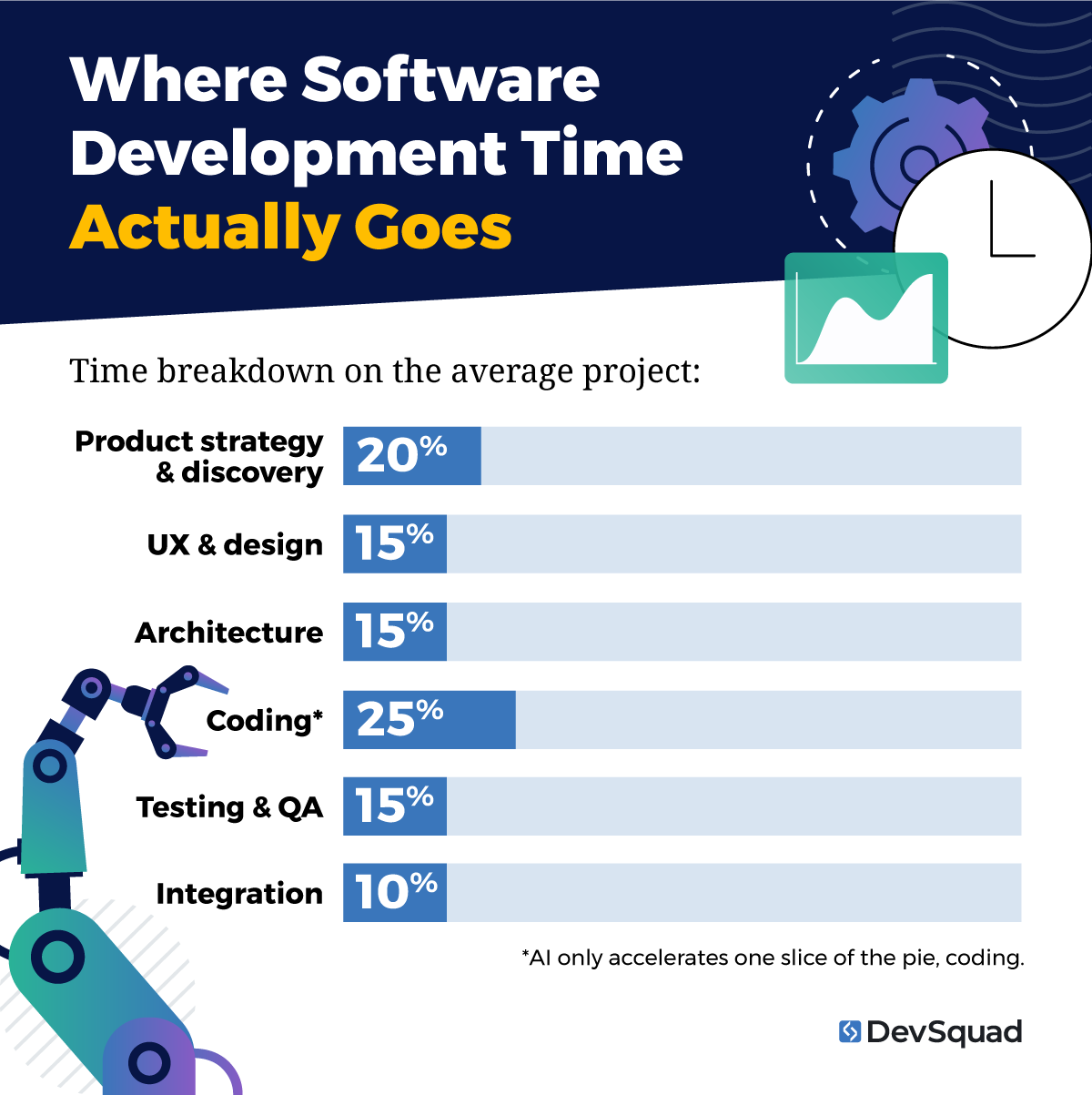
AI increases velocity, and that changes behavior. Teams ship more features, test more ideas, and expand scope faster than before. What starts as efficiency often turns into expansion. You do not spend less. You build more.
We see this across the software industry. Developers complete tasks faster, but faster output does not reduce total project scope or complexity.
The result is simple. AI lowers the cost per unit of work, but it increases the volume of work. Total software development costs tend to stay flat or rise, especially as expectations increase.
What AI actually reduces (and what it doesn’t)
AI reduces real costs in software development. But it does not reduce every cost. The companies that get the most value understand where AI belongs in the workflow and where experienced humans still need to lead.
Where AI reduces costs
AI cuts the most cost from repetitive and time-consuming tasks. These are the areas where speed translates directly into savings.
Boilerplate code generation that used to take hours now takes minutes
Research and debugging that previously required searching across multiple sources
Prototyping and early-stage ideation that can now happen in a single session
Documentation, backlog creation, and acceptance criteria definition
“The structuring of epics, choosing the best language for a specific scenario, well-defined acceptance criteria, technical instructions, and even a more advanced review process have impacted my productivity by at least 30%.”
— Caio Alves, Technical Product Manager at DevSquad
DevSquad’s team sees this firsthand. One of our technical product managers estimated a 30 percent increase in productivity, especially in structuring epics, refining requirements, and reviewing work. Others highlighted faster brainstorming, quicker validation of ideas, and improved discovery workflows.
The broader research also supports this. McKinsey found in 2023 that developers using generative AI could complete some coding tasks—like code documentation— up to twice as fast.
That matters. But it does not mean the full project gets twice as cheap.
Where AI does not reduce costs
AI does not eliminate the hardest parts of software development. These areas still depend on experience, judgment, and clear decision-making.
System architecture and long-term technical design
UX and product strategy that define what should be built
Integration complexity across systems, APIs, and data layers
Stakeholder alignment and decision-making across teams
AI can assist in these areas, but it cannot own them. Teams still need strong leadership to make the right tradeoffs and guide the product in the right direction.
Where AI increases costs
AI can also introduce new costs, especially when teams move faster without enough control.
QA and validation to confirm AI-generated outputs are correct
Code review and oversight to maintain quality and consistency
Rework caused by incorrect or incomplete AI-generated solutions
Managing larger codebases created by faster development cycles
AI cannot say it does not know, and it often suggests incorrect solutions with confidence. That shifts more responsibility to developers to validate every output.
AI reduces real costs in software development. But it does not reduce every cost. The companies that get the most value understand where AI belongs in the workflow and where experienced humans still need to lead.
Understanding AI deflation in the software industry
AI is pushing parts of software development toward deflation. That does not mean everything gets cheaper. It means specific inputs cost less, while others become more valuable.
What is AI deflation?
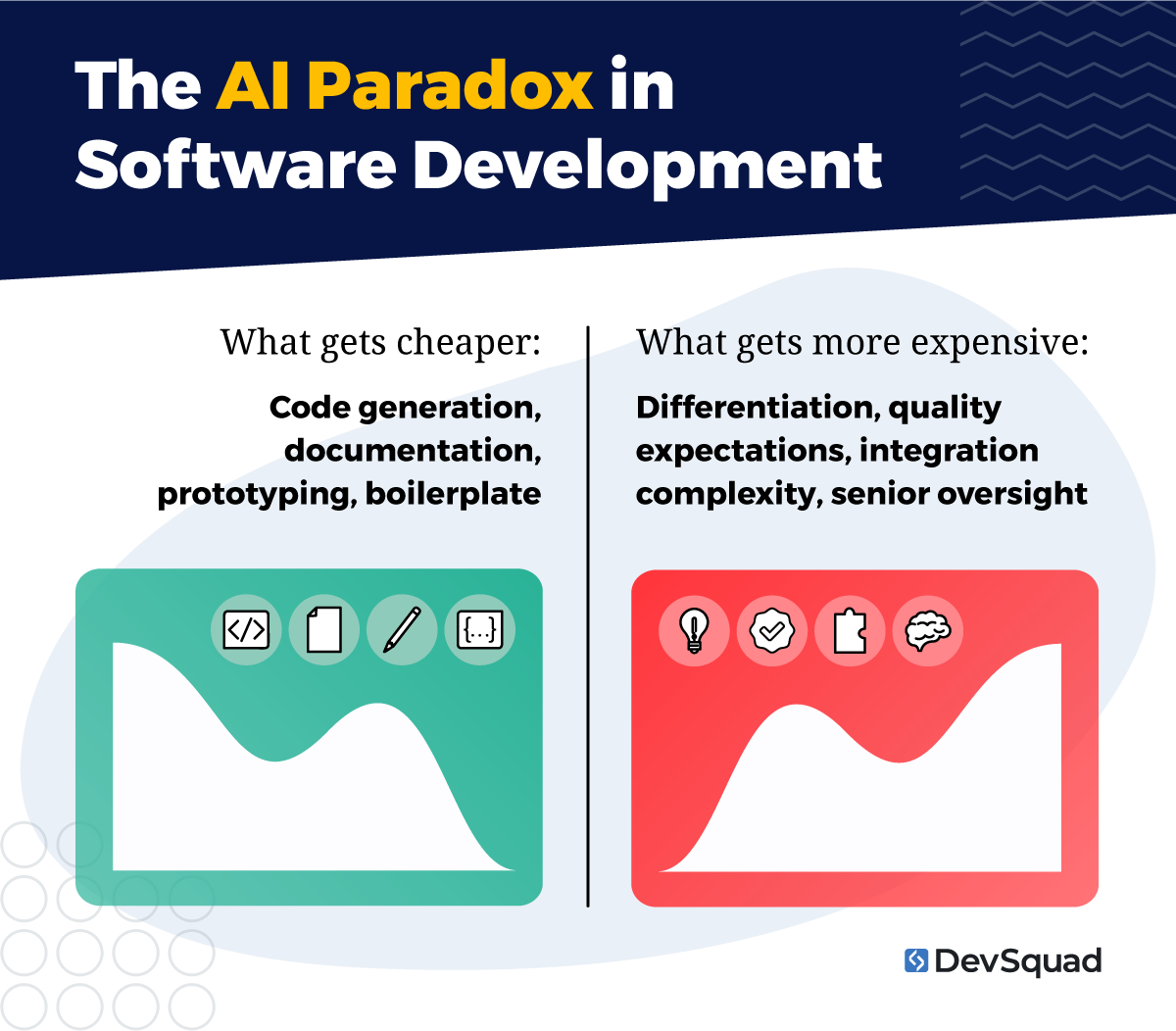
AI deflation refers to the falling cost of producing software at the execution level. Code is faster to write, easier to test, and quicker to iterate on than ever before.
Lower cost of producing code as AI generates large portions of implementation
Lower barrier to entry as non-experts can now build functional products
Faster iteration cycles that allow teams to test and refine ideas quickly
This is why we are seeing more products launched with smaller teams.
But more does not mean better, and this only tells part of the story.
What is not deflating
The parts of software that create real business value are not getting cheaper. In many cases, they are getting more expensive.
Complexity continues to rise as systems integrate more tools, data sources, and services
Differentiation becomes harder as more competitors can build similar products faster
Product quality expectations increase as users expect polished, reliable experiences
As AI lowers the cost of building, it raises the standard for what “good” looks like. That shifts pressure onto teams to deliver better products, not just faster ones.
The new reality: cost compression vs cost expansion
The software industry is splitting into two tracks.
Simple software is getting cheaper as AI reduces the cost of building basic functionality
High-quality software remains expensive, and in many cases costs more to build and maintain
That gap is where most companies struggle. They assume AI will reduce total cost, but it mainly compresses the cost of execution while expanding the cost of complexity, quality, and differentiation.
The takeaway is straightforward. AI is not eliminating software development costs. It is redistributing them.
AI tools help me write specs, analyze feedback, and explore ideas faster. It reduces dependency on others for early validation, allowing me to move quicker and make better decisions.
— Vitor Carnello Jatoba, Technical Product Manager at DevSquad
Why software development costs are shifting—not disappearing
AI is not removing costs from software development. It is moving them. What used to be expensive is now cheap. What used to be manageable is now harder.
Teams are producing more code than ever. That sounds like progress. It also means there is more to test, more to review, and more to maintain over time. Faster output expands the surface area of the system.
More code produced creates more long-term maintenance and technical debt
Faster iteration increases the number of decisions teams need to make
More available options introduce more complexity across the system
Speed changes behavior. When teams can build quickly, they explore more ideas, test more features, and expand scope without always tightening focus. That increases total effort, even if individual tasks take less time.
“Complex tasks now have a different approach, as if a very smart work colleague was working together with me on it. This can be both for discovery and delivery.”
— Nelson Pereira, Technical Product Manager at DevSquad
Nelson Pereira, technical product manager at DevSquad, described AI as working with “a very smart colleague” during both discovery and delivery.
That is the right way to think about it. AI supports the work. It does not replace judgment. Teams still need experienced people to choose the right approach, validate outputs, and keep the product aligned with business goals.
The bottom line is simple. AI reduces friction in execution, but it increases the importance of decision-making. That is why costs are shifting, not disappearing.
How AI is changing the software industry cost structure
AI is not just speeding up development. It is reshaping how costs show up across the entire software lifecycle. The biggest shift is not in how fast teams code. It is in how they think, decide, and manage complexity.
From coding to orchestration
Developers are spending less time writing code. That part is getting automated. The job is shifting toward guiding the system instead of building every piece by hand.
Teams now spend more time validating outputs, selecting the right approach, and making sure everything fits together. Execution is faster, but direction matters more. The value has moved from writing code to orchestrating it.
Rising importance of senior talent
AI raises the floor, but it also raises the stakes. Less experienced developers can move faster, but mistakes scale just as quickly.
Strong fundamentals are now critical. Developers need to evaluate AI-generated outputs, spot issues early, and make the right architectural decisions. Without that oversight, teams move fast in the wrong direction and pay for it later.
DevSquad’s teams have seen this firsthand. AI improves productivity, but only when guided by solid technical knowledge and judgment.
Increased importance of product thinking
AI makes it easier to build. That does not mean teams should build more. It means they need to decide better.
Faster builds amplify bad decisions. Teams can test more ideas, but they also risk expanding scope and wasting effort. Product strategy becomes the main cost lever. The teams that win are the ones that know what not to build.
The hidden costs AI introduces
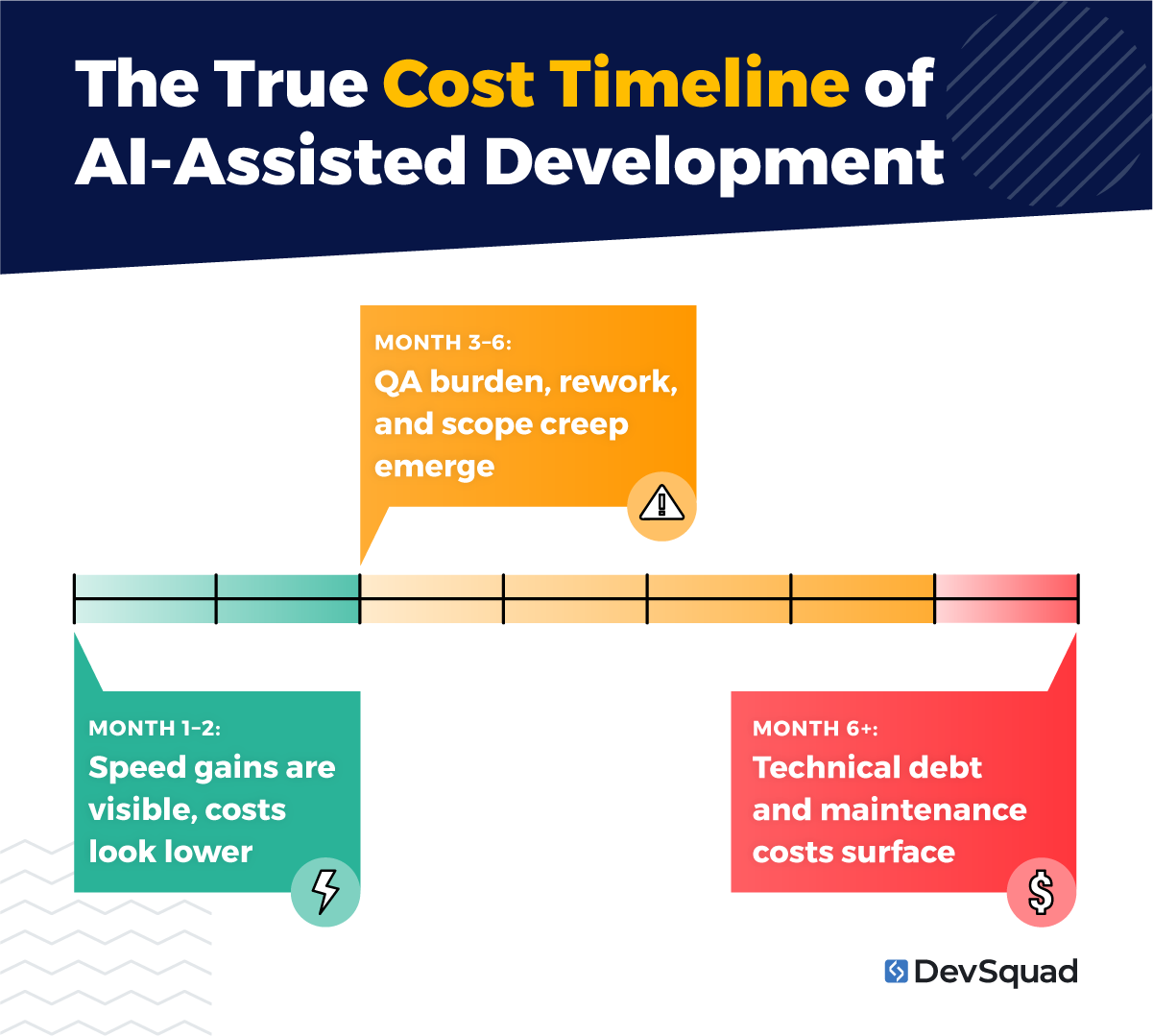
AI makes it easier to build. It also makes it easier to build the wrong things. Most teams focus on speed gains and miss the second-order effects that show up later in the lifecycle.
Overproduction of features as teams expand scope simply because they can
Increased QA burden from a larger volume of code and faster release cycles
Misleading confidence from AI outputs that appear correct at first glance
Technical debt created by rapidly generated code that was never designed for long-term scale
These costs do not show up immediately. They build over time, and they compound.
AI produces answers quickly, but those answers still require strong technical judgment to validate.
That is the core risk. AI does not hesitate. It does not flag uncertainty. It gives you an answer, and the team carries the responsibility of deciding whether that answer is right.
How to actually reduce software development costs in the AI era
AI can lower costs, but only if you use it the right way. Speed alone does not create efficiency. The biggest gains come from better decisions.
“AI has greatly changed the focus of development. Previously, applying a series of quality assurance processes was essential to improve development. AI reduces the number of these processes, allowing us to get straight to the point quickly.”
— Caio Alves, Technical Product Manager at DevSquad
Focus on discovery before development
The fastest way to waste money is to build the wrong thing quickly. AI makes that easier than ever. Teams that follow an agile product development approach validate ideas early and reduce wasted development.
Validate ideas before writing code. Test assumptions with users. Define the problem clearly before expanding the solution. This is where the biggest cost savings happen.
Invest in UX and product strategy
Poor product decisions create long-term costs. Fixing them later is always more expensive than getting them right upfront.
Strong UX design best practices reduce rework and improve adoption. They also keep teams focused on the features that actually matter. That discipline becomes more important as AI increases development speed.
Use AI to accelerate, not replace thinking
AI works best as a multiplier. It helps teams explore options, validate ideas, and move faster through execution. It does not replace judgment.
Combine AI with structured processes. Use it to support discovery, planning, and development. Avoid relying on it blindly. Teams that treat AI as a shortcut tend to create more problems than they solve.
Work with managed, high-performing teams
Coordination is a major cost driver in software development. Misalignment between business and technical teams leads to delays, rework, and missed priorities.
Managed teams reduce that friction. They align business goals with technical execution, improve delivery efficiency, and keep projects focused. In a faster development environment, that alignment becomes a competitive advantage.
Faster development doesn’t mean cheaper products
AI speeds up execution. That part is clear. Teams can move from idea to implementation faster than ever.
But speed does not reduce waste. In many cases, it amplifies it. If the direction is wrong, you just get to the wrong outcome faster.
At DevSquad, the focus is not just on building quickly. It is on building the right thing. That starts with structured discovery. Discovery workshops help define the problem, validate assumptions, and shape a clear execution plan before development begins.
From there, dual-track agile keeps teams aligned. One track focuses on discovery and validation. The other focuses on delivery. This reduces rework and keeps development tied to real user needs instead of assumptions.
Roadmap planning adds another layer of control. Instead of building everything at once, teams prioritize what matters now, what comes next, and what can wait. That discipline prevents scope creep and keeps costs predictable.
The result is simple. AI accelerates execution. Process reduces waste. The best outcomes come from combining both.
When done right though, the costs do reduce. That is seen in the rise in custom software development.
The future of software development costs
AI will continue to accelerate development. That trend is not slowing down. Tools will improve, workflows will get faster, and the gap between idea and execution will keep shrinking.
At the same time, competition will increase. When it becomes easier to build software, more companies enter the market. More products launch. More features compete for attention. Speed becomes the baseline, not the advantage.
That shifts where the real cost advantage comes from.
Better planning to define the right problem before building
Better prioritization to focus on what actually drives value
Better execution to deliver quality without unnecessary complexity
The companies that win will not be the ones that build the fastest. They will be the ones that make the best decisions.
Frequently Asked Questions (FAQs)
AI reduces the cost of coding and speeds up execution. At the same time, it increases the importance of validation, strategy, and quality. The result is cost redistribution, not elimination.
Not necessarily. AI lowers some costs, especially in coding and early-stage work. It also increases costs in QA, complexity, and rework. Total spend often stays the same or increases as scope expands.
AI deflation refers to the decreasing cost of producing code and launching simple products. It lowers the barrier to entry, but complex systems still require significant investment.
The hardest parts of development have not been automated. Architecture, UX, integration, and decision-making still require experienced teams. These areas drive the majority of cost.
Use AI to accelerate execution, but pair it with strong product strategy and discovery. Focus on building the right features, not just building faster. Experienced teams and structured processes make the biggest difference.
Thinking about building your own custom software with the support of AI? Learn about DevSquad’s custom software development where the expertise of our process is paired with the speed of AI.

Dayana Mayfield is a SaaS copywriter and content marketer specializing in SaaS marketing, positioning, and go-to-market strategy. She has consulted for over 195 SaaS companies, focusing on both traffic and conversions. She has been featured in Entrepreneur, Forbes, and Business Insider. Outside of work, Dayana writes SciFi novels and spends her evenings surviving auditions, rehearsals, and tech week as a proud theater mom.