
The travel industry runs on software, but not all software is built to handle the real-world complexity of bookings, logistics, customer experience, and partner networks. Off-the-shelf platforms often fall short, forcing travel and hospitality businesses to work around their tools instead of building systems that work for them.
That’s where custom software development for travel comes in.
Whether you're managing tours, running a booking platform, operating a hotel group, or launching a new travel startup, custom-built software helps you streamline operations, increase bookings, and deliver better service. But building it takes more than code. It requires the right process, tools, and development partner.
In this guide, we’ll break down:
What custom travel software is
Common use cases and industry-specific features
How the discovery process sets the foundation for success
The best frameworks to use (with Laravel leading the pack)
A shortlist of top agencies that specialize in travel and hospitality platforms
If you're exploring ways to improve your tech stack—or building something new from the ground up—this post will help you understand what’s involved, what to expect, and where to start.
What is custom software development for travel?
Custom software development for travel refers to building tailor-made digital tools that meet the specific operational and customer-facing needs of businesses in the travel and hospitality industry. Unlike off-the-shelf platforms that force companies to mold their workflows to rigid templates, custom travel software is built from the ground up to fit how your business actually runs—your booking flows, pricing logic, user interfaces, integrations, and everything else in between.
Whether you're a tour operator, hotel chain, booking platform, or corporate travel agency, custom software for travel and hospitality gives you the ability to automate back-office operations, elevate the traveler experience, and differentiate your brand in a competitive space.
Why go custom?
Generic software often fails to address the nuanced complexities of the travel industry. Booking logic, seasonal pricing, multi-vendor inventory management, and real-time availability are just a few of the core challenges that require highly specific solutions. Add compliance needs and you’re looking at a landscape where flexibility and adaptability are mandatory.
Custom travel software solutions give companies complete control over how their systems work and evolve over time. This is especially critical as your business grows, your customer base becomes more diverse, and your internal operations become more sophisticated.
Another strong motivator is the improved efficiency of development that has arisen from AI assistance. Things like reviewing and debugging have become streamlined, and these efficiencies are passed onto you when you work with the right development partner.
Travel and hospitality software development: beyond features
More than just engineering, travel industry software development involves a strategic discovery process that starts with understanding your customers and internal stakeholders. Successful outcomes depend on the right mix of product strategy, UX design, and agile execution, not just code.
That’s where firms like DevSquad stand out. With a consulting-first approach, DevSquad works with travel and hospitality businesses to define what success looks like, prototype the right features, and execute development in manageable sprints. From building your roadmap to launching version 1 to running ongoing discovery and releases, DevSquad helps you ship scalable travel software that aligns with both user needs and business goals.
21 use cases for custom travel software
Custom travel software solutions are used to solve a range of problems across customer experience, internal operations, and partner integrations. Whether you’re improving how customers interact with your brand or streamlining internal systems, each use case brings measurable value.
Enhancing the traveler experience
Travelers today expect a seamless, personalized experience from research and booking to check-in and support. Custom software helps you deliver that kind of journey across web and mobile.
Dynamic itinerary planning: Let users build multi-stop, personalized travel itineraries with real-time availability and pricing.
Self-service booking portals: Allow travelers to manage their own reservations, upgrades, and add-ons through custom portals tailored to your exact offerings.
Loyalty and rewards systems: Build programs that tie directly into your customer data and incentivize repeat bookings with meaningful perks.
Mobile apps for trip management: Provide travelers with real-time notifications, mobile boarding passes, in-app chat, and offline itinerary access.
Multi-language localization: Customize experiences based on traveler location, language, and regional norms for smoother international use.
Personalized content and upselling: Present travelers with relevant offers—like insurance, transportation, or add-on excursions—based on trip details and profile data.
Streamlining operations and logistics
Behind every trip is a complex web of workflows. Custom travel software can centralize operations, reduce manual effort, and improve decision-making.
Inventory and availability management: Synchronize your inventory across hotels, flights, tours, and more—ensuring accurate availability at all times.
Custom CRM and guest profiling: Track traveler preferences, behaviors, and past interactions to deliver more personalized service and targeted marketing.
Automated document handling: Generate and deliver travel documents, invoices, waivers, and confirmations automatically based on trip status.
Operations dashboard for travel agents or staff: Give your internal teams a single source of truth for managing bookings, requests, and issues.
Workflow automation for repetitive tasks: Automate pre-trip reminders, post-trip feedback requests, vendor confirmations, and more.
Incident response and trip disruption management: Route disruptions to the right internal or partner teams quickly with pre-defined workflows and communication logic.
Managing partners and vendor ecosystems
Travel businesses often work with a wide array of partners—airlines, hotels, tour operators, payment providers. Custom integrations streamline collaboration and data flow.
Third-party API integrations: Connect seamlessly with GDSs, airline APIs, property management systems, and other travel data sources.
Vendor portals: Create branded partner portals where suppliers can upload inventory, manage pricing, and track performance.
Affiliate and reseller management systems: Allow third parties to book under your brand while maintaining control over pricing and commissions.
Commission tracking and payouts: Automate the tracking and payment of partner commissions with clear audit trails and reporting.
White-label booking engines: Deploy fully branded versions of your booking interface for partners, resellers, or affiliates.
Improving financial visibility and compliance
Travel software needs to handle complex payment flows and regional regulations. Custom tools provide transparency and reliability across your financial operations.
Multi-currency and tax logic: Support global payments with country-specific tax rules and currency conversions baked into your system.
Custom reporting and analytics: Build dashboards that reflect your specific KPIs, segmented by channel, region, or trip type.
PCI-compliant payment processing: Implement secure, compliant payment flows that reduce risk and support diverse payment methods.
Automated invoicing and reconciliation: Generate accurate invoices and match payments to bookings automatically, reducing manual errors.
11 common travel industry software development features
From intuitive booking interfaces to backend automation, custom software for travel and hospitality relies on a foundational set of features.
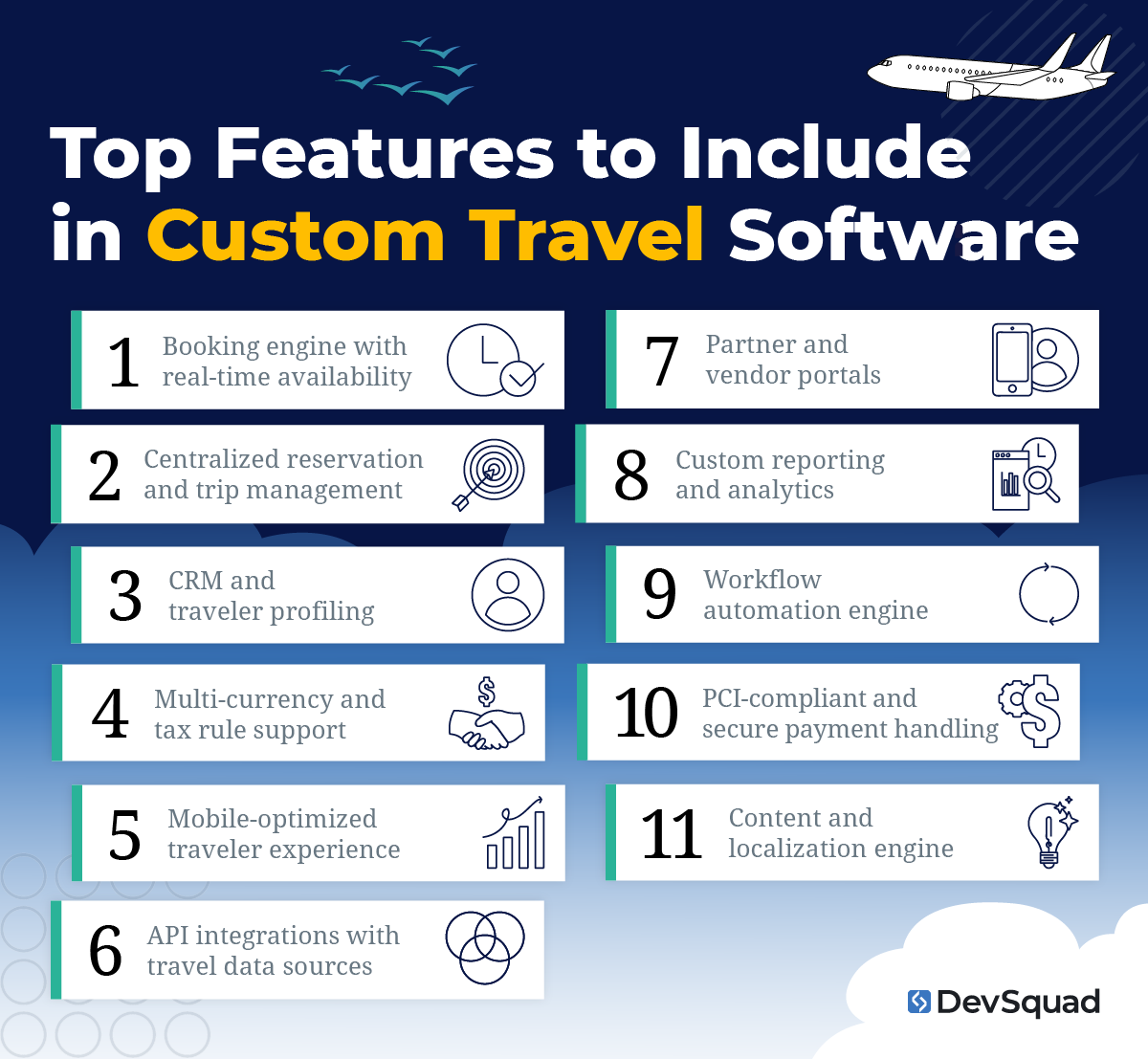
1. Booking engine with real-time availability
A robust booking engine is central to any travel platform. It must surface real-time availability and pricing pulled from your internal inventory or third-party sources (like GDSs or hotel APIs). This is what enables self-service booking, dynamic itinerary building, and white-labeled portals for resellers or partners.
2. Centralized reservation and trip management
At the core of many travel platforms is a reservation management system that gives travelers, agents, and staff a single place to view and modify trip details. This supports operational dashboards, disruption handling, automated notifications, and seamless multi-channel booking workflows.
3. CRM and traveler profiling
Your platform should include a custom CRM layer that tracks user behavior, preferences, and history across all touchpoints. This feeds into use cases like loyalty programs, personalized upselling, and targeted marketing—allowing your team to deliver experiences that feel uniquely tailored.
4. Multi-currency and tax rule support
Travel companies operating across borders need financial infrastructure that adapts to regional requirements. Support for multiple currencies and country-specific tax logic makes it possible to process payments accurately and issue compliant invoices worldwide.
5. Mobile-optimized traveler experience
A responsive mobile interface (or standalone app) is critical for managing trips on the go. Features like mobile check-in, push notifications, offline itinerary access, and in-app support all enhance the traveler experience while reducing reliance on manual communication.
6. API integrations with travel data sources
From flights and hotel aggregators to insurance providers and transportation systems, integrations power nearly every modern travel workflow. A modular integration layer allows you to sync with the systems your business depends on—enabling real-time pricing, availability, and third-party fulfillment.
7. Partner and vendor portals
Custom portals give suppliers and partners access to the tools they need—whether it’s uploading inventory, managing pricing, or reviewing commission reports. This supports the affiliate, white-label, and vendor-side use cases, while maintaining control and oversight on your end.
8. Custom reporting and analytics
Custom dashboards give your team the data it needs to make smarter decisions. Whether you’re tracking booking trends, payment issues, or campaign performance, you can build reports tailored to your exact KPIs—not the defaults found in generic platforms.
9. Workflow automation engine
Travel businesses run on hundreds of small workflows—confirmation emails, vendor notifications, feedback requests, and more. Embedding workflow automation into your platform reduces manual touchpoints and helps your team scale without adding headcount.
10. PCI-compliant and secure payment handling
Security is non-negotiable in travel. Built-in PCI-compliant payment flows, tokenized card storage, and fraud protection help you process payments safely. For use cases involving multi-party transactions, custom rules for payouts and reconciliation can also be implemented.
11. Content and localization engine
Support for multi-language content, region-specific formatting, and location-aware experiences makes your product truly global. This allows you to scale across markets and deliver a localized experience to every user—whether they’re travelers or vendors.
The custom software development for travel discovery process
Travel platforms don’t operate in a vacuum. They sit at the center of complex systems—guest management, partner networks, vendor tools, payment processors, mobile interfaces, and customer support. A weak integration, missed dependency, or poorly scoped feature can ripple across your entire operation.
That’s why smart product development starts with structured discovery. The right discovery process turns scattered needs into a focused roadmap. It reduces risk, aligns stakeholders, and ensures you’re building software that fits your business—today and as it scales.
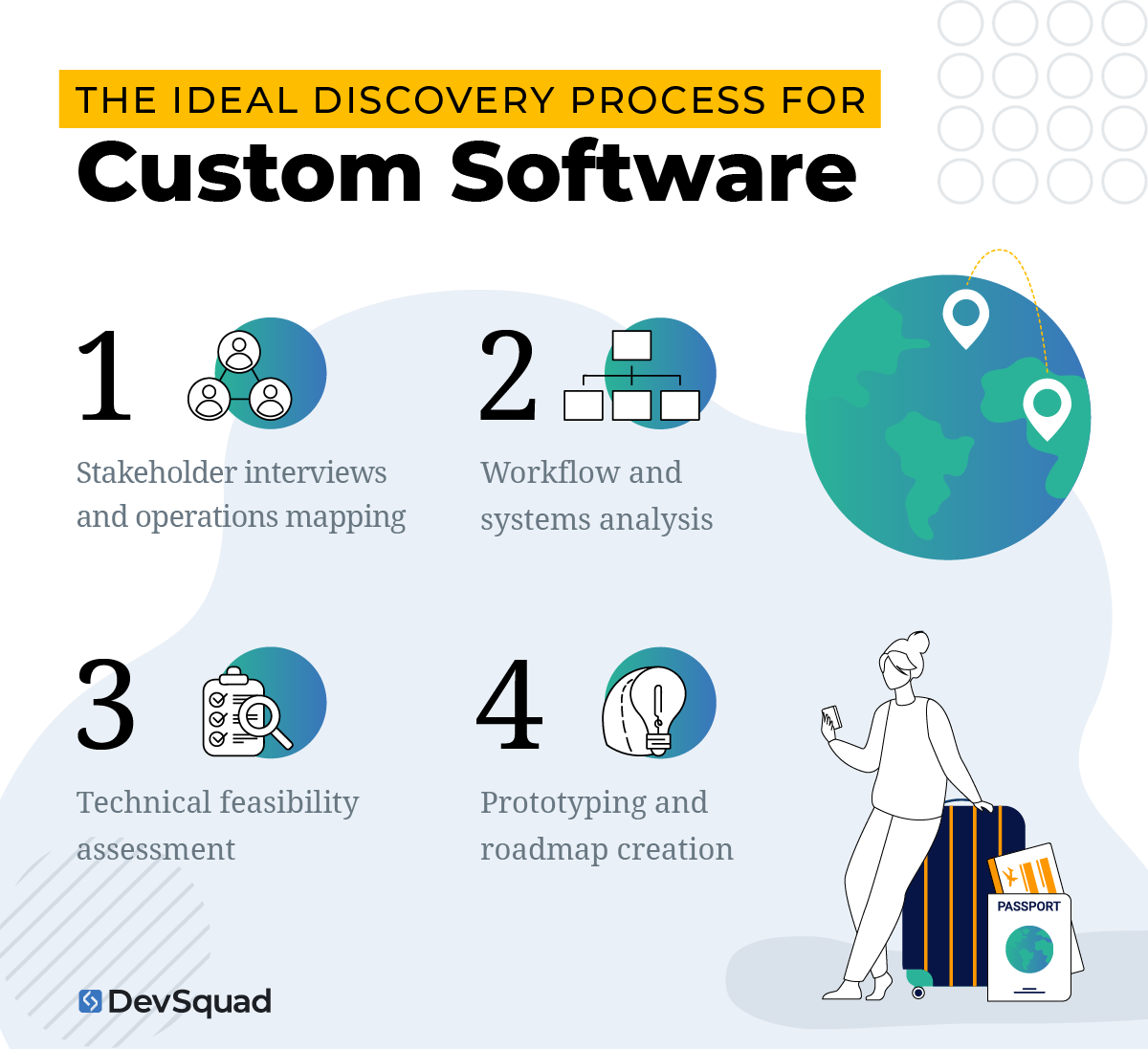
Here’s how DevSquad runs that process.
1. Stakeholder interviews and operations mapping
Start by understanding how your travel business operates in the real world—not just on paper. This means speaking directly with the people who book trips, support customers, manage vendors, or oversee finances.
Interview customer support staff, travel agents, product owners, and business stakeholders.
Surface day-to-day pain points that aren’t obvious in reports or dashboards.
Map team goals and how different groups define success—bookings, partner performance, user retention, etc.
This step ensures your software reflects actual workflows, not assumptions.
2. Workflow and systems analysis
Once you understand the people and operations, dig into how work gets done—and where systems are slowing things down or failing to connect.
Document how information moves between departments and tools: booking engines, CRMs, spreadsheets, emails, partner portals.
Audit any current software or platforms you’re using—and where those tools fall short.
Identify manual tasks, double entry, or outdated processes that could be improved or automated.
This gives you a clear view of what your software needs to do, and where it can add the most value.
3. Technical feasibility assessment
Even a great idea can fall flat if it’s not technically feasible within your budget, timeline, or infrastructure. Assess what’s realistic now, and what can be staged for later.
Review any third-party APIs your software must integrate with (GDSs, hotel systems, payment providers, etc.).
Check for platform constraints like multi-currency support, mobile responsiveness, or compliance (e.g., PCI-DSS, GDPR).
Identify risks early—before they create expensive rework mid-project.
This step aligns technical strategy with business goals.
4. Prototyping and roadmap creation
Once requirements are clear and technically sound, build a prototype and development plan to bring it all together.
Design a high-fidelity, interactive prototype that reflects real user flows and UI needs.
Gather feedback from internal stakeholders and early users (such as agents or vendors).
Create a phased roadmap—typically Now, Next, Later—to prioritize mission-critical features first, and push less essential features into future releases.
This step gives you something tangible to align your team around before writing any code.
Why structured discovery matters
Structured discovery keeps you from investing in development before confirming what you actually need—or what your users will actually use. That’s how products go over budget, miss deadlines, or fail to deliver ROI.
A structured discovery process gives you clarity, control, and momentum. It turns complexity into a clear, strategic build plan.
Best frameworks for developing custom travel software
The right software framework makes development faster, more reliable, and easier to maintain. For travel and hospitality platforms, that means using tools that can handle complex bookings, support integrations, and deliver a smooth experience to users.
You don’t need to be technical to understand the value of choosing the right tools. What matters is selecting frameworks that align with your business goals, support modern features, and scale as you grow.
Laravel (backend)
Laravel is a powerful and widely used framework for building custom software. It’s known for being secure, stable, and efficient—especially when dealing with complex logic like booking flows, vendor integrations, and user permissions.
For travel companies, it offers a flexible foundation to build around things like real-time availability, payment processing, and custom workflows. It also supports fast development, which helps keep project timelines and costs in check.
Vue.js or React (frontend)
To create a smooth, responsive user experience, modern travel software often uses frontend frameworks like Vue.js or React. These tools power everything travelers interact with: booking pages, dashboards, trip planners, and mobile-friendly features.
They make the interface feel fast and seamless—without reloads or delays—and are especially helpful for companies offering self-service tools or customer-facing portals.
Tailwind CSS (styling and UI)
Tailwind CSS is a utility-first framework that helps development teams create clean, consistent designs without writing everything from scratch. This keeps the software lightweight and visually polished, while allowing room for custom branding and user interface tweaks as the product evolves.
Additional tools based on business needs
Beyond core frameworks, certain tools and services can extend the functionality of custom travel software. These are typically added based on the specific goals of the platform, such as international expansion, third-party integrations, or automation.
Some common tools include:
Pusher or Socket.IO: For real-time notifications like booking updates, flight delays, or agent chat
Laravel Passport or Auth0: For secure authentication and user access control
Stripe or Braintree: For processing payments and handling multi-currency transactions securely
SendGrid or Mailgun: For automated emails such as confirmations, reminders, and promotions
Lokalise or Phrase: For managing translations and localizing content for global travelers
Selecting the right tools depends on the platform’s scope, budget, and technical requirements. When integrated thoughtfully, these services help streamline development, improve performance, and reduce manual effort over time.
Top 5 agencies offering travel software development services
If you're looking for a development partner to help build or scale your travel platform, choosing the right agency matters. Travel and hospitality platforms come with unique demands—real-time data, third-party integrations, global users, and customer-facing interfaces that have to work flawlessly.
The best agencies don't just write code. They help clarify your product vision, guide your tech decisions, and build systems that perform in the real world. Here’s a look at five agencies offering custom travel software development, starting with one that takes a strategy-first approach to every engagement.
1. DevSquad
DevSquad is a product-focused development agency that specializes in building scalable SaaS and custom platforms for startups and growing companies. Their process begins with a structured discovery phase to define the right features, integrations, and roadmap before development starts. For travel and hospitality clients, this helps reduce risk and speed up time to value.
Rather than handing projects off to freelancers or large offshore teams, DevSquad assembles dedicated squads that include a product manager, developers, QA engineers, and UX/UI designers. This model gives clients more control, clearer communication, and faster iteration cycles.
Key strengths:
Structured discovery process focused on business goals and user needs
High-fidelity prototyping before development begins
Dedicated, fully managed product teams
Fast go-to-market timeline with agile development cycles
Library of pre-built components to speed up travel platform development
No long-term contracts
2. GP Solutions

GP Solutions is a travel technology firm with over two decades of experience delivering software to tour operators and other travel businesses. Their offerings include both customizable out-of-the-box platforms and full-scale custom development for companies with complex or niche needs.
They’re known for products like GP Travel Enterprise—a comprehensive ERP platform for travel businesses—and GP Travel Hub, which simplifies supplier integration through a unified API framework.
Key strengths:
Robust product suite with 150+ modules for end-to-end travel operations
Custom development with full IP ownership and tailored workflows
Unified travel API aggregator with 75+ pre-integrated suppliers
Strong global presence with offices in Europe, the U.S., and UAE
3. Chetu
Chetu is a large-scale software development company offering custom travel and hospitality solutions across nearly every vertical in the industry—from hotels and vacation rentals to food service, resorts, and gaming. With a global team and over 20 years in the market, they provide both standalone software and deep integrations with major platforms like Travelport and Sabre.
Chetu is known for its flexible engagement models, allowing businesses to bring in dedicated developers or fully managed teams for projects of any size. Their breadth of services includes AI-powered automation, custom PMS systems, guest management tools, and digital guidebooks.
Key strengths:
Wide-ranging expertise across the travel, hospitality, and entertainment sectors
Strong integration support for Travelport, Sabre, and other global systems
Dedicated development teams available on demand
AI-driven features like dynamic pricing and guest service automation
4. Zoftify
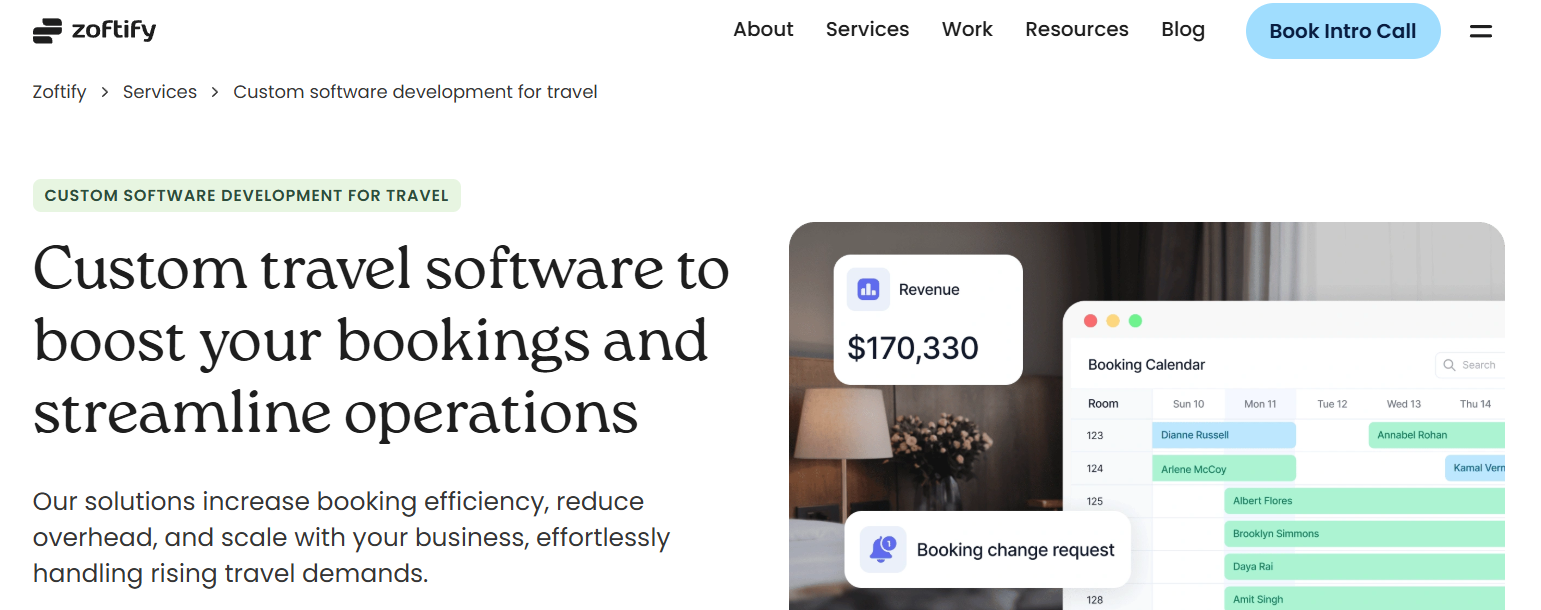
The boutique travel software development agency Zoftify builds modern, user-friendly platforms for companies looking to improve booking flows, upgrade legacy systems, or launch new travel apps. With a focus exclusively on the travel industry, they combine domain knowledge with efficient execution using scalable technologies.
Their team develops both customer-facing and back-office systems, offering everything from custom booking engines to travel API integrations.
Key strengths:
Deep specialization in the travel and hospitality sector
Custom travel apps with offline access, real-time updates, and notifications
Pre-built modules to accelerate delivery without sacrificing quality
Clear design and prototyping process for early alignment
5. CMARIX
CMARIX is a global software development company offering custom travel and hospitality solutions for travel agencies, tour operators, and hospitality businesses. With delivery teams across the U.S., India, and Europe, they focus on building bespoke platforms that support bookings, reservations, portals, and mobile travel experiences.
Their services span custom travel software, legacy system modernization, travel portals, mobile apps, and deep GDS integrations.
Key strengths:
Broad range of custom travel and hospitality software solutions
Experience with booking systems, travel portals, and GDS API integrations
Support for modernization of legacy travel platforms
Global delivery model with flexible engagement options
Ready to build your own custom travel software? Learn more about DevSquad’s approach to custom software development.

Dayana Mayfield is a SaaS copywriter and content marketer specializing in SaaS marketing, positioning, and go-to-market strategy. She has consulted for over 195 SaaS companies, focusing on both traffic and conversions. She has been featured in Entrepreneur, Forbes, and Business Insider. Outside of work, Dayana writes SciFi novels and spends her evenings surviving auditions, rehearsals, and tech week as a proud theater mom.