
The best CRM development companies in 2027 are DevSquad, SOLTECH, ScienceSoft, Itransition, and Peeklogic. DevSquad builds custom CRMs that clients own, SOLTECH offers a team based entirely in the US, and ScienceSoft suits regulated industries. Itransition runs large enterprise CRM programs, and Peeklogic specializes in Salesforce. The best fit depends on the work you need. You may need a CRM built from scratch, your current Salesforce or HubSpot account extended, or a platform set up. DevSquad ranks first for custom CRM development, where you own the finished system.
If you're reading this, your current CRM probably doesn't match how your team sells. Reps may keep a separate spreadsheet, and new reports may mean exporting data and rebuilding it by hand.
This guide compares the seven companies in a table, explains how they were chosen, and covers the three kinds of CRM work. It ends with the questions to ask a vendor before you sign.
CRM development companies compared
Company | HQ | Best for | Team model | Starting budget | Clutch rating |
|---|---|---|---|---|---|
Salt Lake City area, Utah | A custom CRM you own, or plan to sell | Fully managed squad: US strategists, Latin American developers, technical PM | Rapid Prototyping, then a month-to-month development subscription (no long-term contract) | 5.0 (2 reviews) | |
Atlanta, Georgia | US-only team, custom CRMs on a Salesforce back end | 100% US-based team, custom builds plus staffing | $10,000+ minimum | 4.9 (56 reviews) | |
McKinney, Texas | Regulated industries, CRM customization plus client portals | 250 to 999 employees, delivery across US and Europe | $5,000+ minimum | 4.8 (45 reviews) | |
Lakewood, Colorado (Denver area) | Enterprise CRM programs on Salesforce, Dynamics 365, or Odoo | 1,000 to 9,999 employees | $25,000+ minimum | 4.9 (42 reviews) | |
Austin, Texas | Salesforce-native custom development | Salesforce specialists, 50 to 249 employees, dev teams in Europe | $1,000+ minimum | 5.0 (103 reviews) | |
Dallas, Texas | Commercial real estate CRM | CRM consultancy with its own CRE product, 50 to 249 employees | $5,000+ minimum | 4.9 (16 reviews) | |
New York, New York | Custom development inside HubSpot | 100% US-based, full-time team | $5,000+ (HubSpot directory) | No Clutch listing found. Rated 4.9 to 5.0 in the HubSpot Solutions Directory |
Ratings and minimums can change, so check each Clutch profile before you reach out. Hourly rates are left out because they vary by role and project, which makes them hard to compare.
How these CRM development companies were chosen
DevSquad researched each company on this list. Each one was checked against three sources. These were its review platform profile, its own case studies or service pages, and at least one named client or verified CRM review. Companies that appeared only on their own ranking pages were not included.
Each company was scored on four criteria:
Criterion | Weight | What counted |
|---|---|---|
Verifiable CRM delivery | 35% | A named client, a verified Clutch review, or a published case study involving a CRM |
Fit for the type of work (build, extend, configure) | 25% | Whether CRM work is core to the firm or one line in a long service list |
Review depth and recency | 20% | Number of verified reviews and at least one recent review |
Ownership and handover | 20% | Whether the client owns the code and data model, and whether the firm supports handover |
I gave delivery proof more weight than certifications, because a platform certification only shows that a team can set up the tool. A CRM that still works well three years later shows the team can design the data model. The data model is the structure that defines how records connect.
DevSquad wrote this list and ranks itself first, so you should keep that in mind and check each company's linked Clutch profile. DevSquad's own Clutch profile has two reviews, both from 2018, so its case studies say more about its work than its rating does. More client feedback is on the DevSquad reviews page.
What kind of CRM help do you need?
Companies that call themselves a CRM development company do three different kinds of work: they build new CRMs, extend existing platforms, or set platforms up. Hiring the wrong kind usually means paying for skills your project doesn't use.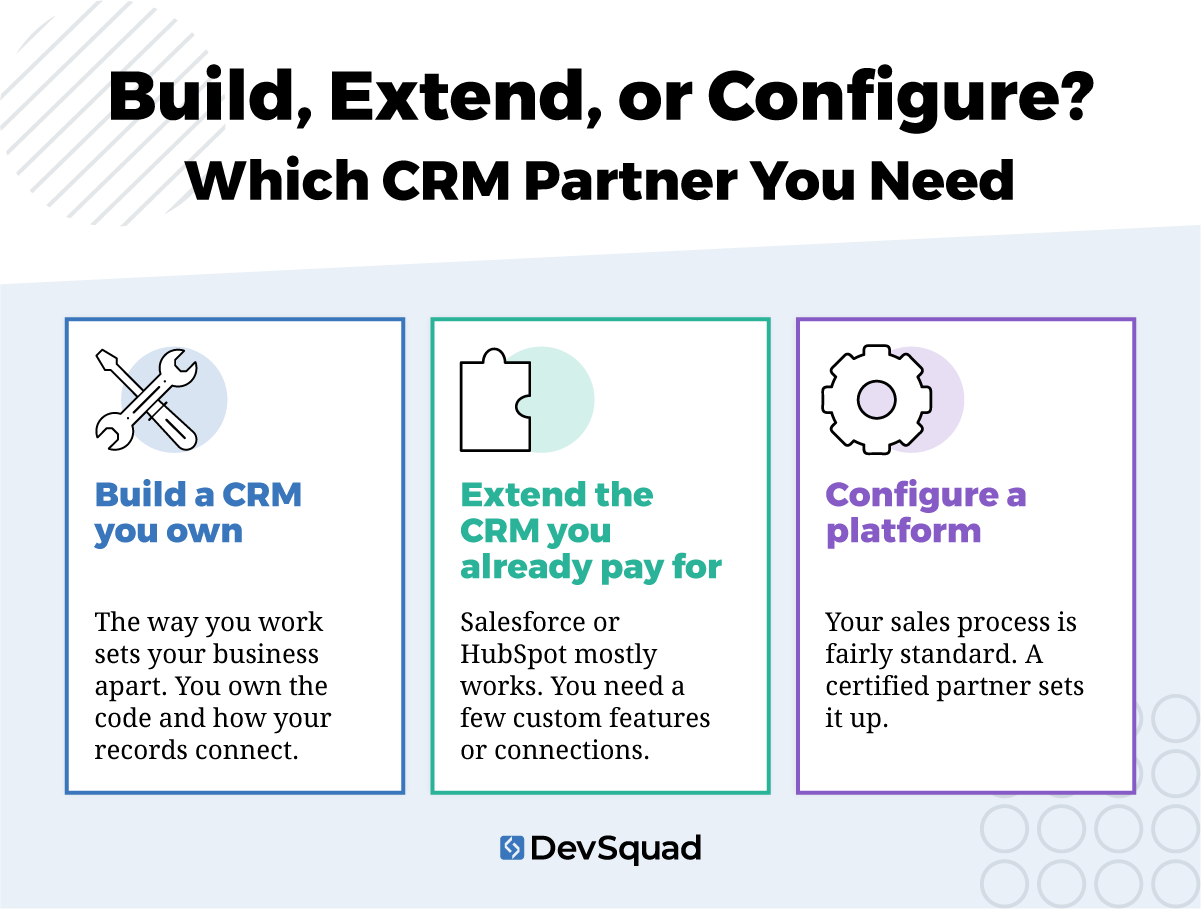
Build a CRM you own
A custom build makes sense when the way you work is a big part of what sets your business apart. Field service, compliance, franchise operations, and industry-specific marketing often need records and steps that a standard CRM doesn't have. With a custom build, you own the code, the data model, and the product roadmap, and you can sell the CRM to other businesses later. DevSquad, SOLTECH, ScienceSoft, and Itransition all build custom CRMs. The process is similar to building other internal software, except the system tracks customers rather than internal operations.
Extend the CRM you already pay for
Extension work fits when Salesforce or HubSpot mostly works for you but is missing a few pieces. Those pieces might be a new type of record, a connection to your billing system, or an app the standard settings can't create. Peeklogic extends Salesforce, Aptitude 8 extends HubSpot, and Ascendix extends Salesforce or Dynamics 365 for commercial real estate. DevSquad and SOLTECH also do custom Salesforce work. If you plan to stay on Salesforce, read these Salesforce development best practices first.
Configure a platform and stop there
If your sales process is fairly standard, a certified partner can set up Salesforce or HubSpot for less than a custom build costs. You can find these partners in the Salesforce partner directory on AppExchange or in the HubSpot Solutions Directory. None of the companies on this list focus only on setup, so those directories are the better place to look for this kind of help.
The 7 best CRM development companies
Now let’s take a look at the best agencies to consider.
1. DevSquad
DevSquad is the best fit when your CRM gives you an edge over competitors, or when you might sell it one day.
At a glance | |
|---|---|
HQ | Salt Lake City area, Utah |
Founded | 2014 |
Clutch rating | |
Best fit | Build a CRM you own |
Budget | Rapid Prototyping, then a month-to-month development subscription (no long-term contract) |
Every custom CRM project at DevSquad starts with Rapid Prototyping. That phase produces a clickable prototype, the technical architecture, and a prioritized roadmap. After that, a monthly team led by a technical product manager builds the CRM, and clients can take development in-house later if they choose. DevSquad also does custom Salesforce development and ServiceNow work.
Two of the CRMs DevSquad built are now products that the clients sell. The HiBeam case study describes a marketing agency that works with auto repair shops. Its old tools required a separate campaign for every type of customer. DevSquad rebuilt the campaigns so that a single campaign sends different messages to different customer groups. The platform connects to each shop's existing point-of-sale system. HiBeam now sells it as software to other companies and has three customer accounts live.
The OSI Systems case study describes FarSite, a platform for complying with federal contract rules. DevSquad built a CRM into FarSite that replaced the paid CRM subscription OSI had been using. OSI also sells FarSite to outside companies.
On every CRM DevSquad builds, I ask for automated tests on the integrations before the team adds new features. The connection to your point-of-sale or billing system is where problems usually start, and they can go unnoticed for weeks.
What clients say:
"A Porsche owner and a Toyota Camry owner are completely different customers. No other industry would market to them the same way, so why should automotive shops? That was the limitation we kept hitting with every tool out there. DevSquad helped us build a product with better segmentation and targeting to drive more ROI for our clients." — Chris Matson, Founder and CEO, HiBeam
Choose DevSquad if your process doesn't fit a standard CRM, you want to own the code, or you might sell the system later. Skip DevSquad if you only need Salesforce or HubSpot set up, or you want a fixed-price, fixed-scope project.
2. SOLTECH
SOLTECH is the strongest option on this list if your development team must be based in the US.
At a glance | |
|---|---|
HQ | Atlanta, Georgia |
Founded | 1998 |
Team size | 50 to 249 employees |
Minimum project | $10,000+ |
Clutch rating | |
Best fit | Build, often on a Salesforce back end |
According to its Clutch profile, SOLTECH's team is 100% US-based, and CRM consulting with a Salesforce focus is one of its services. Two Clutch reviews describe CRM projects. In one, SOLTECH built software for a student scholarship nonprofit, using Salesforce to store the data behind it. The new system replaced a platform the nonprofit had been licensing, and the client now owns its software. In the other, Finishing Dynamics, an architectural metal fabricator, replaced a 20-year-old database with a custom system built on Salesforce. That system handles quotes, paint orders, inventory, and packing lists, and the client says it came in under budget.
In the Finishing Dynamics project, SOLTECH showed a small working mock-up before the contract was signed. A few reviews mention invoices that went past the agreed fixed fee and ask for clearer scoping. Ask SOLTECH for a detailed statement of work before you start.
Choose SOLTECH if you need an onshore team. Skip SOLTECH if you want a team that also leads product strategy and user research before the build.
3. ScienceSoft
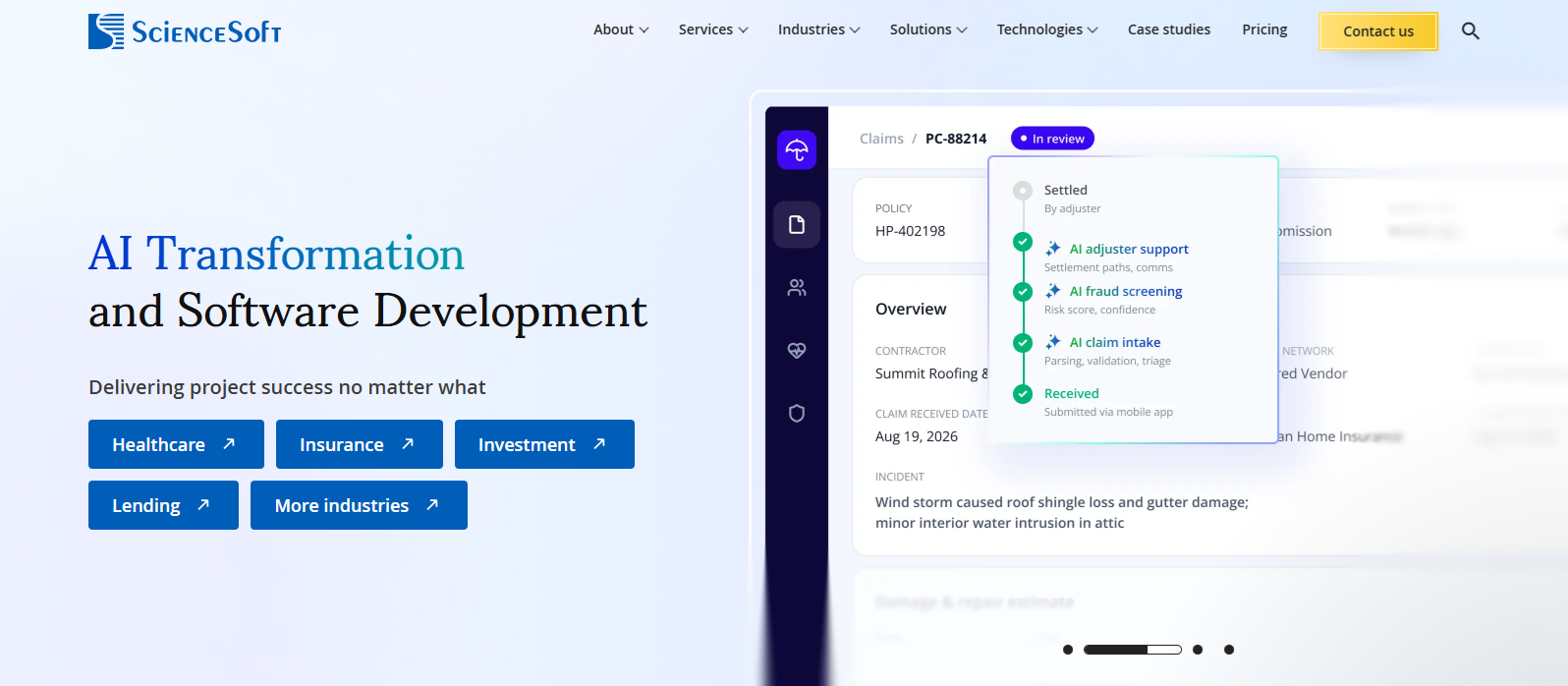
ScienceSoft fits regulated industries that need CRM work combined with client portals and compliance documentation.
At a glance | |
|---|---|
HQ | McKinney, Texas |
Founded | 1989 |
Team size | 250 to 999 employees |
Minimum project | $5,000+ |
Clutch rating | |
Best fit | Build or extend |
ScienceSoft was founded in 1989, earlier than any other company on this list. Its Clutch profile highlights healthcare, insurance, and investment clients, and lists ISO 27001 and ISO 13485 certifications. In one Clutch review, a roofing company describes hiring ScienceSoft to add custom features to Salesforce. The team wrote custom code (Apex) that automated the company's ordering, invoicing, and production steps, so those processes no longer ran on paper. The client had invested about $70,000 at the time of the review and said the changes caused no interruptions to the business.
The $5,000 minimum is low, but ScienceSoft's most common project size on Clutch is $50,000 to $199,999. Some reviewers mention difficulty working across time zones with the European delivery teams. Agree on meeting hours at the start of the project.
Choose ScienceSoft if compliance documentation matters as much as features. Skip ScienceSoft if you want the same small team from discovery through launch.
4. Itransition
Itransition is built for enterprise CRM programs that cover several platforms and business units.

At a glance | |
|---|---|
HQ | Lakewood, Colorado (Denver area) |
Founded | 1998 |
Team size | 1,000 to 9,999 employees |
Minimum project | $25,000+ |
Clutch rating | |
Best fit | Build or extend across Salesforce, Dynamics 365, and Odoo |
Itransition has been a Microsoft partner since 2008 and is a Salesforce Crest partner, one of Salesforce's top partner levels. That combination helps when one division runs Dynamics 365 and another runs Salesforce. In a published client story, Bruntwood, a UK commercial property company, replaced several poorly connected systems with one Salesforce-based CRM. Itransition's own pages report a percentage increase in leads for Bruntwood. This list doesn't repeat that figure because no independent source confirms it.
For smaller divisions, Itransition also builds simple CRMs on Microsoft Power Apps. That option can cost less in licensing than a full Dynamics 365 rollout. Projects follow formal enterprise phases for consulting, data migration, and launch.
Choose Itransition if you need several CRM platforms managed as one program. Skip Itransition if your project is a focused build under the $25,000 minimum.
5. Peeklogic
Peeklogic is a Salesforce-only firm with the most Clutch reviews on this list and a low starting budget.
At a glance | |
|---|---|
HQ | Austin, Texas, with development teams in Europe |
Founded | 2015 |
Team size | 50 to 249 employees |
Minimum project | $1,000+ |
Clutch rating | |
Best fit | Extend Salesforce |
Peeklogic has 103 Clutch reviews. Most of those projects cost less than $10,000, a size that suits adding features to a Salesforce account you already use. In one review, Aryval describes building its custom software on Salesforce with Peeklogic. Aryval had only early wireframes when Peeklogic joined, and Peeklogic wrote the scope of work from those. Other reviews cover an installable Salesforce app (a managed package) for a software company and several connections between Salesforce and Jira. Peeklogic bills by the hour, and reviewers describe its estimates as transparent.
Choose Peeklogic if you're keeping Salesforce and need custom code built inside it, such as Apex or Lightning components. Skip Peeklogic if you want to leave Salesforce or run a system outside it.
6. Ascendix Technologies
Ascendix specializes in CRMs for commercial real estate brokerages and investment firms.
At a glance | |
|---|---|
HQ | Dallas, Texas |
Founded | 1996 |
Team size | 50 to 249 employees |
Minimum project | $5,000+ |
Clutch rating | |
Best fit | Extend Salesforce or Dynamics 365 |
Ascendix works on Salesforce and Dynamics 365. It also sells AscendixRE, its own commercial real estate CRM built on Salesforce. AscendixRE comes with ready-made records for properties, listings, and deals. In a Clutch review, a JLL executive describes Ascendix as JLL's CRM partner since 2010. Ascendix connected JLL's Microsoft CRM to one of its real estate products, and the executive says CRM adoption grew about six times. Transwestern, another commercial real estate firm, describes Ascendix setting up, configuring, and supporting its CRM since 2012. Another review covers a commercial real estate firm's move from Pipedrive to a new CRM, including moving the data and training staff. If your brokerage tracks leases and available properties, those records are already built.
Choose Ascendix if you run a brokerage or commercial real estate investment firm. Skip Ascendix if you work outside real estate and don't need its ready-made records.
7. Aptitude 8
Aptitude 8 is the best choice for custom development inside HubSpot, beyond basic setup.
At a glance | |
|---|---|
HQ | New York, New York |
Founded | 2020 |
Partner status | HubSpot Elite Solutions Partner |
Budget | From $5,000 (HubSpot Solutions Directory) |
Rating | 4.9 to 5.0 in the HubSpot Solutions Directory. No Clutch profile found |
Best fit | Extend HubSpot |
Aptitude 8 is an Elite Solutions Partner, HubSpot's highest partner tier, with a full-time team based entirely in the US. Clients work with a team that covers strategy, development, and project management rather than a single consultant. On its G2 page, the company lists Uber Freight, SXSW, and Formstack as clients. It also describes itself as HubSpot's #2 Global Partner of the Year for 2024. One review in the HubSpot directory describes how Aptitude 8 set up Segment, a customer data tool, across HubSpot, Shopify, and Salesforce. According to that review, the project stayed on scope and on budget.
Choose Aptitude 8 if HubSpot is where your customer data lives. Skip Aptitude 8 if you want a CRM that doesn't depend on a HubSpot subscription.
Questions to ask a CRM development company before you sign
The four questions below show quickly how each company handles ownership, data, adoption, and reporting.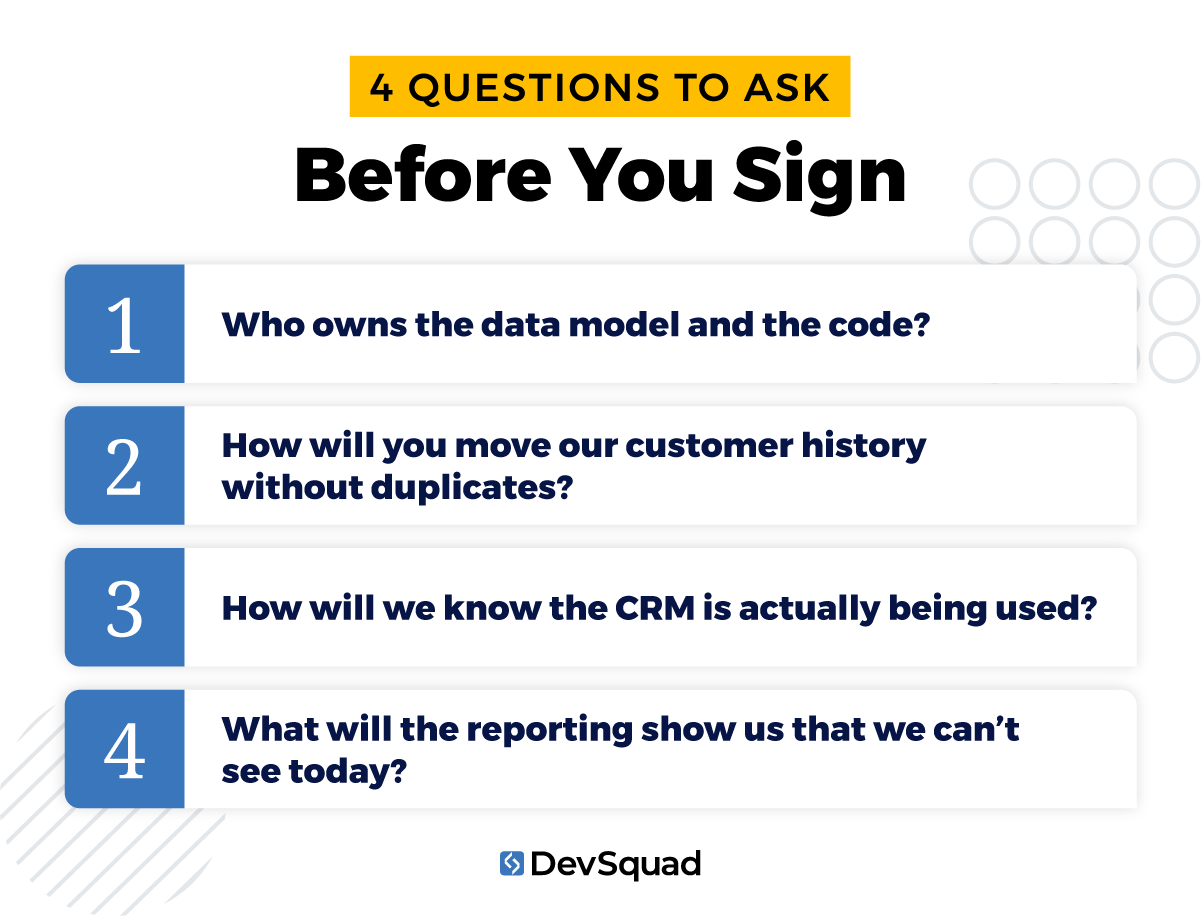
Who owns the data model and the code?
On a custom build, your contract should say that you own both, along with the code repository and the hosting accounts. When a partner extends a platform, you own the custom code they write, but not the platform itself. A good partner can show you how customers, locations, and jobs connect in the CRM they plan to build.
When I review a CRM another team built, I look at the data model before I look at any screens. If customers, vehicles, and jobs all sit on one contact record, every report you request later needs a workaround.
How will you move our customer history without duplicates?
Data migration determines whether your team trusts the new CRM. Older systems often store the same customer under slightly different names. Before the switch-over date, the partner should write down how it will match duplicate records and run a test import.
A distribution company came to DevSquad with a CRM that a previous contractor had built on nightly spreadsheet imports. Each import created duplicate accounts, so the sales reps stopped trusting the pipeline report and went back to their own lists. DevSquad started by adding tests around the import and writing down the rules for matching records, before building any new features.
How will we know the CRM is actually being used?
You can measure whether your team is using a new CRM. A good partner adds usage reports from the start, so you don't have to wait for complaints. Ask what they plan to track in the first 90 days after launch.
"The most useful usage number can be the absence of activity. On an emergency alert platform, we built a metrics view that shows whether customers are actually using the system. If an account has run no required drills in months, either something is not working for them or they have quietly stopped relying on the product. Both are worth a phone call." — Vitor Carnello, Product Manager, DevSquad
What will the reporting show us that we can't see today?
A strong CRM project answers a business question your old tool couldn't, such as which marketing brings in customers. Ask each partner to name one decision their reports will help you make. If they can't name one, they may not understand your business yet.
"Sometimes the most useful part of a build is one you did not plan. For a building maintenance contractor, reporting by region showed completed jobs, scheduled jobs, and unscheduled demand across its service area. They could see which areas generated work and stopped advertising into the ones that did not. The reporting was not the point of the build, but it changed where they spent their marketing money." — Caio Alves, Product Manager, DevSquad
Companies left off this list
Two groups of companies were left out. Large staffing firms such as BairesDev and Chetu were excluded because their CRM-specific work was hard to verify. Some CRM software development companies were also left out because their CRM work appeared only on their own ranking lists. For a broader list of custom software builders, see DevSquad's guide to custom software development companies.
Choosing your CRM development partner
First decide what kind of CRM work you need, then choose a company that specializes in it. If Salesforce or HubSpot mostly works, hire a partner that extends it well. If your process is standard, have a certified partner set up a platform and keep the rest of your budget. If the way you sell or serve customers sets your business apart, build a CRM you own.
DevSquad focuses on custom builds. Every project starts with Rapid Prototyping, so you see the data model and a clickable prototype before you commit to a monthly team. If you're considering a custom build, talk to DevSquad about custom CRM development.
CRM development companies FAQs
Cost depends on scope, integrations, and how much data needs to move. On the Clutch profiles checked for this list, the most common project size was $50,000 to $199,999 for SOLTECH, ScienceSoft, and Itransition. Smaller extension projects, such as adding a feature to Salesforce, can cost a few thousand dollars. Ask each CRM development agency for a scoped estimate after discovery.
Customize the platform if your process is fairly standard and only a few things are missing, such as one integration or one new record type. Build a custom CRM if standard records keep forcing workarounds, or if the CRM will be part of what you sell. A good CRM software development company should tell you which applies to you before it gives you a quote.
The timeline depends on scope and integrations. DevSquad's custom CRM page says most clients have a working first version in 3 to 4 months, with more features added in later phases. Extending an existing platform usually takes less time. Data migration is the step most likely to cause delays, so plan the test import early.
Yes, if you plan for it from the start. HiBeam and OSI Systems both built CRMs for their own operations and now sell them to other businesses. Neither started out as a software company. To sell a CRM, you need separate accounts for each customer, settings each customer can change, and billing. DevSquad's guide to vertical SaaS covers these requirements.
You should, but make sure the contract says so. Confirm that you own the code repository, the data, and the hosting accounts, and that the CRM developers will document the system for handover. If a partner extends a platform, you own the custom code but still pay for the platform license. If the partner hosts anything for you, get administrator access to those accounts from the first day.
DevSquad offers software and AI solutions built to fit your business. Learn more about DevSquad.

Rafael Lunardelli is the CTO at DevSquad and founder of Pinguim Academy. With nearly two decades in software development, he specializes in scalable systems, DevOps, QA, and modern PHP development. Rafael has led enterprise projects at KPMG and now teaches thousands of developers through his Laravel-focused courses, conference talks, and online content.