
When your product is evolving quickly, every release carries a hidden risk: breaking something that used to work perfectly.
That’s where automated regression testing comes in. By re-running targeted test cases after each change, you can catch bugs before they reach production.
But not all regression testing processes deliver the same value. Without a clear strategy, even the most advanced automation tools can lead to redundant tests, false positives, and wasted time.
That’s why following proven automated regression testing best practices is critical.
In this guide, we’ll walk through 27 best practices that cover everything from building a strong testing strategy to using modern frameworks like Playwright. Along the way, we’ll explore how to blend manual regression testing and running automated regression tests into your CI/CT pipeline, prioritize high-risk areas, and keep your test suite relevant over time.
Be it your first regression testing process or a refinement of what you’ve already built, this is your playbook for incorporating regression testing into a fast, reliable release process.
What is automated regression testing?
Automated regression testing is the practice of using software tools to automatically re-run a suite of predefined test cases after code changes. The reason is to ensure new updates haven’t introduced defects into existing functionality. In other words, it’s about confirming that what worked before still works now — without requiring testers to manually check every feature.
While manual regression testing is still used in certain contexts, automation offers speed, repeatability, and scalability. It removes the bottleneck of repetitive, time-consuming test execution, allowing QA teams to focus on exploratory testing and higher-value analysis.
In an automated setup, regression test scripts are triggered whenever changes are committed — often as part of a CI/CT pipeline (continuous integration and continuous testing). This means running automated regression tests becomes part of the everyday development workflow, not just a pre-release scramble.
A robust regression testing process often includes:
Retesting previously validated functionality to confirm stability after code changes.
Including tests from multiple layers of the system — such as API, integration, and UI — to catch issues early.
Maintaining a regression suite that evolves with the application, so coverage stays relevant.
The ultimate goal is to ship new features and fixes quickly while maintaining confidence in the quality of your product. By incorporating automated regression testing into your delivery process, you not only prevent costly defects from slipping into production but also create a culture of continuous quality.
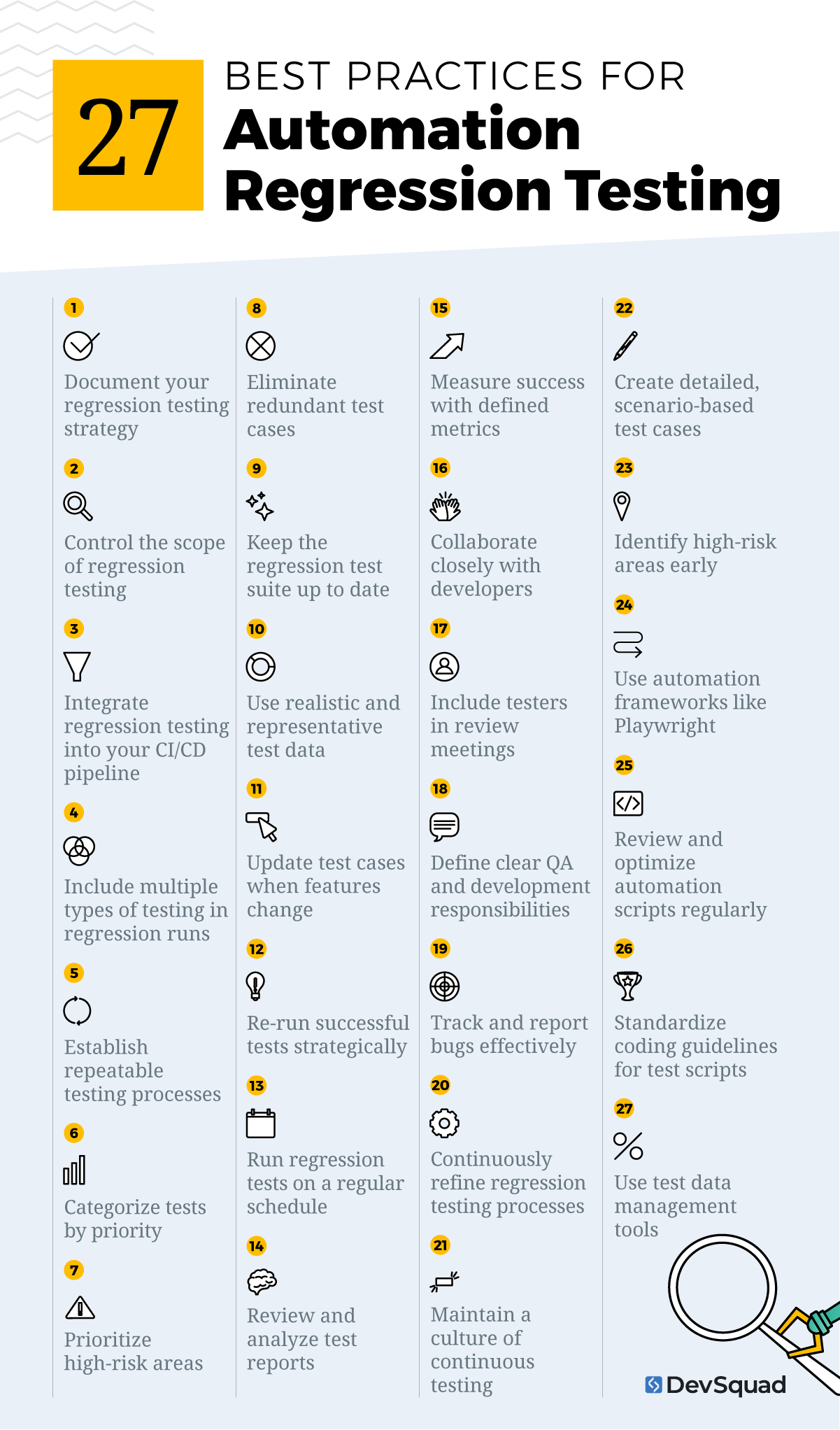
Best practices for building a solid regression testing strategy
Your regression testing strategy is the foundation of your quality assurance process. Without a clear plan, testing can become inconsistent, incomplete, and difficult to scale. These best practices will help you set up a solid, repeatable framework for incorporating regression testing into your development cycle.
1. Document your regression testing strategy
Write down how regression testing will be performed, including purpose, scope, criteria for retesting, and execution schedule. This gives your team a shared reference and ensures running automated regression tests happens the same way every time, even under tight deadlines.
2. Control the scope of regression testing
Avoid running every test case for minor changes. Use commit analysis, release notes, and risk assessments to pinpoint the areas most likely impacted by recent updates. Targeting your runs reduces execution time, focuses resources where they matter most, and still safeguards critical functionality from regressions.
3. Integrate regression testing into your CI/CD pipeline
Automate execution through your CI/CT pipeline so regression runs trigger automatically on merges, deployments, or pre-release builds. This continuous approach shortens feedback loops, catches defects before they reach production, and provides developers with near real-time results. This ultimately helps teams fix issues quickly while changes are still fresh in their minds..
4. Include multiple types of testing in regression runs
Don’t rely on a single test type. Combine unit, integration, API, and UI tests to catch issues at every layer of the system. This multi-layered approach improves coverage, validates both back-end logic and front-end functionality, and helps uncover cross-functional defects that might otherwise go undetected.
5. Establish repeatable testing processes
Define consistent steps for initiating, running, and reporting regression tests. This can include standardized naming conventions, clear entry and exit criteria, and a set order for execution. Repeatable processes reduce confusion, speed onboarding, improve result reliability, and make it easier to track performance trends over multiple sprints.
Best practices for organizing and maintaining your regression test suite
A regression suite only delivers value if it’s well-organized, relevant, and actively maintained. As your product evolves, outdated or redundant tests can slow execution, create false positives, and drain QA resources. These practices will help you keep your suite lean, focused on high-impact coverage, and easy to scale as your application grows.
6. Categorize tests by priority
Group tests by criticality so the most important ones always run first. High-priority tests safeguard core business functionality, while lower-priority cases can run as resources allow. This tiered approach makes for quick feedback on the features that matter most, helping teams act faster when critical paths are impacted.
7. Prioritize high-risk areas
Focus testing on components with a history of defects, complex logic, or high customer impact. High-risk areas often include payment systems, authentication flows, or heavily used integrations. Prioritizing them increases the odds of catching serious issues before they reach production and cause costly downtime or damage to user trust.
8. Eliminate redundant test cases
Over time, suites can accumulate duplicate or overlapping tests that waste time and add maintenance overhead. Regularly audit your test cases to remove redundancies and consolidate similar scenarios. This keeps the suite lean, shortens execution time, and reduces the risk of conflicting or confusing test results.
9. Keep the regression test suite up to date
Update your regression suite after every release to reflect new features, UI changes, and retired functionality. Removing outdated cases prevents false positives and wasted execution, while adding new coverage ensures you’re validating what truly matters. A current suite maintains accuracy and confidence in your overall testing process.
10. Use realistic and representative test data
Make sure your test data mirrors real-world scenarios, including edge cases and variations in user behavior. Data diversity helps reveal bugs that only occur under specific conditions and prevents bias in results. This realistic approach better predicts how your system will perform in actual production environments.
Best practices for executing regression tests effectively
Even the best-designed test suite can fall short without disciplined execution. The way you schedule, run, and respond to regression testing has a direct impact on release quality and speed. These practices will help you keep cycles predictable, fast, and results-driven so incorporating regression testing strengthens your delivery process rather than slowing it down.
11. Update test cases when features change
Whenever requirements shift or bugs are fixed, update impacted test steps and expected results. Treat this as retesting readiness work: map changes to cases, refactor brittle steps, and retire no‑longer‑relevant checks. Up-to-date cases prevent false positives, reduce noise in results, and keep coverage aligned to what customers actually use.
12. Re-run successful tests strategically
Don’t blindly replay everything. Re-run previously passing cases that touch changed code, integrations, or high-traffic paths. Use selective replays to validate stability after a fix, then escalate to broader sweeps if signals degrade. Combine targeted automation with spot manual regression testing on edge scenarios that are faster to verify by hand.
13. Run regression tests on a regular schedule
Make running automated regression tests part of your daily rhythm. Trigger suites on merges, nightly builds, and pre-release gates to support CI/CT. Frequent runs surface defects when they’re cheapest to fix, keep feedback loops tight for developers, and provide trend data you can act on before issues reach production.
14. Review and analyze test reports
Treat reports as decision tools, not artifacts. Look for recurring failures, flakiness patterns, slowest suites, and modules with rising failure rates. Tag failures by root cause (data, environment, code, test script) and capture remediation owners. Clear, actionable reporting shortens time-to-fix and builds confidence in the pipeline.
15. Measure success with defined metrics
Track a focused set of KPIs: pass rate, defect leakage, mean time to detect (MTTD), mean time to remediate (MTTR), flake rate, and total execution time. Set baselines, then improve iteratively—cut flake rate, speed critical paths, and raise signal quality. Metrics turn incorporating regression testing into a measurable driver of delivery speed and stability.
Best practices for collaboration between testers and developers
When developers and testers work as a unified team, quality improves, defects are caught earlier, and releases move faster. These practices help bridge communication gaps, align priorities, and make quality a shared responsibility.
16. Collaborate closely with developers
Foster daily communication between QA and development teams. This can include quick stand-ups, shared documentation, and open channels for discussing test results. Collaboration helps developers understand test coverage and testers understand code changes, leading to faster issue resolution and fewer misunderstandings.
17. Include testers in review meetings
Involve testers in sprint planning, backlog refinement, and code review sessions. Their input can highlight potential risks and edge cases early, ensuring testing considerations are built into development decisions. This proactive involvement reduces rework and keeps quality top-of-mind throughout the cycle.
18. Define clear QA and development responsibilities
Clearly outline which tasks belong to QA and which belong to developers. This includes ownership of test creation, execution, defect logging, and resolution. Defined responsibilities prevent overlap, avoid dropped tasks, and help both sides work efficiently toward the same release goals.
Best practices for continuous improvement in regression testing
Regression testing should evolve with your product, processes, and team. Regularly reviewing and refining your approach keeps it efficient, relevant, and effective. These practices will help you maintain a testing process that delivers increasing value over time.
19. Track and report bugs effectively
Use a consistent bug tracking process to capture issues with clear reproduction steps, severity levels, and related test cases. Well-documented bugs speed up resolution and help identify patterns in recurring issues. Over time, this data can guide improvements to both code quality and test coverage.
20. Continuously refine regression testing processes
Treat your testing workflow as a living system. Review execution speed, pass/fail trends, and coverage gaps regularly. Gather feedback from testers and developers, then make targeted adjustments—be it updating tools, refining test cases, or improving automation scripts. Small, consistent improvements compound into major gains.
21. Maintain a culture of continuous testing
Embed testing into every stage of development rather than treating it as a final step. Encourage frequent, automated regression runs, pair testing sessions, and early defect detection. A culture of continuous testing promotes shared ownership of quality and helps teams catch problems before they reach production.
Best practices for strengthening test case design
Well-designed test cases improve defect detection, reduce false positives, and make your regression suite more maintainable. These practices focus on creating tests that are both thorough and efficient.
22. Create detailed, scenario-based test cases
Design test cases to reflect real-world usage, covering both typical and edge scenarios. Include clear preconditions, execution steps, and expected outcomes. Detailed cases make it easier for any tester to execute them accurately and for automation scripts to replicate them reliably.
23. Identify high-risk areas early
Assess your application to find components that are business-critical, complex, or prone to defects. Prioritize these areas for comprehensive test coverage. Focusing on high-risk zones first is key for identifying the most impactful issues before they can affect end users.
24. Use automation frameworks like Playwright
Leverage tools such as Playwright for browser and API testing to increase speed, coverage, and reliability. Modern automation frameworks handle cross-browser scenarios, dynamic content, and integration points more efficiently than manual testing, helping your team validate changes quickly without sacrificing quality.
Best practices for keeping your automation framework healthy
An automation framework is only as effective as its upkeep. Regular maintenance keeps scripts reliable, execution times fast, and results trustworthy. These practices will help you sustain long-term value from your regression testing automation.
25. Review and optimize automation scripts regularly
Schedule periodic reviews to remove obsolete tests, refactor inefficient code, and address flaky behavior. This keeps the suite lean, reduces false positives, and keeps your automation aligned with current product functionality.
26. Standardize coding guidelines for test scripts
Establish and enforce consistent naming conventions, folder structures, and documentation standards for all test code. Standardization improves maintainability, makes collaboration easier, and shortens onboarding time for new team members.
27. Use test data management tools
Leverage tools that automate the creation, refresh, and cleanup of test data. This prevents data-related failures, improves consistency between environments, and allows your tests to run without manual intervention or environment-specific adjustments.
Automate with confidence and release without bottlenecks.
Are you reviewing these best practices because you’re setting up your first automated regression testing process? Or maybe you’re looking to strengthen something you’ve already started? Either way, building a process that incorporates these practices takes time, discipline, and experience.
Working with a high-functioning TestOps team means these best practices aren’t just theoretical—they’re ingrained in the way the team works from day one. Established teams already have the tools, workflows, and communication habits to make collaboration seamless, execution efficient, and improvements continuous.
With DevSquad, you get a dedicated TestOps Squad that works inside your process to speed up releases, strengthen test coverage, and eliminate QA slowdowns.
We combine Playwright, AI-driven tooling, and years of agile delivery expertise to build a lean, reliable automation framework tailored to your product. When and if you’re ever ready, we will train your in-house team to own and expand it, so you leave with both the process and the skills.
Ready to automate your testing? Learn more about our automated testing services.

Dayana Mayfield is a SaaS copywriter and content marketer specializing in SaaS marketing, positioning, and go-to-market strategy. She has consulted for over 195 SaaS companies, focusing on both traffic and conversions. She has been featured in Entrepreneur, Forbes, and Business Insider. Outside of work, Dayana writes SciFi novels and spends her evenings surviving auditions, rehearsals, and tech week as a proud theater mom.