
A senior software engineer is essential to any successful team and business with a digital offering. They are the technological backbone of a product or service, and in the digital age, nearly every business needs software engineers in some capacity. Similar to other tech roles, they are in high demand, particularly senior positions, which require more experience and a more niche skillset.
In fact, software engineer employment is expected to grow by 15 percent between 2024 and 2034 - noticeably higher than other industries. Now, with the onset of AI and machine learning integrations, the continuous need for innovative software, and extensive backlog of legacy app modernizations, software engineers are even more desirable to help companies to keep pace.
Companies looking to hire senior software engineers need to have an in-depth understanding of the role, the new landscape, and the best channels to find the right talent. Here's what to look for in a senior software engineer, as well as a recap of their responsibilities and salaries:
What do senior software engineers do?
A senior software engineer is both creative and a problem-solver, responsible for leading the entire development program for a piece of software. They develop, design, and install software solutions, as well as build applications for users to complete certain tasks, and make the underlying system that runs software.
They also serve as technical mentors and project leaders within the development team. That means senior software engineers also lead a wider team of developers, and ensure that all contributions improve the software functionality or user experience.
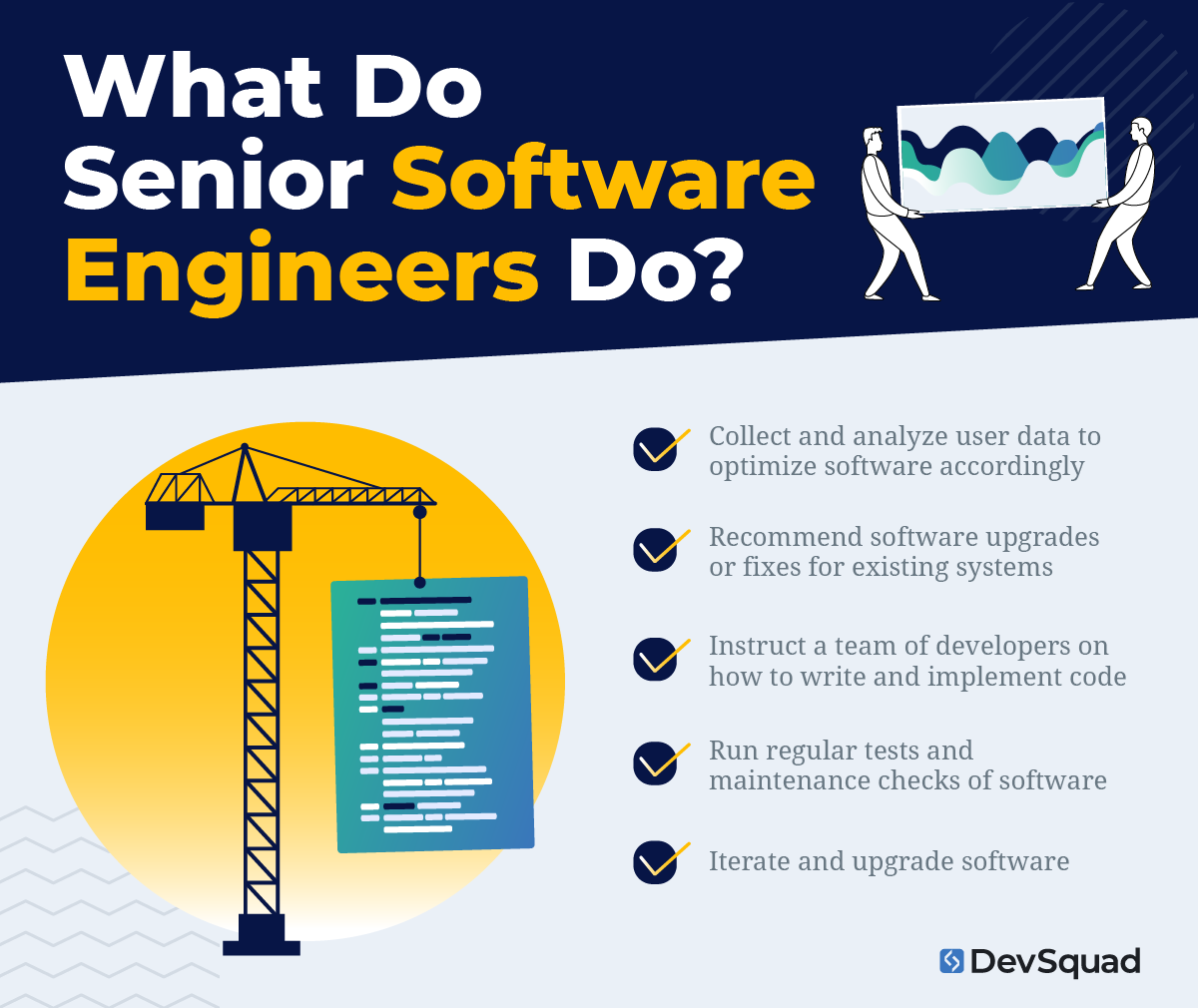
Additional senior software engineer tasks include:
Collect and analyze user data to optimize software accordingly
Recommend software upgrades or fixes for existing systems
Instruct a team of developers on how to write and implement code
Run regular tests and maintenance checks of software
Iterate and upgrade software
Leadership and collaboration
Senior engineers are also expected to collaborate across technical and non-technical departments. They must be able to translate complex ideas to stakeholders and guide junior developers through best practices and long-term architectural decisions.
Problem-solving and innovation
Beyond execution, they also play a critical role in solving business problems with scalable, efficient software solutions. They often identify opportunities for technical innovation that can improve user experience or streamline operations.
How much do senior software engineers earn in the US?
According to Glassdoor, on average, senior software engineers in the US earn $200,000 annually. Of course, this figure can fluctuate depending on the company, location, experience, certifications, and the type of role (i.e. full-time, part-time, freelance, outsourced).
Factors that influence salary
A senior engineer at a well-funded startup in San Francisco will likely earn more than one working for a mid-sized company in the Midwest. The reasons can be everything from how shiny the company is to the cost of living in a particular city.
Here are some key factors to consider:
Location: Where you are and how much it costs to live there are major factors in salary.
Company size and stage: Startups may offer equity in place of higher pay, while established companies often pay more upfront.
Experience level: Engineers with 10+ years of experience or leadership roles often command a premium.
Certifications and specializations: Niche skills or credentials—like cloud certifications or AI/ML expertise—can push salaries higher.
Role type: Full-time employees often receive different compensation than contractors, consultants, or freelancers.
Why salaries are rising
Senior software engineers are amongst the top 12 highest-paid tech positions. Their salaries are a reflection of the expertise needed to fulfil the role properly. Software engineers not only construct and manage systems, they also drive innovation.
There is also the supply and demand issue. Senior software engineers are in short supply, meaning competition for top talent is fierce. That places seasoned engineers in a prime position to negotiate better payment.
How smaller companies compete for talent
Competition for top talent means the little guys are often training in solid hires. Smaller businesses and startups that cannot afford high-end wages have to offer other benefits to compensate for the drop in salary. If this is your position consider offering incentives like:
Flexible hours
Equity
Greater product ownership
More vacation days
Remote-first culture
Make sure to take stock in what you have to offer and any unique perks that might just provide the nudge to sway an engineer to work for you.
What technical skills to look for in a senior software engineer?
Senior software engineer jobs require someone with a wide-ranging and up-to-date technical skillset to lead software projects and contribute high-quality code.
They should have fluency in foundational programming languages, comfort with modern frameworks, and familiarity with the tools required for collaboration, testing, and deployment.
Programming languages
These are the core building blocks of any application. Look for fluency in:
Python
Java
Ruby
C
SQL
Modern frameworks and libraries
Frameworks enable rapid, consistent development. A senior engineer should be familiar with both backend and frontend options.
Laravel (PHP)
.NET MVC
Spring (Java)
Vue.js
React
Angular
JQuery
They should also understand the MVC (Model-View-Controller) pattern and be able to apply it effectively.
Infrastructure and tooling
Senior developers should know how to set up, maintain, and troubleshoot application environments. This includes:
Visual Studio
Entity Framework
RDBMS (relational databases)
IIS (Internet Information Services)
Version control systems like Git
JSON and XML for structured data
Protocols and API design
They should be able to design robust systems that communicate across services and platforms.
REST
SOAP
HTTP
TCP/IP
POP/SMTP
SaaS architecture
API integration and documentation
Testing and quality assurance
Testing is critical for maintaining stability in production environments.
Automated test frameworks
Unit and integration testing
Fixtures and mocks
Development methodologies
Agile and Scrum experience is essential for working within iterative, fast-moving teams.
Ultimately, a senior software engineer should be able to deliver scalable, maintainable software using a broad mix of tools—while adapting to your project’s specific stack. If your product depends on a particular ecosystem, focus your evaluation on those technologies. But don’t negate the others as the broader knowledge in your senior staff will help you stay on the leading technological edge.
What soft skills should you look for in a senior software engineer?
While technical skills certainly matter in your search for a senior software engineer, soft skills also come into play. You may have a genius applicant who ticks all the tech boxes, but what if they can't communicate well in the team? How will they lead and present to people if they're nervous public speakers? These are a few attributes that aren't deal-breakers, but should be taken into account during the selection process:
Communication
This is arguably the most important soft skill. Senior software engineers must be able to articulate themselves well both verbally and written, and adapt their communication depending on who they're speaking to. They may be extremely knowledgeable about tech features, but if they can't clearly describe processes to other stakeholders, there will be a problem.
Listening
Similar to communication, a senior software engineer should listen in a way that can take on board criticism and read between the lines. For example, they should know if a team member is struggling but afraid to say, if a client is losing interest in a project or if a vendor doubts a recent fix.
Time management
Like in any job, time management is huge. For senior software engineers, their time has to be split among stakeholders, the team, vendors, and other departments. Balancing what is and isn't a priority is essential to keep things moving forward.
Mentorship
As the head of fellow software engineers, a senior role means being patient, personable, and willing to use creative techniques to teach others. A senior software engineer is responsible for others' professional development, and so has to provide meaningful guidance.
Critical thinking
This ties in to problem solving, analysis, and troubleshooting. Critical thinking is what allows a senior software engineer to assess a situation, make a judgement, and take action. What's more, they have to judge without bias, cynicism or lack of evidence. In an increasingly data-focused business landscape, critical thinking is what drives informed decisions.
Attention to detail
Despite wearing many hats, senior software developers are required to keep a close eye on everything going on. They have to know when to slow down and check on things, develop their own methods of quality assurance, and detect issues before they are irreversible or have negative consequences.
How to vet for the top skills
Vetting for top skills requires an assessment and an evaluation of the results.
Use practical tests
A practical test is the most effective way to vet senior software engineer skills. Fizz Buzz, TestDome, and Mettl, are platforms offering assessments on coding, problem solving, and software architecture.

Consider in-house assessments
Alternatively, you can design an in-house test and use the hardware and accounts your team typically work with to get an impression of the candidate. It's worth testing senior software engineers on their ability to code individual components and larger, more complex systems.
What to look for in the results
When reviewing their test, be sure to pay attention to the performance of the code, and its reliability, security, and scalability. For the practical tests, be sure to evaluate the distribution of their results, not just the overall score.
Identify signals of leadership and collaboration
There are a few signals that reveal whether a senior software engineer is great as opposed to good. They should display natural leadership abilities, and be comfortable working seamlessly with other technical and non-technical roles. Additionally, they should be able to communicate the most complex scenarios in the simplest of terms.
Ask behavioral interview questions
In the interview, ask them about their previous teams and projects, encouraging them to specify how they were viewed by their colleagues and to give examples of times when they encountered issues and overcame them.
See if they were the first port-of-call for analysts, testers, and product owners - did people respect their opinion and expertise?
Were they asked to comment on code that they hadn't written themselves?
Another giveaway is if your candidate was called on to represent the tech team in cross-departmental meetings or if they were looked at to determine the next sprint phase.
Must-have vs. nice-to-have skills
When hiring a senior software engineer, it's easy to get caught up in finding someone who checks every box. But in reality, the most successful hires tend to have the essentials covered and the curiosity or leadership to grow into the rest.
Here’s a breakdown of the core skills you should expect, versus those that are valuable but not critical from day one.
Must-have skills
These are the non-negotiables. Candidates should already have these skills to succeed in a senior-level role from day one.
Strong proficiency in at least one core programming language (e.g., Python, Java, or C#)
Solid understanding of data structures, algorithms, and system architecture
Experience with version control systems like Git
Familiarity with modern development frameworks (e.g., React, .NET, Laravel)
Ability to write secure, scalable, and maintainable code
Experience working in Agile or Scrum environments
Strong communication and cross-functional collaboration skills
Leadership experience—formally or informally—in a dev team
Nice-to-have skills
These skills aren’t required, but they can elevate the candidate’s contribution or reduce onboarding time.
DevOps experience or familiarity with CI/CD pipelines
Cloud infrastructure experience (e.g., AWS, Azure, GCP)
Experience with mobile development or cross-platform frameworks
Background in API design or third-party integrations
Familiarity with containerization tools like Docker or Kubernetes
Exposure to AI/ML projects or data-heavy systems
Contributions to open-source projects
Previous experience mentoring junior developers or leading architecture decisions
These lists aren’t fixed. They should flex depending on your product goals, team maturity, and growth plans. But knowing what’s essential now—and what can be learned later—will help you hire with clarity.
What top engineers expect from employers
Senior engineers are in high demand, and they have options. Winning them over requires more than compensation—companies need to create an environment where these professionals can do their best work. Here’s what top engineering talent consistently looks for in an employer, in their own words.
They want to be listened to
Experienced engineers often prioritize long-term impact over flashy moves. They don’t expect every decision to be exciting, but they do expect their input to be heard and valued.
“Most good engineering decisions don’t feel exciting in the moment.
They feel boring, obvious, and sometimes even slow.
But months later, those are the decisions you’re most grateful for.” — Venkateswara Rao Kotapati, Senior Manager of Data & Software Engineering at CVS
They want autonomy with clarity
Top engineers don’t want micromanagement—but they do want clear goals and context so they can make informed decisions.
They want a culture of learning, not just output
The best engineers stay curious. They want room to grow, experiment, and share knowledge, not just ship features at all costs.
They want to be part of the conversation
Top engineers listen carefully to leadership and can quickly tell whether decision-makers understand the tradeoffs behind product and technical choices. They want context and to know that what they say has value in the decision making process.
“Engineers quickly assess whether leadership understands the work. They do this long before trust is established.
They listen for clarity in tradeoffs, not certainty. Leaders who can explain why decisions were made earn credibility. Leaders who hide behind slogans lose it.” — Waldemar Vega, AI Infrastructure Architect at Konfidential, LLC.
How to hire a senior software engineer?
1. Understand the market
Because senior software engineers are in such high demand, the best ones have the luxury of being able to pick the organization they want to work for. What this means is that, often, you're the one being interviewed by senior software engineers. That shouldn't intimidate you though, instead think of it as an opportunity to showcase your brand personality and find the person most suited to your culture.
2. Write a job description
The job description you post says a lot about your business. Many companies make the mistake of posting a vacancy and only focusing on what they're looking for, rather than what they offer. Early on in the description, introduce your company, state what your mission is, and describe what sets you apart from other players. Avoid generic terms and cliches, list the perks that come with the role, and remember to present your company in a positive light.
Once you're happy with the job description, have a technical writer and any software engineers already working with you proofread it.
3. Share information about your company
Beyond the job description, ensure you have easily-accessible content on your website and social media accounts that provide a clear picture of your company. Many candidates will do their research to learn about the offices, team, and structure of the business; if they can find this information quickly, it implies that your company is organized and transparent.
4. Have a screening call
After you've received resumes and have narrowed down your pool of candidates, it's time to have a screening call. This doesn't have to be overly formal, it can be a 'getting-to-know-each-other' chat where you can check the credibility of someone's experience and become familiar with their general demeanor. A common misconception is that this call has to be tech-heavy, which is not the case - it should be ten minutes to connect person-to-person.
5. Create a take-home test
Design and send a technical test for the candidate to complete. The test should be representative of what your company does and take no longer than two hours to complete. You could ask them to refactor code, fill in a multiple-choice quiz, take part in a coding challenge or any activity that confirms their technological skill set without being too taxing. The trick here is not to overwhelm candidates, you want to keep them interested and engaged.
6. Plan the interview
The interview is the chance for a full conversation. It is not another test but a dialogue between both parties.
Start with behavioral questions to get a sense of how the software engineer has performed in the past and how they could perform in similar situations. Then follow-up with deep-dive questions that hone in the applicant's tech curiosity - the answers will be what distinguish senior software engineers from entry-level ones.
Even if the interviewee cannot give a concrete answer, what matters is their methodology and explanation for why they choose a certain course of action. The more thought-provoking your questions are, the more likely you'll impress the candidate and show that there's potential to learn while working at the company.
Naturally, during this section, you also need to monitor if the person is a good team fit; if you're having the interview in-person, ask an existing team member to go to lunch with the candidate. This provides the interviewee with a lower-pressure environment to ask questions and get a feel for the culture, while your team member can get to know their potential new lead.
No doubt, hiring a senior software engineer can be a complicated journey. However, understanding what they do, salary expectations, and the technical and soft skills required, will make your search faster and more efficient. As one senior software engineer puts it, "when thinking about your recruitment process, think about how the perfect candidate will experience it, and tailor it for them."
Happy hiring!
Frequently Asked Questions (FAQs)
What are the primary responsibilities of a senior software engineer?
Senior software engineers have a managing role. They lead the design, development, and maintenance of complex systems. They write code, review others’ work, architect scalable solutions, and mentor junior team members. Beyond technical execution, they contribute to product strategy, collaborate across departments, and improve development processes. Their role is equal parts builder, leader, and problem-solver.
Should I use a hiring agency when looking for a senior software engineer?
Using a hiring agency can speed up your search—especially if your internal team lacks technical expertise or bandwidth. Agencies can pre-vet candidates for technical and soft skills. However, make sure the agency understands your tech stack and team culture. For high-impact roles, a product-focused hiring process is just as important as speed.
What is the typical salary of a senior software engineer?
As of 2024–2026, senior software engineers in the U.S. typically earn around $200,000 annually, though that number varies by location, company size, and experience. Engineers with specialized skills or leadership responsibilities may earn significantly more. Compensation can also include equity, bonuses, or additional benefits—especially in competitive tech markets.

Dayana Mayfield is a SaaS copywriter and content marketer specializing in SaaS marketing, positioning, and go-to-market strategy. She has consulted for over 195 SaaS companies, focusing on both traffic and conversions. She has been featured in Entrepreneur, Forbes, and Business Insider. Outside of work, Dayana writes SciFi novels and spends her evenings surviving auditions, rehearsals, and tech week as a proud theater mom.